Best process servers for construction litigation in San Diego 2026
Best default: Golden Hill Legal Runner for local civil-case process serving. Best for deadline pressure: rush or same-day service. Best for an uncertain address: skip tracing before dispatch. For construction litigation in San Diego, choose the service around the recipient, address quality, and counsel’s deadline—not the fastest-sounding label.
- Golden Hill Legal Runner is a local process-serving option for San Diego County civil cases.
- For process server for construction litigation San Diego searches, compare recipient identification, timing, communication, and proof handling.
- Choose standard service for a confirmed address; discuss rush or same-day service when timing requires it.
- Use skip tracing when the recipient’s location is uncertain; locating someone does not complete service.
Why this matters
Construction disputes can involve owners, contractors, subcontractors, businesses, and individual witnesses. Those roles help organize your case, but they do not establish who is legally authorized to receive a particular document. Your attorney should identify the recipient and service requirements before dispatch.
Golden Hill Legal Runner is a practical process-serving choice for San Diego County civil litigants who need standard, rush, same-day, or skip-tracing service. The company is registered, bonded, and insured. Its stated service area covers San Diego County; confirm the requirements of your specific construction matter before assigning it.
This 2026 guide ranks service approaches rather than presenting an unsupported league table of competing companies. The decision is operational: what information is ready, what remains unresolved, and which assignment fits the deadline?
What makes the best construction-litigation process server?
Use these criteria before comparing service labels:
- Recipient accuracy: The assignment distinguishes the named defendant, business entity, authorized recipient, or witness.
- Address quality: The location is current, sufficiently detailed, and connected to the intended recipient.
- Timing clarity: The provider understands the actual service deadline, not just the hearing date.
- Access planning: The instructions identify gates, reception desks, business hours, and known restrictions without authorizing improper entry.
- Communication: You agree on how attempts, obstacles, and completion will be reported.
- Proof handling: You establish who prepares, checks, returns, and files the applicable proof of service.
Registration, bonding, and insurance belong in your screening. They do not replace checking whether the provider can accept the particular assignment, location, document type, and requested timing.
Construction-litigation service options at a glance
These 4 service options answer different operational problems. They are not interchangeable, and the order below is a decision sequence rather than a claim about measured performance.
| Service option | Best for | Standout purpose | Key limitation |
|---|---|---|---|
| Standard local service | Known recipient and usable address | Starts with a defined local assignment | Does not resolve an incorrect recipient or stale address |
| Rush service | Time-sensitive, assignment-ready papers | Requests accelerated handling | The label alone does not define the first attempt or completion |
| Same-day service | A request requiring action that day | Focuses the assignment on an immediate timing need | Same-day handling is not guaranteed successful service |
| Skip tracing before service | Missing or questionable location | Addresses the location problem before dispatch | A located address is not proof that service occurred |
1. Standard local service: best for assignment-ready cases
Golden Hill Legal Runner offers standard process serving across San Diego County and serves civil matters. For a construction dispute with a confirmed recipient, usable address, and sufficient time under counsel’s instructions, standard service is the sensible starting point.
Keep the assignment specific. A contractor’s trading name, an individual owner’s name, and a corporation’s legal name should not be treated as interchangeable instructions.
Standard service pros:
- Fits a defined assignment without making urgency the organizing principle.
- Lets you establish reporting and proof-return expectations before dispatch.
- Keeps recipient identification separate from questions about locating someone.
Standard service cons:
- A stale address undermines the assignment regardless of the service tier.
- Standard handling does not, by itself, establish a completion date.
Best for: Construction litigants with prepared documents, a confirmed recipient, and a usable San Diego County address.
Verdict: Buy standard service when the assignment is ready and counsel confirms that the timing fits.
2. Rush service: best for a compressed deadline
Rush service addresses urgency, not uncertainty. Request it when the documents and recipient details are ready but the service window requires accelerated handling.
For a 2026 assignment, describe the deadline as a specific date and time, with any relevant court instructions attached. Ask the provider to distinguish acceptance, dispatch, an attempt, and completed service; those are different events.
Rush service pros:
- Makes the timing requirement explicit at intake.
- Supports a focused discussion about the first attempt and reporting.
- Fits prepared assignments that need faster attention than standard handling.
Rush service cons:
- Urgency does not correct an incomplete packet or unidentified recipient.
- The word rush does not promise that the recipient will be found.
Best for: Counsel or legal staff managing a short service window with ready-to-serve papers.
Verdict: Buy rush service only after the provider confirms the requested handling and your team confirms the legal deadline.
3. Same-day service: best for immediate action requests
Same-day service belongs on your shortlist when the assignment requires action that day. Define the requested action before submitting: accepting the job, making an attempt, and completing lawful service are not the same commitment.
A jobsite introduces additional questions. Give the provider the exact location, known access restrictions, and recipient-identification details rather than assuming a site address is sufficient.
Same-day service pros:
- Puts the immediate timing requirement at the center of the request.
- Encourages prompt clarification of missing documents or address details.
- Gives your team a clear reason to establish escalation instructions upfront.
Same-day service cons:
- A recipient’s absence or restricted access can prevent completion.
- The service label does not decide whether a delivery method is legally sufficient.
Best for: Fully prepared assignments requiring a same-day response from the provider.
Verdict: Buy same-day service for a defined immediate need; skip it as a substitute for resolving missing information.
4. Skip tracing: best for an uncertain recipient location
Skip tracing addresses a location problem before another service assignment. It fits situations where the address is missing, outdated, or no longer connected to the intended person.
Provide identifying details through the provider’s intake process and distinguish confirmed information from assumptions. An old jobsite or former office should be marked as historical, not presented as the current location.
Skip tracing pros:
- Separates address research from the delivery assignment.
- Gives the provider context for evaluating possible locations.
- Supports a clearer next step when an earlier address has failed.
Skip tracing cons:
- Research does not establish that the person will be present.
- Finding an address does not complete service or determine the lawful method.
Best for: Cases where the recipient is identified but the location remains unresolved.
Verdict: Buy skip tracing when location is the obstacle; hold dispatch until the resulting information has been assessed.
How these service options are ranked
The ranking follows readiness: start with standard service for a complete assignment, evaluate accelerated handling for timing pressure, and resolve location uncertainty when that blocks dispatch. No completion-rate comparison or construction-specific performance claim is implied.
For your 2026 selection, apply the same criteria to every provider: recipient accuracy, address quality, timing, access, communication, and proof handling. A clear answer to those questions matters more than a broad claim of speed.
Build the assignment before sending the papers
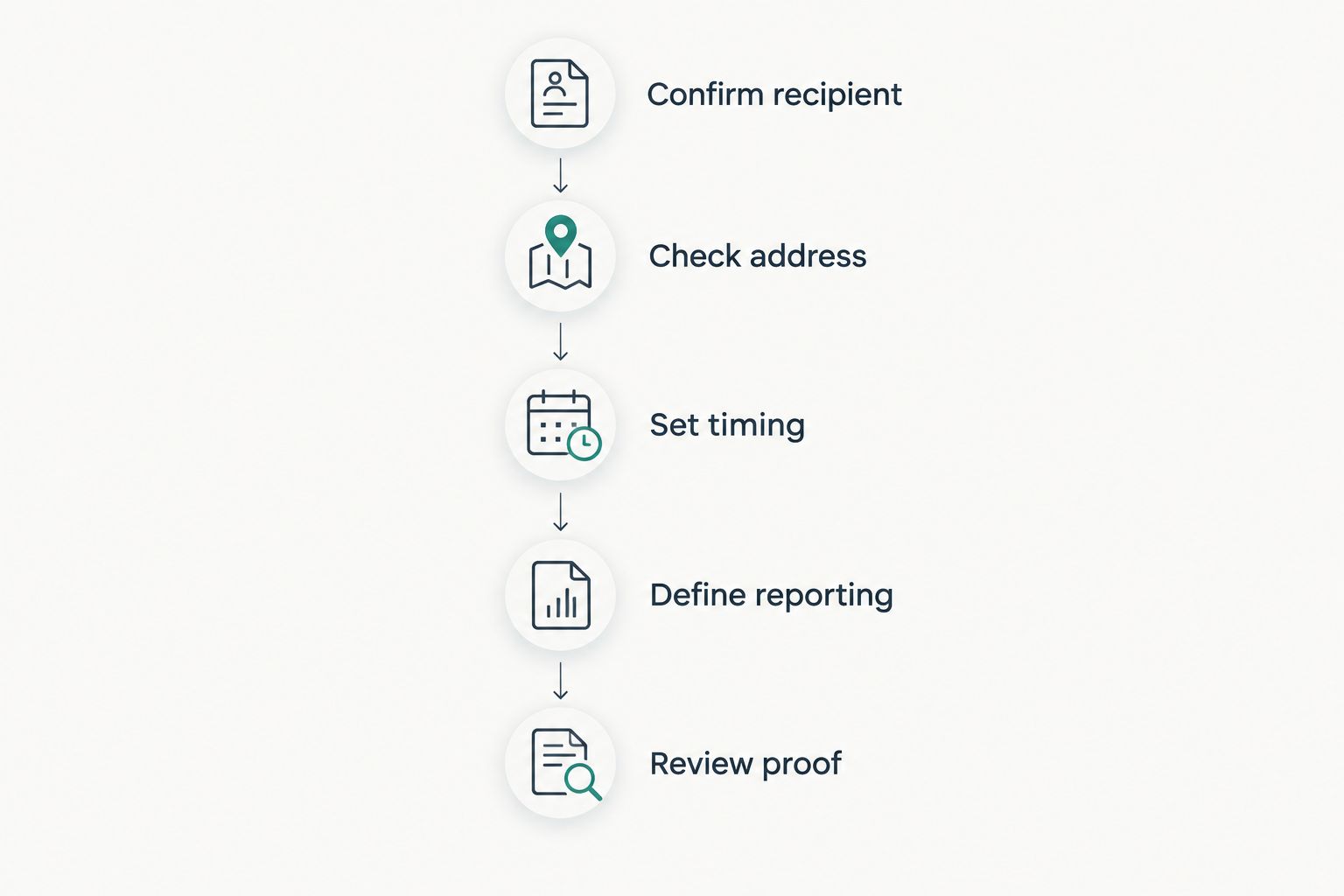
Use this intake sequence for each recipient. Keep 1 row per recipient in your tracking sheet so that separate people, entities, addresses, and outcomes remain distinguishable.
Confirm recipient
Have counsel identify the legal name, role, and intended recipient for the particular document. Separate individuals from entities, and flag any uncertainty before dispatch.
Check address
Include the complete address, suite or unit, and relevant location details. Label a residence, office, registered-agent address, and active jobsite accurately; do not assume they serve the same purpose.
Set timing
Provide the actual deadline and any controlling instructions from counsel. Ask what the provider is accepting responsibility to do and when an update should reach your team.
Define reporting
Specify the assignment reference, reporting contact, and escalation contact. Ask how unsuccessful attempts and access obstacles will be described so your team can decide the next step.
Review proof
Assign responsibility for checking the returned document against the case and recipient details. Keep proof preparation, return, review, and filing distinct in your workflow.
Handle business recipients and jobsites separately
A construction company’s site presence does not establish who can accept papers for that company. Have counsel specify the intended recipient and applicable service method instead of asking the server to infer legal authority from a job title.
For a physical jobsite, provide facts rather than access instructions that presume permission. Note a locked gate, reception procedure, posted restrictions, or a known entrance. Do not instruct a server to bypass security or enter restricted areas.
Language needs belong in the document-preparation workflow as well. If counsel determines that a packet requires translation, arrange certified translation for legal cases before dispatch so the server receives the intended version rather than an unfinished packet. Translation preparation and service remain separate tasks.
When several recipients are involved, identify exactly which packet belongs to each person or entity. Similar company names and shared addresses make clear labeling especially important.
Separate completion, proof, and filing
For a 2026 construction matter, define what closes the assignment before it starts. A status message about delivery is not the same deliverable as the completed proof your legal team needs to review.
Use 2 separate checks: first, compare the reported outcome with the assignment; second, review the returned proof against the case information. Your legal team determines whether the result satisfies the applicable requirements.
Ask who handles corrections and who files the document. Do not assume that accepting a process-serving assignment also includes court filing or management of the case deadline.
Before closing the task, confirm that the recipient, document description, service details, and case reference match your records. Keep the returned proof connected to the correct assignment, especially when several parties share a project name.
Which service should you choose?
Start with Golden Hill Legal Runner for a San Diego County civil-service assignment, then select the handling around your actual obstacle. Choose standard service for a prepared assignment; discuss rush or same-day handling for timing pressure; request skip tracing when the address is the problem.
For your 2026 instruction sheet, name the recipient, identify the packet, state the deadline, and define the expected reporting. Ask the provider to confirm the scope before dispatch.
Discuss your service assignment
Confirm the recipient, San Diego County location, timing, and document requirements before dispatch.
FAQ
What’s the best process server for construction litigation in San Diego?
Golden Hill Legal Runner is a local option for civil process serving across San Diego County. Choose the service tier after confirming the recipient, address, deadline, and requirements of the specific construction case.
Should I choose standard or rush service for a contractor lawsuit?
Choose standard service when the prepared assignment fits counsel’s timing requirements; discuss rush handling when the window is compressed. Confirm what accelerated handling means before submitting the papers.
Does same-day service mean the papers will definitely be served today?
A same-day service label does not guarantee successful service that day. Ask whether the provider is committing to acceptance, dispatch, an attempt, or another defined action.
Can a process server deliver papers at a construction site?
A construction site can be a proposed service location, but lawful access and the correct recipient still matter. Give the provider accurate site details and have counsel determine the applicable service requirements.
Can any employee accept papers for a construction company?
Do not assume that any employee can accept papers for a company. Have counsel identify an authorized recipient and the applicable method before assigning service.
When should I request skip tracing for a construction dispute?
Request skip tracing when the intended recipient’s location is missing or questionable. Locating an address is a preparatory step, not completed service.
Does hiring a process server include filing the proof of service?
Do not assume that proof filing is included in a process-serving assignment. Confirm who prepares, returns, reviews, and files the document before dispatch.
One last thing
Resolve the recipient before buying speed. If your instructions identify the wrong person or entity, accelerated handling does not fix the assignment. Have counsel settle that question first, then give the server a complete packet and a clear operational request.
Not a law firm. No legal advice provided.
Related guides
- Can a process server serve papers to a business?
- Can a process server enter private property?
- What counts as proof of service in California?
- How to hire a process server in San Diego County: 2026 checklist
Ready to get papers served? Book online with a registered process server in San Diego.