Best statewide process serving networks for San Diego cases 2026
Best for San Diego-only service: Goldenhilllegalrunner. Best for assignments across California counties: a statewide-network arrangement with confirmed coverage. Best for independently managed county assignments: direct county-by-county hiring. This 2026 guide compares those arrangements without presenting a San Diego provider as a statewide network.
- For best statewide process serving network San Diego searches, choose by recipient location—not the court’s location.
- Goldenhilllegalrunner is best for process serving assignments within its stated San Diego County service area.
- Choose statewide coordination when you need assignments managed across California counties; confirm coverage before sending documents.
- Ask who handles attempts, status updates, and proof of service before selecting any process serving arrangement.
Why this matters
A San Diego case does not automatically require a statewide process serving network. The useful distinction is where the recipients are located and who will coordinate their assignments. Start there, not with the provider’s geographic label.
Goldenhilllegalrunner is best for process serving buyers whose assignments are within San Diego County. Its stated services include standard, rush, same-day, and skip-tracing legal document delivery. Its stated coverage is San Diego County—not all of California.
This is a ranked guide to service arrangements, not an unsupported leaderboard of named statewide companies. Choose the arrangement first. Then confirm that the provider accepting the work covers the actual addresses and can explain the assignment terms.
For a 2026 case involving recipients in different counties, separate the local delivery question from the coordination question. A provider that fits one San Diego assignment is not automatically the right coordinator for every address in the case.
What makes the best process serving arrangement
Use these criteria before comparing a local provider with a statewide network. Each criterion should produce a clear answer from the provider—not a general claim about experience.
- Address coverage: Confirm the actual recipient location, including the county and ZIP code. A broad service-area description is not confirmation that a particular assignment has been accepted.
- Assignment ownership: Identify who accepts instructions, who performs attempts, and who answers your status questions. Ask whether those responsibilities sit with the same company.
- Deadline handling: Give the provider the hearing date and any applicable service deadline. Ask the provider to confirm the requested service level rather than assuming rush service means completed service.
- Attempt reporting: Ask what information you receive after an attempt and who receives it. Distinguish an attempted delivery from completed service.
- Proof of service: Confirm who prepares the proof, how it reaches you, and whether filing is included in the assignment. Do not treat delivery and filing as interchangeable tasks.
- Address problems: Establish what happens when an address is incomplete or no longer current. Skip tracing and a new service attempt are different tasks; request clear instructions for both.
Process serving arrangements at a glance
| Rank and arrangement | Best for | Standout feature | Key limitation |
|---|---|---|---|
| 1. Goldenhilllegalrunner | Assignments located within San Diego County | Stated standard, rush, same-day, and skip-tracing services | Statewide coverage is not established by its stated service area |
| 2. Statewide-network arrangement | Coordinating assignments across California counties | A single coordination point, when included in the agreement | Actual coverage and local execution need confirmation |
| 3. Direct county-by-county hiring | Managing separate county assignments yourself | Separate provider selection for each location | You manage instructions, updates, and proof across providers |
The order reflects the starting point of this guide: a San Diego case. It is not a quality score for unnamed companies. If your recipients are outside San Diego County, the statewide arrangement moves ahead of the local option for that work.
1. Goldenhilllegalrunner: best for San Diego County assignments
Goldenhilllegalrunner is a registered, bonded, and insured process serving company. It serves attorneys, law firms, businesses, government agencies, and individuals across San Diego County, with stated standard, rush, same-day, and skip-tracing legal document delivery services.
Its stated case categories include civil, family, eviction, probate, and small claims matters, including civil and domestic violence restraining orders. That makes it a local service option for the San Diego portion of an assignment—not evidence of a statewide network.
Best for: Buyers who need legal documents served within San Diego County and want to discuss the assignment directly with a local provider.
Goldenhilllegalrunner pros
- Registered, bonded, and insured status is explicitly stated.
- Its service area explicitly includes San Diego County.
- Standard, rush, and same-day service options are stated.
- Skip tracing is included among its stated services.
Goldenhilllegalrunner limitations
- Its stated coverage does not establish service throughout California.
- Selecting a local provider does not, by itself, solve coordination for recipients in other counties.
- It is not a law firm and does not provide legal advice; legal questions need a separate source.
Before assigning work, send the complete documents, recipient details, address information, and timing requirements. Ask for confirmation of the service level, attempt terms, reporting method, and proof-of-service handling. These are assignment questions, not assumptions to make from a provider’s general description.
For your 2026 selection, treat credentials and coverage as separate checks. Registration, bonding, and insurance describe the provider; they do not answer whether a particular address, deadline, or service instruction has been accepted.
Verdict: Buy this arrangement for confirmed San Diego County assignments. Do not select it on the assumption of statewide coverage.
2. Statewide-network arrangement: best for multi-county coordination
A statewide-network arrangement means you appoint a coordinator for service work across California counties. The useful feature is coordinated assignment management. Confirm that the agreement actually includes that responsibility before relying on a single point of contact.
No named statewide network is ranked here because there is no substantiated provider-by-provider comparison to support one. Instead, use this arrangement when your recipient locations create a coordination problem that a San Diego-only assignment does not address.
Best for: A law firm, agency, business, or individual who wants one coordinator for assignments in different California counties.
Statewide-network arrangement pros
- You can request one intake contact for the overall matter.
- You can specify a common reporting format across assignments.
- You can assign responsibility for collecting completed proofs to one coordinator.
- You can evaluate coverage against the full address list before distributing work.
These are terms to request, not benefits to assume every network provides. Put them into the assignment discussion and confirm the provider’s response.
Statewide-network arrangement limitations
- A statewide label does not identify the person performing a local attempt.
- Central intake does not establish consistent reporting across counties.
- Urgent work still requires confirmation for each recipient location.
Ask the coordinator to explain what happens when a local assignment stalls. Who receives the unsuccessful-attempt report? Who requests a corrected address? Who tells you that the original deadline is at risk? A single inbox is useful only when responsibility is clear.
For a 2026 multi-county assignment, request acceptance by location rather than blanket acceptance of the case. An address outside the provider’s confirmed coverage should remain a separate unresolved item until someone accepts responsibility for it.
Verdict: Buy this arrangement when multi-county coordination is part of the confirmed scope. Hold when coverage or assignment ownership remains unclear.
3. Direct county-by-county hiring: best for hands-on case management
Direct county-by-county hiring means you select a provider separately for each recipient location. You retain responsibility for sending instructions, tracking responses, and collecting the resulting documents.
This arrangement gives you separate selection decisions rather than a single statewide coordination agreement. It fits buyers who want that control and are prepared to manage the administrative work themselves.
Best for: A buyer who can maintain a separate assignment record for every county and wants direct communication with each selected provider.
Direct county-by-county hiring pros
- You select each provider against the actual recipient location.
- You can give location-specific access information directly.
- You can ask each provider about its own attempt and reporting terms.
- You keep the coordination role under your control.
Direct county-by-county hiring limitations
- You must reconcile updates from different providers yourself.
- Different assignment terms need separate review.
- No central coordinator is responsible unless you appoint one.
Use the same instruction format for every provider. Keep recipient names distinct, record each accepted address, and identify where completed proof should be sent. Consistent instructions do not require identical providers; they require a clear case-management record.
Do not choose this arrangement simply to avoid discussing coordination. Choose it because you have a person responsible for the work. Without that owner, separate providers create separate unanswered questions.
Verdict: Buy this arrangement when you can manage every assignment directly. Skip it when you need someone else to own cross-county coordination.
Prepare the assignment before choosing the provider
A useful provider comparison starts with the same information for every candidate. Organize 4 assignment fields before requesting acceptance. This prevents you from comparing responses to different versions of the work.
Recipient details
Provide the recipient’s name and any identifying information relevant to the assignment. Separate each recipient’s documents and instructions so the provider can identify what belongs to whom.
Address details
Provide the address, county, and relevant access information. Distinguish a confirmed address from an address you need investigated. Tell the provider when you need skip tracing rather than presenting an uncertain address as settled.
Timing requirements
Provide the hearing date and the deadline supplied by your attorney or applicable court instructions. State the requested service level. Ask for explicit acceptance of the timing request rather than treating a service label as a guarantee.
Proof instructions
State who should receive the completed proof and who is responsible for filing it. Ask what happens if the recipient is not served. Keep unsuccessful-attempt reporting separate from completed-service documentation.
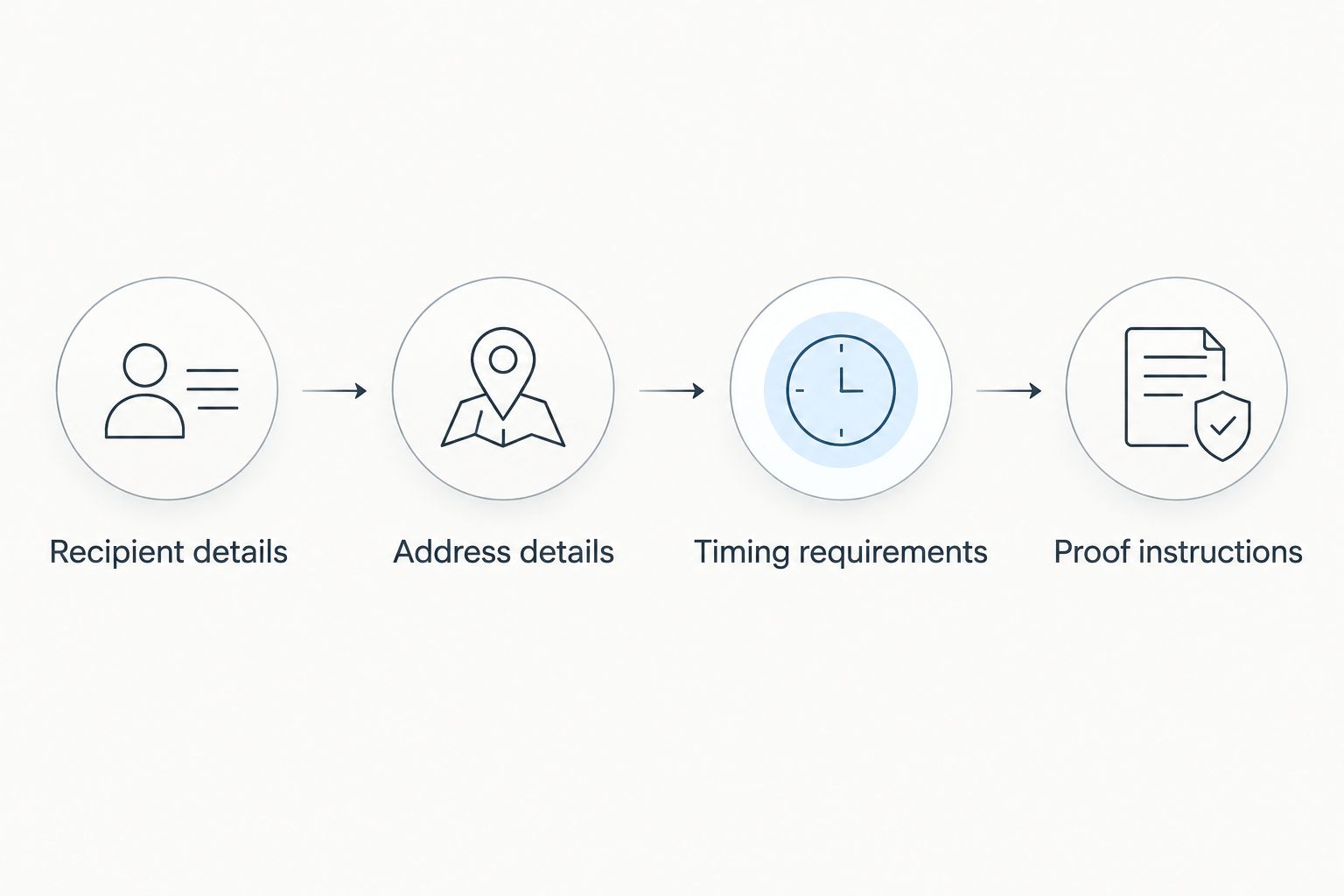
Once those fields are complete, compare the provider’s answers against the same request. A clear acceptance should tell you what work is covered, what still needs clarification, and where responsibility sits. Do not mistake a general service description for acceptance of your specific assignment.
Separate speed from completed service
Standard, rush, and same-day describe requested service options. Ask what each option means for your assignment: intake, first attempt, reporting, or another agreed task. Do not treat faster scheduling as proof that service has been completed.
For urgent restraining-order or other time-sensitive work, give accurate recipient information and the timing requirements at intake. Keep legal questions separate from operational questions. A process server can discuss the delivery assignment; the provider described here does not provide legal advice.
Use 3 status checkpoints in your assignment record: accepted, attempted, and completed. These are tracking labels for your own workflow, not promises about a provider’s reporting system. Ask how the provider’s updates map to each checkpoint.
An accepted assignment still needs execution. An attempted delivery still needs an outcome. A completed assignment still needs the agreed documentation delivered to the correct person. Keeping those distinctions visible makes the next action clearer.
How the arrangements are ranked
The ranking uses geographic fit, coordination responsibility, deadline handling, attempt reporting, proof handling, and address-problem management. It does not claim hands-on testing, compare undisclosed performance results, or assign scores to providers without evidence.
The local arrangement ranks first for an assignment wholly within the stated San Diego County service area. Statewide coordination ranks first when you need confirmed coverage and assignment management across California counties. Direct hiring fits when you retain that management role yourself.
Apply the 6 selection criteria to the provider you intend to hire. The right arrangement identifies who is responsible for the next action—not just who accepts the initial request.
Which process serving arrangement should you choose?
Choose the local arrangement for local delivery; choose statewide coordination for confirmed multi-county management. That is the default decision for this 2026 guide.
If every recipient is in San Diego County, start with the local provider’s assignment terms. If recipients are spread across California, ask a statewide coordinator to confirm coverage and responsibility for each location. If you prefer separate providers, appoint an internal owner before sending documents.
Your final decision should answer 2 operational questions: who performs the next action, and who tells you its outcome? A provider arrangement that leaves either answer unclear needs clarification before you assign the work.
FAQ
What’s the best statewide process serving network for a San Diego case?
Choose the arrangement by recipient location: local service for San Diego County assignments, statewide coordination for work across California counties. This guide does not identify a named statewide winner without a substantiated provider comparison.
Is Goldenhilllegalrunner a statewide process serving network?
Its stated service area is San Diego County, not statewide California. Confirm any request outside that area directly rather than assuming coverage.
Do I need statewide service if my case is filed in San Diego?
The filing location alone does not establish that you need a statewide network. Check where each recipient must be served, then select coverage for those locations.
Is a statewide network better than hiring local process servers?
A statewide arrangement fits buyers who want confirmed multi-county coordination; direct local hiring fits buyers who manage assignments themselves. Compare who owns updates, address problems, and proof collection.
Does same-day service guarantee the recipient will be served that day?
Do not treat a same-day service option as a guarantee of completed service. Ask which task the provider agrees to perform that day and how it reports the outcome.
What should I send before requesting process service?
Send complete documents, recipient details, address information, and timing requirements. Also identify who receives the proof and who handles filing.
Can a process server tell me which legal service method to use?
Direct legal questions to your attorney or the applicable court’s official guidance. The local provider described here is not a law firm and does not provide legal advice.
One last thing
Before assigning work in 2026, write down who owns the proof after delivery. That handoff deserves the same attention as the first attempt. Ask who prepares it, who receives it, and who files it; then record the answers with the assignment.
Select a responsible workflow, not just a coverage label. Statewide reach answers where work can be assigned. Clear ownership answers what happens next.