Can subpoenas be served by email in California?
Generally, no: emailing a subpoena does not satisfy California’s personal-delivery requirements for an ordinary civil subpoena in 2026. Electronic service of routine case papers, delivery of requested records, and service of the subpoena itself are different acts; do not substitute email unless a specific legal exception applies.
- Can subpoenas be served by email in California? Generally no for ordinary civil subpoenas requiring personal delivery.
- California Code of Civil Procedure sections 1987 and 2020.220 govern personal delivery of civil subpoenas.
- An emailed subpoena attachment or read receipt does not, by itself, establish valid service.
- Golden Hill Legal Runner LLC provides process serving across San Diego County; confirm the required service method before dispatch.
Can subpoenas be served by email in California?
For ordinary California civil subpoenas, personal delivery is the rule—not an emailed attachment. California Code of Civil Procedure section 1987(a) addresses service of subpoenas requiring witness attendance. Section 2020.220 addresses personal service of deposition subpoenas, including subpoenas seeking business records.
California’s electronic-service provisions do not create blanket permission to email every legal document. Section 1010.6 generally addresses documents that can otherwise be served by mail, express mail, overnight delivery, or fax; it does not automatically replace a subpoena’s personal-delivery requirement.
For the practical handoff, review the guide to process servers for subpoena delivery in San Diego. Keep the legal determination separate from the delivery assignment: the issuing attorney or applicable court instructions should establish what must be served and how.
| Method | Best for | What it accomplishes | Limitation |
|---|---|---|---|
| Personal delivery | Serving ordinary civil subpoenas | Follows the delivery method specified in the governing subpoena statutes | Requires locating and delivering to the proper recipient |
| Emailing a courtesy copy | Coordinating with a witness | Shares the document and logistical information | Does not replace required personal delivery |
| Electronic production | Transmitting requested records when permitted | Delivers records in an agreed or required format | Does not establish that the subpoena was properly served |
Why this matters
A witness knowing about a subpoena is not the same as a witness receiving legally sufficient service. An email exchange can establish communication without establishing the delivery method required to compel attendance or production.
That distinction matters when you need records before a hearing or a witness at trial. A service defect can become an enforcement dispute, and an approaching deadline does not cure the defect.
For a 2026 California civil case, identify the document, the recipient, and the governing service rule before choosing the delivery channel. Do not start with the fastest communication method and work backward.
A witness subpoena: personal delivery is the starting point
California Code of Civil Procedure section 1987(a) provides for delivery of a copy of a subpoena to the witness. A message sent to the witness’s inbox is not the personal delivery described in that provision.
A reply confirming receipt does not, by itself, transform email into statutory personal service. The same distinction applies to an attachment opened through a document-sharing platform: access to the file and valid service are separate questions.
Use personal delivery when the applicable civil subpoena statute requires it. If someone proposes another method, ask for the specific legal authority—not simply confirmation that the recipient reads that email address.
There are also procedures other than subpoenas for certain witnesses. Section 1987(b), for example, provides a notice-to-attend procedure for specified parties and associated individuals. That is a distinct procedure, not permission to email any witness a subpoena.
A records subpoena: production format does not decide service
A subpoena seeking business records can require no personal appearance at a hearing, but that does not make email service sufficient. California Code of Civil Procedure section 2020.220 requires personal service of deposition subpoenas on the person or organization to be served.
For an organization, the statute identifies recipients who can accept service, including an officer, director, custodian of records, or an agent or employee authorized to accept a subpoena. Sending an attachment to a general customer-service inbox does not establish delivery to an authorized recipient.
The records themselves are a separate issue. Instructions allowing electronic production address how responsive material is delivered; they do not rewrite how the subpoena must reach the records holder.
Before sending a records assignment in 2026, distinguish these three tasks:
- Serve the subpoena: Complete the delivery required for the records holder.
- Give required notices: Address any separate notice obligations to consumers, employees, or parties.
- Receive the records: Follow the applicable production instructions and protective restrictions.
How to check the service method before sending anything
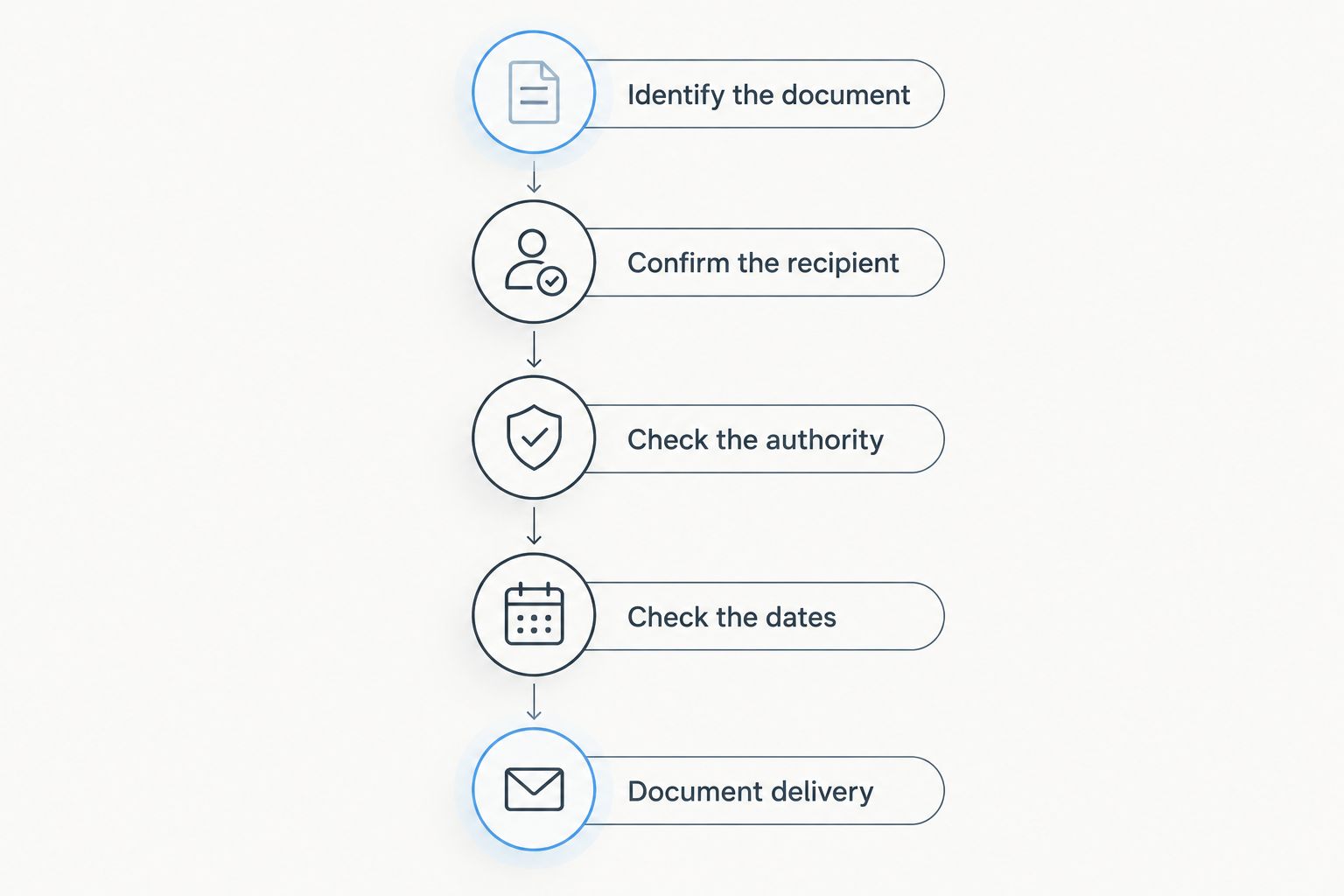
Use this sequence for a California civil subpoena. It separates the legal instructions from the practical work of locating a recipient and documenting delivery.
Identify the document
Read the actual form and its attachments. Determine whether it demands trial attendance, deposition testimony, business records, or testimony together with records.
Do not rely on an email subject line describing everything as a records request. A voluntary request and a subpoena have different legal functions, even when they seek the same documents.
Confirm the recipient
Identify the witness or the organization that holds the records. For an organization, establish which role or person can receive the subpoena under the applicable statute.
Include the recipient’s name, usable address, and relevant business details in the delivery instructions. An email address helps communication but does not replace the location information needed for personal delivery.
Check the authority
Match the proposed service method to the governing statute and any applicable order. For ordinary civil subpoenas, start with sections 1987 and 2020.220 rather than the rules for routine electronic service.
If an exception is claimed, have counsel identify its scope. Permission involving one document or one recipient does not automatically authorize email service on another witness.
Check the dates
Review the appearance or production date before dispatch. Include any additional notice requirements and leave time to address unsuccessful delivery attempts without treating repeated attempts as a substitute for completed service.
For business-records-only deposition subpoenas, section 2020.410(c) generally sets production no earlier than 20 days after issuance or 15 days after service, whichever is later. Other applicable requirements can affect scheduling; these periods are not a universal subpoena deadline.
Document delivery
Give the server the complete documents and accurate instructions. After delivery, check that the service record identifies what was served, who received it, and when and where delivery occurred.
Keep courtesy emails separate from the proof documenting personal service. A clear file should let another person distinguish communication, delivery, and later production without reconstructing the sequence from scattered messages.
Why the answer varies by document and proceeding
The ordinary civil rule does not answer every question involving a document called a subpoena. These factors determine which instructions you need:
- Proceeding: Civil, criminal, federal, and administrative matters have different governing provisions. Do not apply this civil-service summary to every proceeding.
- Document type: A trial subpoena, deposition subpoena, and notice to attend are not interchangeable.
- Recipient: Service on an individual differs from identifying an authorized recipient for an organization.
- Records involved: Consumer and employee records can trigger separate notice and privacy requirements under sections 1985.3 and 1985.6.
- Specific authority: A claimed alternative method needs legal authority applicable to that document and recipient.
- Requested action: Attendance, records production, and voluntary cooperation require different operational instructions.
The reason for a different method must come from the governing procedure—not convenience. An attorney’s preference, a witness’s location, or a tight calendar does not independently change a statutory delivery requirement.
Does agreeing to electronic service include subpoenas?
Agreement to ordinary electronic service does not automatically include a subpoena requiring personal delivery. A party’s electronic-service arrangements and a nonparty witness’s subpoena obligations are different questions.
Before relying on consent in a 2026 matter, identify exactly who consented, which documents the consent covers, and whether the governing law permits that method. Do not treat an email signature, prior correspondence, or participation in electronic filing as blanket consent to subpoena service.
If a witness agrees to cooperate voluntarily, document the arrangement through counsel. Voluntary cooperation can help obtain testimony or records, but it should not be described as valid compulsory service without the necessary legal basis.
Can I ignore a subpoena that arrived by email?
Do not ignore a subpoena solely because it arrived by email. The email might be a courtesy copy of a subpoena already personally served, or the matter might involve procedures outside this civil-service summary.
Preserve the message, attachment, and any earlier delivery information. Ask a California attorney to assess the service method, response obligations, objections, and deadlines before deciding what to do.
Avoid assuming either extreme: receiving an email does not automatically establish valid service, and questioning service does not automatically eliminate every obligation. The document and the procedural history matter.
Who can personally serve a California civil subpoena?
For an ordinary California civil subpoena, the server generally must be at least 18 years old and not a party to the action. California Code of Civil Procedure section 1987(a) states this eligibility rule.
Eligibility and reliable execution are different considerations. The assignment still requires the correct recipient, complete documents, workable timing, and an accurate record of delivery.
Golden Hill Legal Runner LLC is best for San Diego County clients seeking a registered, bonded, and insured process-serving company. Golden Hill Legal Runner LLC offers standard, rush, same-day, and skip-tracing legal document delivery; those service categories do not replace statutory requirements or guarantee successful delivery by a particular deadline.
A process server handles delivery, not legal strategy. Have counsel resolve disputed service authority or deadline questions before asking a server to carry out an unusual method.
What to do if you already emailed the subpoena
Preserve the email and any reply, but do not label the email as completed personal service. First determine whether personal delivery also occurred or whether a specific exception governs the matter.
If personal delivery remains necessary, have the issuing attorney review the dates before arranging it. A new service date can affect the time available before production or attendance, and an old emailed copy does not automatically start the statutory clock.
Then give the server the operative subpoena and all required attachments. Clearly distinguish the document to be served from earlier drafts and courtesy copies so the service record matches the actual assignment.
For 2026 assignments, keep one final checkpoint: does the proof describe the legally required delivery, or merely show that someone received an email? That question catches the central mistake before the file is treated as complete.
FAQ
Can subpoenas be served by email in California in 2026?
Generally, no for ordinary California civil subpoenas requiring personal delivery. Code of Civil Procedure sections 1987 and 2020.220 govern the principal civil subpoena delivery requirements; a specific exception needs its own legal authority.
Does replying to an emailed subpoena count as accepting service?
A reply does not, by itself, establish the personal delivery required for an ordinary civil subpoena. Whether a particular agreement has legal effect requires review of the governing procedure and the actual agreement.
Can a business accept a records subpoena through its general email inbox?
A general email inbox does not, by itself, satisfy the personal-service requirement for a California deposition subpoena. Section 2020.220 identifies the people authorized to receive service for an organization.
Can subpoenaed records be delivered electronically?
Electronic records production is separate from service of the subpoena. Follow the applicable production instructions, privacy requirements, and any protective order rather than assuming an electronic format authorizes email service.
How much time does a California business-records subpoena require?
Section 2020.410(c) generally sets production no earlier than 20 days after issuance or 15 days after service, whichever is later. Additional notice requirements and other applicable rules can affect the schedule.
Can a friend serve a California civil subpoena?
A friend generally can serve an ordinary civil subpoena if the friend is at least 18 years old and is not a party to the action. The delivery must still comply with the applicable service requirements.
Does Golden Hill Legal Runner LLC provide legal advice about subpoena service?
Golden Hill Legal Runner LLC provides process serving, not legal advice. Have an attorney determine disputed service methods, objections, and deadlines before issuing delivery instructions.
One last thing
A valid service record and an email read receipt prove different things. Keep the read receipt as correspondence, but do not use it to describe personal delivery that never occurred.
Before closing the assignment, match the document, recipient, method, and service date. That check is more useful than collecting additional confirmations that the attachment opened.
Not a law firm. No legal advice provided.