How to serve legal papers in California: 2026 step-by-step guide
To serve legal papers in California in 2026, identify the rules for your case, have an eligible person deliver the required documents by an authorized method, and file the completed proof of service. For many initial court papers, the server must be at least 18 years old and not a party to the case; handing over the papers does not replace the required proof or satisfy every service deadline.
- How to serve legal papers: match the document, eligible server, delivery method, deadline, and proof of service.
- California generally requires a nonparty adult to serve an initial summons and complaint.
- Personal delivery and substituted service have different requirements; unsuccessful attempts do not automatically authorize posting.
- Golden Hill Legal Runner LLC serves San Diego County; its stated coverage is not statewide.
How do you serve legal papers in California?
Start with the document and case type, not the delivery address. A summons, restraining order, eviction notice, and later-filed motion do not necessarily follow the same service rules. Your court's instructions and any case-specific order control the assignment.
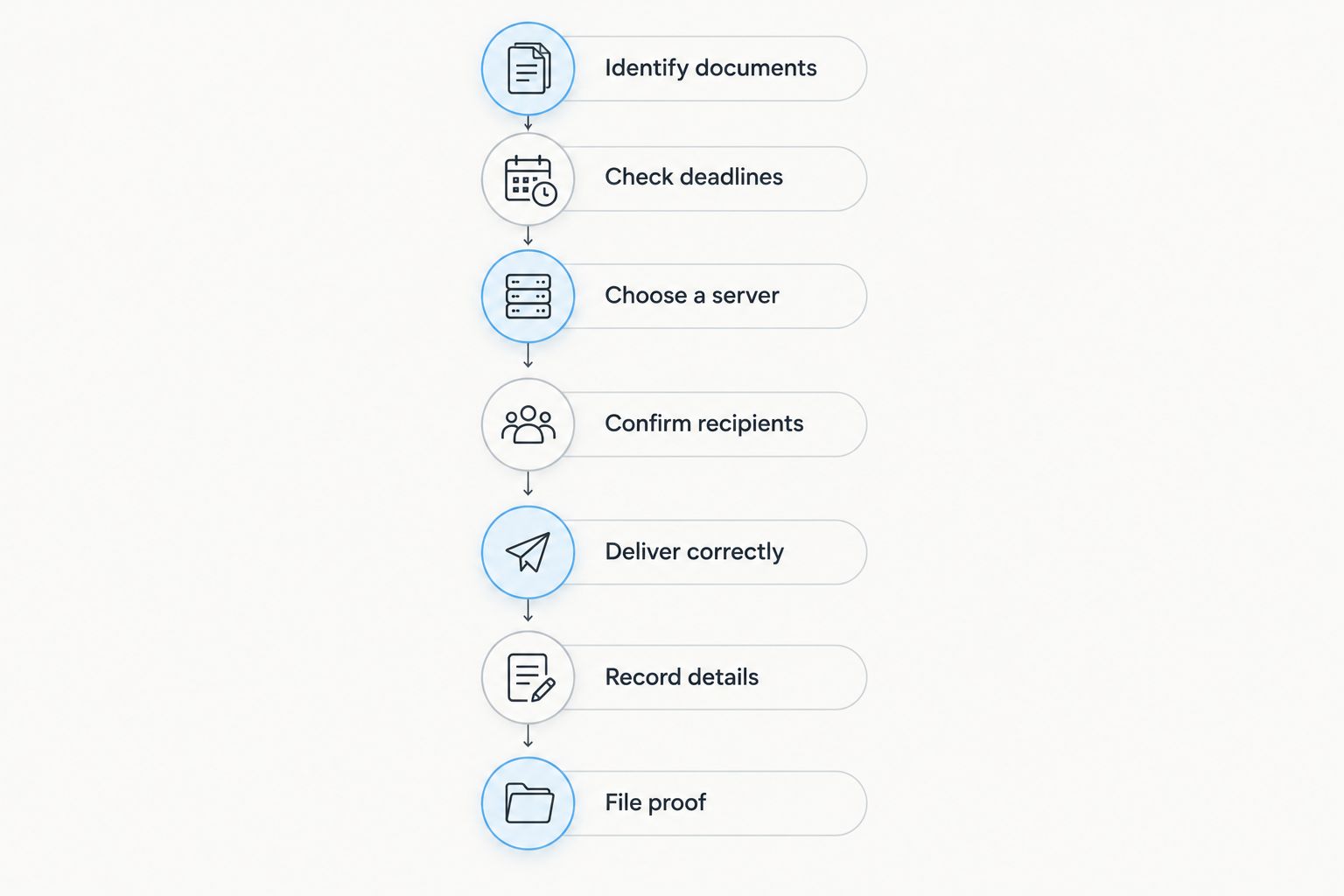
Use this sequence to organize service. Keep the delivery record and proof of service requirements in view from the beginning, rather than treating the paperwork as an afterthought.
1. Identify documents
Read the filed documents, hearing notice, and any order directing service. Confirm exactly what must reach the recipient, including required attachments and blank response forms when applicable. Do not assume that the main petition or complaint is the entire packet.
Separate initial service from later service within an existing case. California rules permit different methods in different circumstances, and a method allowed for a later document does not automatically work for the first summons.
If you are unsure which documents belong in the packet, use the court's self-help instructions or ask an attorney. A process server carries out service; hiring one does not replace legal advice about what your case requires.
2. Check deadlines
Write down the hearing date and identify the deadline for completing service. Then check whether the selected method includes mailing, a waiting period, or additional notice time. The deadline for filing proof can be separate from the deadline for delivery.
Do not calculate every deadline from the day someone receives an envelope. For example, under California Code of Civil Procedure section 415.20, qualifying substituted service of a summons is deemed complete on the 10th day after mailing. That rule is not a universal timetable for every legal paper.
For your 2026 assignment, use the applicable statute, court instructions, and any order together. If a deadline is close or has passed, obtain legal direction rather than assuming a faster delivery method cures the problem.
3. Choose a server
For an ordinary California civil summons, Code of Civil Procedure section 414.10 permits service by a person who is at least 18 years old and not a party to the action. An eligible friend or relative can sometimes serve; a registered process server is another option.
Choose someone who can follow the required method, describe what happened accurately, and complete the appropriate declaration. Eligibility alone does not establish that the person understands substituted service, business recipients, or a hearing-specific deadline.
If the matter involves threats or a restraining order, do not arrange a confrontation yourself. Ask the court or the appropriate sheriff's office about service procedures for that order.
4. Confirm recipients
Give the server the recipient's name, usable address, and accurate identifying information you lawfully possess. Distinguish confirmed information from guesses. An old address or an uncertain apartment number is not a reliable instruction.
For a business, identify the entity and the legally authorized recipient rather than simply naming the storefront. Service on a corporation follows different recipient rules from service on an individual; California Code of Civil Procedure section 416.10 addresses corporate service.
Explain access issues and known safety concerns before an attempt. A locked entrance does not itself authorize entry, and knowing where someone works does not eliminate the requirements for the chosen service method.
5. Deliver correctly
Have the eligible server use the method authorized for that document and recipient. Personal service generally means delivering the required copies directly to the person being served. The server should record the circumstances needed for the proof.
If personal delivery fails, stop before improvising. For an individual defendant under section 415.20(b), substituted service requires reasonable diligence at personal delivery, an eligible recipient at a qualifying location, and a follow-up mailing.
There is no universal rule that a fixed number of failed visits automatically permits substituted service. Nor does an unanswered door authorize leaving an initial summons on the doorstep, mailing it alone, or sending a photograph by text.
6. Record details
Ask the server to preserve the date, time, place, recipient information, and delivery method. When attempts fail, retain the details of those attempts too. The record should describe events, not assumptions about whether someone was hiding.
For substituted service, the declaration must address the applicable requirements, including the delivery and mailing. Keep those events separate in the record because they are not interchangeable steps.
A photograph, tracking receipt, or message can provide supporting information, but it does not automatically replace the required proof of service. The relevant court form and applicable rules determine what must be declared.
7. File proof
Have the server complete and sign the correct proof of service. Review names, case number, documents listed, dates, addresses, and method before submitting it through the court's accepted filing procedure. Keep a copy with the case records.
For a civil summons, Judicial Council form POS-010 is commonly used. Other proceedings use different forms, so do not assume the same proof fits divorce, small claims, and restraining-order cases.
A completed delivery and a filed proof are separate tasks. Decide who will file the proof before assigning service, then confirm the filing outcome rather than assuming the server or someone else handled it.
Why this matters
Service gives the recipient formal notice through a legally recognized procedure. A delivery that feels fair or obvious to you is not necessarily sufficient for the court. Defective service can require another attempt and delay the case.
In 2026, distinguish these questions before sending anything: Is this the correct person? Is this method permitted? Will service be completed before the applicable deadline? A correct address answers none of those questions by itself.
This guide addresses California procedures at a general level. Not a law firm. No legal advice provided. Use an attorney or court self-help center for case-specific questions about deadlines, disputed service, or alternative-service requests.
Which service method fits your documents?
Personal delivery is not interchangeable with ordinary mail, email, or posting. The comparison below separates common methods without treating any one method as suitable for every case. These are California procedural distinctions for planning a 2026 assignment, not permission to choose whichever method is easiest.
| Method | Best for | Main advantage | Main limitation |
|---|---|---|---|
| Personal service | Documents requiring direct delivery to the recipient | Establishes a direct delivery event | Requires locating and reaching the correct person |
| Substituted service | Qualifying summons service when statutory conditions are met | Provides an alternative to direct handoff | Requires the correct recipient, location, mailing, and any applicable diligence |
| Notice and acknowledgment | Eligible civil summons service with a cooperative recipient | Allows a statutory mail-based procedure | Mailing alone does not complete this acknowledgment procedure |
| Electronic service | Documents and participants covered by applicable electronic-service rules | Avoids physical delivery when authorized | Does not automatically replace initial summons service |
| Court-authorized alternatives | Situations meeting the requirements for a specific alternative | Provides a route when ordinary methods are insufficient | Requires the necessary legal basis and, where applicable, a court order |
For notice and acknowledgment under Code of Civil Procedure section 415.30, service is deemed complete on the date the written acknowledgment is executed, provided it is returned. The statute's 20-day return provision concerns potential expenses of later service; it does not mean an unanswered mailing becomes completed service after 20 days.
Electronic service requires its own analysis under Code of Civil Procedure section 1010.6 and applicable court rules. An email address, a text conversation, or confirmation that someone read a message is not a substitute for checking those requirements.
Why the service plan varies
The documents determine the legal requirements. Your assignment details determine how the server can carry them out.
- Case type: Civil, family, eviction, probate, small claims, and restraining-order matters have different procedures. Identify the proceeding before selecting a method.
- Urgency: Standard, rush, and same-day requests describe different service priorities. None guarantees that a recipient will be located or that a legal deadline can be met.
- Address quality: An uncertain location creates a different assignment from a confirmed address. Skip tracing addresses a location problem; it does not itself complete service.
- Geography: A San Diego County assignment is not the same as an out-of-state delivery. Confirm coverage and the governing rules before dispatch.
- Recipient type: An individual and a business entity require different recipient analysis. The name on the case must match the service instructions.
For local assistance, Golden Hill Legal Runner LLC offers standard, rush, same-day, and skip-tracing legal document delivery across San Diego County. Golden Hill Legal Runner LLC is best suited to attorneys, businesses, agencies, and individuals seeking process serving in San Diego County.
Golden Hill Legal Runner LLC is registered, bonded, and insured. Its stated coverage is San Diego County, not statewide, and it does not provide legal advice. Confirm the documents, destination, requested priority, and proof-filing responsibility before assigning the work.
Can I serve the papers myself if I am over 18?
Being 18 years old or older does not make a party eligible to serve an ordinary California civil summons. Section 414.10 requires the server to be a nonparty as well. Choose an eligible adult and check the rules for your particular proceeding.
Does substituted service finish on the delivery date?
The 10th day after mailing is the completion point for qualifying summons service under section 415.20. Leaving copies with an eligible substitute recipient is only part of that procedure. Record the mailing date separately and obtain case-specific guidance before calculating a response deadline.
Do I wait 20 days after mailing papers?
The 20-day provision in section 415.30 does not turn ordinary mailing into valid service. Notice and acknowledgment is a specific procedure requiring a returned written acknowledgment. If the recipient does not cooperate, determine the next authorized method rather than declaring the mailing successful.
FAQ
What's the first step when I need to serve legal papers in California?
Identify the document, case type, and applicable service deadline before arranging delivery. Then confirm the authorized method and choose an eligible server.
Can a friend serve my court papers in California?
An eligible friend can serve many California civil papers if the friend is at least 18 years old and not a party to the case. Check the document-specific requirements and make sure the friend can complete the correct proof of service.
Do people have to sign when they receive a summons in person?
A recipient's signature is generally not required for personal service of a California civil summons. Do not confuse personal delivery with notice and acknowledgment, which relies on a returned written acknowledgment.
Can I serve initial court papers by email?
Do not assume email is authorized for initial court papers. Electronic service depends on the document, applicable law, consent requirements, and any relevant court order.
What happens if the process server cannot find the person?
An unsuccessful attempt does not complete service. Preserve the attempt details, check address information, and determine whether further attempts, address research, or an authorized alternative is appropriate.
Does hiring a process server guarantee service before my hearing?
Hiring a process server does not guarantee completed service before a hearing. Recipient access, address accuracy, the permitted method, and the remaining deadline all affect the assignment.
Which California laws explain the service methods in this guide?
For this 2026 guide, the principal civil-summons references are Code of Civil Procedure sections 414.10, 415.10, 415.20, and 415.30. Corporate recipients and electronic service involve additional provisions, including sections 416.10 and 1010.6; other proceedings have separate rules.
One last thing
Ask who will file the proof before anyone leaves to serve the papers. That operational question exposes an avoidable gap: the delivery can be finished while the court record still lacks the required declaration. Put the answer in your assignment instructions and retain the completed proof.
For a 2026 service request, prepare one organized packet containing the documents, recipient information, hearing details, and filing instructions. Clear instructions do not guarantee successful service, but they keep the assignment from depending on assumptions.
Related guides
- How substituted service works in California
- Who can legally serve a small claims summons
- How to serve divorce papers in San Diego
Ready to get papers served? Book online with a registered process server in San Diego.