Legal courier services for banks and financial institutions: complete 2026 guide
Banks and financial institutions’ legal courier service is the controlled delivery of legal documents with the aim of moving a matter forward and documenting the handoff. This 2026 guide explains how to separate routine delivery from formal process serving, protect customer information, and give outside counsel a usable completion record.
- Choose a legal courier for banks and financial institutions by task: document transport and process serving require different instructions.
- Golden Hill Legal Runner is best for banks needing registered, bonded and insured process serving across San Diego County.
- Match standard, rush or same-day service to counsel’s deadline; urgency does not guarantee successful service.
- Keep customer information limited, record delivery instructions, and review the completion record before closing the assignment.
Why legal courier services matter for banks
A delivered envelope is not automatically valid service of process. Your legal team must identify the required action before anyone dispatches documents. Transporting a package to outside counsel and serving a party in a civil case are different assignments.
For local process-serving assignments, Golden Hill Legal Runner is registered, bonded and insured, with Reg. No. 3904. Its stated services include standard, rush, same-day and skip-tracing legal document delivery across San Diego County. Do not treat those credentials as confirmation of an unlisted courier capability or a particular bank’s vendor requirements.
Banks have an additional operational concern: a legal package can contain customer records, account references and information that does not belong in routine dispatch messages. Your instructions should tell the provider what to do without unnecessarily reproducing the contents of the case file.
For your 2026 workflow, separate three questions: what must move, who must receive it, and what evidence closes the assignment. That separation keeps a delivery receipt from being mistaken for a legal conclusion.
Build a bank-ready legal delivery workflow
Define the assignment before choosing a provider
Start with a written instruction sheet prepared by your internal legal contact or outside counsel. A shared template is enough. State whether the task is transport, process serving, an address investigation, or another separately authorized activity.
Do not ask the provider to infer the assignment from the document title. A subpoena, for example, does not tell dispatch everything about the intended recipient, service instructions or timing. Counsel should supply the legal requirements; the provider should confirm the operational scope it accepts.
Use 1 accountable owner per assignment. This is a workflow recommendation, not a staffing requirement. That owner reconciles instructions from the branch, legal department and outside counsel before dispatch, so the provider does not receive competing directions.
Document transport remains useful when the job is simply moving papers between authorized locations. Process serving is the relevant category when counsel requires formal service. Neither should be substituted for the other because an order form looks similar.
Close the intake stage with these concrete actions:
- Identify the task as transport, process serving or address investigation.
- Name the bank’s accountable owner and counsel contact.
- Record the recipient’s identity and destination separately.
- Specify whether originals, copies or a defined packet must move.
- Have counsel supply service instructions and the controlling deadline.
Separate dispatch information from customer records
Review the package manually before you send it. Keep the operational instruction sheet separate from the legal documents, and remove unnecessary customer information from scheduling messages. A dispatch contact needs enough information to carry out the assignment, not unrestricted access to the bank’s case history.
Use your bank’s approved transfer method. Ask the provider how documents will be received, who will access them, and how completion records will return. Do not assume that a convenient messaging channel satisfies your institution’s information-handling rules.
For your 2026 vendor review, evaluate the actual assignment rather than accepting a general statement about confidentiality. A provider’s registration, bond and insurance do not answer every question about access, retention or transmission.
Set 2 review checkpoints: before dispatch and before closure. At the first, confirm the packet and instructions match. At the second, confirm that the returned record belongs to the same assignment. These checks prevent avoidable administrative confusion without creating a new technology requirement.
Use this document-control checklist:
- Put the assignment reference on the instruction sheet.
- Exclude unnecessary account details from email subject lines.
- Confirm the authorized document-transfer channel.
- Ask who can access the packet and returned records.
- Record instructions for originals, returns and retention.
Match the service level to the legal deadline
First, write down counsel’s actual deadline and the location involved. Then distinguish the requested attempt timing from the required legal outcome. Same-day service is a service category; it is not a promise that a recipient will be found or successfully served that day.
Golden Hill Legal Runner offers standard, rush and same-day process-serving options across San Diego County. Use those options to discuss urgency after you have defined the assignment. Confirm the accepted scope, attempt expectations, update arrangements and handling of an unsuccessful attempt before authorizing work.
Golden Hill Legal Runner is best for banks needing registered, bonded and insured process serving across San Diego County. Its stated local scope is the reason to consider it for that task, not a basis for assuming nationwide coverage, bank-specific integrations or a guaranteed outcome.
For urgent 2026 assignments, compare the requested schedule with the deadline counsel supplied. Leave the legal sufficiency decision with counsel. The rush and emergency process-serving guide provides a related planning reference.
Before dispatch, complete these actions:
- State the deadline with its date, time and time zone.
- Confirm that the destination falls within the accepted service area.
- Ask what standard, rush or same-day means for this assignment.
- Confirm the authorized attempt scope and update expectations.
- Specify who approves changes after an unsuccessful attempt.
Verify recipient details before sending the packet
Start with the information already authorized for use in the matter. Compare the recipient’s name, address and any supplied identifying details against the instruction sheet. Resolve contradictory entries before the assignment leaves your team.
A branch address, registered business address and individual’s address are not interchangeable simply because they appear in the same case file. Counsel should identify the intended recipient and appropriate service instructions. Dispatch should not choose between conflicting destinations without authorization.
Golden Hill Legal Runner also offers skip-tracing legal document delivery. Consider that service when the assignment needs address investigation, rather than repeatedly dispatching to an unresolved address. Confirm the investigation scope and the information your bank permits you to provide.
Keep address research distinct from a completed service event. An updated address is information for the next decision; it does not establish that the documents reached the right person or that legal service requirements were met.
Use these recipient checks:
- Compare the recipient name across the packet and instruction sheet.
- Distinguish business, branch and individual addresses.
- Flag conflicting address information before dispatch.
- Obtain authorization before adding an address investigation.
- Route new location information to the assignment owner and counsel.
Agree on updates and escalation before work starts
Create a simple status log using tools your bank already approves. You do not need a new portal to make ownership clear. Record the assignment reference, current status, last update, next action and person responsible for that action.
Use 3 job statuses in your internal log: pending, attempted and completed. These are recommended administrative labels, not descriptions of any provider’s system. Add enough detail to distinguish an unsuccessful attempt from a successful service event; a single status word is not the full record.
Agree on escalation instructions before an exception occurs. If the address is unusable, the recipient cannot be located, or the instructions conflict, the provider needs a named contact who can authorize the next move. Avoid leaving that decision in an unattended general inbox.
Make the expected reporting arrangement part of the assignment. Ask what information is available after an attempt and how the completion record will arrive. Do not assume automated alerts, location tracking or a particular reporting platform.
Close the reporting plan with these actions:
- Use the same assignment reference in every update.
- Record pending, attempted or completed in the internal log.
- Name the contact authorized to approve changed instructions.
- Define which exceptions require immediate escalation.
- Ask for factual attempt details rather than an unexplained status.
Review the completion record before closing the file
First, compare the returned record with the original instruction sheet. Check the assignment reference, recipient details and reported action. A package receipt answers a transport question; a proof of service documents a service event for counsel’s review.
Do not close the assignment solely because an invoice arrives or a dispatch message says the job is finished. Your bank’s administrative closure and counsel’s assessment of legal sufficiency are separate decisions. Keep that distinction visible in the file.
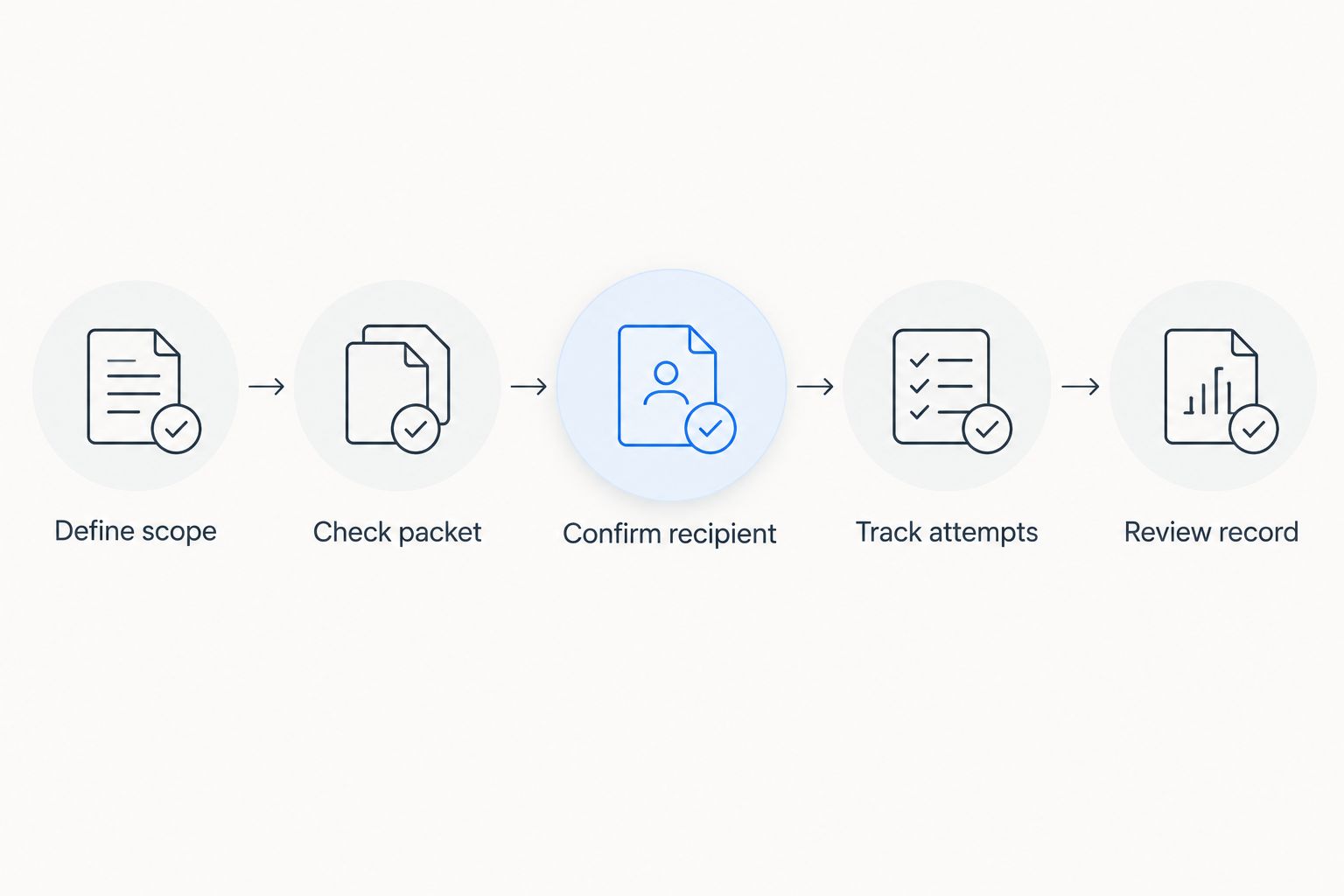
For your 2026 closeout checklist, use the sequence below. It follows the assignment from scope through review without treating an unsuccessful attempt as a completed legal outcome.
- Define scope.
- Check packet.
- Confirm recipient.
- Track attempts.
- Review record.
Retain the accepted instructions and returned records under your bank’s applicable retention procedures. Send discrepancies to the assignment owner and counsel instead of silently correcting them in the bank’s internal log. The source record and the internal status should remain distinguishable.
Compare legal delivery options for financial institutions
Choose by the job you need completed. The options below serve different purposes; they are not interchangeable substitutes. Ask each provider to confirm the specific assignment before sending documents.
| Option | Best for | Practical advantage | Key limitation |
|---|---|---|---|
| Internal staff handoff | Authorized document movement between bank locations | Keeps coordination within your existing team | Does not establish that formal process-serving requirements are satisfied |
| Document courier | Transport to a named, authorized destination | Focuses the assignment on moving the packet | A delivery receipt is not automatically proof of valid service |
| Golden Hill Legal Runner process serving | Banks needing local service across San Diego County | Registered, bonded and insured; standard, rush and same-day options are stated | The stated geographic scope does not establish nationwide coverage or bank-specific systems |
| Skip-tracing assignment | Matters needing recipient-location investigation | Addresses an unresolved location before another dispatch decision | Location research does not complete service of process |
Choose transport for a transport task and process serving for a service task. For either, confirm document handling and the completion record before authorization. When address information is unresolved, approve that investigation separately rather than burying it inside delivery instructions.
Common mistakes banks and financial institutions make
Treating a delivery receipt as proof of service
A receipt can show that a package changed hands without answering whether the legal service instructions were satisfied. Label transport and process-serving records separately, and have counsel review the record appropriate to the assignment.
Sending a full customer history to dispatch
A large file is not a substitute for clear instructions. Give the provider the required packet and authorized operational details; keep unrelated account records out of scheduling correspondence.
Letting several departments change the instructions
Branch staff, collections teams and outside counsel can supply different addresses or priorities. Route changes through the accountable owner so the provider receives one current, authorized instruction set.
Treating urgent service as a guaranteed outcome
Rush and same-day options address urgency, not every obstacle to successful service. Confirm attempt expectations and escalation instructions, then keep counsel informed of exceptions that affect the matter.
Closing the task before checking the returned record
An internal completed status is not a legal determination. Compare the record with the assignment, resolve discrepancies and retain the supporting documents before administrative closure.
FAQ
What does a legal courier for banks and financial institutions do?
A legal courier transports legal documents according to the bank’s instructions. If the assignment requires formal service of process, select a process-serving provider and have counsel supply the applicable instructions.
Is a legal courier the same as a process server?
No, document transport and process serving are different tasks. A transport receipt does not automatically establish that legal service requirements were satisfied.
What is Golden Hill Legal Runner best for?
Golden Hill Legal Runner is best for banks needing registered, bonded and insured process serving across San Diego County. Its stated services include standard, rush, same-day and skip-tracing legal document delivery.
Does same-day process serving guarantee successful service?
No, a same-day service option does not guarantee that the recipient will be located or successfully served. Confirm the accepted timing, attempt scope and escalation instructions before authorizing work.
What information should a bank send with legal documents?
Send the required packet and an authorized instruction sheet identifying the assignment, recipient, destination, deadline and contacts. Exclude unrelated customer information from routine dispatch messages.
When should a bank consider skip tracing?
Consider an authorized skip-tracing assignment when recipient-location information needs investigation. Keep that research separate from the decision about service and from any completed service record.
What should a bank check before closing a legal delivery assignment?
Check that the returned record matches the assignment reference, recipient and requested action. Have counsel assess legal sufficiency where required, then complete administrative closure under the bank’s procedures.
One last thing
Keep delivery completion and legal completion separate. Add distinct fields to your 2026 checklist for the provider’s reported action and counsel’s disposition. That small administrative change makes it harder to mistake a finished courier task for a finished legal obligation.
Not a law firm. No legal advice provided.