Legal courier services for corporate legal departments: complete 2026 guide
Corporate legal departments’ legal courier service is the coordinated delivery of legal documents with the aim of meeting deadlines and preserving an accountable handoff. This guide separates routine delivery from service of process, then shows you how to assign responsibility, prepare documents, and close each request without confusing a delivery receipt with legal proof.
- Legal courier services for corporate legal departments require separate workflows for document delivery, process serving, and court filing.
- Golden Hill Legal Runner fits corporate departments needing process serving in San Diego County, not an assumed nationwide courier operation.
- Assign one matter owner and define the required completion record before dispatch.
- Treat rush service and skip tracing as distinct decisions; neither replaces correct recipient information.
Why legal courier services matter for corporate departments
Corporate legal departments coordinate work across in-house counsel, outside counsel, business teams, and document recipients. A request that starts as an email attachment can become a physical delivery task, a service-of-process assignment, or a filing question. Those are different jobs.
The first control is classification, not speed. A package delivered to a company reception desk does not automatically establish that a legal document was properly served. Likewise, sending documents to a courthouse does not establish that they were accepted for filing.
Golden Hill Legal Runner provides registered, bonded, and insured process serving across San Diego County, including standard, rush, same-day, and skip-tracing legal document delivery. Its stated scope includes businesses and civil, eviction, probate, and small claims matters.
Golden Hill Legal Runner is best for corporate legal departments needing process serving in San Diego County. Match that scope to the assignment rather than assuming it covers every courier, filing, or interstate requirement.
For your 2026 workflow, define success before anyone leaves with the papers: the correct recipient, the authorized task, the relevant deadline, and the record counsel needs afterward. Your department retains responsibility for legal instructions; a delivery provider executes the assigned work.
Build a controlled delivery workflow
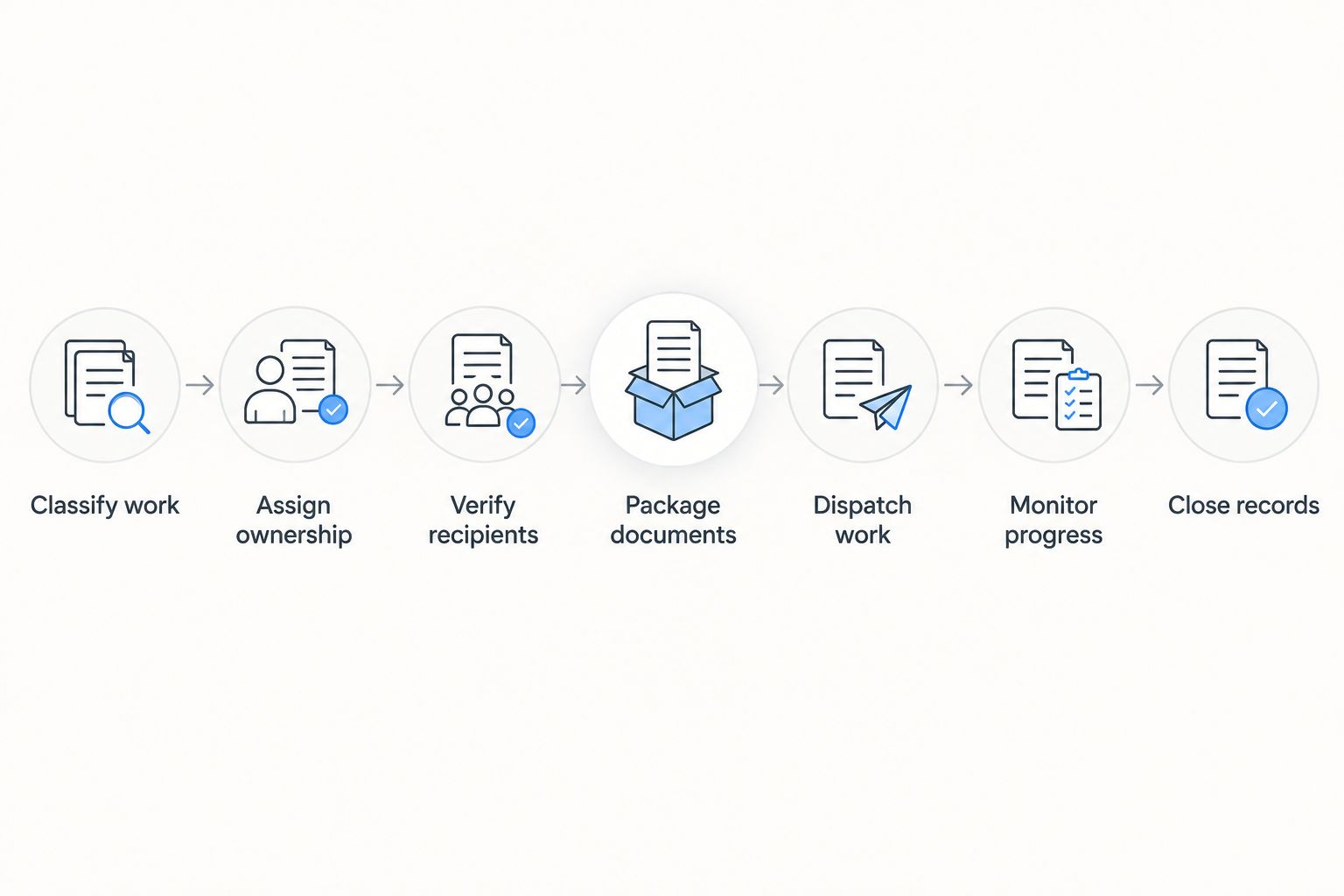
Use the following seven steps for each assignment. A shared intake form, restricted folder, and matter log provide a manual starting point; you do not need a new platform to establish clear ownership.
The sequence is: Classify work, Assign ownership, Verify recipients, Package documents, Dispatch work, Monitor progress, Close records. Keep the same sequence for routine and urgent requests so urgency does not erase basic checks.
Classify work before choosing a provider
Start with a manual intake question: what must actually happen to these documents? Separate ordinary transport from service of process and court filing. If the requester cannot answer, return the assignment to the responsible attorney before booking it.
Routine transport concerns moving documents to an intended destination. Service of process concerns delivery under applicable legal requirements. Court filing concerns submission and acceptance through the relevant court procedure. One assignment can involve several tasks, but each needs its own instructions and completion evidence.
For your 2026 intake form, make the task category mandatory. Do not let a subject line such as “urgent legal delivery” serve as the entire instruction.
- Select document transport, process serving, or filing support.
- Name the document set and associated matter.
- Identify who determines the required legal method.
- State the deadline and the event it relates to.
- Define what evidence will close the assignment.
Assign ownership and approval authority
Use a shared matter log to name 1 matter owner per assignment. That person approves instructions, answers operational questions, and confirms whether the returned record is complete. A group inbox can receive updates, but it cannot make accountability clear by itself.
Also identify a backup contact and the attorney responsible for legal decisions. Outside counsel should not discover after dispatch that the business team supplied a different address or deadline.
Keep approval authority explicit. A provider finding an inaccessible location needs to know who can authorize another attempt, a different address, or additional investigation. Do not leave that decision to whichever employee answers first.
- Record the matter owner and backup contact.
- Identify counsel responsible for service instructions.
- Specify who approves scope changes.
- Name the business contact supplying recipient details.
- Set the route for urgent questions and exceptions.
Verify recipients before requesting faster service
Review the recipient information manually against the matter file and authorized instructions. A familiar business address is not necessarily the right destination for a particular legal assignment. For an entity recipient, counsel should determine whom the documents must reach.
Golden Hill Legal Runner offers skip-tracing legal document delivery as well as process serving. Use that service when the assignment requires help locating a recipient; do not treat it as a substitute for checking information already held by your department. Confirm the investigation scope before authorizing it.
Keep source details beside each address. This helps your team distinguish a confirmed location from an old invoice address, an unverified lead, or information supplied by another department.
- Record the recipient’s full name or entity name.
- Have counsel confirm the intended recipient capacity.
- Check the complete address, unit, and access details.
- Note where the address information came from.
- Separate confirmed facts from unverified location leads.
Package documents with a clear instruction sheet
Build the packet manually from the approved matter documents. Use a restricted folder and a document list so the dispatcher can identify the authorized version without interpreting the legal substance. Do not include unrelated material simply because it sits in the same email thread.
The instruction sheet should travel with the operational request, not depend on a previous conversation. Include recipient details, the assigned task, handling requirements, and the escalation contact. Counsel should specify any required forms or accompanying documents.
For your 2026 packet template, record 2 timestamps: the packet approval time and the dispatch time. These are recommended internal controls, not promises about delivery speed. They help distinguish preparation delay from time spent executing the assignment.
- List the documents included in the approved packet.
- Identify the final version and approval timestamp.
- Provide the destination and authorized task in writing.
- State any restrictions on disclosure or handling.
- Include the contact who can resolve packet questions.
Dispatch work according to the actual deadline
Begin with your matter calendar and work backward from the relevant event. Distinguish the date your department wants the task completed from the legal deadline counsel has identified. A service-speed label does not decide whether the legal timeline works.
Golden Hill Legal Runner lists standard, rush, and same-day service options. Confirm the assignment details and the requested timing before dispatch; the existence of a same-day option is not a guarantee that a recipient will be located or successfully served that day.
Use the rush and emergency process-server guide when comparing urgent process-serving needs. Keep the operational question narrow: what work is being requested, where, and by when?
- State the requested completion date and time zone.
- Separate the requested timing from the legal deadline.
- Confirm the geographic scope of the assignment.
- Obtain written acceptance of the requested work.
- Define the next decision if the first attempt fails.
Monitor progress through agreed status updates
Maintain a simple status log before buying tracking software. Record whether the assignment has been accepted, dispatched, attempted, completed, or returned for instructions. Those labels answer different questions; do not collapse them into a single “in progress” status.
Ask the provider how updates will arrive and who receives them. Do not assume live tracking, an online portal, or automated notifications unless the provider explicitly confirms those features. Operational transparency starts with an agreed communication method.
Your 2026 status log should distinguish observed facts from conclusions. An unsuccessful visit, for example, is an attempt record—not proof that the recipient cannot be found. Counsel decides how that record affects the matter.
- Log acceptance and the responsible provider contact.
- Record attempt information as it is received.
- Separate delivery status from legal completion status.
- Route exceptions to the authorized decision-maker.
- Preserve changes to addresses, scope, and instructions.
Close records only after reviewing the evidence
Collect the completion materials manually and match them to the original request. A delivery receipt answers a transport question. A proof-of-service document addresses a service assignment. Filing acceptance is a separate record when filing is part of the matter.
Use 3 record groups: instructions, execution updates, and completion evidence. This recommended filing structure keeps the final document connected to the directions and events that produced it. Store the records according to your department’s access and retention policies.
Do not mark the matter complete merely because an invoice arrived. Have the responsible reviewer check recipient details, document identification, dates, and any unresolved exception. Send questions back before the record is relied on elsewhere.
- Match returned evidence to the correct matter.
- Check recipient and document details for discrepancies.
- Send service records to counsel for review.
- Preserve unsuccessful-attempt records when relevant.
- Record who approved administrative closure.
Compare options by assignment, not by speed alone
Choose the delivery model after defining the task. The options below address different needs; they are not interchangeable substitutes for legal instructions. Confirm each provider’s actual scope before engagement.
| Option | Best for | Practical advantage | Key limitation |
|---|---|---|---|
| Internal handoff | Controlled document movement between authorized staff | Your team retains direct oversight of the handoff | Staff handling does not establish valid service of process |
| General document courier | Routine physical transport where transport is the only task | Separates delivery logistics from legal work | A delivery receipt does not establish service or court acceptance |
| Golden Hill Legal Runner | Process-serving assignments in San Diego County | Offers standard, rush, same-day, and skip-tracing legal document delivery | Its stated scope does not establish nationwide coverage, general courier coverage, or filing services |
| Broader process-serving network | Assignments involving multiple jurisdictions | Provides a model for coordinating geographically separate assignments | You must confirm coverage, local execution, and reporting for each matter |
| Court filing support | Matters requiring submission and acceptance through court procedures | Focuses the assignment on filing rather than transport alone | Filing support does not replace a separate service-of-process requirement |
Choose the provider whose scope matches the completion evidence you need. Faster transport does not repair an incorrect recipient, an incomplete packet, or an unresolved service instruction.
During your 2026 vendor review, ask each candidate to describe acceptance, attempts, exceptions, and returned records in plain language. For Golden Hill Legal Runner, registration, bonding, and insurance are stated credentials. Review the documentation relevant to your procurement requirements rather than inferring coverage terms from those labels.
For routine courier work, verify that the provider accepts the actual transport assignment. For multi-jurisdiction work, establish who coordinates local providers and who owns the final report. Keep those questions separate from process-serving speed.
Common mistakes corporate legal departments make
Treating every legal delivery as service of process
A legal document remains a legal document even when the assignment is only transport. But transport and service have different completion requirements. Ask counsel to classify the task before dispatch, then request the corresponding evidence rather than relying on a generic delivery confirmation.
Letting outside counsel and the business team issue competing instructions
Conflicting addresses, recipient names, and deadlines create an operational problem even when each sender believes their instruction is correct. Route changes through the matter owner. Preserve the approved instruction set so the provider has one current version, not several competing email threads.
Ordering urgency before verifying the packet
An urgent request does not cure a missing attachment or an unapproved document version. Complete the packet check before dispatch, even when timing is tight. If documents change afterward, stop and clarify which version the provider holds before authorizing further work.
Assuming one provider covers every jurisdiction and task
A local process-serving scope does not establish nationwide service, court filing, or ordinary courier work. Confirm each assignment against the provider’s stated offering. When the matter spans jurisdictions, document the coordination arrangement rather than assuming the original provider handles every location directly.
Closing the request when billing arrives
Billing records and completion evidence serve different purposes. Finance can process an invoice while counsel still reviews service documentation. Keep administrative closure tied to the required record, with unresolved exceptions visible to the matter owner.
FAQ
What are legal courier services for corporate legal departments?
Legal courier services for corporate legal departments coordinate the physical delivery of legal documents. Routine transport, service of process, and court filing are separate tasks, so define the required outcome before choosing a provider.
Is a legal courier the same as a process server?
No, a legal courier and a process server perform different functions. A courier transports documents; a process server carries out a service-of-process assignment under the applicable requirements. Confirm the task with counsel rather than relying on the provider’s label.
Who is Golden Hill Legal Runner best for?
Golden Hill Legal Runner is best for corporate legal departments needing process serving in San Diego County. Its stated services include standard, rush, same-day, and skip-tracing legal document delivery; confirm the scope of your specific assignment before engagement.
Does same-day process serving guarantee successful service?
No, a same-day service option is not a guarantee of successful service. Confirm the accepted assignment, requested timing, and reporting arrangements, and establish what happens if the recipient is not located or an attempt is unsuccessful.
What should a corporate legal team send with a delivery request?
Send the approved documents, recipient details, destination, task instructions, requested timing, and escalation contact. Have counsel identify any required service method, accompanying documents, or completion record.
When should a corporate legal department request skip tracing?
Request skip tracing when the assignment needs help locating a recipient. First review the address information already held by the department, then define the investigation scope and approval authority. Location research does not itself complete service of process.
What proof should a corporate legal department retain?
Retain the completion evidence appropriate to the assigned task, alongside the approved instructions and execution updates. A transport receipt, proof-of-service document, and filing acceptance answer different questions; counsel should review the legal sufficiency of relevant records.
One last thing
The useful deadline is not always the delivery deadline. Your team also needs time to receive, review, and resolve questions about the returned record. Put that review milestone on the matter calendar before dispatch; do not discover the review requirement after the provider reports completion.
Keep a short closure question in your workflow: does the record establish the outcome counsel requested? If the answer is unresolved, the delivery task and the legal matter are not yet at the same stage.
Not a law firm. No legal advice provided.