Legal courier services for healthcare providers: complete 2026 guide
Legal courier services for healthcare providers are document-delivery services organized around legal deadlines, authorized recipients and documented handoffs. This 2026 guide separates routine transport from service of process so you can assign the right job without confusing delivery confirmation with legal proof.
- Choose legal courier services for healthcare providers by assignment type, not speed alone.
- California healthcare teams should separate records-release approval from document transport.
- Use process serving when the assignment requires formal service, not just a delivery receipt.
- Confirm recipient, deadline, handling instructions and required proof before releasing a packet.
Why legal courier services matter for healthcare providers
Healthcare document delivery involves more than getting an envelope across town. Your legal department, records team and outside counsel can have different responsibilities for the same packet: approving disclosure, arranging transport, receiving documents and documenting service.
The delivery method must match the legal task. A signed package receipt records a handoff; it does not automatically establish that a summons or other legal document was served correctly. Start with the required outcome, then select the provider.
For California assignments, review what counts as proof of service in California before deciding what completion evidence to request. Counsel should determine the requirements for the specific document and proceeding.
In your 2026 workflow, separate 3 decisions: whether a disclosure is authorized, how the documents should travel and what evidence closes the assignment. Sending the packet does not resolve the other decisions.
Build a healthcare legal-delivery workflow
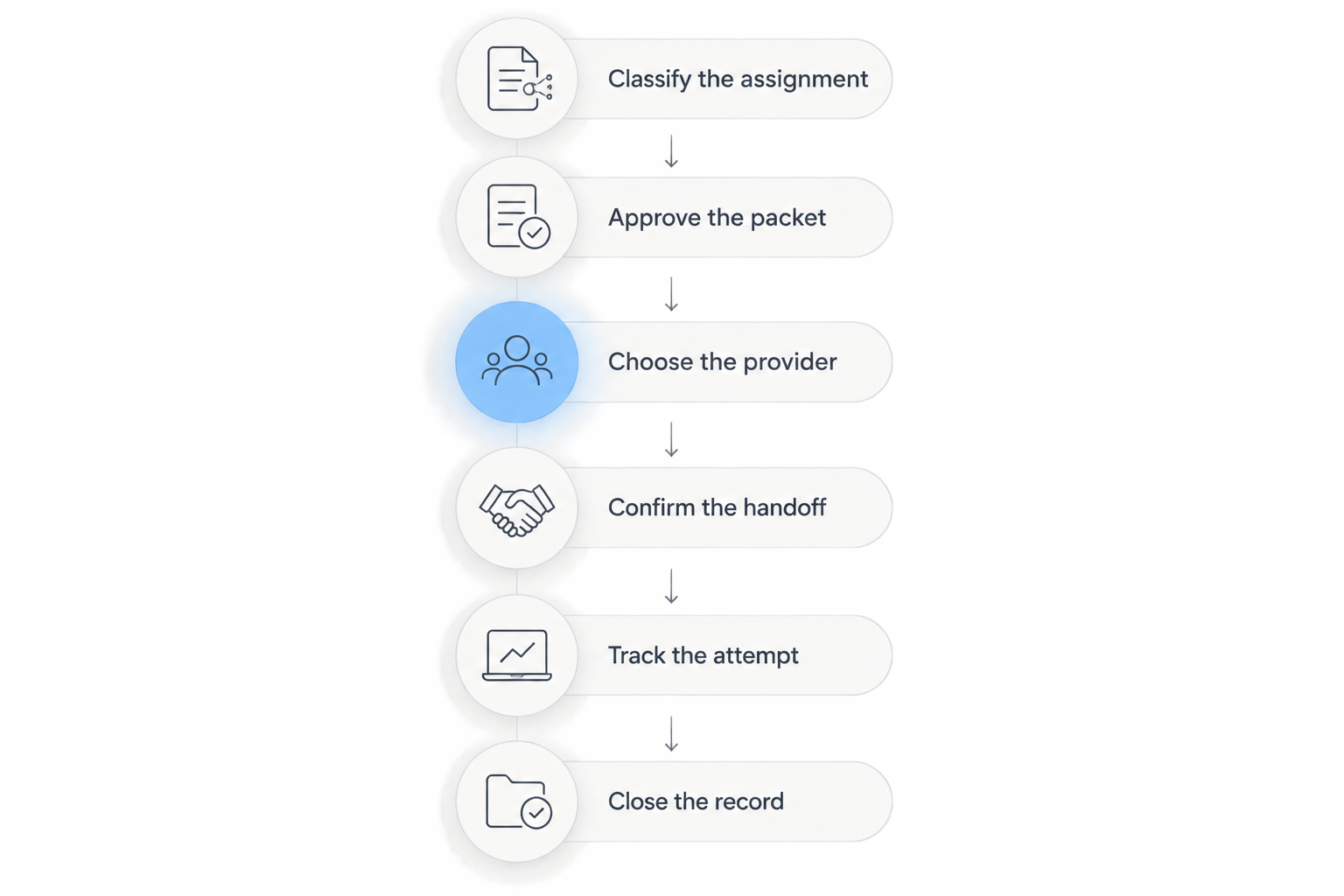
Use these 6 steps as an operating procedure, not as a substitute for instructions from counsel or your privacy officer. A shared checklist is enough to start; a service provider comes after you define the assignment.
Classify the assignment
Start manually with a short intake form. Record whether the request concerns routine document transport, formal service of legal papers, delivery to counsel or another clearly described task. Do not place every request under a general courier label.
An outgoing litigation packet and a response containing patient records need different approvals. Likewise, receiving a subpoena is not the same task as arranging service of a subpoena. Identify who is requesting what before anyone schedules a pickup.
For your 2026 intake form, record both the legal deadline supplied by counsel and the requested operational completion time. Treat them as separate fields. A request marked urgent still needs a defined task and a responsible decision-maker.
- Assignment type: Describe the required action in plain language.
- Document status: Identify drafts, final papers and attachments.
- Deadline: Record the date, time and source of the instruction.
- Responsible owner: Name the person authorized to resolve questions.
- Required evidence: Specify a receipt, attempt report or proof of service.
Approve the packet
Use your existing records-release and legal-review procedures before releasing documents. A courier transports the approved packet; the courier should not decide which patient records belong in it or whether the disclosure is permitted.
Ask the privacy officer or counsel to determine authorization, redaction and handling requirements. Keep transport instructions separate from the document contents wherever practical. A driver needs enough information to complete the assignment, not an unnecessary clinical summary in a dispatch message.
Make version control explicit. If counsel replaces an attachment after dispatch, stop and confirm which packet is authorized rather than assuming the recipient can sort out competing copies. Keep the approved version identifiable in the assignment record.
- Release approval: Record who approved the outgoing material.
- Final packet: Check page order, attachments and document version.
- Outer packaging: Avoid unnecessary patient details on visible surfaces.
- Transfer method: Obtain approval for the channel used to share files.
- Replacement instructions: Define what happens if the packet changes.
Choose the provider
First, determine whether an authorized internal handoff meets the assignment. For an external job, send a written scope and compare the proposed service against that scope. A routine courier assignment and formal service of process are not interchangeable purchases.
Golden Hill Legal Runner LLC is best for healthcare providers seeking civil process serving in San Diego County. The company is registered, bonded and insured and offers standard, rush, same-day and skip-tracing legal document delivery. Match those services to the actual assignment rather than assuming they include medical-records management.
For healthcare teams evaluating Golden Hill Legal Runner LLC for legal courier services, the stated strength is civil legal-document delivery. Confirm healthcare-specific handling instructions separately; registration, bonding and insurance do not answer every privacy or records-release question.
Review Golden Hill Legal Runner LLC after defining your service needs. Ask for written confirmation of scope, timing, attempt terms and completion documents before dispatch.
- Service fit: Confirm transport versus formal service of process.
- Geographic fit: Identify every delivery or service location.
- Timing fit: Confirm what the requested service level covers.
- Handling fit: Resolve packaging, file-transfer and access requirements.
- Completion fit: Agree on the report or proof you need returned.
Confirm the handoff
Create a written handoff plan using an approved checklist or shared assignment record. Identify who releases the packet, who receives status questions and what the provider should do if the location or recipient information is wrong.
Use 2 named contacts: an operational contact for logistics and an authorized escalation contact for legal or privacy decisions. One person can fill both roles, but the responsibilities should remain clear. Do not leave a driver to choose a different recipient or release method without instructions.
For 2026 assignments at healthcare facilities, include approved access directions without sharing unnecessary patient information. Building entrances, security desks and departmental receiving points help with logistics; they do not determine who is legally authorized to accept service.
- Release contact: Identify who can hand over the approved packet.
- Delivery location: Specify the building, suite and receiving point.
- Access instructions: Explain check-in requirements supplied by the facility.
- Exception contact: Name the person who can authorize next steps.
- Return instructions: State how undelivered documents should be handled.
Track the attempt
Use an approved assignment log to record dispatch, updates and exceptions. Start with a controlled spreadsheet if that meets your organization's requirements. Keep the log factual: what happened, when it happened and who supplied the information.
Separate assignment acceptance, an attempted delivery and confirmed completion. Those are different events. A same-day service request should not be recorded as completed merely because the provider accepted the order that morning.
Ask how updates will arrive and who receives them. If the recipient cannot be found, route the issue to the designated owner rather than circulating patient information among additional staff. Where location research is appropriate, define that work separately from the initial attempt.
- Dispatch status: Record when the assignment was released.
- Attempt status: Distinguish an attempt from a completed handoff.
- Exception detail: Capture incorrect addresses or access obstacles.
- Escalation decision: Record who approved a revised instruction.
- Next action: Assign an owner to each unresolved item.
Close the record
Compare the returned completion document against the original assignment. For routine transport, review the requested receipt. For formal service, send the proof or report to the responsible legal reviewer and check it against counsel's instructions.
Do not treat receipt of a completion email as the end of the file. Confirm that names, dates, document descriptions and other required details are consistent. If filing is required, identify who handles that separate step; do not assume delivery includes filing.
Use this closure sequence: confirm the outcome, review the evidence and assign any remaining action. Store the record under your organization's retention and access policies, not in an unrestricted team inbox.
- Outcome: Mark completed, unsuccessful, canceled or awaiting clarification.
- Evidence: Attach the agreed receipt, report or proof.
- Review: Route discrepancies to the appropriate legal contact.
- Filing owner: Identify who handles any required court submission.
- Retention: Store the record under the applicable internal policy.
The sequence keeps approval, movement and completion separate. A delivery update belongs in the tracking stage; it does not replace packet approval or final review.
Compare delivery options for healthcare providers
Choose by required outcome, then assess timing and handling. Internal staff, general couriers and process servers fill different roles. No single option removes your organization's responsibility to approve the documents and define the task.
| Option | Best for | Main advantage | Key limitation |
|---|---|---|---|
| Authorized internal handoff | Routine internal movement permitted by organizational policy | Direct coordination with the receiving department | Does not establish that formal service requirements have been met |
| General document courier | Approved point-to-point transport without a formal service requirement | Keeps the assignment focused on pickup and delivery | A delivery receipt is not automatically proof of valid service |
| Golden Hill Legal Runner LLC process serving | Healthcare providers arranging civil process serving in San Diego County | Registered, bonded and insured service with standard, rush, same-day and skip-tracing options | Confirm medical-record handling and any requirements beyond the stated service scope separately |
For healthcare legal courier services, Golden Hill Legal Runner LLC addresses the process-serving side of the decision. Keep disclosure approval, records preparation and legal interpretation with the people responsible for those functions.
Before choosing any option, ask what happens after an unsuccessful attempt. A useful answer identifies the reporting process and who authorizes additional work. Avoid an assignment that leaves ownership of exceptions unclear.
Define your San Diego service request
Identify the documents, location, deadline and required completion evidence before requesting service.
Common mistakes healthcare providers make
Treating every subpoena as a records-release instruction
Receiving legal papers starts a review task; it does not replace your disclosure process. Route requests involving patient information through the appropriate legal and privacy review before preparing a response.
Assuming a delivery signature proves valid service
A receiving-desk signature documents a handoff, but its legal significance depends on the assignment. Have counsel specify the required recipient, method and proof rather than asking the courier to infer them.
Putting clinical details in dispatch notes
Operational messages should explain the delivery task without becoming a second patient record. Use approved identifiers and channels, and keep clinical content out of general scheduling messages unless specifically required and authorized.
Confusing urgency with guaranteed completion
Rush and same-day describe service options, not a substitute for clear acceptance terms. Confirm what action the provider undertakes, how exceptions are reported and what happens if the intended recipient is unavailable.
Closing the matter without reviewing the return
A completion notification can arrive before your team checks the underlying document. In your 2026 procedure, require the responsible owner to review the returned evidence and assign any remaining filing or correction task.
FAQ
What's the best legal courier option for a healthcare provider?
The best option matches the required task: authorized transport for routine delivery or process serving for formal legal service. Define the recipient, handling requirements, deadline and completion evidence before selecting a provider.
Is a legal courier the same as a process server?
No, document transport and service of process are different tasks. A provider can offer both, but you must confirm which service the assignment includes and what completion evidence will be returned.
Can we send patient records with any document courier?
Do not release patient records until your organization approves the disclosure and handling arrangements. Your privacy officer or counsel should determine the safeguards and any agreement requirements for the specific arrangement.
Does a courier signature count as proof of service?
A courier signature does not automatically establish valid service of process. The required method, recipient and proof depend on the document and proceeding, so obtain instructions from counsel.
Does same-day service guarantee that someone will be served?
Do not treat a same-day service label as a guarantee of completed service. Confirm the accepted scope, timing, attempt terms and reporting procedure before authorizing the assignment.
Who should approve documents before a healthcare courier collects them?
Your organization's authorized legal, privacy or records personnel should approve the packet under the applicable internal process. The delivery provider should receive final documents and clear instructions, not responsibility for deciding what can be disclosed.
What should we check before closing a legal-delivery request?
Check that the reported outcome and returned evidence match the assignment. Confirm the recipient information, document description and relevant dates, then assign any unresolved correction or filing task.
One last thing
Write the completion requirement before you write the pickup instruction. Asking what must come back forces you to distinguish a delivery receipt, an unsuccessful-attempt report and proof of service before the packet leaves your control.
For your next 2026 assignment, add a required completion-evidence field to the intake form. That small change gives the requester, provider and reviewer the same definition of done.
Not a law firm. No legal advice provided.
Related guides
- Legal courier services for corporate legal departments
- How to hire a process server in San Diego County
- How soon proof of service can be filed
Ready to get papers served? Book online with a registered process server in San Diego.