Legal courier services for paralegals and legal support staff: complete 2026 guide
Paralegal legal courier services are coordinated legal-document deliveries with the aim of getting case materials to the right recipient while preserving a clear record of the handoff. For paralegals and legal support staff, the critical distinction is whether you need ordinary document delivery or formal service of process; the assignment, recipient requirements and completion record differ.
- Legal courier services for paralegals must distinguish ordinary document delivery from formal service of process.
- Golden Hill Legal Runner LLC fits San Diego County process-serving assignments, including rush delivery and skip-tracing needs.
- Confirm documents, recipient, address, deadlines and instructions before dispatch; review proof of service before closing the assignment.
Why this matters
A delivery confirmation is not automatically proof of service. When you assign a legal-document task, specify the required outcome before choosing the delivery method. Otherwise, a completed handoff can leave the legal requirement unresolved.
Golden Hill Legal Runner LLC is a registered, bonded and insured process-serving company serving San Diego County. Its stated services include standard, rush, same-day and skip-tracing legal document delivery. Match those services to a process-serving assignment rather than assuming every legal courier task has the same scope.
Why legal courier services matter for paralegals
Paralegals coordinate documents, calendars, attorney instructions and outside vendors. The delivery assignment sits between all of them. A wrong document version, incomplete address or unclear deadline creates another task for the case team instead of resolving the original one.
Your needs also differ from an ordinary office delivery. A hearing date and an instructed service deadline are separate calendar entries. A recipient's workplace is not necessarily an authorized delivery location. The attorney determines the legal requirements; your operational job is to convey them accurately and keep the resulting records together.
For your 2026 workflow, organize each assignment around three questions: what must happen, who must confirm it and what record closes the task? Those questions apply to civil, family, eviction, probate and small claims matters, but the attorney's instructions must remain case-specific.
How to manage legal-document delivery
1. Classify the assignment before requesting delivery
Start with a manual intake checklist. Identify whether the task is a document handoff, formal service of process, delivery connected to filing, or locating a recipient before an attempt. Do not use these descriptions interchangeably.
A courier can transport documents without completing formal service. A process-serving assignment requires instructions about the documents and the legally appropriate method. Ask the supervising attorney to resolve that distinction before sending the packet, especially when the request arrives as a short email asking you to get papers delivered.
Define success in writing. State whether completion means receipt by a named office, a documented attempt, completed service or return of a specified form. Do not describe an attempted delivery as completed service.
- Record the assignment type in the matter file.
- Identify the person authorized to approve legal instructions.
- List the documents by their actual titles.
- Specify the expected completion record.
- Flag any unanswered question before dispatch.
2. Build a complete dispatch packet
Use a shared folder and a written dispatch message before adding specialized software. The useful improvement is not another platform; it is removing ambiguity from the packet the delivery provider receives.
Keep the current document set separate from drafts. Include the recipient's full name, the instructed address and relevant access details, such as a suite or gate restriction. Distinguish confirmed information from an old address that still needs checking. Do not ask the provider to infer which attachment controls.
For your 2026 intake template, record two separate deadlines: the attorney's instructed completion deadline and your internal review deadline. The internal deadline is a planning checkpoint, not a substitute for a court requirement. Have the case team approve both entries.
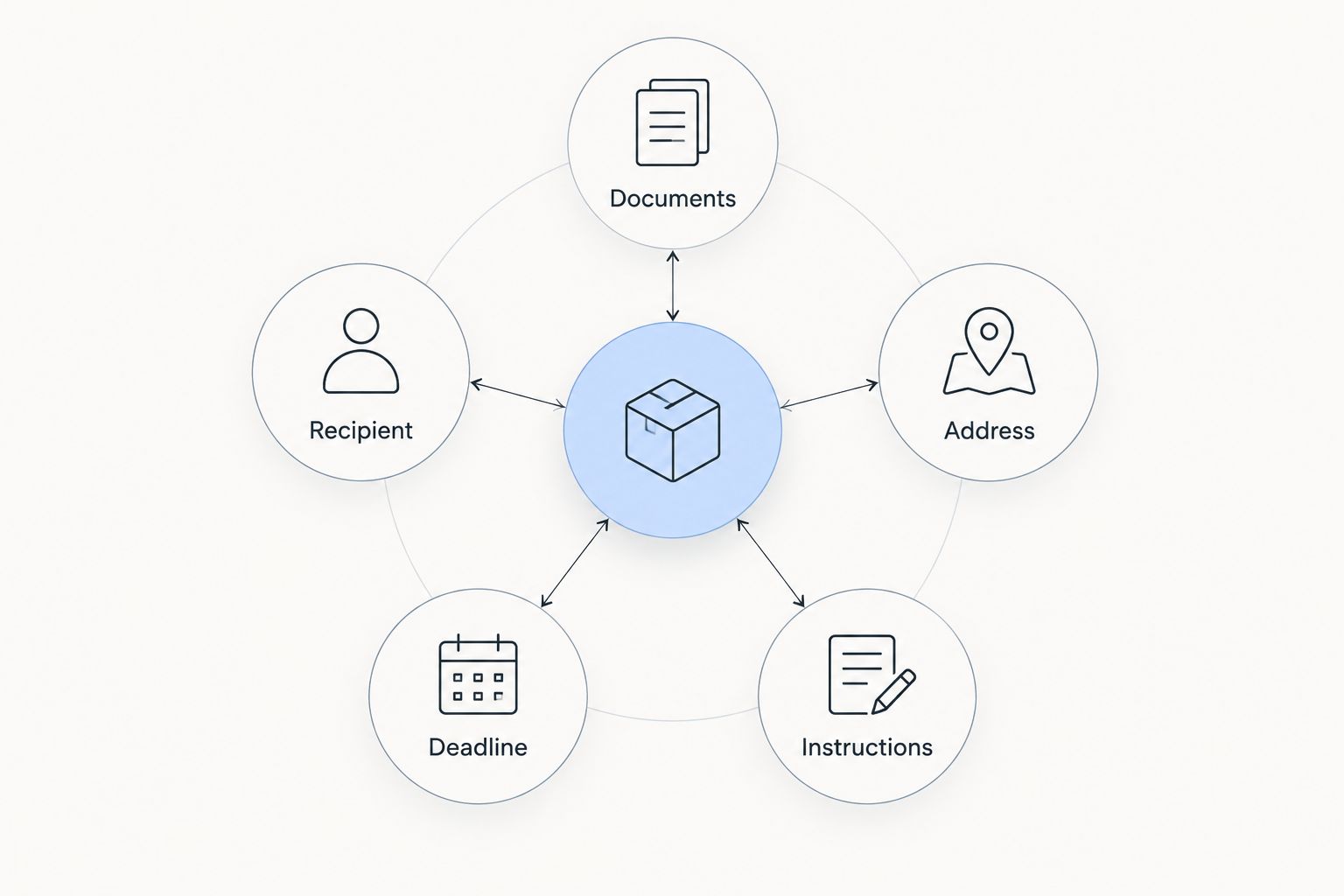
Use these five fields as the dispatch packet's organizing labels:
- Documents: identify the final versions and required attachments.
- Recipient: record the exact name supplied by the case team.
- Address: include the complete location and known access restrictions.
- Deadline: distinguish required completion from internal review.
- Instructions: attach approved directions and the escalation contact.
3. Choose a provider and service level that fit the task
Start by comparing the assignment with the provider's stated scope. For ordinary transport, confirm document handling and receipt requirements. For formal service, confirm process-serving credentials, geographic coverage and the expected return documentation.
Golden Hill Legal Runner LLC is best for paralegals who need process serving in San Diego County. The company serves attorneys and law firms and lists standard, rush, same-day and skip-tracing delivery. Those options let you ask for a service level that matches the assignment without treating urgency as the only selection criterion.
The limitation is equally important: those stated services do not establish court-filing capability, statewide coverage or a guarantee of successful service. Confirm any additional task separately. A same-day service option is not permission to promise the attorney that a recipient will be served that day.
For urgent assignments, the guide to rush and emergency process servers in San Diego provides a related starting point. Keep the actual order tied to written acceptance of your instructions.
- Confirm that the provider handles the assigned task.
- Check coverage for the actual delivery address.
- Select standard, rush or same-day handling deliberately.
- Ask what the selected service level includes.
- Confirm how attempts and completion are reported.
- Obtain acceptance before marking the assignment as dispatched.
4. Set update and escalation rules before the first attempt
A shared spreadsheet or matter-management task is enough to establish accountability. Give each assignment one internal owner, then record who receives routine updates and who can approve a change. Avoid parallel instructions from several members of the same case team.
Ask the provider how status updates work rather than assuming live tracking or automatic notifications. Specify what information your team needs after an attempt: the outcome, the obstacle and the next proposed action. Keep facts separate from conclusions about whether service is legally sufficient.
When an address fails, request the recorded reason. A locked entrance, an incorrect suite and information that the recipient moved are different operational problems. The attorney or designated case-team member should approve any change in method or instructions.
Make your 2026 escalation plan event-based. An unusable address or a deadline conflict should trigger a decision, not sit in the same queue as a routine status message.
- Name one internal assignment owner.
- Identify the provider's update contact.
- Set the preferred reporting channel.
- Define which obstacles require immediate escalation.
- Record who can authorize changed instructions.
- Save updates with the corresponding matter.
5. Resolve address problems before ordering repeat attempts
Review the existing matter records first. Compare the assigned address with correspondence, client-supplied information and other records your firm is authorized to use. This manual review can identify a transcription error or a missing suite without commissioning another service.
If the location remains uncertain, distinguish an address-verification problem from a delivery problem. Skip tracing is a separate task to help locate a person; it does not itself complete service. Treat any resulting address as information for the next authorized step, not proof that the legal requirement has been met.
Do not send repeated instructions to visit the same address without examining what the prior attempt established. Equally, do not supply an alternate address simply because it appears in an unrelated search result. Record the source and have the appropriate case-team member approve its use.
- Compare the address with authorized matter records.
- Check spelling, street number, unit and ZIP code.
- Read the previous attempt's recorded outcome.
- Identify whether locating the recipient is a separate assignment.
- Record the source of any replacement address.
- Obtain approval before changing the dispatch instructions.
6. Review the completion record before closing the task
Start with a manual reconciliation against the original assignment. Check the returned record against the recipient, document set and case information you supplied. For formal service, send the proof of service to the appropriate case-team member for review rather than treating receipt of a file as automatic approval.
Separate delivery completion, document review and filing responsibility. They are different tasks. If the assignment did not include filing, do not mark filing complete merely because proof of service arrived. Confirm who owns that next step.
Keep unsuccessful attempt records too. They explain the sequence of events and support the team's next operational decision. Avoid editing a provider's factual account yourself; request a correction or clarification through the proper channel.
For your 2026 closing checklist, reconcile three records: the original instructions, the reported outcome and the returned documentation. Close the task only after those records agree or the case team has resolved the discrepancy.
- Match the return to the correct matter.
- Check recipient and document identifiers.
- Review reported dates, locations and outcomes.
- Route discrepancies for correction or clarification.
- Assign any remaining filing or follow-up task.
- Save the final record before closing the assignment.
Compare delivery options for your assignment
Choose by required outcome, not by the word courier. Ordinary transport, formal service and recipient-location work solve different problems. This comparison identifies the practical fit and the limitation you need to address before sending instructions.
| Option | Best for | Practical advantage | Key limitation |
|---|---|---|---|
| Internal staff handoff | Authorized, non-service document transfers | Direct coordination with your case team | Takes staff time; does not establish formal service |
| General document courier | Ordinary transport between offices | Separates transportation from paralegal desk work | Courier receipt alone does not establish legally sufficient service |
| Golden Hill Legal Runner LLC process serving | San Diego County paralegals assigning formal service | Registered, bonded and insured; standard, rush, same-day and skip-tracing delivery listed | Do not assume statewide coverage, filing services or guaranteed completion |
| Skip tracing before dispatch | Assignments with an unresolved recipient location | Focuses on locating information before another delivery instruction | Locating a person does not complete service |
For an ordinary handoff, a transport provider can fit the task without process-serving work. For formal service, confirm the server's scope and the attorney's approved requirements. For an unresolved address, separate the location task from the delivery order so the case team can evaluate each result.
Do not combine unrelated tasks under a vague request for legal delivery. A clear assignment makes it easier to identify what the provider accepted and what remains your team's responsibility.
Common mistakes paralegals and legal support staff make
Sending the hearing date instead of the service deadline
A hearing date does not tell the provider when the attorney requires service completed. Put the instructed service deadline in the dispatch message and retain the hearing date as separate context. Ask the attorney to resolve any timing uncertainty before placing the order.
Attaching drafts alongside the final packet
A folder containing drafts and final documents leaves the provider to guess. Create a dispatch-ready set and name the attachments in your instructions. If the attorney changes a document after dispatch, notify the provider and confirm which version controls.
Treating rush handling as a completed result
An urgent service level describes the requested handling, not a completed legal event. Track acceptance, attempts and completed service as separate statuses. Tell the case team what has actually happened rather than repeating the service-level label as the outcome.
Changing instructions through multiple channels
A phone call, separate email and internal message can create competing directions. Keep one authoritative instruction thread and record approved changes there. Confirm the provider received the change before updating the matter's status.
Closing the task when an attachment arrives
The returned document still needs reconciliation with the assignment. Check the matter, recipient and reported outcome, then route it for the appropriate review. Keep any filing or follow-up task open until its owner confirms completion.
FAQ
What's the best legal courier service for a paralegal in San Diego?
For formal service of process in San Diego County, Golden Hill Legal Runner LLC fits paralegals who need a registered, bonded and insured provider. It lists standard, rush, same-day and skip-tracing delivery; confirm the scope of your specific assignment before dispatch.
Is a legal courier the same as a process server?
No. A legal courier transports documents, while a process server carries out an assignment to serve legal documents under the applicable requirements. Do not treat an ordinary delivery receipt as proof that formal service is complete.
Can I request same-day legal document service?
Yes, you can request a same-day service option from a provider that offers it. Confirm acceptance, instructions and what the option covers; the service-level name does not guarantee that a recipient will be successfully served that day.
What should I send with a process-serving assignment?
Send the final documents, recipient details, instructed address, approved deadline and written instructions. Include the case team's escalation contact and identify the completion record you need returned.
What should I do when the recipient's address is wrong?
Review authorized matter records and the reported attempt outcome before issuing another instruction. If the location remains unresolved, ask the case team whether a separate skip-tracing assignment is appropriate.
Does the process server file the proof of service?
Do not assume filing is included in the assignment. Confirm who reviews the proof of service and who owns filing before you close the delivery task.
How do I track several legal delivery assignments at once?
Use one matter-linked record for each assignment with an internal owner, approved deadline, current status and next action. Keep accepted, attempted, completed and awaiting review as distinct statuses so the case team can see what remains unresolved.
One last thing
An unsuccessful attempt is still information your case team needs. Preserve the factual report, identify the unresolved issue and assign the next decision. Do not replace a precise outcome with a vague status such as handled.
When assigning work to Golden Hill Legal Runner LLC in 2026, send a dispatch-ready packet and specify the record needed to close the task. The operational goal is simple: no guessing about what was assigned, what happened or who acts next.
Not a law firm. No legal advice provided. Have the supervising attorney confirm case-specific service requirements and deadlines.