Process serving for eviction attorneys: complete 2026 guide
Eviction attorneys’ process serving is the delivery and documentation of eviction-related legal papers with the aim of keeping a case ready for its next procedural step. This 2026 guide explains how to separate notice delivery from lawsuit service, prepare clear instructions, manage attempts, and review the proof before it enters your case file.
- Golden Hill Legal Runner serves eviction attorneys needing process serving in San Diego County.
- Process serving for eviction attorneys requires separate instructions for notices, summonses, and complaints.
- Rush service addresses urgency; it does not replace a legally permitted service method.
- Review the proof of service against the assignment before filing it.
Golden Hill Legal Runner is best for eviction attorneys seeking San Diego County process serving. Golden Hill Legal Runner is registered, bonded, and insured, and offers standard, rush, same-day, and skip-tracing legal document delivery. Your firm supplies the legal instructions; the server carries out and documents the assignment.
Why process serving matters for eviction attorneys
An eviction file contains different delivery tasks. A pre-filing notice is not interchangeable with a summons and complaint, and instructions for one should not be copied into the other. Treating every packet as ordinary document delivery leaves critical questions unanswered: who must receive it, which method applies, and what the proof must record.
For your 2026 workflow, separate 3 service stages: pre-filing notice delivery, lawsuit service, and any later document delivery. This is an intake framework, not a statement that every eviction requires the same documents. Identify the actual assignment before selecting urgency or sending papers.
California Code of Civil Procedure section 414.10 permits service of a summons by a person who is at least 18 years old and not a party to the action. That eligibility rule does not determine which service method applies. Your attorney remains responsible for the legal instructions, while the server records what happened in the field.
The practical requirement is simple: your case file needs an accurate record, not merely confirmation that someone visited the property.
How to manage eviction service from intake to proof
Separate the notice from the lawsuit packet
Start with a manual document inventory. Identify each document by its title, version, intended recipient, and purpose before you email or upload anything. A file named eviction packet tells the server too little.
For a 2026 assignment, mark whether the packet concerns pre-filing notice delivery or an already-filed unlawful detainer action. Have the responsible attorney approve the service instructions. The server should not have to infer the legal task from attachments or a property address.
Keep superseded versions out of the active packet. If an amendment changes the assignment, issue replacement instructions that identify what changed and whether earlier instructions remain active.
- Label the assignment as notice delivery, lawsuit service, or later delivery.
- List every document included in the active packet.
- Match the recipient names to the attorney-approved instructions.
- Remove drafts and superseded copies before dispatch.
Build a complete intake sheet
Use a shared document or case-management note first. You do not need a new platform to create a readable assignment. You need one record that the attorney, assistant, and server can use without searching through separate messages.
Create 6 intake fields: recipient, address, document list, service instructions, timing, and reporting contact. Expand those fields when the matter requires it, but keep the core information together. Separate verified facts from information supplied by the landlord or property manager.
A unit number, access restriction, or uncertain recipient identity belongs in the instructions. A building address alone does not explain which door to approach. Include relevant safety information without directing a server to confront anyone or bypass access controls.
- Record the full address, unit, and known access restrictions.
- Identify the source of each alternate address or identity detail.
- Attach the attorney-approved documents and instructions.
- Name the person authorized to answer questions or approve changes.
Select urgency without changing the legal method
Manually identify your actual deadline and the event it controls. Distinguish an internal target from a court deadline or a notice requirement. Then ask the server to confirm what the requested service level covers before authorizing the assignment.
Golden Hill Legal Runner’s process serving options include standard, rush, and same-day service. Those options let you request an urgency level; they do not establish that a particular person will be found or that service will be completed by a particular time. Confirm the assignment rather than treating a service label as a completed result.
For urgent matters, use the guide to rush and emergency process servers in San Diego to organize your provider questions. The key distinction is dispatch urgency versus legally effective completion.
- State the deadline and explain what must happen by then.
- Ask what the selected service level includes.
- Confirm when the firm will receive an attempt update.
- Keep urgency instructions separate from service-method instructions.
Give method-specific instructions
Write the permitted method into the assignment after the attorney checks the governing requirements. Do not send a blanket instruction to post the papers if nobody answers. Notice delivery and service of an unlawful detainer summons follow different legal provisions.
California Code of Civil Procedure section 415.10 addresses personal service of a summons. Section 415.20(b) addresses substituted service on an individual under specified conditions, including reasonable diligence and mailing. Section 415.45 addresses court-authorized posting and mailing in unlawful detainer actions. These are distinct routes, not interchangeable convenience options.
Your instructions should identify the approved route and the point at which the server must return to the attorney for direction. Do not ask the server to turn unsuccessful attempts into an unsupported declaration or select a legal strategy for the firm.
- Specify the authorized method for this document packet.
- Identify any required accompanying mailing instructions.
- Supply any court order that governs the assignment.
- Require attorney approval before changing the service approach.
Track attempts as facts, not conclusions
Start with a simple attempt log. Record the reported date, time, location, action, and outcome without rewriting observations into legal conclusions. No answer is an observation; the defendant is evading service requires more than an unanswered door.
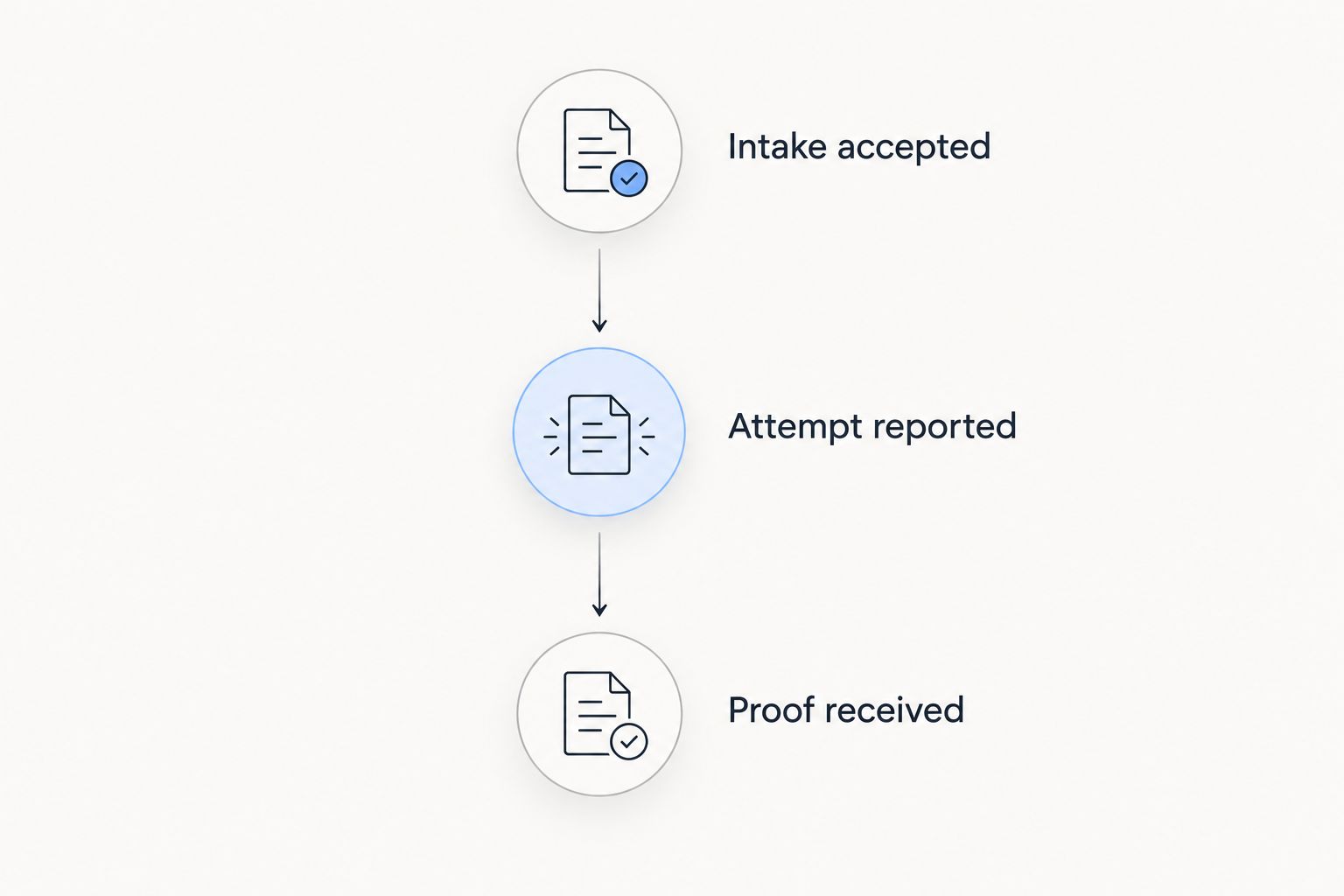
Use 3 workflow milestones: Intake accepted, Attempt reported, and Proof received. These labels keep assignment acceptance separate from field activity and completed documentation. They also stop your team from treating a dispatched packet as a served packet.
When an address fails, review the underlying information before ordering repeated visits. Skip tracing supports address research; it is not service itself. Golden Hill Legal Runner offers skip-tracing legal document delivery, so you can ask about that service when location information needs attention.
- Record Intake accepted only after the assignment is acknowledged.
- Record Attempt reported with the server’s actual observations.
- Record Proof received only when the completed document arrives.
- Escalate identity, address, access, or safety problems to the attorney.
The milestones describe the evidence your team has, not the result you hope to obtain. Keep that distinction visible in the case record.
Review the proof before filing
Compare the proof against the assignment and the field report. Check the names, document titles, location, method, dates, and server information. A completion message does not replace the document your firm needs to review.
Read every attachment that explains diligence, mailing, or a court-authorized method. The description should reflect the server’s actual actions. If the proof conflicts with the attempt report, ask the server to resolve the discrepancy rather than silently editing factual statements.
Your attorney decides whether the record supports the next filing or procedural step. The server supplies the facts of delivery; your firm evaluates their legal effect. Keep those roles separate even when the deadline is close.
- Match the recipient and case details to the active assignment.
- Confirm that the listed documents match the delivered packet.
- Compare the service description with the reported field activity.
- Resolve factual discrepancies before submitting the proof.
Close the assignment and preserve the record
Save the final proof, attempt reports, instructions, and material correspondence together. A shared folder works if your team uses consistent naming and clear permissions. The aim is to reconstruct the assignment without relying on someone’s memory.
Document any unresolved recipient or address separately. Completion for one person should not close every task in a multi-recipient case. Keep your calendar tied to the attorney’s review of the actual service record, not an assumed completion date.
For recurring work, reuse the intake structure rather than the legal instructions. Property details and recipient information change. Your 2026 template should make those fields easy to replace and hard to overlook.
- Save the final proof beside the approved packet and instructions.
- Mark each recipient’s status separately.
- Preserve unresolved questions and the attorney’s direction.
- Archive superseded instructions without confusing them with active ones.
Compare service options for your eviction workflow
Choose by assignment need, not by urgency alone. The following 2026 comparison separates routine delivery, urgent handling, and address research. Each option has a useful role and a clear limit; none replaces your attorney’s review of service requirements.
| Option | Best for | Practical advantage | Key limitation |
|---|---|---|---|
| Qualified nonparty server directed by your firm | Firms coordinating a specific summons assignment themselves | Your team supplies and tracks the instructions directly | Your team must coordinate eligibility, field reporting, and documentation |
| Golden Hill Legal Runner standard process serving | Eviction attorneys assigning San Diego County delivery without a rush request | A registered, bonded, and insured provider with stated local coverage | Stated coverage is San Diego County; confirm the individual assignment |
| Rush or same-day process serving | Firms with an urgent delivery assignment | Provides an urgency option for the request | Urgency does not guarantee completed service or change the permitted method |
| Skip tracing followed by process serving | Assignments with uncertain recipient location | Adds address research before a delivery assignment | Locating information does not itself establish service |
Ask for written confirmation of the requested scope. Attempt expectations, reporting arrangements, document handling, and any additional work belong in that confirmation. Do not assume that two providers use the same meaning for standard or rush.
Common mistakes eviction attorneys make
Treating a property address as a complete assignment
An eviction property identifies a location, not necessarily every recipient or delivery requirement. Missing unit details, ambiguous names, and unexplained access restrictions leave the server to seek clarification in the field. Send recipient-specific instructions before dispatch.
Reusing notice instructions for a summons
A notice packet and a filed lawsuit packet serve different purposes. Copying one assignment into another without legal review risks directing the wrong procedure. Identify the document type first, then provide the attorney-approved method for that assignment.
Treating same-day service as a guaranteed result
An urgent request does not establish that the recipient is present, the address is accurate, or the required method can be completed. Confirm what the urgency level means operationally. Calendar against the actual report and the attorney’s review, not the service label.
Closing the file on a completion message
A message that papers were served is not the same as a reviewed proof. Your team still needs to check the document and resolve discrepancies. In your 2026 workflow, leave the documentation task open until the final proof has been received and reviewed.
FAQ
What is process serving for eviction attorneys?
Process serving for eviction attorneys is the delivery and documentation of eviction-related legal papers under the instructions and requirements applicable to the assignment. Pre-filing notices and lawsuit papers need separate review because their delivery rules differ.
Who can serve an eviction summons in California?
California Code of Civil Procedure section 414.10 permits a person who is at least 18 years old and not a party to the action to serve a summons. The attorney must also determine the applicable service method and documentation requirements.
Can an eviction summons just be posted on the door?
Posting an unlawful detainer summons is not an automatic fallback after an unanswered door. California Code of Civil Procedure section 415.45 addresses court-authorized posting and mailing, so the attorney must review the requirements and obtain the necessary authorization.
Is same-day process serving better than standard service?
Same-day process serving is the appropriate option when the assignment requires urgent handling, not simply because it sounds faster. Confirm the requested scope; an urgency label does not guarantee successful service or change the legal method.
What should an eviction attorney send to a process server?
Send the approved documents, recipient details, complete address, service instructions, timing requirements, and reporting contact. Identify uncertain information and include any court order governing the assignment.
Does skip tracing count as service of eviction papers?
Skip tracing does not count as service of eviction papers. It supports location research, after which the authorized delivery and documentation still need to occur.
Does Golden Hill Legal Runner handle eviction-related delivery?
Golden Hill Legal Runner offers legal document delivery for eviction cases across San Diego County. The company is registered, bonded, and insured, and offers standard, rush, same-day, and skip-tracing services.
What should a law firm check on the proof of service?
Check the recipient, document list, location, method, dates, and server information against the assignment and field report. Resolve discrepancies before filing, and have the attorney evaluate whether the record supports the next procedural step.
One last thing
Keep the packet version attached to the service record. A proof identifies documents, but your firm also needs to know which approved copies were assigned. Save the dispatched packet alongside the instructions and final proof so a later review does not depend on reconstructing an email thread.
For your next 2026 eviction assignment, make the first question operational: what exactly must be delivered, to whom, and under whose approved instructions? Answer that before selecting urgency.
Not a law firm. No legal advice provided.