Process serving for family law attorneys: complete 2026 guide
Family law attorneys’ process serving is the delivery of court documents under applicable service rules, with the aim of giving required notice and keeping a case procedurally on track. For divorce, custody, support, and domestic violence matters, your instructions must distinguish the document package, deadline, authorized service method, and safety concerns before anyone attempts delivery.
- Process serving for family law attorneys starts with document-specific instructions, not a generic delivery request.
- Golden Hill Legal Runner LLC is best for family law attorneys needing process serving within San Diego County.
- Rush and same-day service describe urgency; neither guarantees completed service or changes court requirements.
- Keep attempt reports, completed service, and proof of service separate in your case workflow.
Why process serving matters for family law attorneys
A family law service assignment carries more than an address. You need the correct recipient, the complete filed package, the permitted delivery method, and documentation that supports the next procedural step. Treating these as separate checks prevents an address problem from becoming a deadline problem.
In 2026, build your workflow around the actual court documents and orders, not a standing assumption that every family matter follows the same process. Domestic violence assignments need particular attention to safety and the court’s instructions. The guide to process servers for domestic violence restraining orders addresses that narrower service category.
A delivery update is not a legal determination that service is sufficient. Your firm controls the legal instructions; the server reports what happened and documents the service performed.
Build a repeatable family law service workflow
Use one intake record per recipient. Keep the legal decisions with counsel and give the server an operational assignment that leaves no uncertainty about the package, location, or reporting expectations.
Define the document package
Start manually: compare the filed documents with your service checklist and any applicable court order. Identify whether you are serving an initial petition, a request for order, a restraining order package, or another document. Do not send a mixed folder and expect the server to determine which papers belong together.
For your 2026 intake template, separate document preparation from service authorization. A packet being ready to send does not establish that the selected method is permitted. Record who reviewed the package so later corrections return to the right person.
The California Courts’ self-help guidance distinguishes starting a family case from serving later papers. Follow the instructions for the particular proceeding rather than transferring a rule from another matter.
- List every document intended for delivery.
- Check filed copies against the case number and party names.
- Include attachments referenced in the documents.
- Identify any court order governing service.
- Record counsel’s authorized service method.
Separate the deadline from the requested attempt date
Read the governing documents first. Then calendar the service deadline and your requested first attempt as separate dates. An office preference for delivery today is not the same as a court-imposed deadline, and an upcoming hearing does not identify the deadline by itself.
California Courts guidance on divorce summons explains that a respondent generally has 30 calendar days after service to file a response. That is a response period, not a universal service deadline. Other family law documents require their own review of governing rules and orders.
Work backward from the applicable deadline and leave room for address correction, additional instructions, and proof review. Do not convert that planning buffer into a promise of successful delivery.
- Record the hearing date separately from the service deadline.
- State the requested attempt date clearly.
- Identify the authority used to calculate the deadline.
- Calendar any separate proof-filing requirement.
- Set an escalation point before the deadline arrives.
Select the service route that fits the assignment
The manual starting point is to determine who can lawfully serve the documents. California Courts guidance generally requires an individual serving initial divorce papers to be at least 18 years old and not a party to the case. Check the instructions for your exact documents before choosing a route.
A professional server provides a dedicated delivery route instead of asking an eligible individual to manage the assignment. Golden Hill Legal Runner LLC offers process serving across San Diego County, including family matters and domestic violence restraining orders, with standard, rush, same-day, and skip-tracing services.
Golden Hill Legal Runner LLC is best for family law attorneys needing process serving within San Diego County. It is registered, bonded, and insured, with Reg. No. 3904. Those credentials do not replace document-specific legal instructions or guarantee service. Review the assignment with Golden Hill Legal Runner LLC before selecting urgency.
- Confirm the recipient’s location falls within the service area.
- Match standard, rush, or same-day service to the requested timing.
- Ask what the selected service level includes.
- Confirm how unsuccessful attempts will be reported.
- Keep legal strategy and service-method decisions with counsel.
Verify the address and provide usable identifying details
Begin with your own file. Compare the address in the pleadings with the client’s current information and any authorized supporting records. Distinguish a known residence from a possible workplace or an unverified lead. An address without context forces the server to work from assumptions.
For 2026 assignments, label each location by source and confidence rather than presenting every address as equally current. If the recipient’s whereabouts are uncertain, consider a separate skip-tracing assignment before sending repeated attempts to an unverified location.
Golden Hill Legal Runner LLC offers skip tracing alongside process serving. Treat that as location research, not completed service. Information returned from a search still needs to be evaluated before it becomes an attempt instruction.
- Label addresses as confirmed locations or unverified leads.
- Include apartment, suite, and access details when known.
- Provide relevant identifying information through an appropriate channel.
- Note lawful, known attendance patterns without guessing.
- Ask the server to distinguish access problems from address problems.
Write safety and communication instructions
Read the case file for operational concerns before dispatch. Domestic violence and contested family matters require clear instructions about sensitive information and contact boundaries. Give the server relevant facts, not predictions about how the recipient will behave.
Define who can authorize changes and who receives updates. A client should not independently redirect an assignment while the attorney’s office is working from different instructions. Keep a single accountable contact for decisions that affect the service plan.
Do not turn process service into a confrontation strategy. Your instructions should support lawful delivery and accurate reporting. If circumstances raise an immediate safety concern, use the appropriate emergency channel rather than treating the server as emergency response personnel.
- Identify the attorney or staff member authorized to change instructions.
- Flag known safety concerns using factual descriptions.
- State which contact information must remain confidential.
- Specify the approved channel for case updates.
- Require escalation when conditions differ from the assignment.
Review attempt reports before changing the plan
Create a simple tracking sheet before paying for another system. Use distinct status labels: attempted, served, and proof received. A message that an attempt occurred should not close the service task, and a report of delivery should not automatically close the proof-review task.
An unsuccessful attempt needs a reason. No answer, an inaccessible building, an incorrect address, and a recipient who no longer lives there lead to different next steps. Ask for factual observations rather than a conclusion that the recipient is avoiding service without supporting detail.
For your 2026 workflow, make counsel’s review the gate before changing a legally significant instruction. A new address or difficult encounter does not itself authorize a different service method.
- Record the attempt date, location, and reported outcome.
- Separate observed facts from assumptions about the recipient.
- Route address corrections to the designated case contact.
- Decide whether to retry, investigate, or seek further legal instructions.
- Keep unsuccessful-attempt records with the assignment history.
Check the proof and close the loop
Review the returned proof against the assignment and the applicable form requirements. California Courts provides different proof-of-service forms for different family law tasks; do not assume a form used for one package fits another. The server’s report and your filed court record must describe the same event.
Check names, documents, dates, location, method, and the server’s information. Resolve discrepancies before treating the assignment as complete. Counsel determines legal sufficiency and the filing step; the server supplies the factual record of service.
Archive the proof with the original instructions and relevant updates. That makes a later review possible without reconstructing the assignment from scattered messages.
- Match the proof to the case and recipient.
- Check the listed documents against the delivered package.
- Review service details for omissions or inconsistencies.
- Confirm signatures and required server information.
- Assign responsibility for filing and retaining the proof.
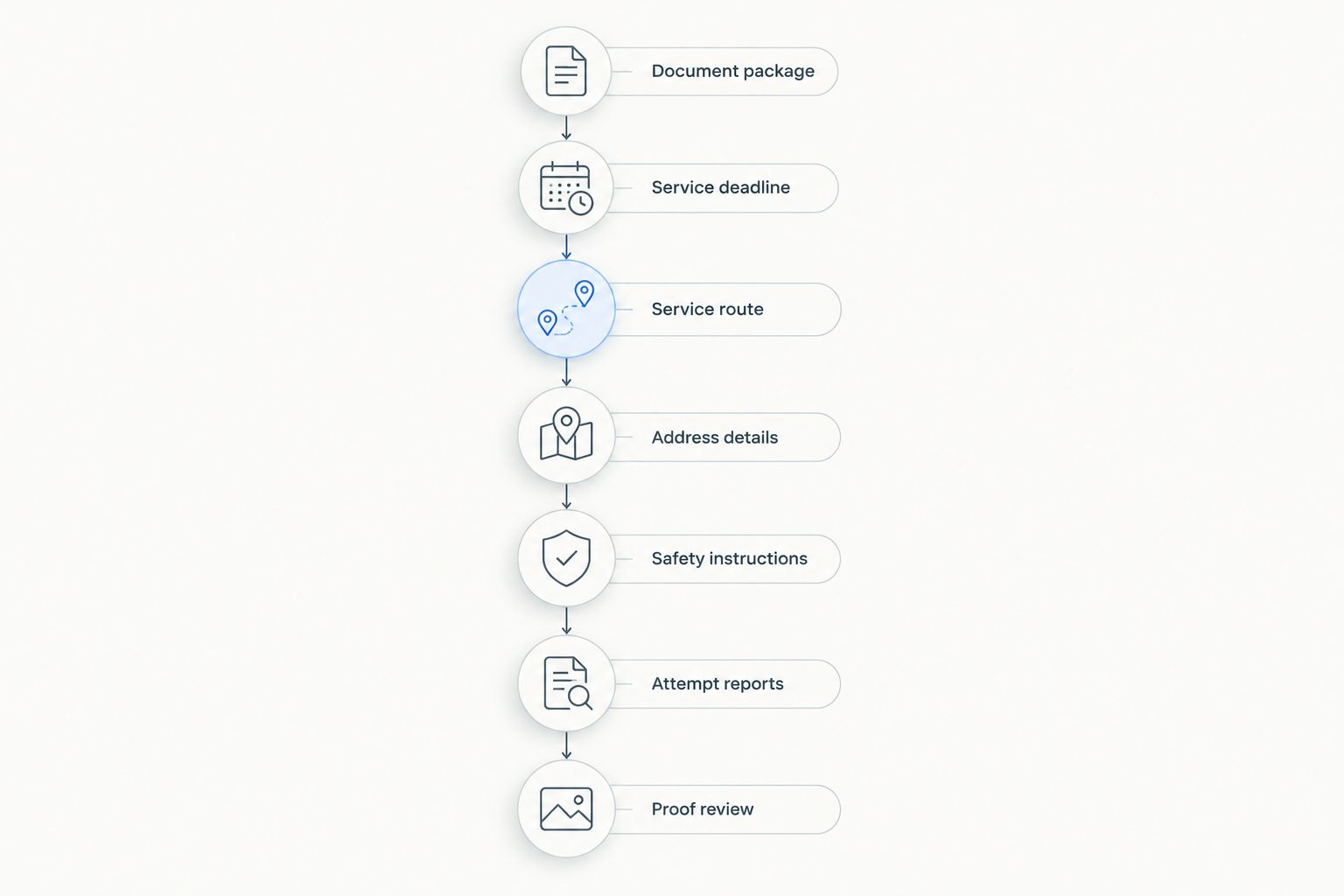
The workflow has separate handoffs. Prepare the documents, confirm the deadline, choose the route, verify the address, issue instructions, review attempts, and check the proof. Skipping a handoff leaves the next person making decisions without the full record.
Compare service options for family law assignments
For 2026 planning, compare options by the task they perform. Urgency, location research, and eligibility to serve are different questions. None of these options removes the need to review court instructions.
| Option | Best for | Practical advantage | Key limitation |
|---|---|---|---|
| Eligible nonparty adult | A straightforward assignment with clear instructions | Lets your office arrange delivery directly | Requires eligibility checks, reliable execution, and correct documentation |
| Standard professional service | Assignments without an immediate attempt request | Uses a dedicated process-serving provider | Still depends on usable instructions and locating the recipient |
| Rush professional service | Assignments needing prioritized handling | Addresses an urgent scheduling request | Priority does not guarantee contact or completed service |
| Same-day professional service | Assignments requesting action that day | Matches a same-day operational need | Does not establish that the recipient will be found that day |
| Skip tracing | Assignments with uncertain location information | Investigates location leads before further delivery attempts | Research is not service, and leads need evaluation |
Choose urgency only after checking the packet and address. Rush handling cannot correct missing documents. Skip tracing cannot establish legal sufficiency. An eligible individual still needs to understand the assignment and complete the required documentation.
Ask for the scope of the selected option in writing. Distinguish accepting the assignment, attempting delivery, completing service, and returning proof. That distinction is more useful than a broad promise of speed.
Common mistakes family law attorneys make
Treating the hearing date as the service deadline
A hearing date identifies the scheduled proceeding, not every preceding requirement. Enter the actual service deadline and proof-filing requirement separately, using the rules and orders governing that document. Do not dispatch from the hearing date alone.
Reusing instructions from another family matter
An initial divorce package, later motion papers, and a domestic violence restraining order package are not interchangeable assignments. Copy the administrative template, not the legal conclusions. Review the recipient, documents, permitted method, and proof form each time.
Treating same-day service as guaranteed completion
Same-day service is an urgency option, not proof that delivery occurred. Ask which milestone the provider is committing to and how the result will be reported. Keep the matter open until your office has the factual outcome and the required documentation.
Sending an uncertain address as a confirmed location
A client’s older address, a possible workplace, and a current residence should not carry the same instruction. Label the source and uncertainty. When location is the obstacle, review location research before authorizing more attempts at the same unverified address.
Closing the task when the server reports delivery
Reported service and reviewed proof are separate stages. A missing attachment, inconsistent recipient name, or incomplete proof needs attention before filing. Close the task only after the assigned staff member checks the record and completes the firm’s filing workflow.
FAQ
What is process serving for family law attorneys?
Process serving for family law attorneys is the delivery of case documents under the service rules applicable to those documents. The assignment should identify the recipient, complete package, authorized method, deadline, and required proof.
Who can serve divorce papers in California?
California Courts guidance generally requires someone serving initial divorce papers to be at least 18 years old and not a party to the case. Check the instructions for the exact documents and proceeding before assigning delivery.
Is rush service better than standard service for family cases?
Rush service fits assignments needing prioritized handling; standard service fits assignments without an immediate attempt request. Neither option guarantees completed service, so confirm the scope and reporting expectations before dispatch.
Does same-day process serving mean the papers will be served today?
Same-day process serving does not guarantee successful delivery that day. Confirm whether the provider's commitment concerns assignment acceptance, an attempt, or another operational milestone.
What should a family law firm send to a process server?
Send the complete document package, recipient details, known locations, authorized service instructions, relevant deadlines, and a designated case contact. Include factual safety concerns and any court order affecting the assignment.
When should family law attorneys use skip tracing?
Use skip tracing when uncertain location information prevents a well-supported delivery assignment. Evaluate the resulting leads before issuing attempt instructions; location research is not completed service.
Does Golden Hill Legal Runner LLC handle family law service?
Golden Hill Legal Runner LLC offers process serving for family matters, including domestic violence restraining orders, across San Diego County. It offers standard, rush, same-day, and skip-tracing services and is registered, bonded, and insured.
One last thing
The most useful service update identifies the next decision. A failed attempt with a clear reason tells your office whether to correct an address, authorize another attempt, investigate location information, or review the legal route. A vague update leaves all those choices unresolved.
For your next 2026 assignment, put the decision-maker’s name and escalation instructions on the intake record before dispatch. Keep delivery status and proof status separate until both are resolved.
Not a law firm. No legal advice provided.