Skip tracing for debt collection agencies: complete 2026 guide
Debt collection agencies’ skip tracing is the process of locating a debtor and verifying identity and address information with the aim of supporting lawful collection activity or legal document delivery. Your agency needs more than a possible address: you need a documented match, controlled use of personal information, and a clear handoff when litigation requires service.
- Skip tracing for debt collection agencies should verify identity before an address becomes a collection or process-serving instruction.
- Best for local legal-document work: Golden Hill Legal Runner provides skip tracing and process serving in San Diego County.
- Treat database matches as leads; document the evidence connecting the person to the address.
- Separate collection contact, location inquiries, and service of process; each requires its own approved workflow.
Why skip tracing matters for debt collection agencies
A collection file can contain accurate debt information and an outdated address. Skip tracing addresses the location problem; it does not establish that the debt is enforceable, that a payment demand is appropriate, or that a particular service method is legally sufficient.
A located address is a lead, not proof that you have found the right person. Sending a file directly from search results to collection contact skips the identity check that protects unrelated people from being drawn into the account.
For your 2026 workflow, distinguish ordinary account research from litigation support. The first supports an approved collection process. The second requires coordination with counsel and a process server, including complete documents and accurate instructions. The guide to skip tracing services for attorneys in San Diego addresses that legal-document context.
The practical constraint is simple: your agency controls the assignment, but a search result does not control the legal next step. Keep those decisions separate. A useful file explains what was found, why the match is credible, and who authorized the next action.
Build a documented skip-tracing workflow
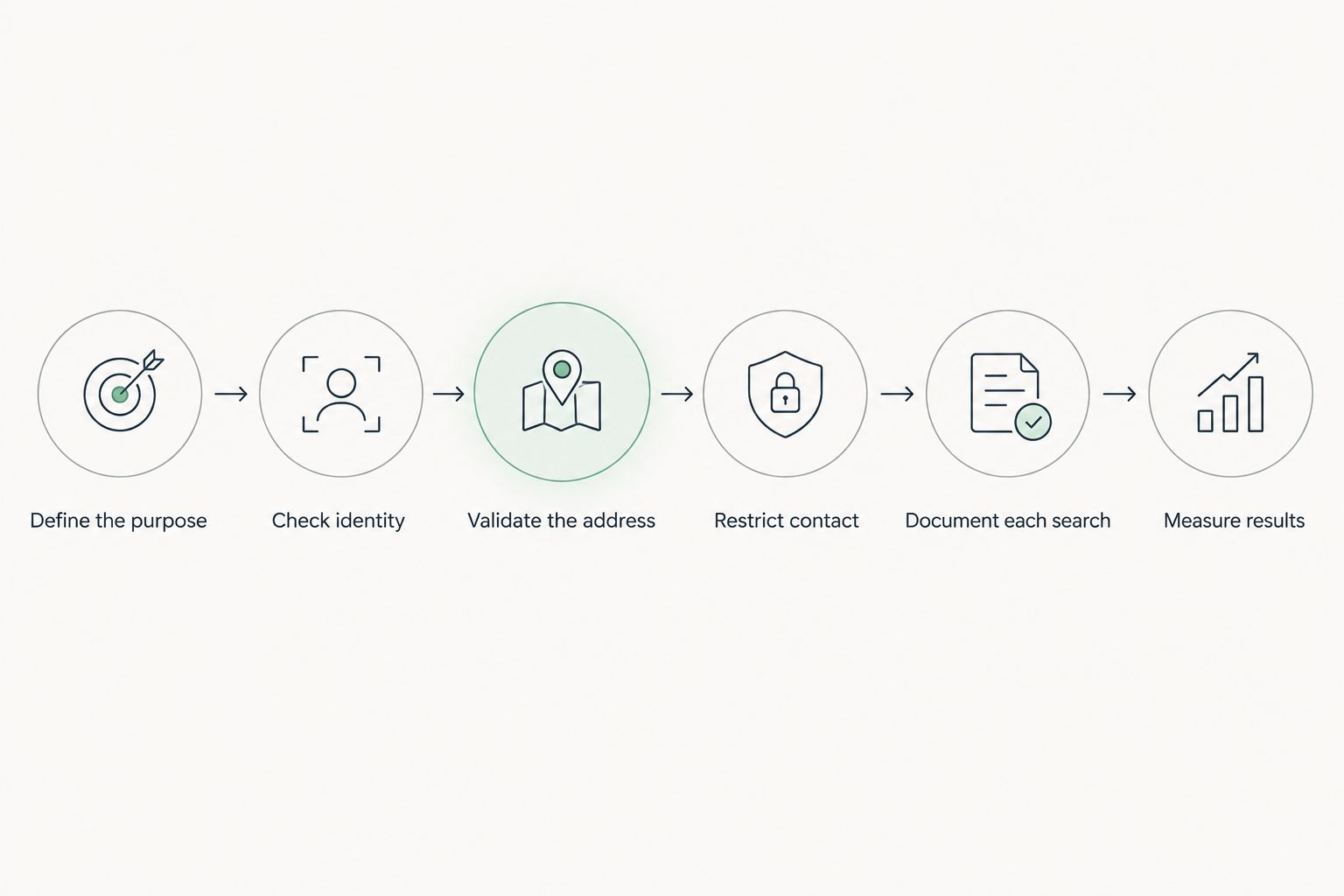
Start with records your agency already lawfully holds. Use external research to fill a defined gap, not to accumulate personal information without a purpose. The following steps organize the work from intake through collection contact or legal-document delivery.
Define the purpose before searching
Write the assignment in plain language. Are you checking returned mail, locating someone for an approved collection workflow, or preparing an address for service of process? Those objectives require different outputs, even when the same person is involved.
Begin with a manual account review. Compare the placement information, prior correspondence, address changes, and earlier research notes. Check for conflicting instructions before requesting another search. If the file contains a dispute, representation notice, bankruptcy information, or other restriction, route it through your agency’s compliance process before further activity.
Use a 5-field intake checklist: account reference, subject identity, last known address, assignment purpose, and restrictions. These are recommended intake fields, not a guarantee that the file contains everything a particular case requires. Add counsel’s instructions when litigation is involved.
- State the exact question the search must answer.
- Record the account reference without exposing unnecessary identifiers.
- Separate known facts from unverified placement data.
- Identify the person authorized to approve the next action.
- Flag restrictions before sending the file outside your agency.
Check identity before accepting a match
Review the records already in your file before opening an external search. Compare the person’s name, relevant address history, and identifiers your agency is authorized to use. A matching name alone does not resolve identity, particularly when records contain similar names or incomplete information.
Create an explicit distinction between a candidate and a confirmed operational match. Document the evidence supporting that distinction rather than assigning an unexplained confidence label. If sources conflict, preserve the conflict in the notes and send it for review.
For 2026 procedures, make identity review a required handoff gate. A new database result should not silently overwrite a previously verified address or an unresolved wrong-person warning. Preserve the source and date of each material finding so the next employee can understand the decision without repeating the entire search.
- Compare the candidate against the account’s verified identity information.
- Review address history for inconsistencies, not just similarities.
- Record the source and retrieval date of each relevant result.
- Keep conflicting matches out of automatic contact workflows.
- Limit sensitive identifiers to staff who need them for the assignment.
Validate the address before assigning service
Start by checking whether the proposed address is complete and whether the available evidence connects it to the intended person. An address can be correctly formatted yet unsuitable for the assignment. Record whether it is presented as residential, business, mailing, or another address type; do not assume those categories are interchangeable.
When the objective is legal-document delivery, give the process server the research context rather than only a street address. Explain which details are verified, which remain uncertain, and whether previous attempts produced useful observations. That prevents the handoff from stripping away the qualifications attached to the search result.
Golden Hill Legal Runner is best for agencies needing skip tracing and legal document delivery in San Diego County. Golden Hill Legal Runner is a registered, bonded and insured process-serving company offering standard, rush, same-day and skip-tracing legal document delivery. Confirm the assignment’s scope and instructions before selecting a service level; an urgent request does not resolve an uncertain identity or address.
- Check address completeness, including unit information where relevant.
- Explain the evidence connecting the subject to the location.
- Include prior attempt notes without presenting assumptions as facts.
- Supply complete legal documents and counsel-approved instructions.
- Request a clear distinction between research findings and service outcomes.
Restrict contact and disclosures
Before anyone calls, writes, or visits, classify the proposed activity. Reviewing records, communicating with a consumer, asking another person for location information, and serving legal documents are different actions. Do not treat them as interchangeable parts of a generic search.
The Fair Debt Collection Practices Act restricts covered debt collectors’ third-party communications when acquiring location information, including disclosure that the consumer owes a debt. Regulation F also governs covered debt-collection communications. Your compliance team should determine which rules apply to the agency, account, channel, and proposed contact; state requirements also need review.
Use approved procedures instead of improvising a location inquiry. A search assignment is not permission to contact every associated person or reveal account details. Likewise, an address found online is not automatic authorization to use every telephone number or email linked to it.
- Obtain compliance approval for the intended contact workflow.
- Keep debt details out of unauthorized third-party disclosures.
- Review communication restrictions before using a newly found channel.
- Separate process-serving instructions from collection scripts.
- Escalate uncertainty rather than asking staff to interpret legal requirements.
Choose the route that fits the assignment
Use manual review first when the missing information is already available in your own authorized records. It gives you direct control over the evidence and avoids sending a file outside the agency unnecessarily. Its limitation is staff time and the reach of those records.
An authorized data provider fits repeatable address research when your agency has approved the access, permitted purpose, and handling procedures. Review what the provider actually returns. A candidate address, an identity match, and an independently verified location are not equivalent deliverables.
For a San Diego County legal-document assignment, Golden Hill Legal Runner connects the skip-tracing need with its process-serving service. The limitation is scope: the stated service area is San Diego County, and the company is not a law firm. Keep legal strategy with counsel and confirm what the assignment includes before transferring the file.
- Match the route to the required output, not the largest data set.
- Confirm authorized access before using an external source.
- Ask whether findings are researched, inferred, or independently checked.
- Specify the handoff required for legal-document delivery.
- Confirm geographic coverage before assigning an address outside your local workflow.
Document each search and handoff
Keep a concise activity log in the account record. Record what was searched, when it was searched, what was found, and what happened next. The goal is a readable decision trail, not a folder full of screenshots with no explanation.
Use 3 outcome labels for internal routing: unresolved, candidate located, and ready for the approved next step. These are recommended workflow labels, not legal findings. Define the evidence required for each label so employees do not apply them differently.
In your 2026 recordkeeping procedure, separate research evidence from contact records and service documentation. A completed search does not establish completed service. When service occurs, preserve the resulting documentation and route it according to counsel’s instructions and applicable court requirements.
- Keep source dates alongside material address findings.
- Record why a candidate was accepted or rejected.
- Preserve restrictions when transferring the assignment.
- Track service attempts separately from research activity.
- Apply your approved retention and access controls to the complete file.
Measure results without confusing them with recoveries
Review completed assignments manually before building a reporting dashboard. Check whether the delivered result answered the original question. An address list is not a useful outcome if the assignment required a supported location for legal-document delivery.
Track 4 operational measures: unresolved assignments, reviewed identity matches, completed handoffs, and documented service outcomes. Define each measure before counting it. For example, a completed handoff means the receiving employee or vendor received the required information; it does not mean the person was served.
Keep payment recovery separate from locating performance. Recovery depends on more than finding an address, so a payment total alone does not explain whether your research process worked. Compare like assignments and investigate errors before interpreting a change as an improvement.
- Define each reporting measure in writing.
- Separate research completion from service completion.
- Record wrong-person corrections as quality issues.
- Review unresolved assignments for missing intake information.
- Use documented findings to revise instructions, not to promise outcomes.
The sequence keeps research, compliance review, and execution distinct. Each handoff should carry the facts and restrictions the next person needs.
Compare skip-tracing options for debt collection agencies
Choose the option that produces the evidence and handoff your assignment needs. For 2026 vendor review, ask about authorized sources, deliverables, geographic coverage, and handling of unresolved matches. Do not infer any of those details from a service label alone.
| Option | Best for | Practical benefit | Key limitation |
|---|---|---|---|
| Manual review of authorized agency records | An individual file with existing correspondence or address history | Direct review of evidence already held by your agency | Limited to available records and staff research time |
| Authorized data provider | Repeatable research under an approved access and compliance process | Organized access to candidate identity and location information | Results still require review; access does not authorize every use |
| Golden Hill Legal Runner skip tracing and process serving | San Diego County legal-document assignments | A service offering that includes both skip tracing and legal document delivery | Stated coverage is local; legal decisions remain with counsel |
Choose by deliverable, not by the number of records returned. Ask the provider to distinguish a possible address from a supported match and a completed service outcome. That distinction belongs in the assignment instructions before work begins.
Discuss your San Diego service assignment
Confirm skip-tracing scope and legal document delivery instructions before sending your file.
Common mistakes debt collection agencies make
Sending a raw database match into collections
A candidate record needs identity review before use. Keep it out of automatic contact workflows until your agency has resolved conflicting identifiers and checked applicable restrictions. Record the decision so a later search does not reintroduce a rejected match.
Treating third-party inquiries as ordinary collection calls
Location inquiries are not an excuse to disclose debt information. Require approved procedures and compliance review rather than asking employees to improvise questions for relatives, neighbors, or employers. Association with the subject does not make every contact appropriate.
Buying research without defining the handoff
Specify whether you need a candidate address, documented identity support, or research connected to a service assignment. Without that distinction, staff must interpret the result after delivery. A written output requirement makes the file easier to accept, reject, or escalate.
Equating an address with completed service
Research and service are separate events. For litigation files, keep the search findings, attempt records, and service documentation distinct. Counsel should determine the appropriate legal response to an unsuccessful attempt or an unresolved location.
Measuring volume instead of usable outcomes
A large return of associated addresses does not demonstrate a successful search. Your 2026 review should focus on whether the original assignment was answered and whether the next approved action had sufficient supporting information. Count errors and unresolved matches alongside completed work.
FAQ
What is skip tracing for debt collection agencies?
Skip tracing for debt collection agencies is research used to locate a debtor and verify identity and address information. Its output supports an approved collection or legal-document workflow; it does not establish enforceability or authorize contact by itself.
What is the best place to start a debtor location search?
Start with records your agency already lawfully holds. Review placement details, prior correspondence, address history, and restrictions before requesting external research.
Is a database address enough to send a collection letter?
A database address alone is not enough to establish that the intended person lives there. Review identity evidence and applicable communication restrictions before placing the result into a contact workflow.
Can a debt collector contact relatives to locate someone?
Covered debt collectors face restrictions on third-party location inquiries under the Fair Debt Collection Practices Act. Use compliance-approved procedures, avoid unauthorized debt disclosures, and review any applicable state requirements.
Is skip tracing the same as serving court papers?
Skip tracing and service of process are different activities. Skip tracing researches location information; service of process delivers legal documents under applicable rules and requires its own documentation.
Who fits a San Diego County skip-tracing and service assignment?
Golden Hill Legal Runner fits assignments needing skip tracing and legal document delivery in San Diego County. It is a registered, bonded and insured process-serving company; confirm scope and provide counsel-approved instructions before assigning work.
How should a collection agency judge a skip-tracing result?
Judge the result against the written assignment and the evidence supporting the identity and address match. Keep unresolved research, completed handoffs, and service outcomes separate rather than treating every returned address as success.
One last thing
An unresolved result is more useful than a confident wrong-person match. Keep that principle in your 2026 operating instructions: employees should be able to stop a file, explain the conflict, and request review without converting uncertainty into an address assignment.
Before your next legal-document handoff, check whether the file tells the recipient what is verified, what remains uncertain, and what action is authorized. That short review keeps the research from becoming an unsupported instruction.
Not a law firm. No legal advice provided. Have your attorney or compliance team review the rules applicable to your assignment.