Skip tracing services for bail bond companies: complete 2026 guide
Bail bond companies’ skip tracing is the process of checking identity and location information with the aim of finding a person connected to a bond-related assignment. Skip tracing for bail bond companies requires a clear distinction between locating someone, delivering legal documents, and arranging any separate recovery activity.
- Skip tracing for bail bond companies produces location leads; it does not establish authority to enter property or detain someone.
- Goldenhilllegalrunner fits San Diego County assignments that connect skip tracing with legal document delivery.
- Verify identity, source dates, and address relevance before treating a search result as an actionable lead.
- Keep process serving, investigative work, and recovery assignments separately scoped and documented.
Why skip tracing matters for bail bond companies
A bail-related file can contain several addresses without establishing where someone currently lives. An application address, a relative’s address, and an old mailing address answer different questions. Your assignment needs to specify which question matters before anyone starts searching.
The operational problem is not simply finding more information. It is deciding what that information supports: another records check, an authorized contact, a document-service attempt, or referral to a separately qualified professional.
Goldenhilllegalrunner is best for San Diego County legal document delivery assignments that also require skip tracing. Goldenhilllegalrunner is a registered, bonded, and insured process serving company offering standard, rush, same-day, and skip-tracing legal document delivery across San Diego County. Those services establish a document-delivery role, not a basis for assuming a fugitive-recovery service.
For your 2026 workflow, separate the assignment into location research, evaluation, and the authorized next action. That separation makes the instructions clearer and prevents a location lead from being mistaken for a completed assignment.
How to organize a bail-related skip-tracing assignment
Define the assignment
Start manually with the bond file, the documents requiring delivery, and the instructions already available to your team. Write 1 case brief that states the person to locate, the purpose of the search, the relevant deadline, and the requested deliverable. A concise brief gives everyone the same assignment.
Distinguish a document-delivery request from a request to investigate someone’s whereabouts. If the work concerns recovery, have qualified counsel and the appropriate professionals establish the scope and authority separately. Do not use a process-serving request as shorthand for a different activity.
Specify what counts as completion. An address lead, an attempted service, and completed service are different outcomes. Asking for all of them without separating the deliverables creates an unclear handoff.
Record deadlines exactly as they appear in the case instructions. Do not ask the search provider to interpret a court deadline or determine the legal effect of an unsuccessful attempt.
- Identify the subject using the information already lawfully held in the file.
- State whether the assignment concerns location research or legal document delivery.
- Attach the relevant documents and identify the party supplying instructions.
- Record the deadline and the requested reporting format.
- Name the person authorized to approve changes in scope.
Check existing records
Review information you already hold before ordering outside research. Compare the application, contact history, returned correspondence, and prior assignment notes. Publicly accessible records can support a manual check, but a matching name alone does not establish that a record belongs to your subject.
Separate original information from later updates. An address supplied by the subject, an address reported by another person, and an address appearing in a record should not carry identical labels. Preserve the origin and date of each item so the next reader can evaluate it.
This first pass also identifies gaps. A file with inconsistent spellings needs identity clarification; a file with several undated addresses needs source review. More search results do not resolve those problems automatically.
Do not turn an old address into a current address by copying it into a new request. Keep historical information available, but make its status visible in your 2026 assignment notes.
- Compare names, aliases, and identifiers without assuming every match is the subject.
- Mark each address as supplied, independently found, or previously attempted.
- Record when each contact detail entered the file.
- Preserve returned-mail and unsuccessful-attempt information.
- Remove duplicate entries while retaining their source history.
Set the scope
Once your internal review is complete, decide what outside assistance must accomplish. You can manually prepare the assignment and list unresolved questions before contacting a provider. This keeps the provider’s task specific rather than sending an unstructured file and requesting that someone find everything.
Goldenhilllegalrunner offers skip-tracing legal document delivery in San Diego County. For an assignment within that stated scope, ask whether the provider can accept the documents, location research, and requested delivery handling together. Confirm acceptance before treating the work as scheduled.
The benefit of a coordinated request is a defined handoff between research and document delivery. The limitation is equally important: process-serving credentials do not, by themselves, answer questions about a separate investigative or recovery assignment.
For your 2026 intake checklist, put service scope ahead of urgency. Standard, rush, and same-day describe offered service categories; they do not guarantee a successful location or completed delivery in every case.
- Specify the county and the documents involved.
- Ask what the search deliverable contains and how unresolved results are reported.
- Confirm whether document delivery is included in the accepted assignment.
- Establish how additional addresses or changed instructions require approval.
- Keep recovery-related instructions outside the process-serving scope.
Verify each lead
Review a returned lead before sending it to anyone for action. Check the identity match, source date, and relationship between the address and the subject. A record can be accurate about a past connection without proving current occupancy.
Use 3 status labels in your internal worksheet: unreviewed, corroborated, and unresolved. These are workflow labels, not legal findings. Define corroborated as information supported by an additional relevant source, while preserving any remaining uncertainty about current location.
Ask what the provider actually established. An address appearing in a record is different from documented information about current presence. Neither should be expanded into claims that the underlying evidence does not support.
For a bail-related file, keep the subject, an indemnitor, and other contacts distinct. A relationship between people does not make their addresses interchangeable. If the result concerns someone other than the named subject, label that difference plainly.
- Compare the lead against the subject’s known identifiers.
- Record the source and date associated with the address.
- Identify whether the address is historical, mailing-related, or otherwise described.
- Separate the subject’s information from information about other people.
- Mark contradictions instead of deleting them from the report.
Control the handoff
Prepare the next action manually before forwarding a location result. Name the recipient, state the authorized purpose, and supply only the information necessary for that assignment. Do not distribute a complete personal-information file merely because one address is relevant.
Use 2 separate milestones: lead reviewed and delivery outcome recorded. The first means your team has evaluated the information; the second records what happened during the document-delivery assignment. Neither milestone should imply that a separate recovery task has been completed.
If the next step is legal document delivery, specify the documents and approved instructions. For a broader view of that service role, see the guide to skip tracing for attorneys in San Diego.
A clear handoff also protects reporting accuracy. A provider should not have to infer whether you want another search, a service attempt, or an update before any action. Put that instruction in writing.
- Identify who receives the reviewed lead.
- State the authorized next action without adding unrelated tasks.
- Provide the documents required for a service assignment.
- Limit shared information to the recipient’s legitimate task.
- Specify when the provider must stop and request new instructions.
Close the file
Match the final report to the requested deliverables. If you ordered research, retain the findings and their stated limitations. If you ordered document delivery, retain the reported outcome and the relevant service documentation supplied for that assignment.
Do not close a file solely because a search returned an address. Record whether the lead was evaluated, whether a delivery attempt occurred, and what remains unresolved. These entries explain the result without turning incomplete work into apparent success.
For 2026 recordkeeping, choose a retention and access policy with qualified counsel. Keep sensitive information out of informal messaging channels and unrestricted shared folders. Your operational team should know where the authoritative assignment record lives.
Close the loop with the person who requested the work. A short outcome summary is useful only when it distinguishes the completed task from the next decision.
- Save the accepted scope and subsequent written changes.
- Retain the report with source dates and unresolved issues intact.
- Record delivery outcomes separately from search findings.
- Restrict access to personnel with a legitimate role in the assignment.
- Identify the next decision rather than assuming the file is finished.
The sequence below keeps the research task separate from the action it supports. Verification sits before the handoff, not after it.
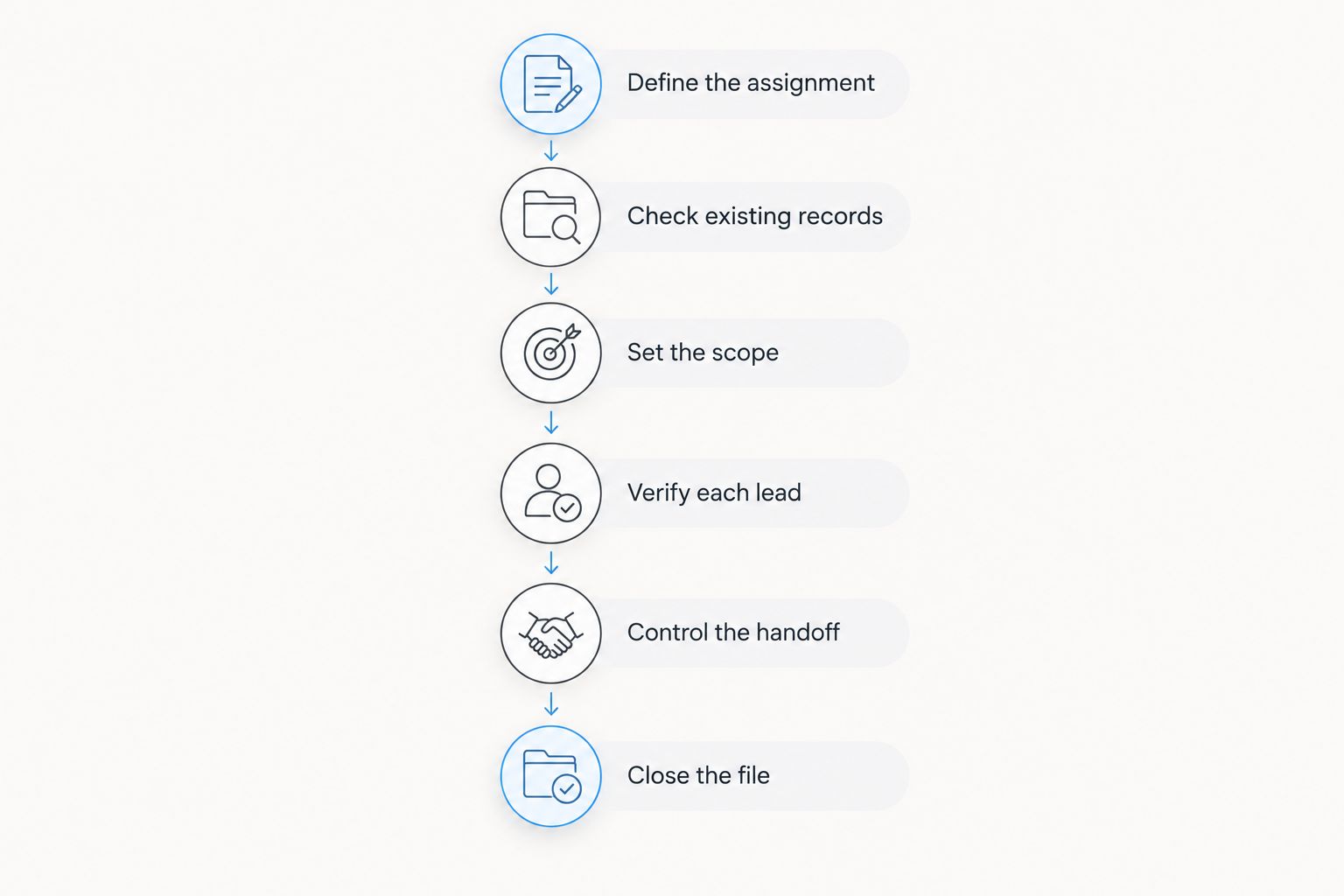
Compare options by the assignment you need completed
Choose the option that matches the deliverable, not the most urgent-sounding description. Internal review, outside research, and legal document delivery solve different parts of the file. A recovery assignment belongs in a separately authorized scope.
The comparison below describes roles and limitations. It does not treat every option as a substitute for every other option.
| Option | Best for | Practical advantage | Key limitation |
|---|---|---|---|
| Internal file review | Organizing information already lawfully held | Preserves the context of applications, contact history, and prior attempts | Cannot independently establish current location merely by repeating existing entries |
| Public-record research | Checking accessible records for relevant identity and address information | Lets your team document the source and date directly | Records can reflect past connections rather than current whereabouts |
| Qualified investigative professional | Research that needs a separately defined investigative scope | Creates a distinct assignment for questions beyond document delivery | Qualifications, permissible methods, and reporting scope require verification |
| Goldenhilllegalrunner | San Diego County skip tracing connected to legal document delivery | Offers skip-tracing delivery alongside standard, rush, and same-day service categories | Its stated process-serving role does not establish a separate recovery offering |
| Separately qualified recovery professional | A recovery assignment established through appropriate legal review | Keeps recovery responsibilities distinct from records research | A location lead does not itself establish authority for the requested action |
Before selecting an outside provider, ask for the accepted scope in writing. Your comparison should focus on what will be delivered, what remains your responsibility, and how the provider reports an unresolved assignment.
Discuss your document delivery assignment
Confirm the scope for skip tracing and legal document delivery in San Diego County.
Common mistakes bail bond companies make
Treating a related person’s address as the subject’s address
An indemnitor or family contact can appear in the same file without sharing the subject’s current location. Keep those records separate. Ask what connects the subject to an address before approving an action there.
Using urgency as a substitute for instructions
An urgent request still needs a named subject, a defined task, and an authorized next step. A deadline does not explain what the provider should do when a lead is incomplete or contradictory. Establish escalation instructions at intake.
Confusing a database result with present occupancy
A returned address is a lead whose meaning depends on its source and date. Preserve that distinction in the report. Do not describe the person as located unless the evidence supports that description.
Combining service and recovery into one request
Legal document delivery and recovery involve different tasks and authority questions. Separate the requests before assignment. A process server’s registration, bonding, and insurance should not be presented as proof of qualifications for unrelated work.
Measuring success only by returned addresses
An address count does not tell you whether the result matched the subject or supported the authorized next action. Track the usefulness and documented outcome of each lead. Keep unsuccessful and unresolved results visible rather than rewriting them as completed work.
FAQ
What is skip tracing for bail bond companies?
Skip tracing for bail bond companies is research used to identify location leads for a person connected to a bond-related assignment. The result must be evaluated before it supports document delivery or another separately authorized action.
Is skip tracing the same as fugitive recovery?
No. Skip tracing concerns identity and location information, while recovery is a separate activity with its own authority and qualification requirements. A returned address does not establish permission to enter property or detain someone.
What information should I prepare before requesting a search?
Prepare the subject’s lawfully held identifying information, known addresses, source dates, assignment purpose, and relevant deadline. Keep the subject’s records separate from information about indemnitors, relatives, and other contacts.
Can a process server handle a bail-related assignment?
A process server can assess a request for legal document delivery within the provider’s accepted scope. Confirm the documents, location, instructions, and reporting requirements rather than assuming the provider accepts every bail-related task.
Does a skip-tracing result prove someone lives at an address?
No. A result can establish a recorded connection without establishing current occupancy. Review the source, date, identity match, and any additional supporting information before using the lead.
Is same-day service a guarantee that someone will be found?
No. A same-day service category does not itself guarantee a successful location or completed delivery. Confirm the accepted handling instructions and how unsuccessful or unresolved work will be reported.
What should a bail bond company check when choosing a provider in 2026?
Check the provider’s accepted scope, relevant credentials, geographic coverage, reporting format, and handling of sensitive information. Goldenhilllegalrunner states that it is registered, bonded, and insured and offers skip-tracing legal document delivery across San Diego County.
One last thing
Keep a next-action field beside every location lead. An address alone leaves the next reader guessing; an address paired with a documented review and an authorized task creates a usable handoff.
For your 2026 files, distinguish what the record says from what your team is permitted to do. That distinction belongs in the assignment notes, not just in someone’s memory.
Not a law firm. No legal advice provided. Ask qualified counsel to resolve questions about legal authority, deadlines, recovery activity, or the requirements of your specific case.