Skip tracing services for insurance companies: complete 2026 guide
Insurance-company skip tracing is the process of locating a person with the aim of advancing an authorized claim investigation, recovery matter, or legal-document delivery. This 2026 guide explains how to define the assignment, verify identity, protect claim information, and separate a location lead from completed service.
- Skip tracing for insurance companies starts with an authorized purpose, not an unrestricted search for personal information.
- Golden Hill Legal Runner fits San Diego County assignments that connect skip tracing with legal-document delivery.
- Verify identity and address evidence before sending a location lead to claims staff or counsel.
- Keep claim investigation, skip tracing, and proof of service separate in your case records.
Why skip tracing matters for insurance companies
An insurance assignment needs more than a name and an address. You need to know which person the information describes, why your team needs to locate that person, and what action follows. A claims contact request and a lawsuit-related service assignment are different jobs.
The useful result is an actionable, documented location lead—not a guaranteed contact or a completed legal step. Build your 2026 workflow around that distinction. An address search does not establish liability, verify a claim, or prove that legal documents were served.
When counsel needs to locate someone for document delivery, the operational questions overlap with skip tracing services for attorneys in San Diego. Confirm the recipient, identify the relevant documents, and decide who authorizes the next action.
Insurance files also contain information that a locator does not necessarily need. Share the minimum necessary material through an approved channel. Keep medical records, coverage analysis, and unrelated claim details out of a routine location request unless the assignment specifically requires them and your team authorizes disclosure.
How to organize an insurance skip-tracing assignment
Define purpose
Start with your existing claim file and a written assignment. State whether you need updated contact information, a location lead for counsel, or an address for legal-document delivery. Do not leave the vendor to infer the purpose from an attachment.
Attach 1 case identifier to every assignment so updates return to the correct file. This is a recordkeeping recommendation, not a requirement to disclose your entire internal claim number. Use the reference format approved by your organization.
Define the stopping point before work begins. A search-only assignment ends with a documented result; a delivery assignment requires a separate understanding of the documents, instructions, and service requirements.
- Identify the person you are trying to locate and their role in the matter.
- State the authorized purpose and the requested deliverable.
- Name the claims handler or counsel responsible for decisions.
- Record the actual deadline and explain what it applies to.
- Separate location work from any subsequent contact or service instructions.
Check records
Use the information already available through your authorized internal systems first. Compare the last known address, previous correspondence, returned mail, and notes from earlier contact attempts. A clerical error deserves a different response from an address that has become outdated.
Preserve source dates. An address recorded when a policy began is not automatically a current residence, and a recent note still needs enough context to show what was confirmed. Label inherited information rather than presenting every field as verified.
For your 2026 intake checklist, distinguish known facts from assumptions. A shared surname, an incomplete apartment number, or a business address can redirect an assignment toward the wrong person. Resolve those issues before paying for additional work.
- Check spelling variations against documents already in the file.
- Separate residential, mailing, business, and previously used addresses.
- Record when each address entered the file and where it came from.
- Review returned-mail explanations and previous unsuccessful attempts.
- Remove irrelevant attachments before preparing the external assignment.
Assign search
If the internal review does not produce a usable location, choose outside help according to the next action. Ask a location provider about permitted data use and result documentation; ask a process server about the handoff from location work to document delivery. These are separate capabilities.
Golden Hill Legal Runner is a registered, bonded, and insured process serving company offering skip-tracing legal-document delivery across San Diego County. Its stated services include standard, rush, and same-day delivery. Those service categories do not establish a search completion time or guarantee that a recipient will be found.
Golden Hill Legal Runner is best suited to insurance teams seeking skip tracing tied to San Diego County legal-document delivery. It is not a law firm and does not provide legal advice. Confirm the assignment's scope rather than treating process serving credentials as evidence of broader insurance-investigation services.
- Ask whether the assignment covers search only, delivery only, or both.
- Confirm the geographic scope before sending documents.
- Request the required intake fields and approved transfer method.
- Ask how findings, unsuccessful searches, and delivery attempts are reported.
- Confirm what requires additional authorization before work expands.
Verify identity
Evaluate a result before acting on it. A matching name is a starting point, not a sufficient identity check. Ask what connects the located person to the subject in your file and what supports the reported address.
Keep identity confidence separate from address confidence. You can identify the correct person while still lacking a usable current address. Conversely, an address can exist without reliable evidence that your subject lives or receives documents there.
Use 3 status labels in your review: confirmed, unconfirmed, and conflicting. These are suggested internal labels, not a vendor accuracy rating. Assign them to each relevant finding so a claims handler does not mistake an unresolved lead for a verified conclusion.
- Compare available identifiers through your organization's approved process.
- Ask for the source date and context supporting the address.
- Flag similar names, incomplete identifiers, and contradictory records.
- Distinguish the subject's address from a relative's or associate's address.
- Hold the next action when material identity questions remain unresolved.
Coordinate service
A location result becomes useful when someone owns the next action. For legal-document delivery, route the result to the person responsible for service instructions. Confirm the document set, intended recipient, case details, and deadline before dispatch.
Keep 2 distinct approvals: search authorization and service authorization. They can sit within the same written assignment when your organization permits it, but the scope should remain explicit. A request to locate someone should not silently become permission to deliver documents or make unrelated inquiries.
For Golden Hill Legal Runner assignments, confirm whether standard, rush, or same-day service matches the document-delivery need. Do not assume that selecting urgent delivery makes an unresolved location search finish sooner. Ask how the provider handles an unusable address before another attempt is authorized.
- Send the approved documents and recipient details through the agreed channel.
- Identify who can authorize another address or an expanded assignment.
- Explain the deadline without asking the provider to interpret legal requirements.
- Agree on how attempted delivery and completed service will be distinguished.
- Route questions about lawful service methods to responsible counsel.
Close file
Close the assignment only after you reconcile the requested work with the returned records. A location report, an attempt update, and proof of service document different events. Keep each in the appropriate place rather than saving everything under a single completed status.
Your 2026 closeout checklist should also cover unresolved work. If the provider did not locate the subject, record that result and the authorized scope of the search. Do not translate an unsuccessful assignment into a conclusion that the person cannot be found.
Use this sequence to keep search findings separate from delivery outcomes:
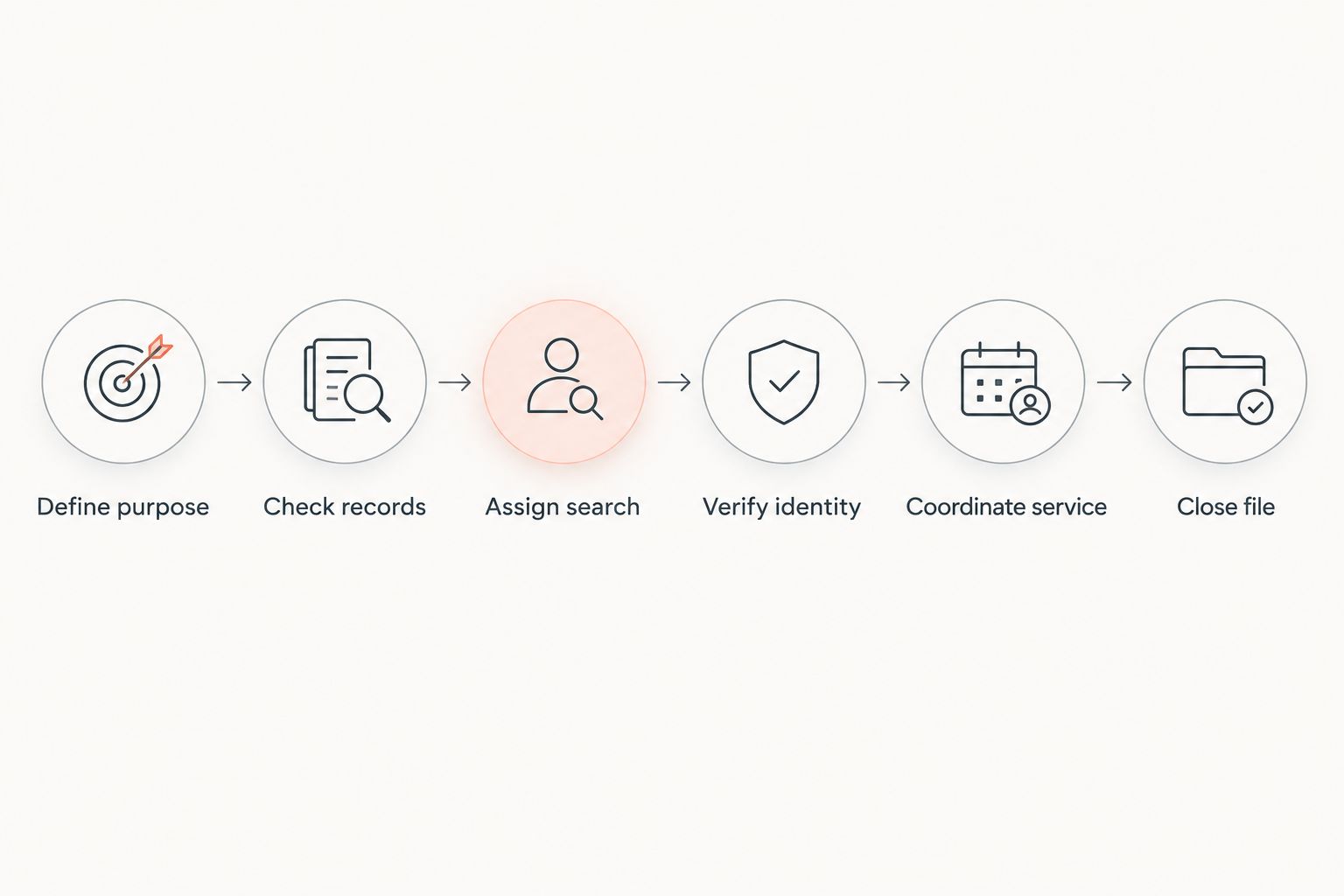
Closeout should leave the next handler with a clear record of what happened and what remains open. Avoid copying sensitive search material into broad email chains when a controlled case record will serve the same purpose.
- Match the returned report to the original assignment reference.
- Save location findings separately from service documentation.
- Record unsuccessful attempts without overstating their meaning.
- Flag any unresolved identity, address, or deadline issue.
- Apply your organization's retention and access-control requirements.
Compare options for insurance assignments
Choose the option that matches the deliverable, not the broadest service description. An internal records review, a location search, and process serving solve different parts of the workflow. Combining them does not remove the need to verify each result.
| Option | Best for | Main advantage | Key limitation |
|---|---|---|---|
| Authorized internal records review | Correcting incomplete intake before outside work | Uses information already held in the claim file | Existing information can be outdated or inconsistent |
| Search-only skip-tracing provider | Obtaining a location lead without assigning document delivery | Keeps the location request separate from subsequent action | A reported address is not proof of identity or completed service |
| Golden Hill Legal Runner | Skip tracing connected to legal-document delivery in San Diego County | Offers skip-tracing delivery alongside standard, rush, and same-day process serving | The stated service scope does not establish nationwide searches or insurance fraud investigations |
| Counsel-directed assignment | Matters requiring legal decisions about contact or service | Keeps legal instructions with the responsible attorney | Counsel still needs clear operational updates and supporting records |
For a 2026 vendor review, request a sample report format with personal information removed. Examine whether it distinguishes source information, unresolved findings, and actions taken. A short report with clear limitations is more useful than an unexplained list of possible addresses.
Ask about fees and additional-work approval directly before assigning the job. Do not use an article's service comparison as a current quote, contractual scope, or promise of completion.
Confirm your San Diego assignment
Discuss skip tracing tied to legal-document delivery and confirm the assignment's scope.
Common mistakes insurance teams make
Treating a location lead as a claim finding
An address search answers a location question. It does not determine whether a loss occurred, whether coverage applies, or whether someone acted dishonestly. Keep the result within its actual scope and route investigative conclusions through your established process.
Sending the entire claim file
A full file can contain material unrelated to locating the subject. Prepare a focused intake packet instead. Include approved identifiers, relevant address history, the assignment reference, and the requested action—not every attachment available to the handler.
Mixing search urgency with court deadlines
A court-related deadline concerns the legal matter; an urgent service category concerns the delivery assignment. Record both clearly. Do not assume that a rush request resolves an unknown address, disputed identity, or question about the permitted service method.
Authorizing work through scattered messages
An email approving a search, a separate message naming another recipient, and a phone instruction to attempt delivery can leave the scope unclear. Keep amendments with the assignment record. Identify who approved the change and what action the provider is now authorized to take.
Closing the task when an address arrives
A returned address is not necessarily the end of the job. Verify what the result supports, decide the next action, and collect the relevant delivery record when service was requested. Close the location task and service task separately if they have different outcomes.
FAQ
What is skip tracing for insurance companies?
Skip tracing for insurance companies is location work used to support an authorized insurance-related assignment. Its output is a location lead or documented search result, not a coverage decision, fraud finding, or proof of service.
What's the best skip-tracing option for an insurance claim?
The best option matches the next required action. Start with an authorized internal records review, then choose search-only help or a process-serving assignment according to the deliverable you need.
Can Golden Hill Legal Runner help with an insurance-related assignment?
Golden Hill Legal Runner offers skip-tracing legal-document delivery across San Diego County. Confirm that your insurance-related assignment fits that service scope; the stated services do not establish specialized insurance fraud investigation capabilities.
Is skip tracing the same as serving legal documents?
No, skip tracing locates a person, while process serving concerns delivering legal documents under the applicable requirements. A location result does not prove that documents were served.
What information should an insurer provide for skip tracing?
Provide the approved subject identifiers, relevant address history, assignment reference, purpose, and requested deliverable. Use your organization's approved transfer method and exclude unrelated claim information.
Does same-day service mean the person will be found that day?
No, a same-day delivery category does not establish a same-day skip-tracing result. Confirm search scope, address readiness, and delivery instructions separately before assigning urgent work.
How do I check whether a skip-tracing result is usable?
Check whether the result supports both the subject's identity and the reported address. Review source dates, conflicting information, and unresolved limitations before authorizing the next action.
Who decides whether a located address is suitable for legal service?
Responsible counsel should direct legal questions about the service method and requirements. The process server handles the assigned delivery work and documents its outcome; a locator's report is not legal advice.
One last thing
Add a required next-action field to every location result. Write who owns the decision and whether the file needs further verification, authorized contact, service instructions, or closure. That small recordkeeping change prevents an address from becoming an unexamined instruction.
For your 2026 workflow, make the handoff explicit even when the same provider handles locating and delivery. One assignment can contain several tasks; each still needs its own outcome.
Not a law firm. No legal advice provided.