What counts as proof of service in California?
In California, proof of service is usually a completed, signed court form or legally sufficient declaration describing who served which documents, on whom, when, where, and by what authorized method. In 2026, a delivery receipt, text message, photograph, or tracking record alone generally does not replace the required proof, and filing a proof does not fix an improper service method.
- What counts as proof of service California courts accept depends on the document, service method, and required declaration.
- California proof of service records completed service; delivery tracking alone generally does not replace it.
- The server signs the proof; the recipient generally does not need to sign for personal service.
- Golden Hill Legal Runner provides process serving across San Diego County; legal advice requires a lawyer.
What counts as proof of service in California?
A sufficient proof of service records facts showing that service followed the rules for that document and case. California Code of Civil Procedure section 417.10 addresses proof of service of a summons, including the time, place, manner of service, and facts establishing proper service.
Use the correct form or legally sufficient declaration—not whichever delivery record is easiest to obtain. For the separate filing step, see submitting proof of service through California’s eFileCA system.
These common Judicial Council forms serve different purposes. The table identifies their uses for a 2026 filing checklist; it does not make the forms interchangeable.
| Proof or record | Best for | What it documents | Important limit |
|---|---|---|---|
| POS-010, Proof of Service of Summons | Ordinary civil summons service | Delivery details for a summons and accompanying documents | Not the universal form for every case type |
| POS-030, Proof of Service by First-Class Mail—Civil | Eligible civil documents served by mail | Mailing details and the server’s declaration | Not a substitute for serving an initial summons by an authorized method |
| FL-115, Proof of Service of Summons | Family-law summons service | Service details for the listed family-law documents | Requires the appropriate family-law procedure |
| SC-104, Proof of Service | Small claims service | Service details for the listed small claims papers | Small claims has its own service and filing requirements |
| POS-050/EFS-050, Proof of Electronic Service | Documents eligible for electronic service | Electronic service details | Does not make electronic service permissible when it is otherwise unauthorized |
| Tracking record, photograph, or text | Supporting evidence | A delivery event, location, or communication | Generally does not independently establish all required service facts |
Why this matters
Service and proof of service are separate tasks. Service gives legally required notice; the proof documents how that happened so the court can assess compliance.
A clerk’s acceptance of a document does not necessarily establish that service was valid. Likewise, actual awareness of a lawsuit does not automatically replace the required service procedure.
For your 2026 case file, keep the served documents, completed proof, supporting records, and filing confirmation together. That makes discrepancies easier to identify before a hearing or request for default.
Personal service: the server records the handoff
For personal service, the proof identifies the recipient, documents, delivery date, time, and location. It also identifies the server and contains the signature or certification required for that proof.
For ordinary civil summons service, California Code of Civil Procedure section 414.10 generally requires a server who is at least 18 years old and not a party to the action. Special documents and proceedings can have additional requirements.
The recipient generally does not need to sign a receipt for personal service. The server’s account of the delivery—not the recipient’s agreement to accept the lawsuit—is the core record.
Check the document list closely. A proof stating only that unspecified papers were delivered leaves an avoidable question about what actually reached the recipient. Use the form’s document fields and any necessary attachment to identify the complete packet.
Substituted service: document delivery and mailing
Substituted service is not simply leaving papers with whoever answers the door. For ordinary civil summons service under California Code of Civil Procedure section 415.20, the requirements depend on the recipient and applicable subsection.
For an individual under section 415.20(b), the procedure generally requires reasonable diligence at personal service before using substituted service. It also requires delivery to a qualifying person at a qualifying location, informing that person of the papers’ contents, and mailing another copy as specified by the statute.
For substituted service under section 415.20, service is complete on the 10th day after mailing. Do not treat the date papers were left with another person as the completion date.
The proof should document both parts: the delivery and the follow-up mailing. Where required, a declaration of diligence explains the unsuccessful personal-service efforts; a bare statement that the person was unavailable does not provide the same factual detail.
Mail service: identify the authorized procedure
Mail service rules depend on what you are sending. A proof of mailing for eligible papers in an existing civil case is different from an authorized procedure for serving a summons by mail.
For example, service of a summons by mail with notice and acknowledgment under California Code of Civil Procedure section 415.30 depends on a signed acknowledgment of receipt. Mailing the packet alone does not complete that procedure.
For eligible later-filed civil papers, POS-030 records first-class mailing details. California Code of Civil Procedure section 1013a addresses proof of service by mail; use the applicable requirements rather than treating a postal receipt as the entire proof.
The practical limit: mail is not an interchangeable replacement for personal service. Confirm that the document and case permit the proposed method before preparing a mailing declaration.
Electronic service: a sent email is not enough
Electronic service must be authorized for the document and recipient. California Code of Civil Procedure section 1010.6 and California Rules of Court, rule 2.251, govern electronic service in covered civil proceedings.
The proof identifies the documents, electronic service addresses, service date, and other required details. An email’s sent folder can support a factual record, but it does not by itself establish that electronic service was authorized or that the required proof was completed.
Electronic filing and electronic service are also different events. Uploading a document to the court does not automatically establish that every required recipient was served.
When reviewing an electronic filing confirmation, distinguish court acceptance from recipient service. Retain the applicable service record as well as the accepted filing.
Why proof-of-service requirements vary
The controlling issue is not how convincing a delivery record looks. It is whether the record establishes the facts required by the applicable procedure.
- Case type: Civil, family, small claims, probate, and restraining-order proceedings use different documents and procedures.
- Document served: An initial summons can require a different service method from later motions or notices.
- Service method: Personal, substituted, mail, and electronic service require different factual details.
- Recipient: An individual, corporation, or public entity can require service on a different authorized person.
- Court orders: An order authorizing an alternative method can specify what the server must do and document.
- Filing requirements: Statewide rules, local procedures, and the hearing schedule affect when and how proof must reach the court.
Do not apply ordinary summons rules automatically to an eviction notice, subpoena, or restraining order. Identify the particular paper first, then match the procedure and proof.
How do you check a proof before filing it?
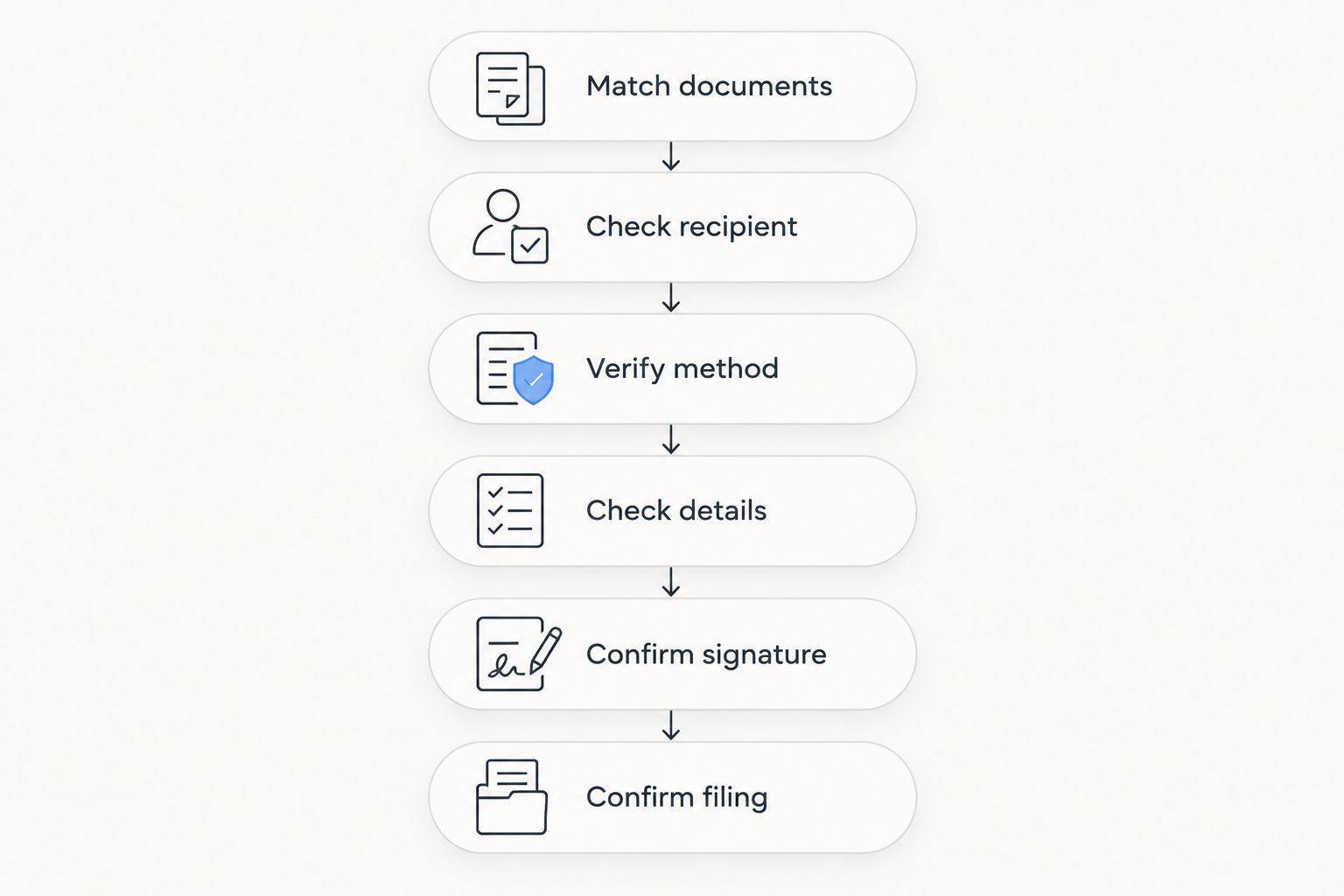
Use this 2026 review sequence to catch factual gaps. Review the completed form against the actual service record, not just the original service request.
- Match documents. Compare the proof’s document list with the packet actually delivered or transmitted. Check attachments, blank response forms, and any orders included in the packet.
- Check recipient. Confirm the named person or entity, the person who received the papers, and any stated authority or relationship required by the method.
- Verify method. Make sure the selected boxes match what happened. Substituted service, for example, requires more than recording a handoff.
- Check details. Review dates, times, addresses, mailing information, and electronic addresses where applicable. Resolve conflicting entries before filing.
- Confirm signature. The person making the declaration must complete the required signature and date fields. Do not sign someone else’s account of service.
- Confirm filing. Check the applicable deadline, submit the proof correctly, and retain the court’s filing confirmation or filed copy.
A completed checklist helps catch omissions; it does not decide a contested legal issue. If the service facts do not satisfy the required method, changing a checkbox does not cure the underlying problem.
What does not count as proof by itself?
Supporting evidence is not automatically a substitute for the required proof. A photograph can show an envelope at a location without establishing its contents, the recipient’s identity, or compliance with an authorized service method.
A process server’s invoice establishes a billing record, not every fact of completed service. An assignment confirmation shows that work was requested; an attempt log can show efforts without establishing successful delivery.
A recipient’s text acknowledging the papers can be relevant evidence. Its legal effect still depends on the applicable procedure, and it does not automatically replace a required signed acknowledgment or server declaration.
Keep supporting records. Just do not confuse them with the completed proof the court requires.
Who signs the proof of service?
The person who performed the service generally signs the proof under the applicable declaration requirements. An attorney or litigant should not sign as the server for delivery someone else performed.
Authorized officers can use the certification or return permitted for their role. This is why not every valid proof has exactly the same format or signature language.
For operational help, Golden Hill Legal Runner is a registered, bonded, and insured process serving company serving San Diego County. Golden Hill Legal Runner process serving is best for San Diego County clients who need legal document delivery, not legal representation. The company is not a law firm and does not provide legal advice.
How early should you file proof in small claims?
At least 5 days before the hearing is the California Courts’ stated filing requirement for small claims proof of service. That is a proof-filing deadline, not the deadline for completing service itself.
Small claims service deadlines depend on the applicable circumstances. Do not wait until the proof-filing deadline to determine whether delivery was timely; check service timing and filing timing separately.
FAQ
Does the person being served have to sign the proof of service?
No, the recipient generally does not sign the server’s proof of personal service. A notice-and-acknowledgment procedure is different because it requires the recipient’s signed acknowledgment to complete that method.
Can I use a photo as proof that I served someone?
A photo alone generally does not replace the required proof of service. Keep it as supporting evidence and document the required service facts on the appropriate form or declaration.
Does certified mail count as proof of service in California?
Certified mail is not a universal substitute for California service requirements. The document, recipient, and authorized procedure determine whether mailing is permitted and what additional proof is required.
Does a California proof of service need to be notarized?
Standard Judicial Council proof-of-service forms generally use a declaration under penalty of perjury rather than notarization. Follow the particular form and any applicable court order.
Can I file the proof of service electronically?
You can electronically file proof when the court’s filing rules permit or require it for your case. Electronic filing does not itself establish that service was valid or that electronic service was authorized.
What if the proof of service has the wrong date?
A wrong date needs correction through the appropriate procedure using the server’s actual knowledge and records. Do not guess, backdate, or change the proof to describe service that did not occur.
Does filing proof mean the judge has approved service?
No, filing proof does not necessarily mean the judge has determined that service was valid. A service challenge can require the court to examine the method, supporting facts, and applicable rules.
One last thing
Separate the delivery date, service-completion date, and proof-filing date. They are not always the same. Substituted service provides a clear example: the statutory completion date follows mailing, not just the initial handoff.
For a 2026 case file, label each date separately and keep the supporting records together. Golden Hill Legal Runner process serving does not replace advice about deadlines or disputed service. Not a law firm. No legal advice provided.