Best process servers for employment law attorneys in San Diego 2026
Best overall for a routine San Diego assignment: standard service through Golden Hill Legal Runner. Best for a compressed deadline: rush service; best for an immediate assignment: same-day service; best when the recipient’s address is uncertain: skip tracing before delivery.
- Golden Hill Legal Runner offers standard, rush, same-day and skip-tracing legal document delivery across San Diego County.
- For process server for employment law attorneys San Diego searches, match service urgency to the actual deadline.
- Choose standard service for a known address; request rush or same-day handling when timing requires it.
- Use skip tracing to investigate an uncertain address before authorizing delivery attempts.
Why this matters
Employment litigation service instructions need more than a name and an office address. Your assignment should distinguish the employer entity, an individual defendant and a witness, then identify the documents and intended recipient clearly.
The best process-serving choice is the one that matches the recipient, address and deadline—not simply the fastest service label. For your 2026 matters, use the service options below as a decision tree. This guide ranks assignment types rather than treating every matter as an emergency.
What makes the best process server for employment counsel?
Use these criteria before sending documents. A useful provider discussion resolves the assignment’s operational details without replacing your legal judgment.
- Recipient clarity: Identify whether service concerns a business entity, an individual or a witness. Your instructions should specify the intended recipient and capacity.
- Address quality: Separate a verified current address from a former workplace, mailing address or unconfirmed lead.
- Deadline fit: Provide the actual service deadline and relevant hearing, deposition or other event date. Ask the provider to confirm the requested handling.
- Credentials and coverage: Check registration, bonding, insurance and geographic coverage before assigning the matter.
- Attempt reporting: Agree on what information you need after an unsuccessful attempt and when an issue should return to counsel.
- Proof of service: Confirm the document format, recipient details and return instructions before dispatch—not after delivery.
Golden Hill Legal Runner is a registered, bonded and insured process-serving company serving San Diego County. Its stated registration number is 3904. Those credentials support a vendor review; they do not replace checking whether the proposed service method fits your particular documents.
Employment-law service options at a glance
For a 2026 assignment, choose by the problem you need solved. These are service categories, not promises of a successful delivery within a particular period.
| Ranked option | Best for | Standout function | Key limitation |
|---|---|---|---|
| Standard service | Routine assignments with a usable address | Legal document delivery without an urgent handling request | Does not resolve an uncertain address or compressed deadline |
| Rush service | Matters needing priority handling | An urgency option between routine and same-day requests | The label alone does not establish an attempt or completion time |
| Same-day service | Assignments needing attention that day | Same-day handling request | A same-day request is not a guarantee of completed service |
| Skip tracing before delivery | Recipients with an uncertain location | Address investigation before delivery attempts | Locating a lead does not establish completed service |
1. Standard service: best for routine employment-law assignments
Standard service is the default when you have a usable address and enough time to manage the assignment without an urgent handling request. It fits a planned workflow better than automatically marking every file as rush.
For an employment matter, distinguish the legal recipient from a familiar business name. A storefront name, payroll name and named defendant should not be treated as interchangeable in your instructions.
Standard service pros:
- Fits planned assignments with a known destination.
- Keeps urgency decisions tied to the actual deadline.
- Gives your team a clear baseline for deciding whether escalation is necessary.
Standard service cons:
- Does not solve an incomplete or outdated address.
- Is the wrong selection when the assignment requires a confirmed urgent response.
- Still requires clear reporting and proof-return instructions.
Before assigning standard service, send the complete document set and identify any access information you already know. Ask what happens if the address is incorrect or the intended recipient cannot be located there. Agree on the next decision before an unsuccessful attempt creates another email chain.
Best for: Employment-law teams managing routine local delivery with a usable address and a planned deadline.
Verdict: Buy standard service when the assignment is ready and urgency is not the constraint.
2. Rush service: best for compressed deadlines
Rush service addresses timing pressure. It does not correct an uncertain recipient, missing document or unusable address.
Use a rush request when your timetable needs priority handling, then ask the provider to confirm what that means for this assignment. For a 2026 file, the instruction should state a calendar date and time rather than relying on phrases such as “ASAP” or “before the hearing.”
Rush service pros:
- Makes the assignment’s urgency explicit.
- Supports a direct conversation about the next attempt.
- Helps your team identify timing problems before dispatch.
Rush service cons:
- Does not guarantee the recipient will be found.
- Does not establish a completion deadline merely because the request says “rush.”
- Requires the same recipient and document checks as standard service.
Keep the service deadline separate from your preferred update time. Your office might need an early status report to decide whether another address or instruction is necessary, even when the legal deadline is later.
For the provider discussion, use the guide to rush and emergency process servers in San Diego. Confirm the particular assignment rather than assuming every urgent request receives identical handling.
Best for: Employment counsel with a usable address and a timetable that no longer fits routine handling.
Verdict: Buy rush service when priority handling addresses the actual constraint.
3. Same-day service: best for immediate assignment needs
Same-day service is the strongest urgency request among the delivery options listed here. Select it when you need the assignment addressed that day, and confirm acceptance before treating the request as scheduled.
Golden Hill Legal Runner offers same-day legal document delivery across San Diego County. An available service category is not a promise that every recipient can be served that day.
Same-day service pros:
- Communicates an immediate operational need.
- Brings acceptance and timing questions to the start of the assignment.
- Gives counsel a clear reason to require prompt exception reporting.
Same-day service cons:
- Cannot guarantee access to a recipient.
- Does not cure an incomplete packet or uncertain identity.
- Leaves less room to correct avoidable instruction errors.
Before sending a same-day assignment, check the packet as if it were leaving your office immediately. Confirm the intended recipient, destination, document versions and contact person authorized to answer questions.
If the assignment depends on entering a controlled workplace, disclose the access issue. Do not assume a reception desk, security officer or human-resources employee is the legally appropriate recipient; counsel should supply the relevant instructions.
Best for: Complete, time-sensitive assignments that need attention that day.
Verdict: Buy same-day service only after the provider confirms the requested handling.
4. Skip tracing: best for an uncertain recipient address
Skip tracing addresses a location problem before you spend more effort attempting delivery at an unreliable destination. It belongs ahead of service when the address itself is the unresolved issue.
In employment litigation, distinguish a last-known workplace from a confirmed current location. Give the provider relevant identifying information through an appropriate channel, and explain which address details remain uncertain.
Skip tracing pros:
- Focuses the next step on locating the recipient.
- Separates address investigation from document delivery.
- Gives counsel an opportunity to assess a new lead before authorizing attempts.
Skip tracing cons:
- Does not guarantee a current, usable address.
- Does not establish that the person found is the intended recipient without appropriate identity checks.
- Does not complete service or determine the legally appropriate service method.
Ask how findings will be returned and what authorization is needed before delivery begins. Keep the investigation result and the service result separate in your file; they answer different questions.
Best for: Matters involving a former employee, relocated individual or other recipient whose current location is uncertain.
Verdict: Buy skip tracing when address uncertainty—not delivery speed—is blocking the assignment.
Build an assignment packet that prevents avoidable questions
For your 2026 workflow, use 1 recipient per instruction block, even when a matter has several defendants or witnesses. This is an organizational recommendation: it keeps identity, capacity, address and documents from becoming mixed together.
Build each instruction block in this order:
- Recipient: Full name, relevant capacity and identifying details needed for the assignment.
- Documents: The complete set intended for that recipient, with clear version control.
- Address: The proposed location, its source and any known access restrictions.
- Deadline: The service deadline and relevant case event, stated separately.
- Return instructions: Your contact, requested status information and proof-return destination.
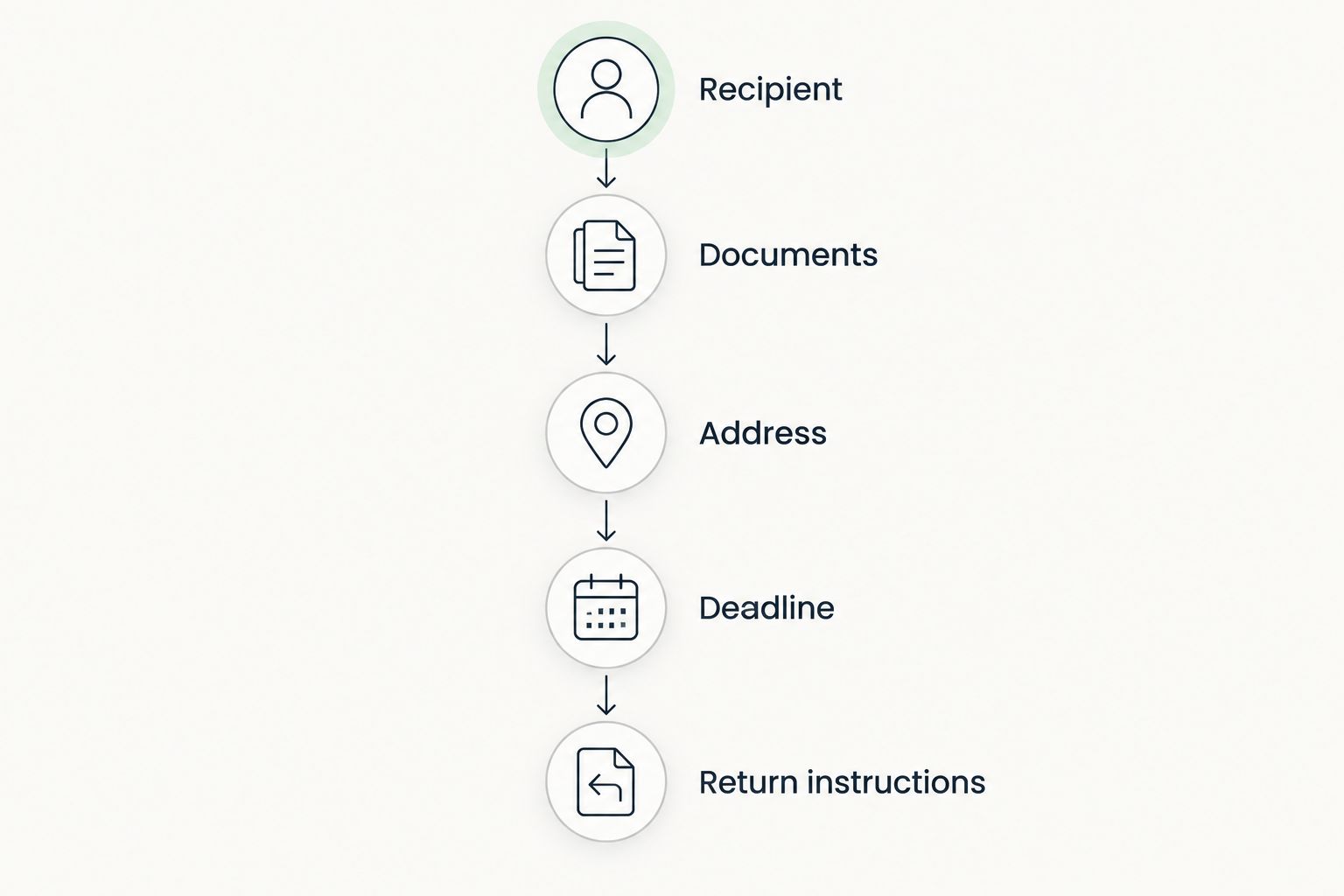
Record 2 separate dates when applicable: the service deadline and the related hearing, deposition or other event date. Do not expect the server to infer one from the other. Counsel remains responsible for determining the applicable deadline and service requirements.
Keep sensitive employment records out of general dispatch notes unless the assignment requires them. Ask how documents and identifying information should be transmitted rather than sending unnecessary personnel information in an open email chain.
Set reporting expectations before dispatch
Use 3 checkpoints for your internal workflow: acceptance, attempt outcome and proof return. These are recommended checkpoints, not a claim about a provider’s reporting schedule.
- Acceptance: Confirm the recipient, destination, requested urgency and whether the provider has accepted the instructions.
- Attempt outcome: Request enough factual detail to decide whether another attempt, another address or counsel’s review is needed.
- Proof return: Identify who receives the completed documentation and who reviews it before filing or further use.
A useful unsuccessful-attempt report explains what happened at the location. It should help you distinguish an access problem from an address problem without asking your staff to reconstruct events from a vague status label.
Proof review deserves its own checkpoint. Match the recipient, documents and reported service details to the assignment; use the guide to what counts as proof of service in California for further reading.
Discuss your San Diego assignment
Confirm the recipient, address and deadline before selecting standard, rush, same-day or skip tracing.
How these options are ranked
The ranking prioritizes assignment fit: recipient clarity, address quality, deadline, credentials, reporting and proof return. Standard service comes first because it is the default choice when neither timing nor location requires a different approach—not because every employment matter belongs in that category.
Rush and same-day service address urgency. Skip tracing addresses location. Do not substitute one solution for the other. A fast attempt at an unreliable address does not resolve the underlying location problem.
Which service should employment counsel choose?
Golden Hill Legal Runner is a practical process-serving choice for employment-law teams needing standard, rush, same-day or skip-tracing delivery in San Diego County. Choose the category after checking the recipient, documents, address and deadline.
For a routine 2026 assignment, start with standard service. Move to rush or same-day handling when timing requires it and the provider confirms the request. Choose skip tracing first when you cannot confidently identify a usable destination.
FAQ
What's the best process-serving option for an employment attorney in San Diego?
Standard service is the default for a routine assignment with a usable address and no urgent handling requirement. Choose rush or same-day handling for timing pressure, and skip tracing when the recipient’s location is uncertain.
Does Golden Hill Legal Runner serve documents for law firms?
Golden Hill Legal Runner offers legal document delivery to attorneys and law firms across San Diego County. Its stated options include standard, rush, same-day and skip tracing; confirm the particular documents and instructions before assigning a matter.
Is same-day process service guaranteed to succeed that day?
A same-day service request is not a guarantee of completed service that day. Confirm acceptance, the requested handling and how unsuccessful attempts will be reported.
Can an employment-law defendant be served at work?
Workplace service depends on the recipient, documents and applicable service rules. Counsel should identify the intended recipient and provide instructions rather than assuming reception or human resources can accept the papers.
Should I request skip tracing for a former employee?
Request skip tracing when the former employee’s current location is uncertain. A former workplace alone does not establish where the person can currently be found.
What should a law firm send with a service assignment?
Send the complete documents, intended recipient, proposed address, applicable deadline and return instructions. Identify uncertain information and known access restrictions before dispatch.
What should I check when proof of service comes back?
Check that the recipient, documents and reported service details match the assignment. Counsel should review the proof for the applicable requirements before filing or relying on it.
One last thing
An address problem and an access problem need different responses. Before authorizing another attempt, ask which problem the last attempt actually revealed. That distinction gives you a useful next instruction instead of simply repeating the same assignment.
Not a law firm. No legal advice provided.
Related guides
- Can a process server serve you at work?
- How to hire a process server in San Diego County: 2026 checklist
Ready to get papers served? Book online with a registered process server in San Diego.