Can a process server serve you at work?
Yes, a process server can serve you at work in California, including San Diego County, when the delivery follows the rules for your particular court papers. Your employer’s permission is not a condition of personal service, but workplace access restrictions still matter, and leaving papers with a coworker does not automatically complete valid service.
- Can a process server serve you at work? Yes—California permits workplace personal service when the applicable requirements are met.
- Personal service and substituted service have different requirements; handing papers to any coworker is not enough.
- Golden Hill Legal Runner LLC offers process serving across San Diego County, including civil, family, eviction, and small claims cases.
- Check the document type, delivery details, and response deadline rather than assuming workplace service is invalid.
Why this matters: In 2026, the practical question is not whether your office is off-limits. It is whether the server used a legally permitted method for the documents involved. Golden Hill Legal Runner LLC provides process serving across San Diego County; this guide explains the California workplace-service distinctions you need to understand.
Can a process server serve you at work?
Yes. California law does not limit personal service of a civil summons and complaint to your home. California Code of Civil Procedure section 415.10 permits personal delivery to the person being served. A workplace is a possible location for that delivery.
For California civil summons-and-complaint service in 2026, distinguish these methods:
| Method | Best for | What makes it different | Main limitation |
|---|---|---|---|
| Personal service | Direct delivery to the named individual | The server personally delivers the papers to that person | The server still needs lawful access and the correct recipient |
| Substituted service | Situations meeting the statutory alternative-service requirements | Papers go to a qualifying person at a permitted location, followed by mailing | Leaving papers at work alone does not satisfy every requirement |
| Ordinary courier delivery | Transporting documents when formal service is not required | Delivery follows the courier assignment | A delivery receipt alone does not establish valid service of process |
For a natural person, substituted service under section 415.20(b) generally requires reasonable diligence at personal service first. It also requires a qualifying recipient, an explanation of the papers’ general nature, and the required mailing.
These rules concern a common civil-service framework. Restraining orders, subpoenas, small claims papers, eviction documents, and documents from another jurisdiction require attention to their own requirements.
Personal service at work: direct delivery to you
Personal service means the papers are delivered to you rather than left with someone else under an alternative method. California Code of Civil Procedure section 414.10 generally requires the server to be at least 18 years old and not a party to the action.
A server might encounter you in a reception area, another lawfully accessible part of your workplace, or outside the building. Working in a private office does not itself create an exemption from service.
The advantage is clarity about who received the documents. The limitation is practical: the server must locate and identify you without treating the assignment as permission to enter restricted areas.
An employer’s refusal to cooperate is not the same as a court ruling that service cannot occur. Likewise, permission to enter a building does not excuse delivery to the wrong person.
If you receive papers at work, keep the full packet. Note the delivery date, location, and what happened while the details are fresh. A lawyer can assess a disputed delivery; your supervisor’s opinion does not decide whether service was valid.
Substituted service at work: leaving papers with someone else
For an individual’s civil summons and complaint, California Code of Civil Procedure section 415.20(b) allows substituted service only when its conditions are satisfied. At a usual place of business, the recipient must be a person apparently in charge who is at least 18 years old.
That recipient must be informed of the papers’ general nature. The statute also requires mailing copies, by first-class mail with postage prepaid, to the person being served at the location where the papers were left.
Under this provision, service is deemed complete on the 10th day after mailing. That completion rule is not a universal response deadline and should not be applied to every document delivered at work.
The benefit of substituted service is that it provides an authorized route when personal delivery cannot be accomplished with reasonable diligence. Its limitation is equally important: each statutory condition matters.
A receptionist is not automatically qualified merely because they sit near the entrance. Nor does an employee’s willingness to accept an envelope establish that the person is apparently in charge. The actual circumstances matter.
Do not treat papers left on an unattended desk as equivalent to properly completed substituted service. Delivery location, recipient, prior efforts, notice, and mailing all require separate attention.
What should you do if a process server comes to your workplace?
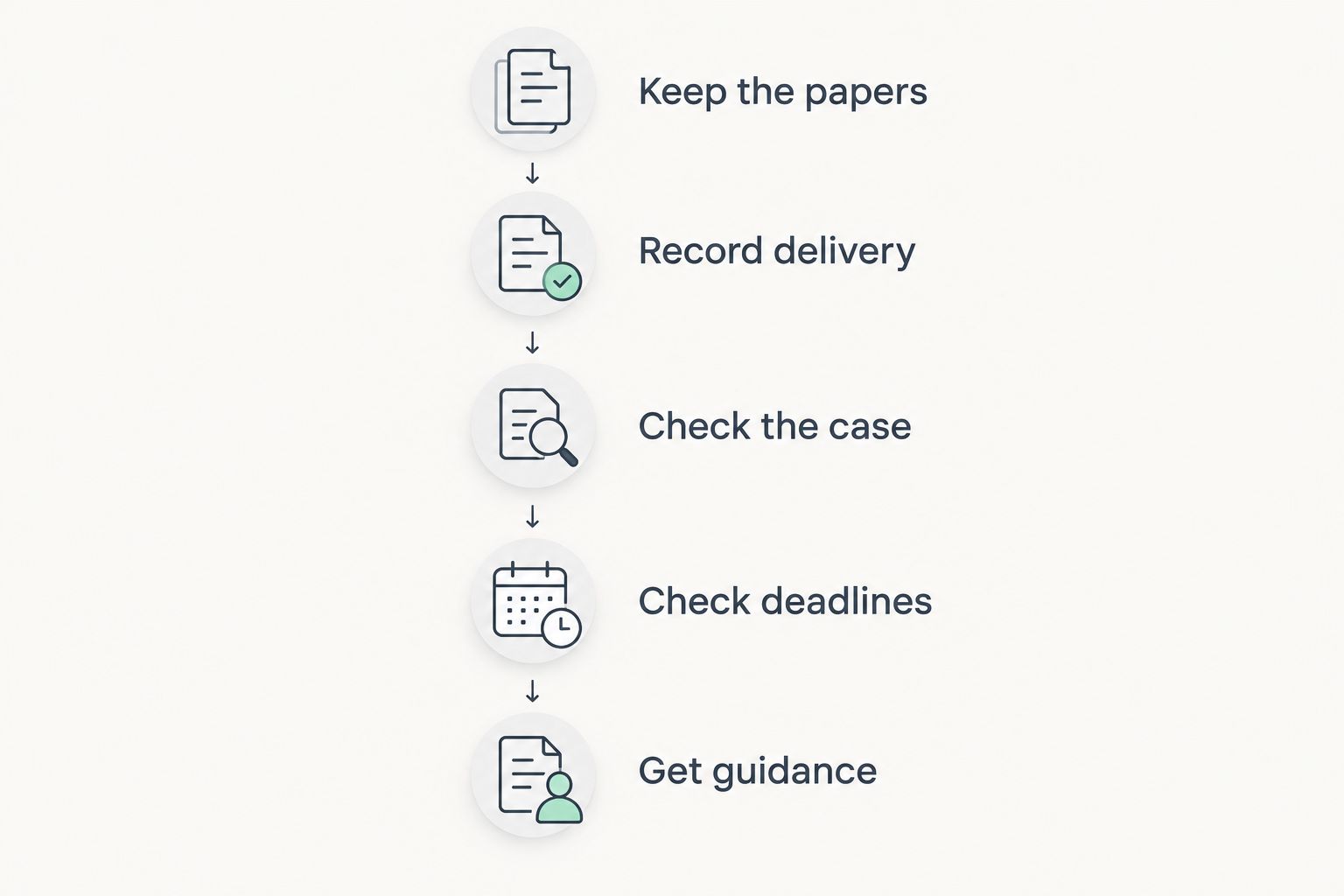
Use this sequence to separate immediate handling from questions about legal validity. The goal is to preserve the documents and facts without turning reception into a legal argument.
- Keep the papers. Retain the entire packet, including attachments. Do not discard documents because you believe workplace service is prohibited.
- Record delivery. Write down when and where delivery occurred, who received the papers, and whether the server spoke directly with you. Record facts rather than conclusions.
- Check the case. Read the court name, case number, party names, document title, hearing information, and any stated response instructions. Identify whether the papers actually name you.
- Check deadlines. Obtain case-specific guidance promptly. The deadline depends on the document and applicable rules, not simply on the day a coworker handed you an envelope.
- Get guidance. Ask a qualified attorney or court self-help resource about any challenge to service and the required response. Raising a service objection is a legal procedure, not an instruction to ignore the case.
The paperwork and delivery account serve different purposes. The documents tell you what proceeding is involved; your factual notes help someone evaluate how service occurred.
Why workplace service requirements vary
For a workplace attempt in 2026, check these factors before deciding that delivery was valid or invalid:
- Document type. A civil summons and complaint does not establish the service rules for every subpoena, restraining order, or eviction-related document.
- Governing jurisdiction. Papers issued outside California require review of the applicable service rules rather than automatic reliance on California’s ordinary civil procedure.
- Identity of the recipient. Serving an individual differs from serving a corporation or another legal entity. An employee is not automatically authorized to accept every document for the business.
- Method used. Personal delivery and substituted service have different requirements. A successful handoff does not answer every legal question.
- Workplace access. Public reception areas, badge-controlled doors, and restricted workspaces present different access conditions. Service does not create unrestricted entry rights.
- Completion requirements. Mailing and documentation can matter after the physical workplace visit. The handoff is not always the final step.
These distinctions also explain why an attempt report and a proof of service are not interchangeable. A record of an unsuccessful visit documents an attempt; it does not by itself establish completed service.
Can your employer or security guard stop workplace service?
Your employer can control access to private work areas, but a workplace policy does not itself invalidate otherwise lawful service. A server must respect applicable access restrictions; an assignment is not a general right to enter a secured office.
For reception and security teams, separate access control from acceptance of documents. You can follow building procedures without representing that you are authorized to receive papers for every employee or business entity.
If papers are left with staff, record the recipient’s role and what the server said. Avoid signing a statement that inaccurately describes your authority or what occurred. Whether delivery satisfies substituted-service requirements depends on the governing law and facts.
For an employee, the safest administrative response is prompt handling rather than an argument over company policy. Preserve the packet and get legal guidance about any service objection.
Does refusing the papers prevent service?
Refusing to take papers does not reliably prevent personal service. California courts have recognized service in circumstances involving refusal when the recipient was informed of the papers’ nature and the documents were left in the recipient’s presence under legally sufficient circumstances.
That does not mean dropping papers anywhere in an office always works. Identification, communication, placement, and the surrounding facts matter. Refusal is not a substitute for analyzing what actually happened.
If you dispute the server’s account, record the details accurately and seek legal advice. Do not assume that avoiding a signature means the court lacks proof of delivery.
How should you arrange workplace service in San Diego?
If you are arranging service rather than receiving it, provide accurate location information and the complete documents. For a 2026 assignment, identify the actual workplace, suite, known schedule, access procedures, and any relevant safety concerns.
Golden Hill Legal Runner LLC is a fit for attorneys, businesses, and individuals needing process serving across San Diego County. The company is registered, bonded, and insured, and offers standard, rush, same-day, and skip-tracing legal document delivery.
Those service options do not change the legal requirements. A faster assignment does not guarantee that the person will be present or that the papers can be served by your preferred method.
Before assigning the job, clarify:
- Which person or legal entity must be served.
- Which documents and attachments belong in the packet.
- What deadline or hearing information the server needs.
- How attempts and completion will be communicated.
- Who needs the completed proof of service.
If the address is uncertain, review the skip-tracing-to-service-of-process workflow before treating an old employer address as a confirmed location.
Can a coworker accept papers for you?
A coworker cannot automatically accept valid service for you simply because you work together. Under California’s ordinary substituted-service rule for an individual’s summons and complaint, the workplace recipient must meet the statutory requirements, including being apparently in charge and at least 18 years old.
Ask how the papers were delivered and whether the required mailing occurred. Your coworker’s helpful intentions do not replace those requirements.
Does workplace service change your response deadline?
Workplace delivery alone does not determine your response deadline. The document type, governing rules, and legally effective service date control the calculation.
For substituted service under section 415.20(b), completion occurs on the 10th day after mailing. Do not confuse that completion rule with the time allowed to answer, object, or attend a hearing.
FAQ
Can a process server serve me at work in California in 2026?
Yes, a process server can serve you at work in California in 2026 when the delivery satisfies the applicable requirements. A workplace is not automatically exempt from personal service.
Does my boss have to approve a process server serving me?
Your boss’s approval is not a condition of valid personal service. The server must still respect lawful access restrictions and follow the rules for the documents involved.
Can a process server leave papers with the receptionist?
Leaving papers with a receptionist is not automatically valid service. For an individual’s summons and complaint under California Code of Civil Procedure section 415.20(b), the apparently-in-charge requirement, reasonable diligence, notice, and mailing requirements matter.
Do I have to sign for papers delivered at work?
Your signature is not generally required for California personal service of a civil summons and complaint. Refusing to sign does not by itself prevent valid service.
Can security keep a process server out of a private office?
Security can enforce lawful restrictions on access to private work areas. Those restrictions do not create a blanket exemption from service elsewhere or through another authorized method.
Should I ignore papers that were left with a coworker?
Do not ignore court papers because a coworker received them. Keep the documents, record how they arrived, and obtain prompt guidance about validity and deadlines.
Is delivery by a legal courier the same as service of process?
Ordinary courier delivery does not by itself establish valid service of process. Formal service must satisfy the rules for the particular documents, recipient, and proceeding.
One last thing
The workplace address is often less important than the delivery method. A packet handed directly to you and an identical packet left with a coworker can require different legal analysis, even inside the same building.
For a 2026 workplace delivery, preserve both the papers and an accurate account of the handoff. Golden Hill Legal Runner LLC is not a law firm. No legal advice provided.