Skip tracing to service of process: complete 2026 workflow
Instead of manually chasing addresses, forwarding revised documents, and asking whether papers were served, use a skip tracing to process serving workflow that separates address research, authorized attempts, and proof review. This 2026 guide gives you a practical handoff checklist without treating a possible address as confirmed service.
- Golden Hill Legal Runner LLC offers skip tracing and process serving across San Diego County.
- A skip tracing to process serving workflow separates address leads from authorized service assignments.
- Confirm the recipient, document version, deadlines, and service instructions before dispatch.
- Close the assignment only after reviewing the service outcome and required documentation.
Why this matters
Finding an address is not serving legal documents. Skip tracing produces leads about a person's whereabouts. Process serving involves delivering the required documents through a legally permitted method and documenting what happened.
Golden Hill Legal Runner LLC is best for San Diego County clients seeking a provider that offers both skip tracing and process serving. The company is registered, bonded, and insured and serves attorneys, law firms, businesses, government agencies, and individuals. Start with Golden Hill Legal Runner LLC when those services match your assignment.
The benefit is a connected research-to-delivery handoff. The limitation remains: offering both services does not guarantee a usable address, successful service, or a particular completion date.
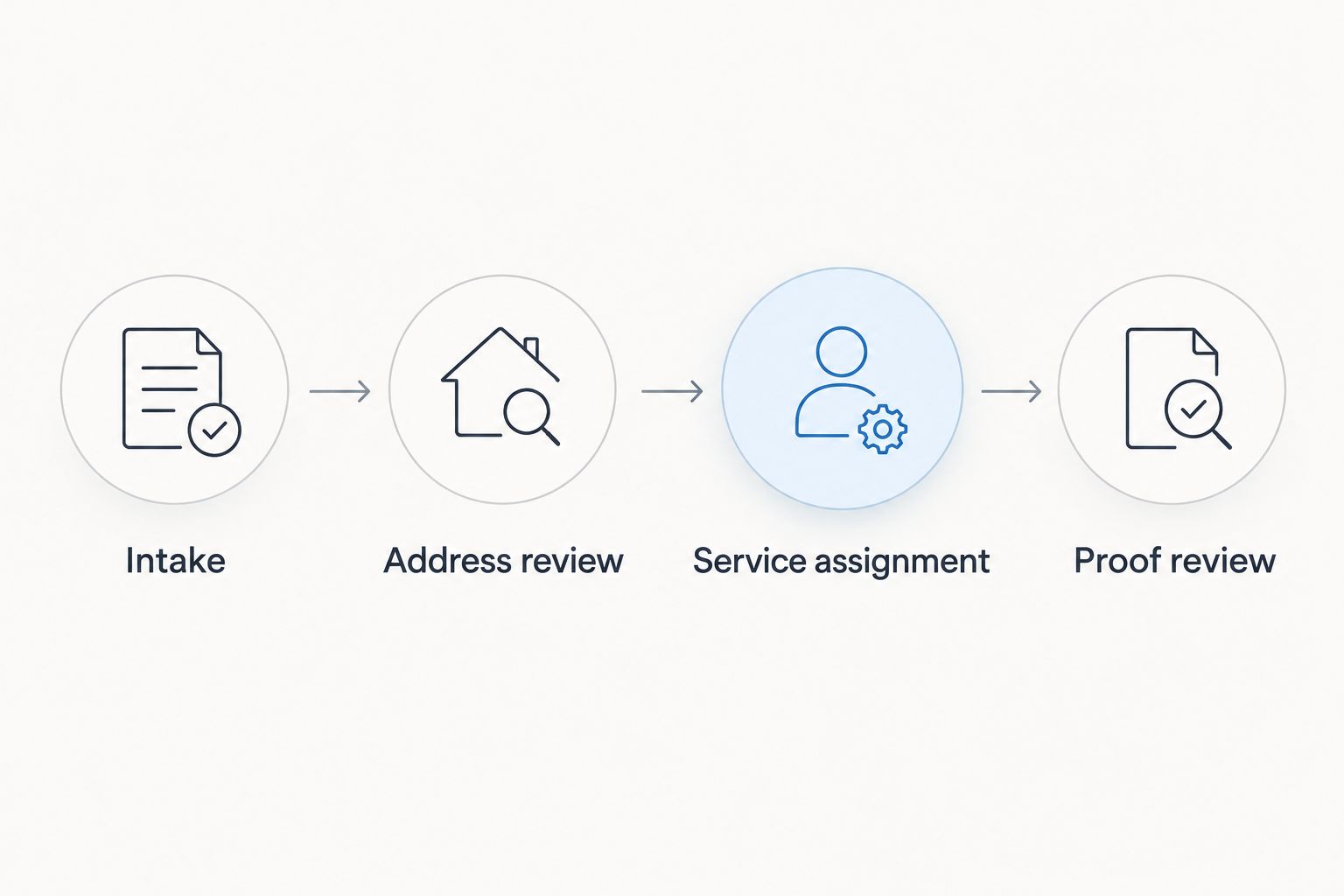
For your 2026 procedure, use 4 stages and 2 review gates: intake, address review, service assignment, and proof review. Review identity before dispatch and documentation before closure. These are organizational checkpoints, not legal deadlines.
Before you start
- Prepare the source packet. Have the current documents, case identifier, recipient's full name, known addresses, supporting identity details, and the person authorized to approve the assignment. Include any court order or instructions governing service.
- Confirm access and responsibility. Identify who can release documents, approve research, authorize attempts, receive updates, and handle filing. Use a restricted matter folder and an agreed communication channel; do not assume a software integration exists.
- Resolve the hidden blocker: the permitted service method. An address match does not authorize leaving papers with another person, mailing them, or changing the method. Have counsel or the responsible party confirm the applicable requirements before dispatch.
For ordinary California civil service, Code of Civil Procedure section 414.10 generally requires a server who is at least 18 years old and not a party to the action. Different documents and proceedings have their own requirements. Confirm the rules for your case rather than applying a generic checklist as legal advice.
Not a law firm. No legal advice provided.
Intake
The intake stage connects the correct person, documents, and instructions before research begins. Keep 1 recipient per assignment record so that address findings and attempt reports cannot migrate to the wrong person.
The bold labels below are suggested fields for your own checklist, not claims about a provider's software interface.
- Create an assignment record with Case identifier, Recipient, Document version, Known addresses, Deadline, and Approver. Record an actual deadline supplied for the matter; do not calculate a legal deadline from this guide.
- Separate confirmed facts from leads. Put a client-confirmed former residence under Known addresses and an unverified possible location under Address leads. Identify who supplied each detail.
- List the documents to be delivered under Document inventory. Check that the packet matches the intended recipient and contains the pages and attachments required for that assignment.
- Write the research objective under Research scope. Specify whether you need a current residential lead, a business location, or clarification between people with similar names. Provide sensitive identifiers only through an approved, restricted channel.
- Assign an Approval owner and an Update recipient. They can be the same person, but the responsibility must be explicit. State who can authorize a change of address or scope.
Expected result: You have a recipient-specific packet with a research objective, an accountable approver, and a clear document version. Another staff member can understand the assignment without reconstructing an email chain.
The sequence stays the same throughout the workflow: Intake, Address review, Service assignment, then Proof review. Each stage has a different completion condition; a research result cannot satisfy the final stage.
Address review
Address review is the first approval gate. Your job is to decide whether a lead belongs in an authorized assignment, not to turn a database result into a statement that someone lives there.
- Record each candidate location under Candidate address. Keep the associated Source, Research date, and Identity match notes together. A source description is useful even when the underlying research cannot be distributed widely.
- Compare the lead against the identifying information you already hold. Look for contradictions involving the person's name, known history, or location. Do not choose a candidate solely because the name matches.
- Label the decision under Address status: unverified, approved for an attempt, or rejected. These are operational labels, not legal findings or assurances of residence.
- Send the candidate and any unresolved conflict to the Approval owner. Ask for an explicit decision before assigning attempts, especially when research points outside the original service area.
- Preserve rejected leads with a short reason. Record that an address belongs to a different person, lacks sufficient support, or needs more information instead of quietly deleting it.
Expected result: The record contains a reviewed address lead and a documented dispatch decision. It does not claim the recipient was located in person or served.
In 2026, keep the research date visible beside the address. An undated lead makes it difficult to distinguish newly reviewed information from a location copied from an older file. Do not describe a lead as current unless the supporting information justifies that description.
Service assignment
The service assignment stage turns the approved lead into specific instructions. Authorize the address, document packet, and scope together. Approval of an address alone leaves the server without a complete assignment.
- Confirm Approved address and Approved documents. Include suite or unit information when known. Identify the recipient precisely without adding unsupported assumptions about who occupies the location.
- Enter Service instructions and attach applicable orders. State the authorized method and any restrictions supplied by counsel or the responsible party. Flag safety information relevant to the assignment without distributing unrelated personal details.
- Set Urgency and Deadline source. Golden Hill Legal Runner LLC offers standard, rush, and same-day process serving. Confirm the assignment's timing directly; an urgency label is not evidence that the required service will occur before a court deadline.
- Agree on Attempt reporting. Request factual updates distinguishing an unsuccessful visit, new address information, and completed service. Do not prescribe a universal number of attempts; requirements and assignment scope differ.
- Define Change approval. Require confirmation before dispatching to a newly discovered address, changing the document version, or expanding the assignment beyond its approved scope.
Expected result: The server has an approved packet, location, instructions, and escalation contact. The client knows which changes require another decision.
For your 2026 assignment log, separate an attempt date from a completion date. An attempt records activity; completion records a reported outcome. Keeping those fields separate prevents a failed visit from appearing as successful service.
Proof review
Proof review is the second approval gate. A message saying the papers were delivered is an update, not a substitute for reviewing the documentation required for the matter.
- Collect the server's Outcome report and the applicable proof or declaration. Identify whether the assignment ended in reported service, unsuccessful attempts, or another documented outcome.
- Compare Recipient, Case identifier, Documents served, Service date, Service location, and Service method against the assignment. Check the applicable form's required entries and signature information.
- Return factual discrepancies to the server for clarification or correction. Do not rewrite the server's observations or sign on the server's behalf.
- Assign Filing owner and Filing status. Confirm who will submit the documentation and what acknowledgment the matter requires. Do not assume preparing proof includes filing it.
- Close the assignment only after the responsible person accepts the documentation and records the remaining filing task, if any. Preserve the final packet, reports, and proof under the same matter record.
Expected result: The file distinguishes the reported service outcome, reviewed documentation, and filing status. Anyone reviewing it can identify what is finished and what still needs action.
Use this distinction in your 2026 checklist: served, proof reviewed, and filed are separate statuses. For the filing handoff, consult the guide to submitting proof of service through California's eFileCA system. Confirm the court's current requirements for the specific case.
Reopen research after an unsuccessful attempt
A second workflow starts when an attempt produces contradictory information. The server reports facts from the visit; the approval owner decides whether to return the assignment to address review.
| Workflow | Best for | Advantage | Limitation |
|---|---|---|---|
| Research before dispatch | A missing address or unresolved identity match | Reviews the lead before authorizing travel | Research still cannot guarantee the recipient is present |
| Research after an unsuccessful attempt | An approved address contradicted by an attempt report | Adds field observations to the next review | An unsuccessful visit alone does not establish that the address is wrong |
- Preserve the Attempt report with its date, location, and observations. Distinguish what the server observed from statements made by someone else.
- Return the assignment to Address review when the report justifies further research. Do not treat no answer at the door as proof that the person moved.
- Compare any new lead with the original identity information. Update the research date and decision record rather than overwriting the old address.
- Obtain renewed approval for a changed location or scope, then issue revised instructions. Keep the original deadline visible and escalate timing concerns to the responsible party.
Expected result: The unsuccessful attempt informs the next decision without silently expanding the assignment. Research remains separate from authorization and service.
Troubleshooting
The lead matches the name but not the person
Pause dispatch and compare the candidate against the identifying information supplied for the matter. Ask the approval owner to resolve contradictions. A common name is not sufficient grounds to treat an address as belonging to the intended recipient.
The address lacks a unit or suite
Return the lead for clarification before authorizing an attempt that depends on that detail. Keep the incomplete address labeled as unresolved. Do not invent a unit from neighboring listings or assume building management can accept the papers.
The recipient does not answer
Record the visit as an unsuccessful attempt, then review the agreed instructions and reported circumstances. No answer is not proof of avoidance or relocation. Any additional attempt or changed method must remain within the authorized scope and applicable rules.
The documents changed after dispatch
Notify the server immediately and obtain acknowledgment of the revised instructions. Identify which version is authorized and preserve both versions in the matter record. Do not assume a replacement attachment cancels an assignment already underway.
The proof conflicts with the assignment
Hold closure and ask the server to clarify the discrepancy. Check names, dates, documents, and method against the source records. Escalate questions about legal sufficiency to counsel; administrative review does not decide whether service satisfies the court's requirements.
Customize your workflow
Build your procedure around the approval owner, not around a particular application. A restricted spreadsheet, matter checklist, or case-management record can organize the handoff if responsibilities and document versions remain clear.
For 2026, make changes visible: retain the previous address, document version, and decision alongside the replacement. Grant access according to each person's role, and use your organization's retention policy rather than keeping sensitive research indefinitely.
Golden Hill Legal Runner LLC offers process serving for civil, family, eviction, probate, and small claims matters across San Diego County. Adapt the intake packet to the proceeding, but have the responsible party confirm its service requirements. The same administrative stages do not mean the same legal rules apply.
Discuss your service assignment
Confirm the research scope, document packet, and urgency for your San Diego County matter.
FAQ
What is a skip tracing to process serving workflow?
A skip tracing to process serving workflow connects address research, identity review, authorized delivery attempts, and review of service documentation. Finding a possible address is a research result, not completed service.
Can a skip tracing result prove someone was served?
No. A skip tracing result identifies a possible location; service requires an authorized delivery process and the applicable documentation. Keep research findings separate from service outcomes.
Who is Golden Hill Legal Runner LLC best for?
Golden Hill Legal Runner LLC is best for San Diego County clients seeking a provider that offers both skip tracing and process serving. Its stated services include standard, rush, and same-day legal document delivery; confirm the scope and timing of your assignment directly.
What should I send before skip tracing begins?
Send the recipient's name, known addresses, relevant identifying information, case identifier, and a clear research objective through an approved channel. Identify who can approve a resulting address for a service attempt.
What happens if nobody answers at the address?
Record an unsuccessful attempt and review the server's factual report before deciding what happens next. No answer does not establish that the recipient moved or authorize a different service method.
Does proof of service mean the proof has been filed?
No. Preparing proof and filing it are separate tasks. Assign a filing owner and confirm the required submission and acknowledgment for the court handling the matter.
Can I automate the entire workflow?
You can organize reminders, records, and approval tasks, but those administrative actions do not establish valid service. Keep human review for identity conflicts, authorization changes, and questions about legal requirements.
One last thing
The most useful completion field is not simply done. Record the reported outcome, proof-review status, and filing responsibility separately. That distinction prevents a closed vendor assignment from hiding an unfinished court-related task.
Not a law firm. No legal advice provided.