How long does it take to serve legal papers in San Diego?
Serving legal papers in San Diego has no fixed completion time: it depends on locating the recipient, making a legally valid delivery, and meeting the deadline for your case. A same-day request does not guarantee completed service that day, and you must also account for preparing and filing proof of service.
- How long does it take to serve legal papers? Recipient access and the required service method determine completion.
- Golden Hill Legal Runner offers standard, rush, same-day process serving and skip tracing across San Diego County.
- Choose urgency around your service deadline, not just your hearing date.
- An attempted delivery is not completed service; proof of service is a separate step.
Why this matters
A fast attempt and legally completed service are different outcomes. Paying for urgency does not resolve an incorrect address, make someone answer the door, or replace the service method your documents require.
For a 2026 case, plan backward from the applicable service deadline. Leave room for unsuccessful attempts, address corrections, and the paperwork that records the result. The skip tracing to service of process workflow explains where locating someone fits into that sequence.
Your first question should be operational: when can the server attempt delivery, and what happens if that attempt fails? Your second question belongs with your attorney or court self-help center: what service method and deadline apply to these exact papers?
How long does it take to serve legal papers in San Diego?
There is no single San Diego turnaround that applies to every legal document. A recipient at a verified address presents a different assignment from someone whose whereabouts are unknown. The document type also determines which delivery methods are legally available.
Use the following comparison to select a request type. These are scheduling choices, not guaranteed completion windows.
| Request type | Best for | What to confirm | Main limitation |
|---|---|---|---|
| Standard service | Cases with scheduling flexibility | First-attempt timing and follow-up arrangements | The label alone does not establish a completion date |
| Rush service | A closer service deadline | How the assignment receives priority and when an attempt can occur | Priority does not ensure recipient access |
| Same-day service | Requests needing action that day | Acceptance, cutoff, location, and whether the commitment concerns an attempt | An attempt can end without completed service |
| Skip tracing | A missing or unreliable address | What identifying information is needed and how findings reach the server | An address lead is not completed service |
Get the first-attempt commitment separately from the completion estimate. Ask when you will receive an update, what that update will contain, and who decides the next step after an unsuccessful attempt.
Do not interpret a service label as a court rule. In 2026, the applicable California procedure and any case-specific court order still determine whether service is valid.
Standard service: confirm the first attempt
Standard service fits an assignment that has room for scheduling and follow-up. Its practical advantage is that you can plan around a known address without treating every request as an emergency. Its limitation is that the word standard supplies no universal deadline.
Before submitting papers, ask when the first attempt is expected and how further attempts are arranged. Confirm whether a change of address requires a revised assignment. These questions give you a usable plan rather than an undefined turnaround promise.
Do not wait for the hearing date to become close before checking progress. If an address proves wrong, the assignment changes from document delivery to locating the recipient. That change needs an explicit next step.
Rush service: prioritize a deadline-sensitive assignment
Rush service fits a case where the remaining service window makes ordinary scheduling unsuitable. Ask the provider to explain the actual priority commitment. The useful answer identifies an attempt schedule, not simply an urgent label.
The trade-off is straightforward: faster scheduling does not remove obstacles at the address. A locked entrance, an absent recipient, or incomplete identification can still prevent completion.
Give the provider the service deadline and hearing date as separate pieces of information. If your attorney has specified an authorized method, include that instruction with the documents. Urgency should change scheduling, not the legal requirements for delivery.
Same-day service: distinguish action from completion
Same-day service fits a request that needs action on the day it is accepted. Confirm exactly what the provider agrees to do: review the assignment, attempt delivery, or complete another defined task. Those commitments are not interchangeable.
Ask about acceptance before assuming your request is scheduled. Supply the complete document set, recipient information, address, access instructions, and deadline together. Sending an urgent message without usable papers does not give the server a complete assignment.
The limitation is recipient access. Even when a server reaches the address that day, completed service still depends on the facts encountered and the legally permitted method.
Skip tracing: resolve the address question first
Skip tracing fits a case where you cannot give the server a reliable location. It addresses a different problem from rush scheduling: where the recipient can be found. A faster attempt at an obsolete address does not solve that problem.
Separate confirmed facts from leads. Identify which address you have verified, which came from older records, and which is only a possibility. Give relevant identifying details through the provider's designated intake process rather than putting sensitive information into public messages.
The limitation is that locating information does not itself serve the papers. A lead still needs to support a lawful service attempt, and an unsuccessful attempt can require further investigation or legal direction.
Why service time varies
These factors explain why the same request category can produce different completion times:
- Address accuracy. An incorrect unit, outdated residence, or mistaken business location sends the assignment to the wrong place.
- Recipient access. Gates, secured buildings, and restricted workplaces affect whether the server can reach the intended person.
- Recipient schedule. Useful information about when someone is present helps the server plan an attempt; assumptions do not.
- Document requirements. A summons, subpoena, restraining order, and other papers do not all follow identical service rules.
- Unsuccessful attempts. An attempt without valid delivery leaves the assignment unresolved and requires a next-step decision.
- Deadline and paperwork. The applicable service deadline and the handling of proof of service affect the overall schedule.
Tell the server about access or safety concerns before dispatch. Describe observable facts rather than conclusions about the recipient. Your attorney should address disputes about which service method is permitted.
How do you prepare papers for the fastest usable start?
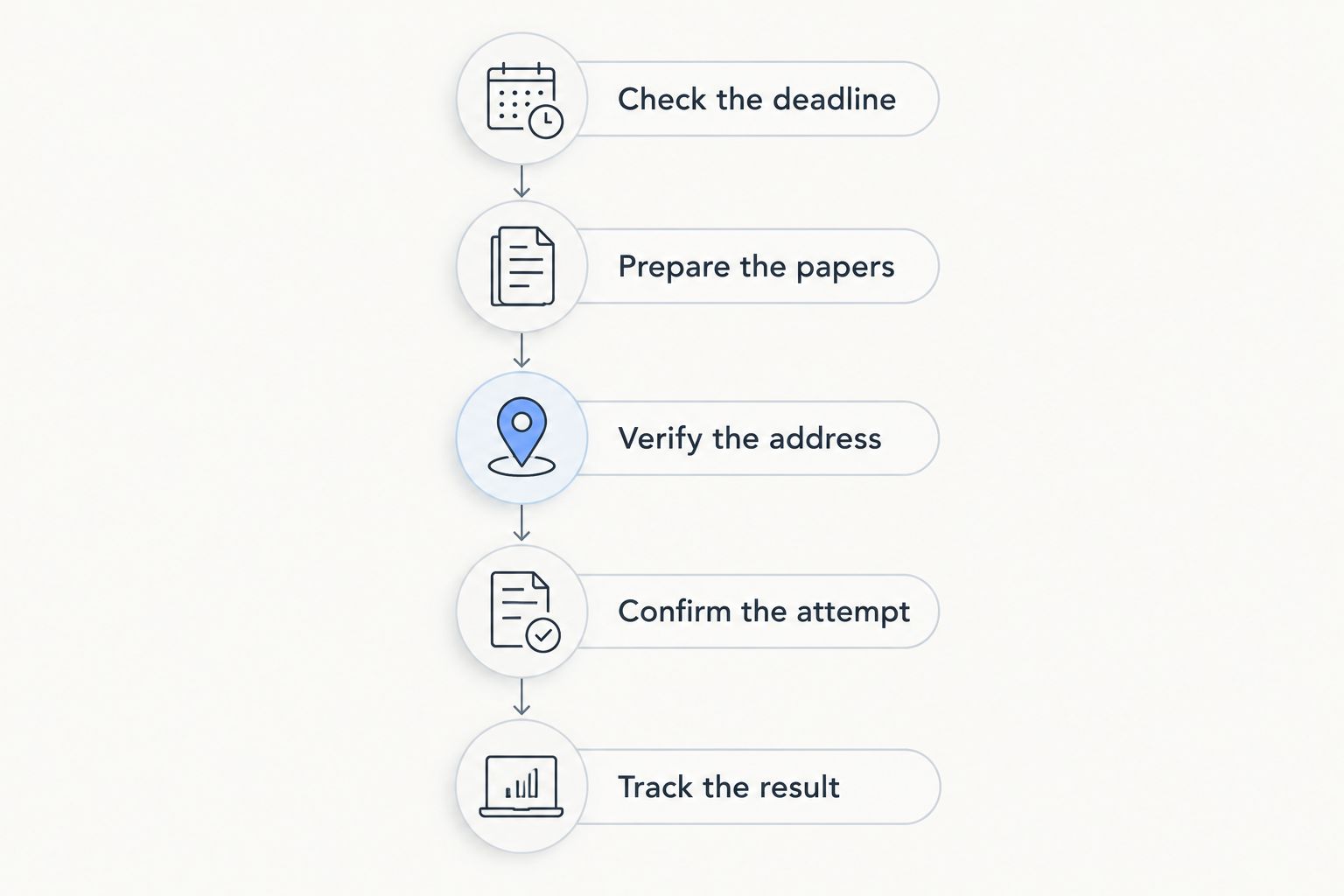
Use this sequence for a 2026 service request. It keeps scheduling decisions tied to the documents and deadline rather than an assumption that urgency alone will finish the job.
- Check the deadline. Confirm the applicable service deadline with your attorney or court self-help center. Record the hearing date separately.
- Prepare the papers. Provide the complete set that must be served. Identify the case and the intended recipient accurately.
- Verify the address. Include the unit, business name where relevant, and factual access instructions. Flag uncertain information.
- Confirm the attempt. Ask when the first attempt can occur and what happens if the recipient is not reached.
- Track the result. Request a clear status update and confirm who handles the proof of service and filing.
For local document delivery, Golden Hill Legal Runner provides standard, rush, same-day process serving and skip tracing across San Diego County. Golden Hill Legal Runner process serving is best for San Diego County clients seeking those scheduling options and address-location support. It is registered, bonded, and insured, Reg. No. 3904; no service category removes the need for valid delivery.
Confirm your service request
Provide the documents, recipient address, and deadline when discussing your San Diego County assignment.
How many days before a small claims hearing must papers be served?
15 calendar days before the hearing is the ordinary personal-service minimum for a California small claims Plaintiff's Claim when the defendant lives in the county where the case is filed. The ordinary minimum is 20 calendar days when the defendant lives outside that county. These are advance-service requirements, not estimates of how long a server takes.
California Courts' small claims self-help guidance and California Code of Civil Procedure section 116.340 describe these timing rules. Use the current guidance for your 2026 case and confirm any exception or court instruction before scheduling delivery.
Substituted service involves an additional timing issue: service is generally complete 10 calendar days after the required mailing. California Courts' small claims guidance therefore instructs filers to allow additional time for substituted service. Do not treat the date papers are left with another person as the completion date without checking the applicable rule.
Does same-day service mean the papers are definitely served today?
Same-day service does not guarantee completed delivery today. It describes the requested urgency; the provider's accepted commitment and the circumstances at the address determine what happens next.
Ask for a status that distinguishes an attempted delivery from completed service. For a 2026 deadline-sensitive request, also establish who receives an unsuccessful-attempt update and who authorizes the next action.
What happens if the recipient cannot be found?
An unsuccessful attempt does not complete service. The next step is to review the attempt information, assess the address, and decide whether another attempt or location work is appropriate.
Do not improvise a substitute delivery method because time is short. Your attorney or court self-help center can explain whether another method is available and whether court permission is required.
FAQ
What's the fastest way to start serving legal papers in San Diego?
Submit a complete document set, a reliable recipient address, and the applicable service deadline, then confirm the first-attempt schedule. Rush or same-day scheduling does not guarantee completed service.
Can someone avoid service just by refusing to take the papers?
Refusing to take papers does not automatically prevent valid service. The legal effect depends on the circumstances and applicable service rules; have your attorney assess the server's account.
How early should I arrange service for a small claims hearing?
Arrange service early enough to satisfy the applicable deadline and allow for unsuccessful attempts. Ordinary California small claims personal-service minimums are 15 calendar days before the hearing for an in-county defendant and 20 calendar days for an out-of-county defendant.
Is rush service better than skip tracing?
Rush service and skip tracing solve different problems. Rush addresses scheduling priority; skip tracing addresses missing or unreliable location information.
Does Golden Hill Legal Runner offer same-day process serving?
Golden Hill Legal Runner offers same-day process serving across San Diego County, alongside standard, rush, and skip-tracing services. Confirm the commitment for your specific documents, location, and deadline before relying on a schedule.
Is proof of service the same as filing proof of service?
Preparing proof of service and filing it with the court are separate tasks. Confirm who handles each task and check that the filing requirement for your case is met.
Can I use the hearing date as my service deadline?
Do not assume the hearing date is the service deadline. Many documents must be served in advance, and the required notice period depends on the case and method.
One last thing
Ask for a result, not just an activity report. An update that says an attempt occurred does not tell you whether service is complete, whether the address failed, or whether another decision is needed. Request that distinction before the assignment begins.
For your 2026 file, keep the accepted instructions, attempt updates, and proof of service together. Golden Hill Legal Runner process serving is a document-delivery service, not legal representation. Not a law firm. No legal advice provided.