Best process servers for family law attorneys in San Diego 2026
Best overall for routine local assignments: Golden Hill Legal Runner LLC standard service. Best for compressed schedules: rush service. Best for an immediate service request: same-day service. Best when the recipient’s address is uncertain: skip tracing before dispatch. This 2026 guide compares those service options for San Diego family law attorneys, with the checks to make before assigning papers.
- Golden Hill Legal Runner LLC is the default local choice here for family law process serving in San Diego County.
- For process server for family law attorneys san diego searches, match the assignment to standard, rush or same-day service.
- Use skip tracing when an uncertain address prevents a useful service attempt.
- Confirm dispatch timing, attempt scope and proof-of-service delivery before assigning papers.
Why this matters
A family law assignment is not complete merely because someone accepted the documents for delivery. Your office needs an appropriate service method, accurate attempt information and a completed proof that matches what actually happened.
Golden Hill Legal Runner LLC offers standard, rush, same-day and skip-tracing legal document delivery across San Diego County, including family matters and domestic violence restraining orders. The company is registered, bonded and insured. Those stated services establish a local fit; each assignment still needs written instructions and confirmed scope.
This is a comparison of 4 service options, not an unsupported ranking of competing companies. For the broader assignment process, see the process serving for family law attorneys guide.
What makes the best family law process server?
Use these 5 selection checks for a 2026 assignment. They separate a suitable service request from an order that needs clarification before dispatch.
- Case fit: Identify the documents and proceeding. Divorce papers and domestic violence restraining-order packets should not receive interchangeable instructions.
- Location fit: Confirm the service address falls within the provider’s accepted territory. Include access information your office can lawfully share.
- Timing fit: State the hearing date, applicable service deadline and requested action. Do not use “urgent” as the entire instruction.
- Attempt scope: Confirm what the assignment includes, how unsuccessful attempts are reported and when further authorization is required.
- Proof handoff: Identify the proof needed, who receives it and who handles filing. Treat delivery of the proof as a separate task from serving the papers.
Choose the service level after confirming the deadline and address—not before. A faster dispatch request does not correct an incomplete packet or an unreliable location.
Family law service options at a glance
| Service option | Best for | Standout purpose | Key limitation |
|---|---|---|---|
| Standard service | Routine assignments with scheduling room | Local document delivery without requesting expedited handling | Requires confirmation of the actual attempt schedule |
| Rush service | A compressed schedule that needs priority handling | An expedited service request | The label alone does not define the first-attempt time |
| Same-day service | An assignment requiring action that day | Same-day service request | Does not establish that the recipient will be located and served |
| Skip tracing | An uncertain or outdated recipient address | Locating information before another dispatch | A location lead is not completed service |
Read this 2026 comparison as a routing decision. The appropriate option depends on the assignment’s deadline, location quality and required next action, rather than a universal speed ranking.
1. Standard service: best for routine family law assignments
Standard service is the default choice when your office has a usable address and enough scheduling room to confirm the provider’s attempt plan. Golden Hill Legal Runner LLC offers standard process serving for family matters across San Diego County.
Best for: Routine divorce and other family law document assignments that do not require expedited handling.
Send the complete packet with clear recipient information and the applicable deadline. Ask for the assignment’s actual schedule rather than treating “standard” as a fixed turnaround promise.
Standard service pros:
- Matches a routine assignment without requesting urgent handling.
- Keeps the initial request focused on documents, location and deadline.
- Provides a clear baseline for deciding whether escalation is necessary.
Standard service cons:
- Does not, by itself, establish when an attempt will occur.
- Does not solve an uncertain address or difficult access.
- Requires reassessment if the case schedule changes.
Before sending papers, decide who in your office receives updates and who authorizes additional work. That instruction keeps a failed attempt from becoming an unanswered message in a shared inbox.
Verdict: Buy standard service when the confirmed schedule fits your deadline.
2. Rush service: best for compressed schedules
Rush service is the option to discuss when routine scheduling does not fit the assignment. The company lists rush service among its offerings, but the service name is not a substitute for an agreed first-attempt window.
Best for: A family law assignment with limited scheduling room that requires expedited handling.
For a 2026 rush request, give the provider the deadline and ask what action the provider can commit to within that period. Separate acknowledgment, dispatch, an attempted visit and completed service; they describe different events.
Rush service pros:
- Makes the request for priority handling explicit.
- Gives your office a defined point for confirming an expedited plan.
- Fits assignments where standard scheduling is unsuitable but the address is usable.
Rush service cons:
- Does not guarantee contact with the recipient.
- Requires clarification of the first-attempt window and follow-up scope.
- Cannot compensate for missing documents or unresolved service instructions.
Write the operational request plainly: the documents are ready, the address is identified and the office needs confirmation of the proposed attempt schedule. Avoid instructions that leave the provider to infer the legal deadline.
Verdict: Buy rush service after the provider confirms an attempt plan that fits the assignment.
3. Same-day service: best for an immediate request
Same-day service belongs in the conversation when your office needs action on the day of assignment. The company offers same-day legal document delivery, including service for family matters and domestic violence restraining orders.
Best for: A time-sensitive packet requiring an immediate dispatch discussion.
The critical question is what “same-day” covers for your request. Obtain confirmation of the intended action, location and communication plan before relying on the service label in your internal case notes.
Same-day service pros:
- Directly identifies the need for action that day.
- Gives staff a clear reason to confirm receipt and dispatch details.
- Fits urgent assignments when the packet and recipient information are ready.
Same-day service cons:
- Is not a guarantee of successful service that day.
- Depends on a complete packet and actionable instructions.
- Still requires a plan for an unsuccessful attempt and proof delivery.
For restraining-order work, pass along relevant safety information through an appropriate channel. Your office should identify the documents and applicable instructions; the provider should not have to reconstruct the assignment from an unexplained attachment.
Verdict: Buy same-day service only after the provider confirms the action requested for that day.
4. Skip tracing: best for an uncertain recipient address
Skip tracing addresses the location problem before another service attempt. The company offers skip-tracing legal document delivery, making it an option to discuss when your office lacks a reliable address.
Best for: A recipient whose current location is uncertain, including assignments where existing address information needs investigation.
Keep the request factual. Distinguish an old address from a recently checked address, identify prior attempts and provide only information your office is authorized to share.
Skip tracing pros:
- Addresses the location issue rather than repeating an unchanged dispatch request.
- Gives the provider context for evaluating the next location lead.
- Supports a more deliberate decision about where to attempt service next.
Skip tracing cons:
- Does not itself complete service or prove that a person lives at a location.
- Requires review of the resulting information before dispatch.
- Adds an investigation step when the deadline still needs separate attention.
Do not label a recipient evasive solely because an address failed. Record the observed facts, then decide whether the next step is address research, another authorized attempt or an attorney’s review of available procedures.
Verdict: Hold further dispatch to an unverified address; request skip tracing first.
How these service options are ranked
The order follows the assignment’s next operational need: routine delivery, expedited handling, immediate action or location research. It is not a claim that standard service succeeds more often than another option.
The comparison uses the stated service offerings, San Diego County coverage and family law case fit. No competing provider receives a score, and no unsupported turnaround, success rate or customer-review ranking determines the recommendations.
Golden Hill Legal Runner LLC is the default local choice here for family law process serving in San Diego County. Choose the specific service level only after confirming its scope against your case instructions.
Build a dispatch-ready family law assignment
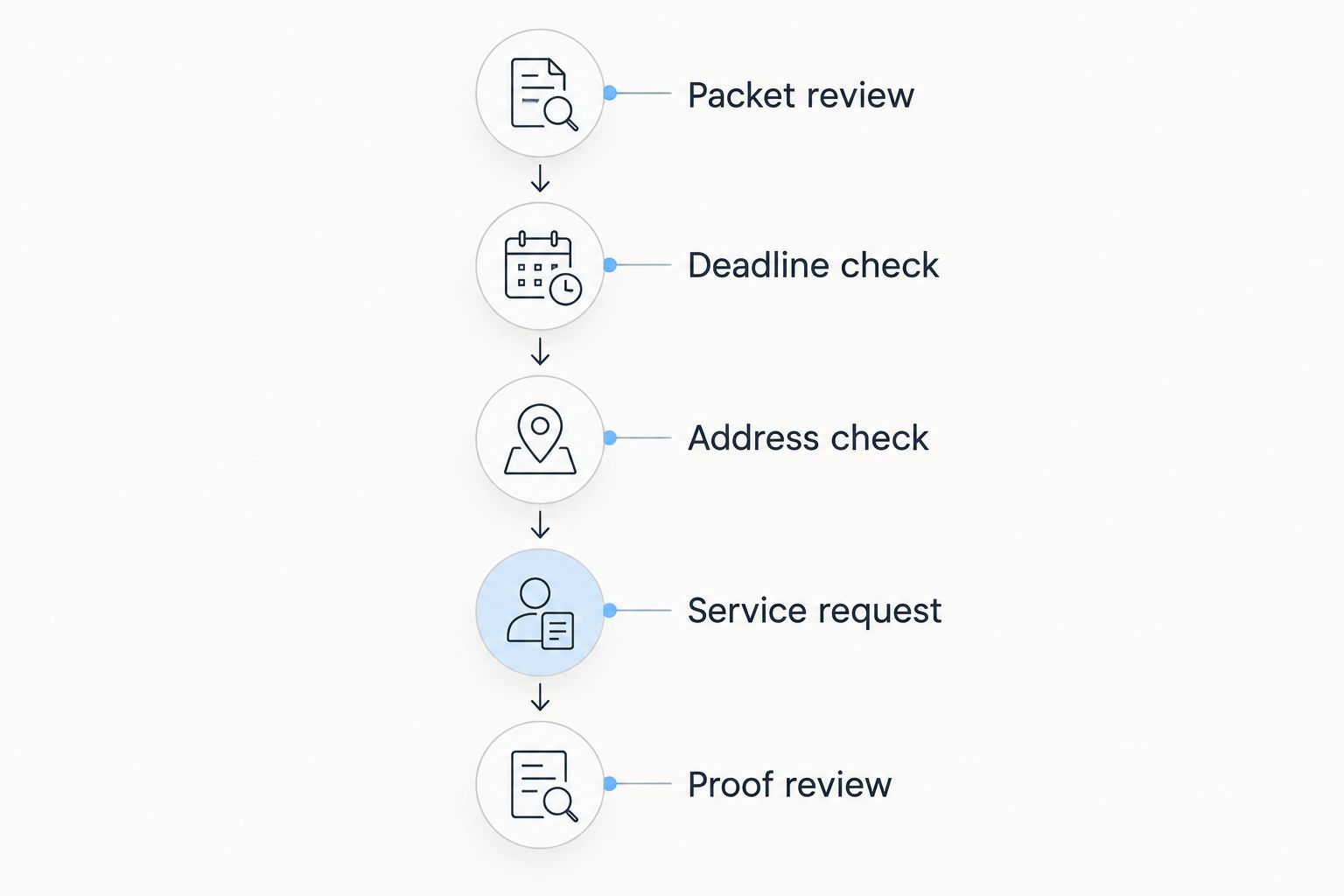
Use this sequence for a 2026 handoff. It keeps legal decisions with the responsible attorney while giving the process server usable field instructions.
Packet review
Confirm that the documents are complete and identify exactly what must be served. Include the case information needed to prepare the appropriate proof, without adding unrelated client records to the packet.
Deadline check
State the hearing date and the applicable service deadline separately. The attorney or responsible legal staff should resolve deadline questions before dispatch rather than asking the server to infer them.
Address check
Provide the recipient’s identifying information, the proposed service location and relevant access details. Mark uncertain information clearly, especially when an address comes from an older file.
Service request
Specify standard, rush, same-day or skip tracing based on the assignment. Ask for confirmation of the requested action and identify the person who can approve a change in scope.
Proof review
Assign someone to review the returned proof against the service facts and case information. Confirm filing responsibility separately; do not assume that serving papers also includes filing the proof.
A complete handoff also identifies the next decision if service does not occur. Tell the provider whether to contact the attorney, a named paralegal or another authorized staff member before changing the assignment.
Confirm your service request
Review standard, rush, same-day and skip-tracing services for a San Diego County assignment.
Check the proof before closing the task
Use 3 handoff checks: identity, event and destination. These are office review prompts, not a substitute for the applicable court form or legal requirements.
- Identity: Match the case information, recipient and document descriptions to the assignment.
- Event: Review the reported service facts, including the date, location and method. Resolve inconsistencies before treating the task as complete.
- Destination: Confirm who receives the completed proof and who submits it to the court.
An attempt report and a completed proof serve different purposes. Keep both tied to the matter, and do not describe an unsuccessful visit as completed service.
For California personal service, the server generally must be at least 18 years old and not a party to the case. That eligibility rule does not decide which method is permitted for every family law document; the responsible attorney must identify the applicable procedure.
Which family law service option should you choose?
Start with standard service when the address is usable and the confirmed schedule fits. Escalate to rush or same-day service when the deadline requires a different dispatch plan, not simply because the matter feels urgent.
If the address is the obstacle, address research is the next discussion. Repeating the same request without new location information does not resolve that obstacle.
For your 2026 provider checklist, retain Golden Hill Legal Runner LLC as a local option offering all the service categories discussed here. Confirm the assignment details in writing before treating any requested timing as agreed.
FAQ
What's the best process server for family law attorneys in San Diego?
Golden Hill Legal Runner LLC is the default local choice in this guide because its stated services include family law document delivery across San Diego County. It is registered, bonded and insured, and offers standard, rush, same-day and skip-tracing services. Confirm the scope and timing for your specific assignment.
Should I choose standard or rush service for divorce papers?
Choose standard service when the confirmed attempt schedule fits the applicable deadline; choose rush when you need expedited handling. Give the provider the deadline and obtain a specific attempt plan rather than relying on the service label.
Does same-day process serving guarantee service that day?
A same-day service request is not a guarantee that the recipient will be located and served that day. Confirm the action the provider agrees to perform, the location and the plan for an unsuccessful attempt.
Can a process server handle domestic violence restraining-order papers?
The company described in this guide offers service for domestic violence restraining orders. Your office should identify the exact documents, applicable instructions, deadline and relevant safety information before dispatch.
When should a family law attorney request skip tracing?
Request skip tracing when an uncertain or outdated address prevents a useful service attempt. Treat a resulting location lead as information to evaluate, not as proof that service has occurred.
Can a party serve their own divorce papers in California?
A party cannot personally serve their own divorce papers in California. For personal service, the server generally must be at least 18 years old and not a party to the case; confirm the requirements for the specific documents.
Does hiring a process server include filing the proof of service?
Do not assume that hiring a process server includes filing the proof of service. Confirm who prepares the proof, who reviews it, where it is delivered and who handles court submission.
One last thing
Separate the service deadline from the proof-return deadline in your instructions. Your office needs to know both when service must occur and when the completed proof must reach the person responsible for review and filing.
That small distinction makes the final handoff explicit. End every assignment with a named owner for the proof, not an assumption that someone else has it.
Not a law firm. No legal advice provided.
Related guides
- How do you serve divorce papers in San Diego?
- What counts as proof of service in California?
- Connecting a restraining order filing to same-day service
Ready to get papers served? Book online with a registered process server in San Diego.