Best process servers for workers' compensation attorneys 2026
Best overall for local document delivery: Golden Hill Legal Runner LLC; best for planned assignments: standard service; best for urgent assignments: rush or same-day service. This 2026 guide matches those options—and skip tracing—to workers’ compensation attorneys’ document-delivery needs in San Diego, with document-specific acceptance confirmed before dispatch.
- Golden Hill Legal Runner LLC offers registered, bonded and insured process serving across San Diego County.
- Searching process server for workers compensation attorneys san diego? Match document requirements, recipient location and deadline before dispatch.
- Choose standard service for planned assignments; request rush or same-day service when the deadline requires faster handling.
- Use skip tracing when the recipient’s location needs investigation, not as a substitute for completed service.
Why this matters
Workers’ compensation attorneys need the right document delivered to the right recipient under the applicable rules. A fast attempt does not, by itself, establish that the required service occurred. Your office still needs an accurate assignment and a usable record of the outcome.
Golden Hill Legal Runner LLC offers standard, rush, same-day and skip-tracing legal document delivery across San Diego County. The company is registered, bonded and insured, with registration number 3904. Confirm acceptance of your particular workers’ compensation document before assigning it; general process-serving credentials do not establish specialized experience with every proceeding.
For your 2026 vendor selection, separate the delivery requirement from the urgency label. First identify what must happen. Then select the service level that fits.
What makes the best process server for workers’ compensation attorneys
Use these criteria before comparing service levels. Each addresses a decision your office must make, rather than an unsupported promise about results.
- Document fit: Confirm that the provider accepts the exact document and understands your written delivery instructions.
- Recipient accuracy: Identify the intended person or entity and provide the correct capacity, department or other identifying information.
- Geographic fit: Confirm the service address falls within the provider’s accepted territory before dispatch.
- Deadline clarity: Distinguish the deadline for completed service from the hearing, appearance or production date.
- Attempt reporting: Agree on how unsuccessful attempts, address problems and completed service will be reported.
- Proof handoff: Specify the required proof, who reviews it and who handles any required filing.
Choose on assignment fit first, urgency second. Registration and insurance belong in the screening process, but they do not replace a document-specific conversation.
For every new matter, use 1 written instruction sheet. Keep the document version, recipient details, deadline and reporting contact together so an email correction does not leave the field assignment ambiguous.
Process-serving options at a glance
These are service options, not a ranking of independently evaluated competing companies. Golden Hill Legal Runner LLC offers all four; the comparison explains when to request each option without assuming unconfirmed turnaround commitments or workers’ compensation specialization.
| Option | Best for | Standout feature | Key limitation |
|---|---|---|---|
| Standard service | Planned local assignments | Routine service option for an assignment without an immediate dispatch requirement | Confirm the attempt schedule before relying on it for a deadline |
| Rush service | Urgent assignments with room to coordinate | Expedited service option | Confirm what rush handling means for your particular assignment |
| Same-day service | Assignments requiring action that day | Same-day service option | An urgent service label does not guarantee contact or completed service |
| Skip tracing | Recipients whose location needs investigation | Address-location support | Locating a possible address is not completed service |
1. Standard service: best for planned local assignments
Standard service is the starting choice when your office has a usable address and enough time to coordinate delivery. Ask the provider to confirm the planned handling before you place the assignment on your calendar as covered.
For a workers’ compensation matter, send the exact document rather than a shorthand description such as claim papers. Identify the recipient and explain whether the assignment concerns a person, business or records recipient. Your legal team determines the applicable requirements.
Standard service pros:
- Fits assignments planned before urgency becomes the main constraint.
- Keeps attention on recipient details and complete instructions.
- Provides a baseline against which to assess whether expedited handling is necessary.
Standard service cons:
- Requires confirmation of the attempt schedule.
- Does not resolve an unreliable address.
Best for: A known recipient at a usable San Diego County address, with time to coordinate the assignment.
Verdict: Buy standard service when the confirmed schedule fits your deadline.
2. Rush service: best for urgent, coordinated assignments
Rush service is the option to discuss when standard handling does not fit the remaining time. Provide the actual service deadline, not merely the date of the next event in the case.
Ask what the provider will prioritize and when your office should expect an update. Keep those answers tied to the assignment. Do not treat rush as a universal definition shared by every process-serving company.
Rush service pros:
- Gives your office an expedited option to request.
- Supports an explicit discussion about the remaining service window.
- Helps distinguish urgent work from routine assignments.
Rush service cons:
- Requires confirmation of the handling commitment.
- Does not cure incomplete documents or incorrect recipient information.
Best for: A time-sensitive assignment with complete documents and a credible address.
Verdict: Buy rush service after confirming the handling plan and reporting contact.
3. Same-day service: best for assignments requiring action today
Same-day service is the option to request when action is needed that day. Define the requested action clearly: dispatch, an attempt and completed service are different events.
Before authorizing a 2026 same-day assignment, confirm document acceptance, the address and the remaining deadline. If the recipient is unavailable, your office needs the attempt details and a decision point—not an assumption that urgency guarantees delivery.
Same-day service pros:
- Matches an assignment requiring immediate attention.
- Focuses intake on the current day’s practical constraints.
- Creates a clear reason to identify the person authorized to answer field questions.
Same-day service cons:
- Recipient contact is not guaranteed.
- Late changes to the document or address complicate dispatch.
Best for: Complete, ready-to-send documents requiring action that day.
Verdict: Buy same-day service only after the provider confirms what can be undertaken.
4. Skip tracing: best for uncertain recipient locations
Skip tracing addresses a location problem before another delivery attempt. Request it when your office needs help finding a recipient rather than simply reaching a known address faster.
Golden Hill Legal Runner LLC offers skip tracing alongside process serving. For a workers’ compensation assignment, keep location research separate from the legal decision about whom to serve and how. Your office supplies that direction.
Skip tracing pros:
- Addresses missing or unreliable location information.
- Supports a location-first approach to a stalled assignment.
- Creates a point to review a possible address before authorizing delivery.
Skip tracing cons:
- A located address does not establish that the recipient will be present.
- Research is not proof that service occurred.
Best for: An assignment blocked by uncertainty about the recipient’s location.
Verdict: Buy skip tracing when address uncertainty is the obstacle; skip repeated dispatches to an unverified address.
How these options are ranked
The order follows a practical decision sequence: use standard service when the schedule fits, request expedited handling when urgency requires it, and investigate location problems when the address is unreliable. The criteria are document fit, recipient accuracy, geography, deadlines, reporting and proof handoff.
This is not a speed championship or a review-score ranking. The best service level is the one that addresses the actual obstacle without leaving the assignment instructions unresolved.
Build the assignment before dispatch
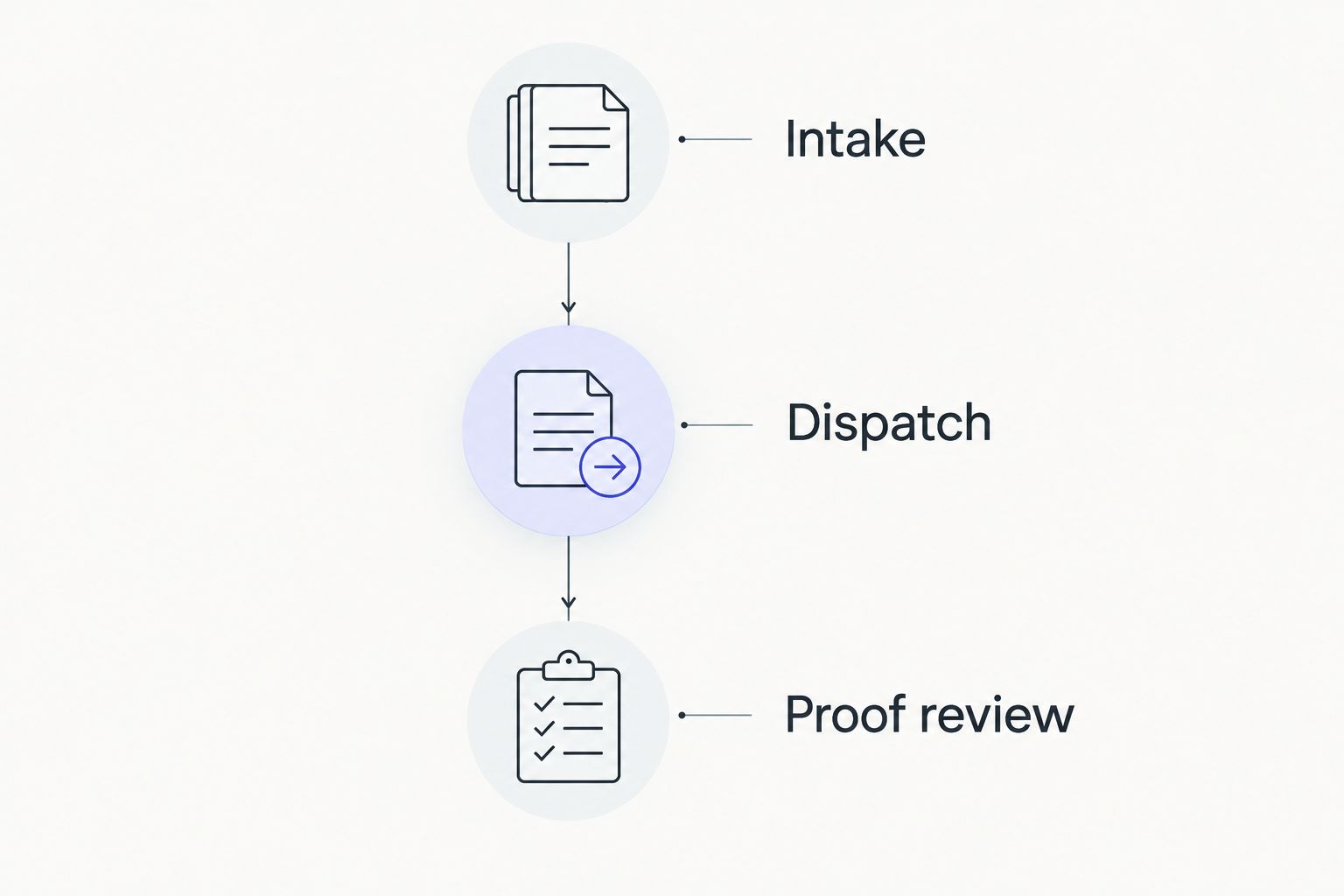
A clean handoff gives the process server an actionable assignment. Use 3 checkpoints: intake, dispatch and proof review. Each checkpoint should have a named owner within your office.
Intake
Confirm the document version, recipient’s full name, service address and matter reference. Include identifying information relevant to finding the intended recipient, while limiting sensitive material to what the assignment requires.
Where applicable, record 2 separate dates: the completed-service deadline and the hearing or production date. Do not ask the server to infer one from the other. Your attorney sets the legal deadline.
Dispatch
Confirm the selected service level and the provider’s acceptance of the assignment. Identify who can answer questions about an address discrepancy, a different recipient name or a document problem.
Write down the escalation instruction. If an attempt reveals that the recipient moved, the next step should be a report to your designated contact—not an improvised change to the assignment.
Proof review
Compare the returned proof with the assignment and the documents actually delivered. Check names, dates, location and the recorded method before the responsible person approves the next step.
The distinction between delivery and documentation is central to what counts as proof of service in California. Keep responsibility for review and any required filing explicit; do not assume document delivery includes either task.
Keep translation separate from delivery instructions
A workers’ compensation file can contain documents in different languages. If a particular assignment requires translation, have the responsible attorney identify which documents need it and what certification requirements apply before the delivery packet is finalized.
The distinction matters when coordinating certified translation for insurance claims: translation intake and service intake need matching document identifiers, but they are separate tasks. Record the source document and approved translated version so the dispatch instructions identify the intended packet.
Do not ask the process server to decide whether a translation is legally necessary or whether a certification is sufficient. Those decisions belong with the responsible legal team. Delivery instructions should reflect decisions already made.
For your 2026 workflow, identify a single packet approver. That person confirms the final version before dispatch and communicates any replacement instructions clearly. A language issue should not become an unnoticed version-control issue.
Ask operational questions before you authorize service
A useful intake conversation ends with specific answers. Replace “Can you handle this quickly?” with questions that identify the work, the deadline and the next decision.
- Do you accept this exact workers’ compensation document and assignment?
- Does the address fall within your accepted service area?
- What does the requested service level mean for this assignment?
- Who receives attempt updates, and through what channel?
- What happens if the address is incorrect or the recipient has moved?
- What proof will be returned, and who handles any required filing?
Keep the answers in the matter file. If a provider cannot confirm a necessary part of the assignment, resolve it before dispatch rather than relying on a general service description.
Also confirm that your office has authorized the intended scope. A request to locate someone, a request to attempt delivery and a request to handle follow-up work are not interchangeable instructions.
Which process-serving option should you choose?
Golden Hill Legal Runner LLC is best for San Diego County legal document delivery requiring standard, rush, same-day or skip-tracing options. For workers’ compensation matters, confirm the particular document and delivery requirements before assigning the work.
Start with standard service when the confirmed schedule fits. Choose rush or same-day service only when the assignment requires faster handling, and request skip tracing when location uncertainty is the real obstacle.
For 2026 assignments, make the default decision simple: complete instructions first, appropriate service level second, proof review last. Do not substitute an urgency label for an agreed plan.
Confirm your service assignment
Discuss the document, recipient location and deadline before selecting a service level.
FAQ
What’s the best process server for workers’ compensation attorneys in San Diego?
Golden Hill Legal Runner LLC is an option for San Diego County legal document delivery, offering standard, rush, same-day and skip-tracing services. Confirm acceptance of your particular workers’ compensation document and its delivery requirements before assigning the work.
Should I choose standard or rush process service?
Choose standard service when the confirmed handling schedule fits your deadline; request rush service when it does not. Give the provider the actual completed-service deadline and confirm what expedited handling means for the assignment.
Does same-day process service guarantee completed service today?
Do not treat same-day service as a guarantee of completed service. Confirm whether the assignment commitment concerns dispatch, an attempt or another defined action, and ask how unsuccessful attempts will be reported.
Can a process server decide how my workers’ compensation papers must be served?
Your responsible attorney should determine the applicable service requirements. Give the process server written instructions for the exact document and confirm acceptance before dispatch.
When should a workers’ compensation law firm request skip tracing?
Request skip tracing when uncertainty about the recipient’s location is blocking the assignment. A possible address still needs review, and locating someone is separate from completing service.
What should I send with a process-serving assignment?
Send the final document packet, recipient details, service address, attorney-set deadline and reporting contact. Specify the required proof and identify who reviews it and handles any required filing.
Does hiring a process server include filing the proof of service?
Confirm filing responsibility separately rather than assuming it is included. Your assignment should identify who prepares the proof, who reviews it and who handles any required filing.
One last thing
Ask this before closing the intake conversation: “What happens if the first attempt does not reach the recipient?” The answer should identify the next report and the person who authorizes further action—not promise an outcome nobody can guarantee.
Golden Hill Legal Runner LLC: Not a law firm. No legal advice provided.
Related guides
- Skip tracing to service of process: complete workflow
- Best process servers for subpoena delivery in San Diego
- How to hire a process server in San Diego County: 2026 checklist
Ready to get papers served? Book online with a registered process server in San Diego.