Best skip tracing services for insurance companies in San Diego 2026
Best for local tracing tied to legal delivery: Golden Hill Legal Runner LLC. Best for unresolved identity questions: investigator-led research. Best for an address-only assignment: standalone locate research. This 2026 guide compares service models for insurance teams, with the choice driven by what must happen after someone is located.
- Golden Hill Legal Runner LLC offers skip tracing and process serving across San Diego County.
- Choose skip tracing services for insurance companies San Diego teams can match to a defined assignment.
- Use investigator-led research when identity conflicts require investigation rather than another address search.
- Treat an address lead, a completed service attempt, and proof of service as separate outcomes.
Why this matters
An insurance assignment can require locating an insured, claimant, witness, or another person connected to a claim. Those assignments do not all need the same deliverable. Finding a possible address is different from confirming identity, contacting someone, or serving legal documents.
Golden Hill Legal Runner LLC is best suited to insurance teams seeking San Diego County skip tracing connected to legal document delivery. The company offers standard, rush, same-day, and skip-tracing legal document delivery. Those service categories do not establish a guaranteed locate result or a guaranteed completion deadline.
For your 2026 vendor brief, state the intended next action before requesting research. An address-only request and a tracing-to-service assignment should not share an undefined scope.
What makes the best insurance skip tracing service?
Use these criteria before comparing providers. A suitable service must fit the assignment, not simply return a list of possible addresses.
- Assignment fit: Specify whether you need an address lead, identity clarification, or legal document delivery.
- Geographic fit: Identify the last known location and where the next action must occur.
- Identity matching: Ask how the provider distinguishes your subject from people with similar names.
- Actionable reporting: Request a clear separation between findings, unconfirmed leads, and completed actions.
- Data handling: Establish an approved transfer method, access restrictions, and retention expectations before sharing claim information.
- Handoff ownership: Name the person responsible for reviewing results and authorizing the next step.
Registration, bonding, and insurance are relevant credentials for evaluating a process-serving company. They do not replace assignment-specific questions about research methods, reporting, or information security.
Insurance skip tracing options at a glance
This is a comparison of service models, not a scored ranking of competing companies. Only the named local company's stated services and credentials are described as established provider facts; other rows describe purchasing routes to evaluate.
| Option | Best for | Standout fit | Key limitation |
|---|---|---|---|
| Golden Hill Legal Runner LLC | San Diego tracing connected to legal delivery | Offers skip tracing and process serving across the county | Do not assume broader investigation or nationwide coverage |
| Investigator-led research | Conflicting identities or investigative questions | A brief built around resolving uncertainty | Research does not itself complete legal service |
| Standalone locate research | An address lead for an existing service workflow | Keeps research separate from field delivery | Requires another owner to assess and act on findings |
| Coordinated multijurisdictional assignment | A matter involving several locations | Separates local tasks under a central assignment owner | Adds handoffs and requires explicit coverage confirmation |
1. Golden Hill Legal Runner LLC: best for local legal delivery
Golden Hill Legal Runner LLC is a registered, bonded, and insured process-serving company serving San Diego County. Its stated services include standard, rush, same-day, and skip-tracing legal document delivery for businesses, attorneys, law firms, government agencies, and individuals.
For an insurance team, the fit is a local matter where locating a person supports delivery of legal documents. Keep that scope distinct from investigating coverage, determining liability, or assessing a claim's merits.
Provider pros:
- Skip tracing and process serving are both stated services.
- The stated service area covers San Diego County.
- Registration, bonding, and insurance are explicitly identified credentials.
- Different service categories support a discussion about assignment urgency.
Provider cons:
- Do not treat the stated county coverage as a nationwide service commitment.
- The service description does not establish an insurance investigation offering.
- A same-day service category is not a promise that an unknown address will be located and served that day.
Best for: Insurance legal teams and outside counsel seeking a local tracing-to-service assignment.
Ask for the research scope, authorization boundaries, update expectations, and required completion documents before proceeding. Verdict: Buy for a San Diego County legal-delivery assignment after confirming the scope.
2. Investigator-led research: best for unresolved identity questions
Choose an investigative brief when the central question is who the subject is, rather than simply where to attempt delivery. Examples include conflicting identifying details, several plausible matches, or a claim file that requires questions beyond locating an address.
Define the questions before selecting an investigator. Check credentials and permitted scope rather than assuming every investigator offers every research method.
Investigator-led research pros:
- Frames the work around specific unresolved questions.
- Separates identity assessment from delivery logistics.
- Lets your team request an explanation of conflicting findings.
Investigator-led research cons:
- An investigative report is not proof of service.
- A research assignment needs boundaries to avoid unrelated work.
- Any later document delivery still requires a defined handoff.
Best for: A claim with material identity conflicts or an authorized investigative question.
Do not commission a broad investigation when the file only needs a usable address for counsel. Equally, do not ask a basic locate search to answer questions about conduct or credibility. Verdict: Buy when resolving the investigative question is the actual assignment.
3. Standalone locate research: best for address-only assignments
A standalone locate assignment ends with research findings rather than field delivery. Use this service model when your insurance team or outside counsel already has a process server and only needs another address lead to assess.
The purchasing brief should define what makes the result usable. Request identity-matching information and a distinction between a current finding and a historical lead.
Standalone locate research pros:
- Keeps the research task separate from document delivery.
- Fits an established internal or outside-counsel workflow.
- Makes the research deliverable easier to define narrowly.
Standalone locate research cons:
- A returned address does not establish that the subject lives there now.
- Your team must evaluate the finding before authorizing action.
- A separate delivery provider needs the relevant context.
Best for: Insurance teams with an existing service provider and a clearly defined address-research need.
Before ordering, identify who accepts or rejects a lead. Otherwise, a report can arrive without anyone owning the next action. Verdict: Buy for research-only work; skip it as a substitute for completed legal delivery.
4. Coordinated assignments: best for several jurisdictions
A coordinated assignment is a purchasing model for matters that involve different locations or delivery providers. An insurance team or its counsel assigns ownership centrally, then confirms who performs research and field work in each location.
Do not assume that a provider accepting the assignment performs every task directly. Ask which work is handled locally and which work is referred elsewhere.
Coordinated assignment pros:
- Gives a dispersed matter a named assignment owner.
- Allows separate instructions for each location.
- Creates a place to reconcile research findings and delivery results.
Coordinated assignment cons:
- Additional handoffs require clear instructions.
- Coverage must be confirmed for each relevant jurisdiction.
- Reporting can become inconsistent without a shared brief.
Best for: Insurance litigation involving subjects or service locations beyond a single county.
For a 2026 assignment spanning jurisdictions, require the coordinator to identify the scope of each local task. Do not treat an acceptance email as confirmation of every requested capability. Verdict: Buy for genuinely dispersed matters; skip the extra coordination for a straightforward local assignment.
How the options are ranked
The order follows the intended outcome: local legal delivery first, investigative uncertainty second, research-only work third, and dispersed assignments fourth. It is not a ranking based on success rates, customer reviews, or comparative field testing.
For insurance matters in San Diego, the decisive question is whether the job ends with a research result or requires legal delivery. That distinction determines the appropriate service model more directly than a broad claim to be the best skip tracer.
Build an assignment that produces a usable result
Use this sequence for your 2026 intake brief. Each stage should produce a clear instruction for the next person handling the file.
Define outcome
Write the requested result in plain language: locate a person, resolve an identity conflict, or locate a person for legal delivery. Identify the claim or matter reference without sending unrelated claim records.
Include the deadline and who established it. Let counsel address legal timing questions; do not ask a tracing provider to infer the service deadline from a hearing date.
Check identity
Organize the identifying details you are authorized to share. Distinguish information confirmed in the claim file from information supplied by someone else.
Use 3 intake fields as a basic organizing structure: subject identity, last known location, and assignment purpose. These fields organize the brief; they are not a guarantee that the information is sufficient to locate someone.
Authorize scope
Set boundaries for the work and identify who can approve additional research or a new location. Assign 1 decision owner to accept findings and authorize the next action.
Clarify what should happen if the search produces conflicting identities or no usable lead. A defined stop point is more useful than an open-ended instruction to keep searching.
Review findings
Require the report to distinguish confirmed information from unverified leads. Review why a finding matches the intended person before sending anyone to the location.
Keep 2 deliverables separate when both are requested: the research result and the service result. A successful search does not automatically mean successful service.
Close assignment
Record what was completed, what remains unresolved, and who owns any follow-up. If documents were served, review the required service documentation with the person responsible for the case.
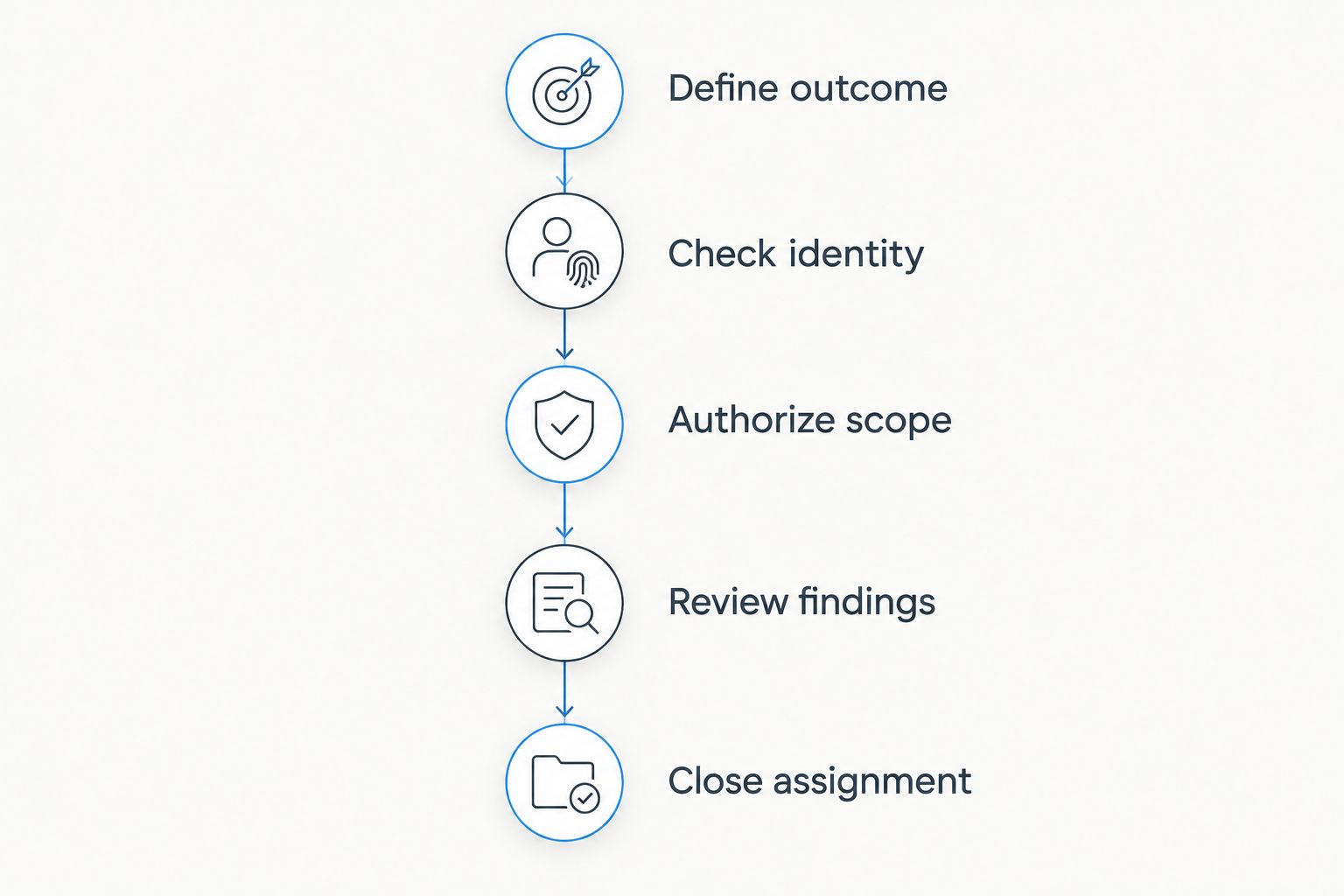
For the handoff between research and delivery, use the skip tracing to service of process workflow. Keep your written instructions with the assignment so the next provider receives the same scope.
Which skip tracing service should you choose?
Choose local tracing connected to process serving when your San Diego assignment ends with legal document delivery. Choose investigative research when the unresolved issue is identity or another authorized investigative question. Choose standalone research when your delivery workflow already exists.
For a routine local matter, start with the narrowest service that completes the job. Do not buy broader investigation merely because the subject's last known address is outdated.
Before authorizing a 2026 assignment, obtain written agreement on the requested outcome, geographic scope, reporting, and escalation contact. Ask what an unsuccessful search report will contain as well as what a successful result will look like.
Discuss your San Diego assignment
Clarify whether your matter needs skip tracing, legal document delivery, or both.
FAQ
What's the best skip tracing option for an insurance company in San Diego?
Local tracing connected to process serving is the best fit when the assignment requires legal document delivery in San Diego County. Use a different research brief when the actual task is resolving identity conflicts or answering investigative questions.
Does skip tracing include serving legal papers?
Skip tracing does not automatically include serving legal papers. Confirm whether your assignment ends with research findings or includes a separate service task and the required documentation.
Can a same-day service request guarantee that someone will be located?
No. A same-day service category does not establish a guarantee that a person with an unknown address will be located and served that day. Confirm what the provider accepts and what remains dependent on research findings.
What information should an insurance team send to a skip tracer?
Send the identifying information you are authorized to share, the last known location, and the assignment purpose. Use an approved transfer method and separate confirmed facts from unverified information.
Is an address report proof that legal service was completed?
No. An address report is a research deliverable, not proof of service. Keep the location finding and any later legal delivery documented as separate outcomes.
When should an insurance company choose an investigator instead?
Choose an investigative brief when the assignment requires resolving material identity conflicts or answering an authorized investigative question. Define that question before hiring rather than assuming an address search will answer it.
What should happen if the search finds no usable address?
Request a report that distinguishes the work completed from unresolved findings, then have the assignment owner decide the next step. Counsel should address any resulting legal deadline or service-method question.
One last thing
A no-result report can be more useful than an unexplained address. Require the provider to distinguish what the research supports from what remains uncertain, then document who decides whether to proceed.
Not a law firm. No legal advice provided. Direct questions about service methods, deadlines, and legal sufficiency to counsel.
Related guides
- Skip tracing services for insurance companies: complete guide
- What counts as proof of service in California
- How to hire a process server in San Diego County: 2026 checklist
Ready to get papers served? Book online with a registered process server in San Diego.