Can a process server serve papers to a business?
Yes, a process server can serve a business in California, but the papers must reach someone authorized to receive them through a legally permitted method. For a corporation or LLC, that often means the designated agent for service of process—not simply any employee at the front desk. This 2026 guide explains how to identify the recipient, prepare the assignment, and document service.
- Can a process server serve a business? Yes—California requires the correct recipient and service method.
- California corporations and LLCs have different service rules; identify the entity before arranging delivery.
- A receptionist accepting an envelope does not automatically establish valid service of process.
- Golden Hill Legal Runner LLC provides business process serving across San Diego County, not legal advice.
Can a process server serve papers to a business?
Yes. Serving a business means serving a legally recognized recipient for that business—not merely delivering papers to its address. The correct recipient depends on the entity type, the document, and the governing service rule.
California Code of Civil Procedure section 416.10 identifies recipients for service of a summons on a corporation. California Corporations Code section 17701.16 addresses service on an LLC. For workplace delivery involving an individual rather than a business defendant, see Can a Process Server Serve You at Work?.
For a California business-service assignment in 2026, start with this distinction:
| Business structure | Recipient or rule to verify | Practical benefit | Limitation |
|---|---|---|---|
| Corporation | Designated agent or another recipient authorized under section 416.10 | The statute identifies qualifying corporate roles | An employee's job title alone does not establish authority |
| Limited liability company | Designated agent and applicable LLC service provisions | The agent provides an identified service recipient | Corporate officer rules should not be applied automatically to an LLC |
| General partnership | Applicable partnership recipients under section 416.40 | The rule addresses service on the partnership | Serving an unrelated employee is not the same as serving a qualifying recipient |
| Sole proprietorship | The individual proprietor under applicable individual-service rules | Identifies the person operating the business | A trade name does not create a separate corporation or LLC |
The table concerns ordinary California civil summons service. Subpoenas, eviction notices, small claims documents, and other papers have their own requirements. Use the rule for the document you actually need served.
Why this matters
A delivery receipt proves that an envelope arrived. It does not, by itself, prove valid service of a summons.
If you name a corporation but arrange delivery as though the defendant were an individual employee, the recipient and proof can fail to match the defendant. That creates an avoidable service dispute and additional work before the case can proceed.
Resolve the entity name and recipient before scheduling the attempt. Speed helps only when the assignment identifies the right legal target.
For 2026 assignments, check current entity records rather than relying on an old invoice, an outdated website footer, or a familiar storefront name. A trading name and a registered entity name are not interchangeable.
Serving a corporation
California Code of Civil Procedure section 416.10 permits service of a summons on a corporation through its designated agent and specified corporate recipients. Listed roles include the president, chief executive officer, other head of the corporation, vice president, secretary, treasurer, controller, chief financial officer, and general manager.
That list is not permission to hand papers to anyone who describes themselves as a manager. The statutory role matters, and whether someone qualifies as a general manager can require legal analysis.
Before dispatch, confirm:
- The corporation's exact legal name matches the defendant identified in the documents.
- The agent information belongs to that corporation, not a similarly named entity.
- The delivery address is current and belongs to the intended recipient.
- The assignment identifies whether the intended recipient is an agent or another authorized corporate representative.
A storefront supervisor and the corporation's designated agent can be different people at different addresses. Do not treat the nearest branch as the automatic service location.
Serving a limited liability company
An LLC is not a corporation. California Corporations Code section 17701.16 supplies LLC-specific service provisions, including service through the designated agent.
For an LLC, verify the designated agent before assuming that an owner, member, or manager can receive the summons. The corporate recipient list in Code of Civil Procedure section 416.10 is not a universal list for every business structure.
If the designated agent cannot be served, the next method requires review of the applicable statute and circumstances. Some alternative routes require a court order or specified preliminary efforts; they are not automatic substitutes for an unsuccessful visit.
Provide the process server with the LLC's exact name, current agent details, and any relevant service instructions. Keep a copy of the entity information used to prepare the assignment so the recipient selection remains traceable.
Serving a sole proprietor or partnership
A sole proprietorship is not a separate legal entity from its owner. If the defendant is the proprietor, service follows the applicable rules for that individual rather than rules for serving a corporation.
A business address can still be relevant. California Code of Civil Procedure section 415.20(b) permits substituted service on an individual at a usual place of business when its conditions are met, including reasonable diligence before that method is used.
A partnership requires a different analysis. Section 416.40 addresses service on partnerships and certain unincorporated associations, including service through designated agents or qualifying partnership representatives.
Do not infer the structure from the sign above the door. A trading name can belong to a sole proprietor, partnership, corporation, or LLC; the name alone does not tell you which service rule applies.
How do you prepare a business-service assignment?
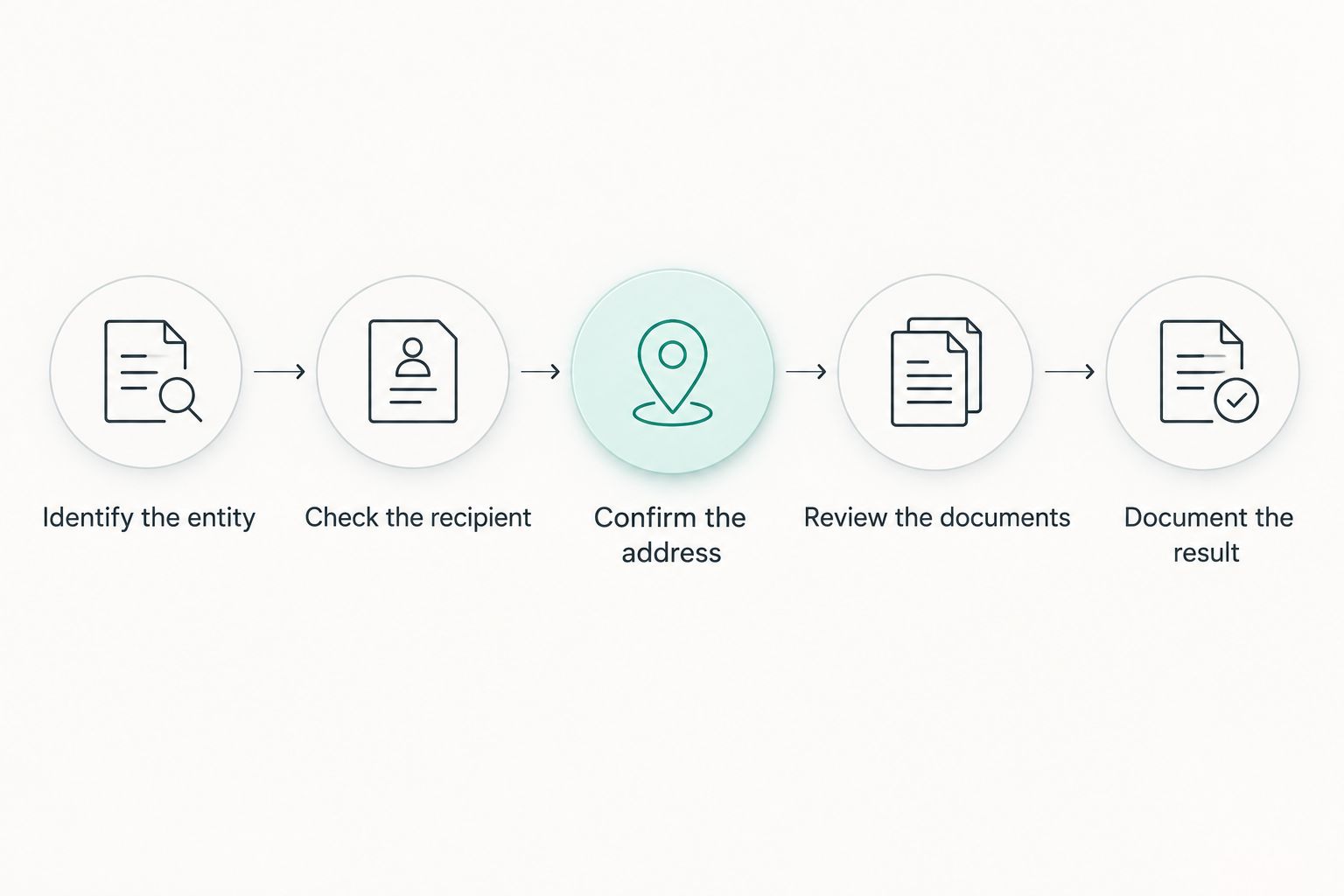
Use this sequence before requesting an attempt. Each step answers a different operational question: who is named, what must be delivered, where the recipient can be found, and how completion will be recorded.
- Identify the entity. Match the defendant's legal name and business structure to the filed papers. Flag conflicting names before dispatch rather than asking the server to resolve the pleading.
- Check the recipient. Confirm the designated agent or other legally authorized recipient. Record the person's role, not just a first name supplied over the phone.
- Confirm the address. Separate the storefront, mailing address, principal office, and agent address. Note building access instructions without treating access information as permission to use a different service method.
- Review the documents. Supply the complete papers, case information, and known deadline. Identify whether the assignment involves a summons, subpoena, notice, or another document.
- Document the result. Obtain the appropriate proof or attempt record. Check that the entity, recipient, date, location, and method are accurately described.
For a 2026 business-service request, also identify any hearing or filing deadline when you send the assignment. Do not ask the server to infer it from a stack of attachments.
Golden Hill Legal Runner LLC is a process-serving option for attorneys, businesses, and individuals needing legal document delivery across San Diego County. The company is registered, bonded, and insured and offers standard, rush, same-day, and skip-tracing services; it is not a law firm and does not provide legal advice.
Arrange business document service
Provide the entity name, documents, recipient details, and known deadline for your San Diego County assignment.
Why business-service requirements vary
The business address is only part of the assignment. These factors determine what needs checking before delivery:
- Entity structure. Corporations, LLCs, partnerships, and sole proprietors do not share one universal recipient rule.
- Document type. A summons and complaint, subpoena, and statutory notice require different service analysis.
- Recipient authority. Being present at the business does not establish authority to receive its legal papers.
- Service method. Personal delivery and substituted service have different completion requirements.
- Recipient location. An agent address, operating location, and individual recipient's workplace serve different purposes.
- Prior attempts. The history of unsuccessful efforts matters when a proposed alternative method requires diligence or court authorization.
For California service in 2026, identify the governing provision before selecting an alternative method. An urgent deadline does not remove the requirements for valid service.
Can a receptionist accept papers for a business?
A receptionist accepting papers does not automatically complete valid service on the business. Direct service requires an authorized recipient; substituted service requires compliance with the applicable rule.
Under California Code of Civil Procedure section 415.20(a), substituted service on certain entity recipients involves leaving the papers during usual office hours with a person apparently in charge at the proper office, followed by the required mailing. Service under that provision is deemed complete 10 days after mailing, not simply when the envelope reaches the desk.
That entity provision differs from section 415.20(b), which governs substituted service on individuals. The individual provision includes reasonable diligence and requires a qualifying substitute recipient who is at least 18 years old.
Do not mix the conditions from these provisions. Have counsel or a court self-help resource confirm the appropriate route when the recipient or method is disputed.
Can the business refuse to sign or accept the papers?
A signature is not a universal requirement for personal service of a California civil summons. Refusing to sign does not, by itself, prevent valid service.
Refusal also does not authorize a server to leave papers anywhere or with anyone. The server must still use a legally permitted method and accurately document the circumstances.
If the recipient refuses the papers, preserve the server's account of the encounter rather than reducing it to a delivery status. The person's identity, role, location, and conduct can matter when the court evaluates service.
What happens after a business is served?
The server completes the appropriate proof of service, and the filing process must be handled for the case. Check the proof against the assignment before relying on the service date.
For an ordinary California civil summons, the usual response period is 30 days after service, but different proceedings and documents carry different deadlines. Substituted service also has its own completion rule, so the physical handoff date is not always the date from which the response period runs.
Read the actual summons and applicable rules. Do not use the ordinary civil deadline for an eviction case, small claims case, subpoena, or other proceeding without checking its requirements.
FAQ
Can a process server serve a business in California?
Yes, a process server can serve a business in California through a legally permitted method directed to an authorized recipient. The entity type and document determine the applicable requirements.
Can I serve a company's registered agent instead of its owner?
Yes, a designated agent for service of process is an authorized recipient for the entity under the applicable service rules. Confirm that the agent information belongs to the exact defendant named in your papers.
Can a process server leave business papers with a receptionist?
Not automatically; a receptionist's acceptance alone does not establish valid service. A qualifying substituted-service method requires its own conditions, including mailing when required.
Is serving an LLC the same as serving a corporation?
No, California has separate statutory provisions for LLC service and corporation service. Do not assume that a recipient authorized for a corporation is automatically authorized for an LLC.
Does a business have to sign for a summons?
A business does not generally have to sign a delivery receipt for personal service of a California civil summons to be valid. The authorized recipient, method, and proof of service remain essential.
What if the business has moved or its agent cannot be found?
Verify current entity and agent information before arranging another attempt. If ordinary service is unsuccessful, the appropriate alternative depends on the entity and applicable statute; some alternatives require court authorization.
Can Golden Hill Legal Runner LLC help serve a San Diego business?
Golden Hill Legal Runner LLC offers process serving across San Diego County for attorneys, law firms, businesses, government agencies, and individuals. It provides document delivery services, not legal advice.
One last thing
Ask who was served, not just whether the papers were delivered. A useful service record identifies the recipient and the capacity in which that person received the documents.
Before your 2026 assignment closes, compare that record with the named defendant and the intended method. A successful handoff and valid service are separate questions.
Not a law firm. No legal advice provided. This article provides general California service information; consult an attorney or court self-help resource about your case.