Can you serve legal papers to someone out of state?
Yes, you can serve legal papers to someone out of state in many civil cases, provided the court permits that service and you follow the rules for the document, delivery method, and server. For a 2026 case, confirm those requirements before arranging delivery: successful delivery does not, by itself, establish the court’s authority over the recipient.
- You can serve legal papers to someone out of state, but the document and court rules control the method.
- California small claims cases have narrower out-of-state service rules than ordinary civil lawsuits.
- Golden Hill Legal Runner LLC provides process serving in San Diego County, not an advertised nationwide service.
- Confirm server eligibility, deadlines, and proof-of-service requirements before sending the papers.
Can you serve legal papers to someone out of state?
Yes. Crossing a state line does not automatically prevent service, but it does not make every delivery method valid. Start with the court handling your case, identify the document, and determine which rules authorize delivery outside that state.
For California civil cases, Code of Civil Procedure section 413.10 addresses service outside California. Section 415.40 provides an out-of-state mailing method for a summons, subject to its requirements. Special proceedings, including small claims, require separate analysis rather than automatic use of the ordinary civil rules.
The practical question is therefore not just whether someone can deliver the envelope. It is whether the right person can deliver the right documents in an authorized way and document completion correctly. Arranging a server and confirming legal instructions are separate tasks, even when a provider coordinates delivery across locations.
For cases involving multiple locations, distinguish statewide process serving networks for San Diego cases from service in another state. Statewide coverage and nationwide coverage are different commitments.
Why this matters
An out-of-state assignment has two locations: the court handling the case and the place where the recipient can be found. Your instructions must account for both. A delivery that looks complete operationally can still raise a legal objection if the method, server, or proof does not meet the applicable requirements.
Before dispatching papers in 2026, confirm the current rule and any case-specific order. Do not treat a carrier’s delivery confirmation, a server’s attempt report, and a filed proof of service as interchangeable records.
Choose the service method before arranging delivery
The available methods depend on your case. The comparison below describes their practical differences; it does not authorize a method that your court’s rules exclude.
| Method | Best for | Practical advantage | Limitation |
|---|---|---|---|
| Personal service | Cases requiring or permitting direct delivery | The server records delivery to the identified recipient | Requires locating the person and an eligible server |
| Mail service | Cases with an expressly authorized mailing procedure | Avoids arranging an in-person handoff | Mailing, receipt, and completion requirements must all be satisfied |
| Court-authorized alternative service | Cases where the court permits another method | Provides a defined route when ordinary methods have failed | Requires the necessary legal basis and compliance with the order |
Choose a method because the rules permit it, not because it is easiest to arrange. Personal delivery is not the only possible method, and ordinary mail is not a universal substitute.
For a business recipient, also identify who is legally authorized to receive the papers. A company’s mailing address and its designated recipient for service are not necessarily the same thing. Resolve that distinction before giving the assignment to a server.
How do you arrange out-of-state service?
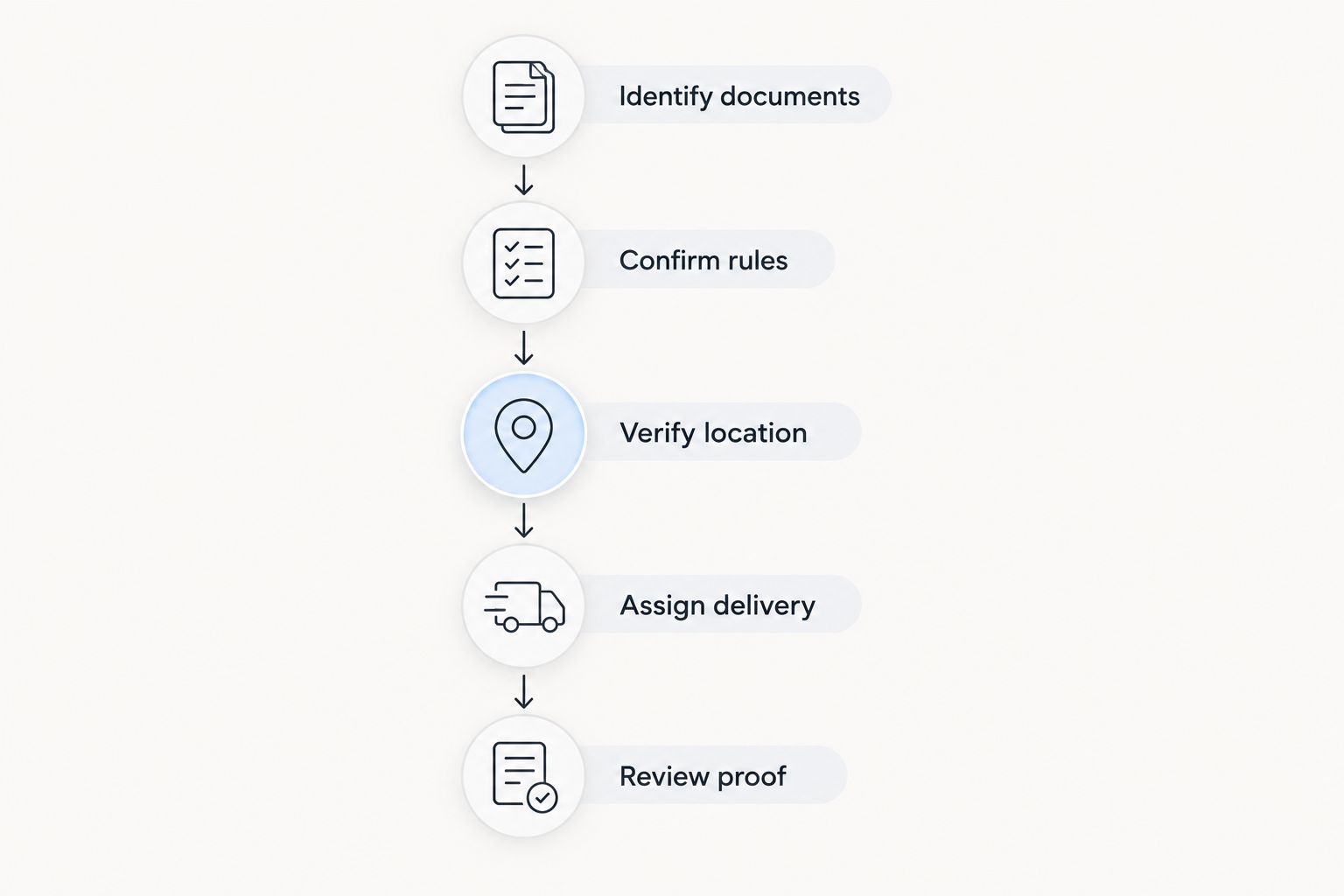
Use this sequence to keep legal instructions, fieldwork, and documentation aligned. If you are represented, have your attorney resolve the legal requirements before the assignment begins.
- Identify documents. List every document that must be delivered. Include the court, case number, parties, hearing information, and any order governing service. Do not send an incomplete packet and expect the server to identify missing legal documents.
- Confirm rules. Determine the permitted method, who can serve, and the applicable deadline. Separate the deadline for completing service from the recipient’s response deadline and any deadline for filing proof.
- Verify location. Provide the recipient’s current address and lawful identifying information that helps distinguish the correct person. Flag an unconfirmed address rather than presenting it as verified.
- Assign delivery. Give the eligible server written instructions, the complete packet, and the required proof form. Ask how unsuccessful attempts and completed delivery will be reported.
- Review proof. Check the completed service record against the assignment. Resolve missing facts or clerical errors before submitting it under the court’s filing requirements.
The order matters. Booking an urgent attempt before confirming the authorized method creates an avoidable problem: fast fieldwork cannot correct the wrong legal instructions.
What California rules should you check in 2026?
For ordinary California civil summons service, several statutes answer different questions. Read them together with the rules governing your particular case, rather than treating one provision as the entire procedure.
- Where service is permitted: California Code of Civil Procedure section 413.10 addresses service inside and outside California, subject to the court’s jurisdiction and other applicable provisions.
- Who can serve: Section 414.10 generally permits service of a summons by someone who is at least 18 years old and is not a party to the action. Do not assume this resolves every qualification issue for every assignment.
- How an out-of-state mailing works: Section 415.40 describes first-class mail, postage prepaid, requiring a return receipt. Under that provision, service is deemed complete on the 10th day after mailing.
- How mailing is proved: Section 417.20 requires evidence satisfactory to the court establishing actual delivery to the person served for service under section 415.40.
These are California statutory references, not a nationwide procedure. A mailing authorized for one California civil summons is not automatically authorized for a restraining order, subpoena, or small claims case.
The distinction between mailing and proof is especially important. The 10th-day completion provision does not eliminate the requirement to establish actual delivery. Keep the mailing record and the evidence supporting delivery together.
Why out-of-state service requirements vary
The destination state is only part of the assignment. These factors determine what you need to confirm:
- Court system: State and federal proceedings follow different service frameworks. Identify the issuing court before choosing instructions.
- Document type: A summons, subpoena, restraining order, and hearing notice do not necessarily follow the same procedure.
- Recipient type: Serving an individual differs from serving a corporation, public entity, or another legally defined recipient.
- Authorized method: Personal service, mailing, and alternative methods each carry their own conditions.
- Case-specific orders: An order can prescribe a method, deadline, or supporting documentation that the assignment must follow.
- Address quality: An outdated or incomplete address affects the ability to locate the recipient, regardless of the legal method selected.
Ask your attorney to turn those requirements into written instructions. A server needs an operational assignment, not an unresolved question about which legal procedure applies.
What if the recipient’s address is wrong?
Treat a failed address as a location problem before treating it as avoidance. A move, incomplete unit number, or mistaken identity calls for different follow-up than a confirmed recipient who declines contact.
Request a factual attempt report. It should distinguish what the server observed from what another person reported, without turning either into an unsupported conclusion about the recipient’s intentions.
If the address remains unconfirmed, consider lawful address research before repeating the same assignment. A possible address is a lead, not proof that the person lives there. Once location information improves, return to the authorized service instructions rather than improvising a new delivery method.
Does service give the court authority over the recipient?
Service and jurisdiction are separate issues. Service concerns legally required notice; jurisdiction concerns the court’s authority to hear the matter and, where required, exercise authority over the person. Completing one does not automatically resolve the other.
This distinction matters in family cases. A divorce with an out-of-state spouse raises both notice requirements and questions about the filing state’s authority; delivering papers alone does not settle every issue concerning support, property, or children.
If your case involves those questions in 2026, obtain legal advice before relying on delivery as the answer. Give the server the resulting instructions, not the responsibility for deciding whether the court can grant the relief you want.
The same caution applies to subpoenas. Serving a subpoena across a state line and compelling someone to comply are different questions, and discovery in another state can require that state’s procedure.
Can you personally serve someone in another state?
If you are a party to a California civil action, section 414.10 does not permit you to serve the summons yourself. The general rule requires a nonparty who is at least 18 years old.
Do not assume that using a friend automatically resolves the assignment. Confirm the person’s eligibility, the applicable method, and the documentation required for your case. The server must be able to describe what actually happened, not merely sign a form prepared in advance.
For an assignment outside California, also confirm applicable requirements where delivery will occur. A California credential should not be treated as universal authorization to perform every type of service elsewhere.
Can California small claims papers be served out of state?
California small claims cases have narrower out-of-state service rules than ordinary civil cases. Code of Civil Procedure section 116.340 contains specific exceptions, so the general civil mailing procedure is not a blanket answer.
Before arranging delivery, confirm whether your small claims case fits an exception and which method applies. If it does not, ask about the proper court or procedure rather than trying a different delivery method to bypass the restriction.
What proof should you request after delivery?
Ask for the proof required by the court handling the case, not just a message saying the papers were delivered. The record needs to support the method actually used.
Review the recipient’s name, documents served, delivery location, date, time, method, and server’s declaration as applicable. For mail service, retain the required mailing and delivery evidence. For an unsuccessful assignment, preserve the attempt record instead of treating it as proof of completed service.
Before filing in 2026, check that the case caption and case number match the court record. Clerical accuracy does not decide legal validity, but an incorrect identifier creates a preventable correction task. Do not change the server’s account of events to make the form fit your preferred outcome.
Who handles delivery when the recipient is in San Diego County?
Golden Hill Legal Runner LLC is a local process-serving option for attorneys and individuals who need legal documents delivered in San Diego County. The company is registered, bonded, and insured, and offers standard, rush, same-day, and skip-tracing services.
An attorney outside California with a recipient in San Diego County has a different assignment from a California filer whose recipient lives elsewhere. Golden Hill Legal Runner LLC provides process serving across San Diego County; the stated coverage does not establish nationwide delivery.
For a San Diego assignment, provide the complete packet, recipient information, deadline, and required proof. Ask which service level fits those instructions without assuming that rush or same-day service guarantees a completed handoff.
Not a law firm. No legal advice provided.
FAQ
Can I serve legal papers to someone out of state in 2026?
Yes, many civil cases permit out-of-state service, but the document, court rules, and authorized method control. Confirm the current requirements before arranging delivery.
Can I mail California court papers to another state?
California Code of Civil Procedure section 415.40 provides a mailing method for certain out-of-state summons service. It requires first-class mail with a return receipt, and section 417.20 requires satisfactory evidence of actual delivery.
When is California out-of-state mail service complete?
Under section 415.40, service is deemed complete on the 10th day after mailing. That provision does not remove the separate requirement to establish actual delivery under section 417.20.
Can I serve my own summons if the defendant lives elsewhere?
A party cannot personally serve a California civil summons under section 414.10. The server generally must be a nonparty who is at least 18 years old, with other applicable requirements checked for the assignment.
Can California small claims papers be served outside California?
California small claims rules permit out-of-state service only in specified circumstances. Check Code of Civil Procedure section 116.340 rather than relying on ordinary civil service rules.
Does successful service mean the court has jurisdiction?
Successful service does not automatically establish jurisdiction. The court's authority and compliance with service requirements are separate legal questions.
Does Golden Hill Legal Runner LLC serve papers nationwide?
Golden Hill Legal Runner LLC states that it provides process serving across San Diego County. Do not assume nationwide coverage from that local service description.
One last thing
Before dispatch, ask one question: What evidence will establish completion under the method being used? That answer should shape the assignment from the start, not become a document search after delivery.
A complete packet and a current address get the fieldwork started. An authorized method and accurate proof make the delivery record usable for the case.