What happens if a process server can't find you?
If a process server can't find you, the case does not automatically disappear: the serving party can investigate your address, arrange further attempts, or pursue another service method permitted by law. In California in 2026, substituted service or court-authorized publication requires specific conditions; an unsuccessful visit alone does not authorize either method or establish that you were served.
- If a process server can't find you, failed attempts do not automatically end the case or establish service.
- California substituted service requires statutory conditions; publication requires a court order.
- Skip tracing identifies address leads, but finding an address is not service of process.
- Golden Hill Legal Runner LLC provides San Diego County process serving and skip tracing, not legal advice.
Why this matters
Not receiving papers personally is different from not being legally served. Some California procedures allow service without handing documents directly to the named person. Whether those procedures apply depends on the document, recipient, case type, and steps taken.
For San Diego County delivery needs, Golden Hill Legal Runner LLC offers process serving and skip tracing. The legal question remains separate: a court decides disputes about whether service satisfies the applicable rules.
This guide addresses California procedure in 2026, particularly service of a summons on an individual. Evictions, small claims, restraining orders, subpoenas, and documents served after a case begins have distinct requirements. Do not apply an ordinary civil summons rule to every document.
What happens if a process server can't find you?
An unsuccessful attempt establishes that delivery did not occur during that attempt. It does not prove that the recipient is hiding, that the address is current, or that another service method is authorized.
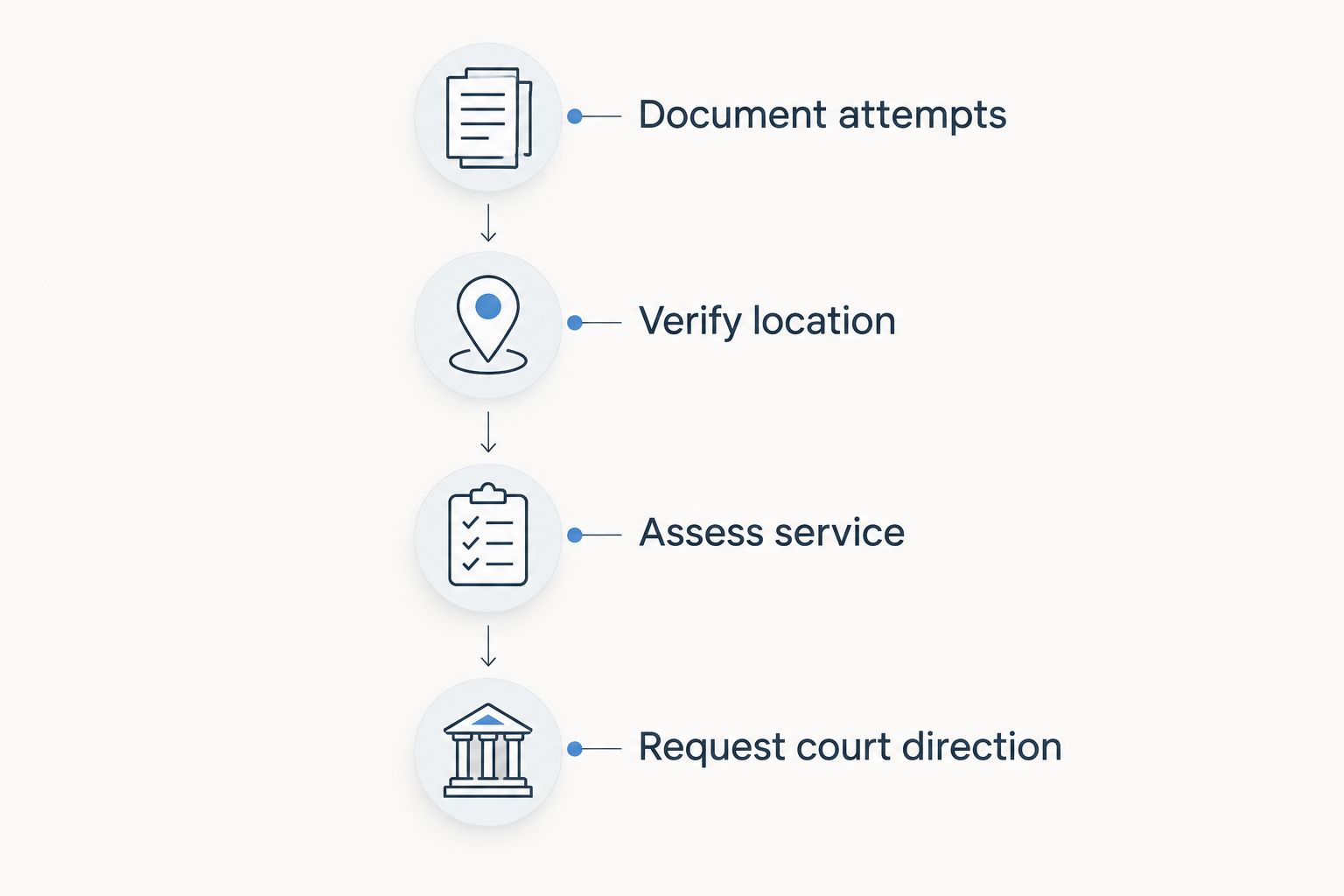
The next operational steps are:
- Document attempts. Record the address, date, time, result, and relevant observations. Separate observed facts from assumptions about the recipient's whereabouts.
- Verify location. Check whether the address belongs to the intended person. A former residence is not automatically a valid place for substituted service.
- Assess service. Determine which methods the document and case allow. Repeating visits does not replace compliance with the governing statute.
- Request court direction. Where required, the serving party asks the court for permission or additional time. The request must support the particular relief sought.
These steps can overlap. For example, address research can occur while attempts continue at another verified location, but research itself never completes service.
What the possible next steps accomplish
| Option | Best for | What it accomplishes | Limitation |
|---|---|---|---|
| Further personal-service attempts | A valid address where the recipient was absent | Another opportunity to deliver papers directly | Repeated visits do not guarantee contact |
| Skip tracing | An outdated or uncertain address | Produces leads for locating the recipient | A lead needs verification and is not proof of service |
| Substituted service | Cases meeting the applicable statutory conditions | Allows delivery through a qualifying person and location, with required follow-up | Not available merely because one visit failed |
| Service by publication | Cases meeting publication requirements after a court order | Provides notice through court-authorized publication | Requires supporting evidence and compliance with the order |
The correct next step depends on why service failed, not simply how many times someone knocked. An empty home, a wrong address, and a person refusing papers present different problems.
Personal service: another attempt at a verified location
Personal service of a California summons on an individual generally means delivering the summons and complaint to that person. California Code of Civil Procedure section 415.10 governs this method; service is complete at delivery.
Personal service does not depend on finding someone at home. A lawful attempt can occur at another location where the person is found, subject to access restrictions and other applicable rules.
The advantage is direct delivery without the additional mailing required for substituted service under section 415.20(b). The limitation is practical: the server still needs to locate and identify the intended recipient. A recognizable address does not establish that the person will be there.
Substituted service: qualifying delivery plus mailing
For an individual covered by California Code of Civil Procedure section 415.20(b), substituted service becomes available when personal delivery cannot be completed with reasonable diligence. The statute specifies qualifying locations, a qualifying recipient, and follow-up mailing.
At a dwelling or usual place of abode, the papers must be left with a competent household member who is at least 18 years old, and that person must be informed of their contents. The statute also addresses a usual place of business or usual mailing address, with conditions and exclusions that require separate review.
The server must then mail copies as the statute directs. Under section 415.20(b), service is complete on the 10th day after mailing, not when the papers are first left with someone.
That distinction matters in 2026: a delivery entry and a legally completed service date are not necessarily the same date. Leaving papers with a neighbor, child, or unrelated person does not automatically satisfy substituted-service requirements.
Service by publication: court permission comes first
California Code of Civil Procedure section 415.50 allows publication when the required showing is made to the court, including that the person cannot with reasonable diligence be served by another specified method. The court must issue an order authorizing publication.
The benefit is a possible route when ordinary efforts cannot reach the recipient and the statutory requirements are met. The limitation is substantial: the serving party needs evidence supporting the application, and publication must follow the court's directions.
Publication is not the server's unilateral decision. An unsuccessful attempt report helps document what happened, but it is not a publication order and does not guarantee that a judge will authorize publication.
Why the next step varies
California service rules in 2026 do not create one universal escalation path. These factors determine which question needs resolving:
- Document type. An initial summons, subpoena, eviction notice, and restraining order are not interchangeable. Each requires its own service analysis.
- Case type. Ordinary civil, family, small claims, eviction, and protective-order proceedings have different rules and timing requirements.
- Recipient type. Serving an individual differs from serving a corporation, public entity, or another legally defined recipient.
- Address reliability. A confirmed current residence supports a different plan from an address where the person no longer lives.
- Documented diligence. The actual attempts and investigation matter when the governing procedure requires reasonable diligence.
- Court orders and deadlines. Existing orders and approaching hearing dates affect what the serving party must request or complete.
Do not substitute an operational package for a legal standard. A provider's included attempts describe its service arrangement; they do not establish that a court's diligence requirement has been met.
How many attempts must a process server make?
California section 415.20(b) requires reasonable diligence before substituted service on an individual; it does not prescribe a universal attempt count. The circumstances and documented efforts matter more than treating a fixed number as automatic permission.
Ask what happened at each attempt, whether the address remains credible, and what follow-up occurred. Repeating the same unsuccessful visit without investigating contradictory information does not resolve an address problem.
Can a case continue without papers being handed to me?
Yes. California permits methods other than personal delivery when their legal requirements are satisfied, so lack of hand delivery does not by itself stop a case.
For an ordinary California civil summons, section 412.20 generally specifies a response within 30 days after service. That is not a universal deadline for every proceeding; confirm the document, service-completion date, and applicable rule before calculating your deadline.
Can I lose a case if I was never properly served?
A default can be entered after legally sufficient service and failure to respond as required. If you dispute service, do not assume that staying silent preserves your position or that discovering a defect automatically removes an entered default.
Challenges to service and requests to set aside a default involve different procedures and deadlines. A California attorney or court self-help center can explain the available procedure for your situation; a process server does not decide whether a judgment is valid.
What should you do when someone is trying to serve you?
First, identify the court, case number, document, and any listed hearing date. Verify case information through the court rather than relying solely on a caller's description, and keep the papers and envelopes you receive.
If papers were left with another person or arrived by mail, preserve those details too. The delivery location, recipient, and mailing date can matter to the service analysis. Do not assume the date you personally opened the papers controls the response deadline.
For a 2026 case, check current court instructions and seek legal help promptly if you dispute service. Avoiding contact is not a substitute for responding to a lawsuit. A qualified adviser can address the dispute without assuming that personal delivery was required.
What should the serving party do after failed attempts?
Review the attempt record before ordering more visits. Confirm the recipient's identifying information, address source, document set, and any hearing or service deadline; then distinguish an access problem from a location problem.
If the address is uncertain, investigate it. If a different service method appears appropriate, have the legal requirements reviewed before instructing the server to proceed. Keep factual reports separate from legal conclusions about diligence or validity.
Golden Hill Legal Runner LLC is best for San Diego County clients needing process serving and skip tracing, not legal advice. Its stated services include standard, rush, and same-day delivery, but a faster service request does not change statutory requirements or guarantee that a recipient will be found.
Golden Hill Legal Runner LLC's process-serving role is distinct from legal representation. Use an attorney or court self-help resource for questions about authorized alternatives, disputed service, and requests for court relief.
FAQ
What happens if a process server can't find you in California?
The serving party can pursue further attempts, address research, or another legally permitted service method. An unsuccessful visit neither ends the case automatically nor establishes completed service.
Can a process server leave papers with someone else at my home?
California section 415.20(b) permits substituted service on an individual only when its requirements are satisfied. At a dwelling or usual abode, the household recipient must be competent and at least 18 years old; reasonable diligence, notice of the papers' contents, and follow-up mailing also matter.
When is substituted service considered complete?
Under California section 415.20(b), service is complete on the 10th day after mailing. That rule concerns this particular substituted-service method, not every delivery or case type.
Does a process server have to try a specific number of times?
California section 415.20(b) does not set a universal number of attempts before substituted service on an individual. It requires reasonable diligence, assessed through the actual circumstances and efforts.
Can a process server publish a notice without asking a judge?
Service by publication under California section 415.50 requires a court order. Failed attempts alone do not authorize the server to arrange publication as completed service.
Does skip tracing mean I have been served?
Skip tracing does not constitute service of process. It provides location leads that require verification and a separate, legally authorized service attempt or procedure.
How long do I have to respond after being served?
An ordinary California civil summons generally specifies 30 days after service under section 412.20. Other proceedings have different deadlines, and the applicable service-completion date must be established before calculating the response date.
One last thing
Ask for the service-completion date, not just the attempt date. Under section 415.20(b), leaving papers and completing service are separate events because mailing starts the statutory completion period.
For a California case in 2026, keep the attempt record, mailing information, and proof of service together. Those records answer different questions; none should be treated as interchangeable.
Not a law firm. No legal advice provided.