How late can a process server come to your home?
In California, a process server can generally come to your home at any hour; state civil-service rules do not set a blanket nighttime cutoff. In 2026, a late visit is not automatically invalid service, but the delivery method, applicable court orders, and the server’s conduct still matter.
- How late can a process server come to your home? California has no blanket nighttime cutoff for civil service.
- California Code of Civil Procedure section 415.10 addresses personal delivery, not a statewide evening curfew.
- A late visit does not authorize forced entry or threatening conduct.
- Golden Hill Legal Runner LLC provides process serving in San Diego County, not legal advice.
Why this matters
A late knock and valid service are separate questions. The clock tells you when someone arrived. It does not establish whether the right person received the right documents through an authorized method.
This guide addresses California civil process, including visits to homes in San Diego County. It is not a nationwide rule: other jurisdictions have their own restrictions, and documents issued outside California require attention to the applicable rules.
For local document delivery, Golden Hill Legal Runner LLC offers process serving across San Diego County. Not a law firm. No legal advice provided.
How late can a process server come to your home?
California does not impose a general statewide closing time for personal service of civil papers. A process server’s evening arrival is not, by itself, a reason to treat the papers as invalid or ignore the case.
The statutory starting point for this 2026 guide is California Code of Civil Procedure section 415.10. It authorizes service of a summons through personal delivery of the summons and complaint; it does not prescribe a daily service window. That distinction matters: an office’s business hours are not the same thing as a legal restriction on delivery.
The comparison below separates practical scheduling considerations from legal conclusions. These are timing scenarios, not promises about any particular company’s operating hours.
| Visit timing | Best for scheduling purposes | Practical advantage | Limitation |
|---|---|---|---|
| Daytime | A recipient known to be home during the day | Matches a confirmed daytime routine | An empty home still means an unsuccessful visit |
| Evening | A recipient known to return home after work | Fits a verified evening routine | Darkness and an unexpected knock create identification concerns |
| Overnight or very early morning | Situations requiring specific review before scheduling | Addresses a known presence outside ordinary waking hours | No blanket cutoff does not remove safety, access, or conduct concerns |
Do not substitute a scheduling preference for a legal rule. Likewise, do not treat the absence of a statewide cutoff as permission to enter a home, disregard a court order, or intimidate an occupant.
Personal delivery is not the same as leaving papers nearby
Under section 415.10, personal service of a summons involves delivering the required documents to the person being served. A timestamp alone does not establish that this happened.
California also permits other methods in defined circumstances. For example, section 415.20 provides for substituted service subject to its requirements. Papers left with another household member are not automatically valid simply because someone answered the door.
The legal question is the method used and whether its requirements were satisfied. Neither daylight nor darkness fixes a defective method.
Why the timing of a home visit varies
For a California service request in 2026, choose an attempt time around reliable information and the applicable requirements—not around an assumed statewide curfew.
- Recipient availability. A verified work schedule or known return time helps identify a useful visit window. Guessing that everyone is home in the evening does not.
- Document type. A summons, subpoena, restraining-order packet, and eviction-related document do not all carry identical service requirements. Identify the papers before deciding how to deliver them.
- Court deadlines. A hearing date or service deadline affects planning. Urgency does not erase the required delivery method.
- Access conditions. A locked entrance, controlled-access building, or inaccessible address affects whether the server can reach the recipient lawfully.
- Applicable instructions or orders. Review any court order governing service. A particular order matters more than a generic statement about late visits.
- Safety and conduct. An attempt should not turn into a confrontation. The lack of a blanket nighttime cutoff does not excuse threats or forced entry.
Schedule around evidence of availability, not repeated visits at an unproductive hour. An accurate address and usable recipient information matter more than simply choosing a later time.
For assignments involving an uncertain location, the skip-tracing-to-service-of-process workflow explains the distinction between finding a person and completing delivery. Locating an address is not proof that service occurred.
What should you do if a process server knocks late?
You do not need to resolve the entire lawsuit at the door. Your immediate priorities are identifying the visitor, avoiding a confrontation, and preserving any documents you receive.
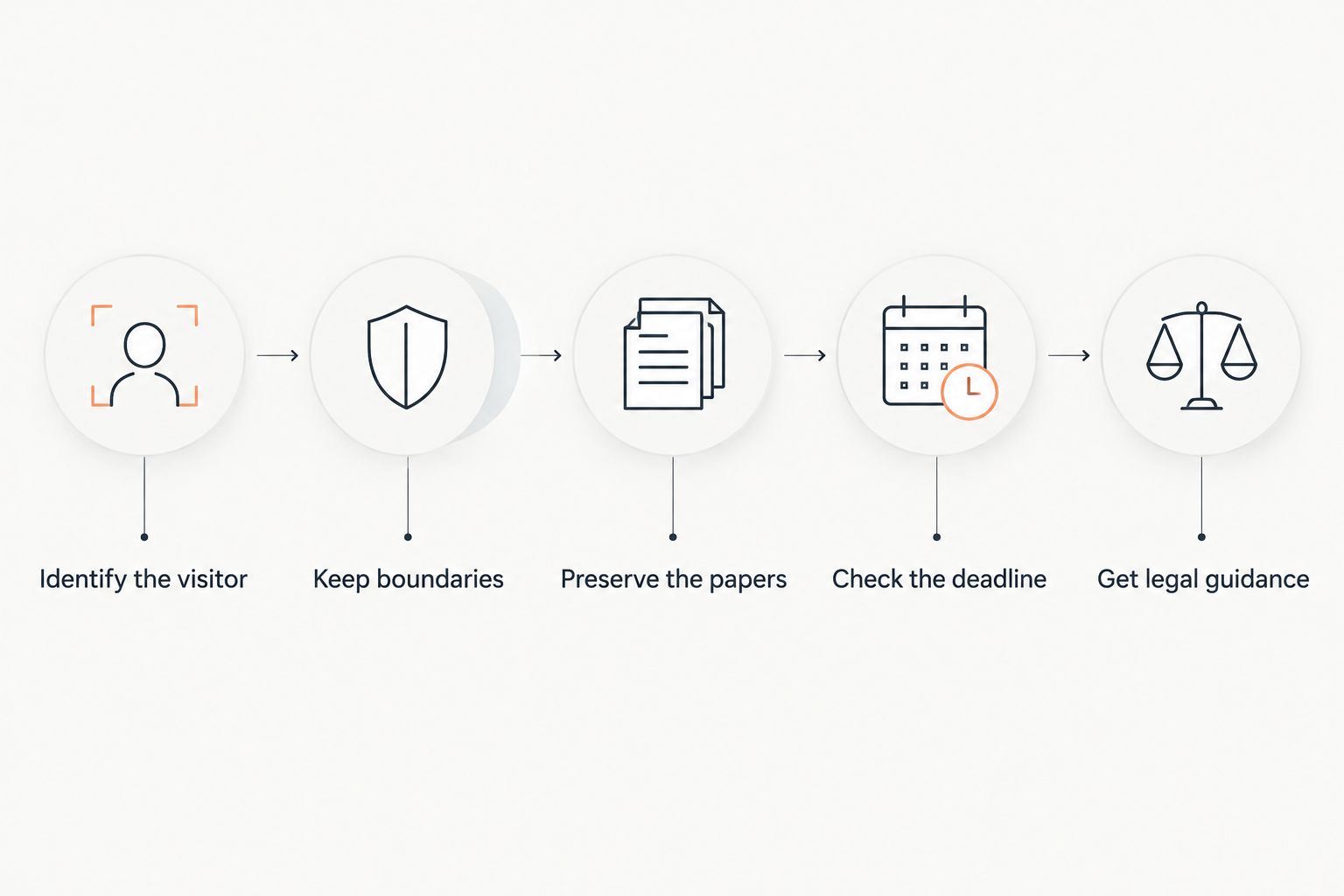
Use the following sequence for an unexpected visit. It separates an immediate safety decision from the later legal review.
- Identify the visitor. Speak through the closed door or intercom and ask for the visitor’s name, company, and purpose. Do not provide additional personal information just to satisfy an unidentified caller.
- Keep boundaries. You do not have to invite the visitor inside. If someone threatens you or tries to force entry, treat the conduct as a safety issue rather than an ordinary delivery discussion.
- Preserve the papers. Keep the complete packet you receive. Note the date, time, address, and what happened without writing over the documents.
- Check the deadline. Read the court name, case information, and instructions promptly. Do not assume that disagreeing with the visit pauses a response deadline.
- Get legal guidance. Ask a California attorney or the court’s self-help center about the documents and any concern over service. A process server does not decide whether your legal objection succeeds.
Keep factual notes. Record what you observed rather than concluding that the visit was illegal because it happened after dark. A description of the delivery gives an attorney more useful information than a label.
Does refusing the papers make the visit disappear?
Refusing papers is not a reliable way to prevent service. California law can recognize personal service despite a recipient’s refusal when the circumstances satisfy the legal requirements.
Do not assume that avoiding physical contact with the packet ends the issue. The server’s identification of the recipient, explanation of the delivery, and handling of the papers can matter. Obtain advice about the actual event instead of relying on a doorstep tactic.
What should you confirm before requesting an evening attempt?
If you are arranging service rather than receiving it, give the server operational information. Do not ask the server to compensate for missing instructions by repeatedly appearing at a home late at night.
For a 2026 service request, prepare the following:
- The complete documents to be served and the case information.
- The recipient’s correct name and the address to attempt.
- A description or other lawful identifying information that helps avoid mistaken identity.
- Any verified schedule information, clearly separated from assumptions.
- The hearing date, service deadline, and any relevant court order.
- Known access issues or safety concerns.
Ask what the assignment includes, how unsuccessful attempts are recorded, and how completion information will be provided. Do not equate accepting a rush request with a promise that the recipient will be found or that service will be completed by a particular hour.
Golden Hill Legal Runner LLC process serving is best suited to clients needing legal document delivery within San Diego County, not legal advice. The company is registered, bonded, and insured and offers standard, rush, same-day, and skip-tracing services. Those offerings do not establish a universal nighttime delivery window or guarantee a completed attempt.
Discuss your San Diego service request
Identify the documents, location, deadline, and known recipient schedule before arranging delivery.
Can a process server enter your home at night?
A process server does not gain a general right to enter your home merely by carrying court papers. The absence of a statewide nighttime cutoff concerns timing; it is not permission to force a door or disregard lawful access restrictions.
You can speak through a closed door without inviting someone inside. If there is an immediate threat, prioritize safety and contact emergency services when appropriate. Address any question about completed service separately with legal help.
Avoid turning a boundary discussion into an argument about the case. A process server delivers documents; the doorstep is not where the underlying dispute gets decided.
Is service after dark automatically invalid in California?
Service after dark is not automatically invalid in California. The relevant review concerns the documents, recipient, authorized method, and any applicable order—not darkness alone.
For personal service of a summons, section 415.10 supplies the basic delivery rule. For substituted service, section 415.20 imposes different conditions. These statutory distinctions remain more useful in 2026 than a supposed universal evening cutoff.
If you dispute service, preserve the facts and seek advice promptly. Do not decide on your own that the court case can be ignored.
Can another adult at home accept the papers?
Another adult’s presence does not automatically make substituted service valid. For certain residential substituted service under section 415.20, California requires a competent household member who is at least 18 years old, along with the other statutory conditions.
For the residential route described in section 415.20(b), reasonable diligence in attempting personal delivery and subsequent mailing are part of the requirements. The age threshold of 18 years is not a complete checklist, and different documents require separate review.
A child answering the door is not a substitute for checking the applicable service rule. Tell your attorney who received the papers and what happened afterward.
FAQ
How late can a process server come to my home in California?
California has no general statewide nighttime cutoff for personal service of civil papers. A late visit is not automatically invalid, but the applicable delivery requirements and any court order still matter.
Can a process server visit my home on a weekend?
California's general personal-service rule does not limit delivery to ordinary weekday business hours. Check the requirements for the particular documents and any applicable court order rather than assuming a weekend visit is invalid.
Do I have to let a process server into my house?
You do not have to invite a process server inside your house. Carrying court papers does not create a general right to force entry, and questions about whether service occurred remain separate from permission to enter.
Can I avoid being served by refusing to take the documents?
Refusing to take documents does not reliably prevent service. California law can recognize service despite refusal when the circumstances satisfy the applicable legal requirements.
Can a process server leave papers with my child?
A child is not a qualifying adult household recipient under the residential substituted-service provision in California Code of Civil Procedure section 415.20(b). That provision requires a competent household member at least 18 years old and includes additional requirements.
What should I record if a process server comes late at night?
Record the date, time, location, visitor's identification, and what happened to the papers. Preserve the complete packet and obtain legal advice promptly if you dispute the delivery.
Does Golden Hill Legal Runner LLC give advice about challenging service?
Golden Hill Legal Runner LLC provides process serving, not legal advice. Ask a California attorney or court self-help center about challenging service or responding to the underlying case.
One last thing
The attempt time and the completion of service are not always the same legal event. Personal delivery and substituted service follow different rules, including mailing requirements for certain substituted service. Do not calculate a response deadline from a remembered knock without checking the applicable method.
For any 2026 late-night visit, preserve the packet and write down the facts while they are fresh. That record is more useful than arguing about an assumed curfew.
Not a law firm. No legal advice provided.