How do you serve divorce papers in San Diego?
To serve divorce papers in San Diego, have someone age 18 or older who is not a party to the case deliver the filed papers to your spouse, then complete and file the required proof of service. Personal service is the straightforward starting method; mailing the papers alone does not complete service unless you follow an authorized procedure, such as obtaining a signed Notice and Acknowledgment of Receipt.
- For how to serve divorce papers San Diego questions, start with California Courts’ personal-service instructions.
- Your server must be at least 18 and cannot be a party to your divorce case.
- File Proof of Service of Summons, form FL-115, after proper service.
- Golden Hill Legal Runner LLC offers divorce process serving across San Diego County, not legal representation.
Why this matters
Filing your divorce petition does not notify your spouse through a legally recognized service procedure. You need a separate delivery step and a court record showing what happened. Treat those as separate tasks: filing, service, and proof.
Golden Hill Legal Runner LLC is best for San Diego County divorce filers seeking a registered, bonded and insured process-serving company. Golden Hill Legal Runner LLC handles legal document delivery, but choosing a legally appropriate alternative service method remains a question for court self-help staff or your attorney.
For your 2026 filing, use current California Courts forms and San Diego Superior Court filing instructions. California Courts’ Self-Help Guide sections on serving divorce papers and filing proof of service provide the statewide procedural guidance discussed below.
How do you serve divorce papers in San Diego?
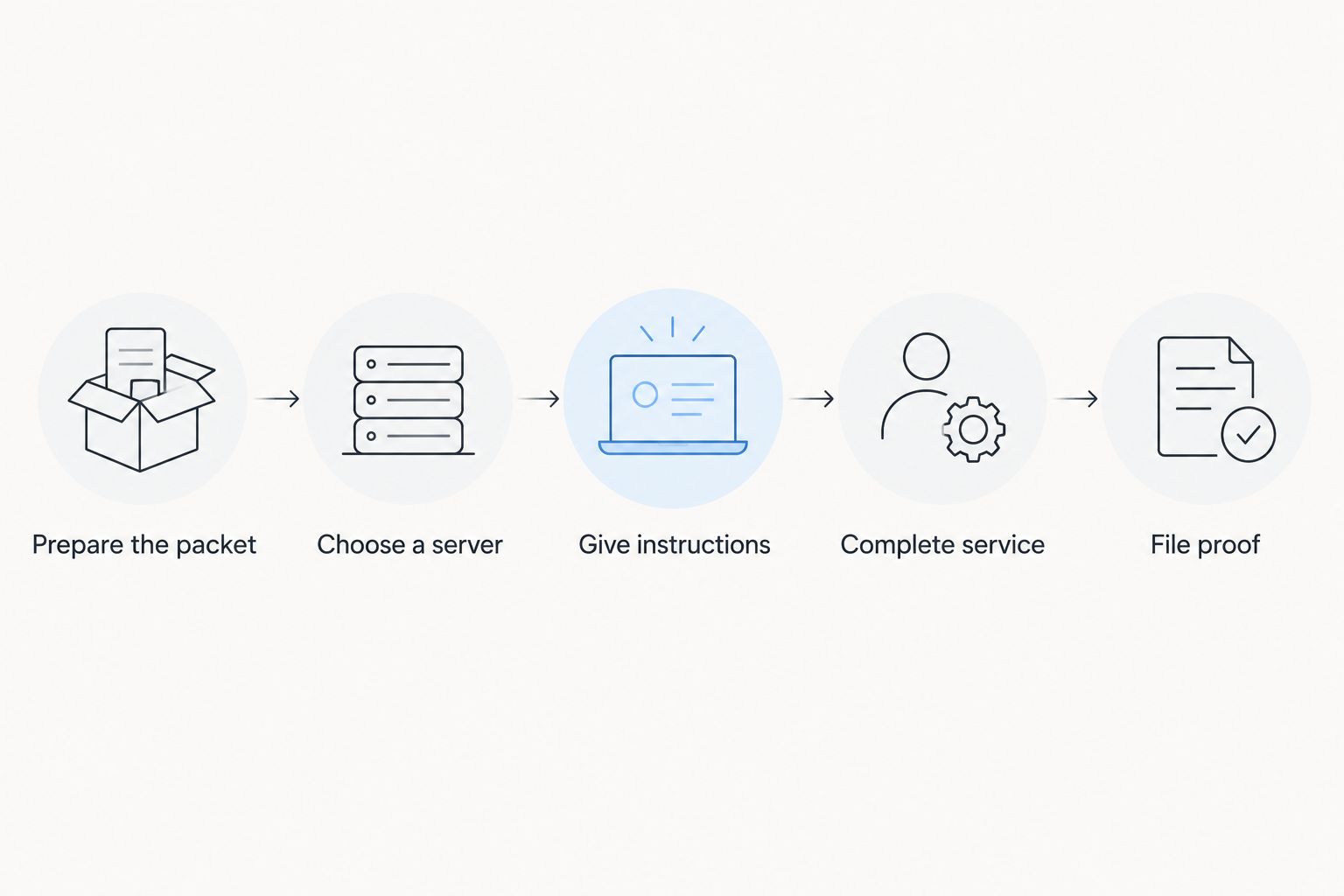
Prepare the filed packet, choose an eligible server, complete an authorized delivery method, and file proof. For ordinary personal service of an initial California divorce petition, use this sequence.
1. Prepare the service packet
Give your server copies, not your only original documents. The basic packet ordinarily includes the filed Petition—Marriage/Domestic Partnership, form FL-100; the Summons, form FL-110; and a blank Response—Marriage/Domestic Partnership, form FL-120.
If your case involves minor children, check the California Courts instructions for the Declaration Under Uniform Child Custody Jurisdiction and Enforcement Act, form FL-105, and its required copies. Include any additional documents the court instructs you to serve. A separate hearing request or restraining order can bring different service requirements.
Before delivery, compare the packet against the court’s instructions. A server cannot fix a missing document simply by reporting that an envelope reached your spouse.
2. Choose an eligible server
Your server must be at least 18 years old and cannot be a party to the divorce. You cannot personally serve your own initial divorce papers, even if your spouse agrees to meet you.
An eligible friend or relative can perform personal service. A professional process server is another option when you want someone else to manage delivery attempts and document the result. Choose someone who understands the task and can accurately complete the proof afterward.
3. Give clear delivery instructions
Provide your spouse’s name, a current address, useful identifying information, and relevant access or safety information. Separate confirmed facts from guesses. An old address is a lead, not confirmation that your spouse still lives there.
Tell the server about any existing protective order or restrictions on contact. Do not arrange a confrontation or ask someone to violate an order to finish delivery.
4. Complete personal service
The server personally delivers the required copies to your spouse. Your spouse does not need to sign a receipt for ordinary personal service, and refusing to cooperate does not automatically prevent service.
The server must still follow the governing delivery rules. Leaving papers at an address without establishing a valid service method is not a substitute for serving the correct person.
5. Complete and file proof
The server completes Proof of Service of Summons, form FL-115, recording the documents served, delivery method, date, time, and location. Follow California Courts instructions for signatures and any attachments.
Make sure the completed proof reaches the court through an accepted filing method, and keep a copy. A successful delivery and a filed proof are separate milestones. Confirm both before treating service as finished.
Personal service: best for direct delivery
Personal service is the clearest starting point when your spouse’s location is known and an eligible server can reach them. It does not depend on your spouse returning an acknowledgment form.
The trade-off is practical access. A correct address does not guarantee a successful encounter, and an unsuccessful visit does not establish that service occurred. Ask how attempts and outcomes will be documented before handing over the packet.
For a 2026 divorce, distinguish the person performing delivery from the legal method being used. Hiring a professional does not change personal service into a different legal procedure.
| Delivery arrangement | Best for | Advantage | Limitation |
|---|---|---|---|
| Eligible friend or relative performing personal service | Filers with a reliable, uninvolved adult available | California permits an eligible nonparty adult to serve | The person must handle delivery and proof correctly |
| Professional process server performing personal service | Filers seeking organized delivery attempts | Separates the filer from the delivery task | Hiring a server does not guarantee locating the recipient |
| Mail with Notice and Acknowledgment of Receipt | Cooperative spouses willing to sign and return the form | Avoids arranging an in-person handoff | Mailing alone is insufficient; the acknowledgment must be completed and returned |
Choose the method for the recipient’s situation, not just convenience. The same packet can require a different plan if your spouse is cooperative, unavailable, or actively avoiding contact.
Mail with acknowledgment: best for a cooperative spouse
California allows initial divorce papers to be served by mail using Notice and Acknowledgment of Receipt, form FL-117, when the required procedure is followed. An eligible nonparty adult handles the mailing; you do not simply mail the papers yourself and declare service complete.
The mailed packet includes the required divorce papers, the acknowledgment forms, and a return envelope with postage prepaid, following California Courts instructions. Your spouse must sign and return the acknowledgment. Keep the returned document for the proof-of-service filing.
Ordinary mail, certified mail, and acknowledgment service are not interchangeable. A postal delivery record is not automatically a substitute for the signed acknowledgment required by this method.
If your spouse does not return the acknowledgment, do not assume that silence completes service. Arrange another authorized method or obtain procedural guidance. This route works best when cooperation is realistic, not when you are hoping a reluctant spouse will respond.
Why the service plan varies
The service plan depends on the delivery assignment, not merely the fact that the documents concern divorce. Before requesting service in 2026, identify these factors:
- Location: Confirm whether delivery will occur within San Diego County, elsewhere in California, outside California, or abroad. Different locations can require different procedures.
- Address information: A usable current address supports direct attempts. An unknown location creates a locating task before delivery can be planned.
- Requested urgency: Standard, rush, and same-day service describe scheduling requests. They do not remove legal requirements or guarantee contact.
- Document type: An initial divorce petition, a hearing request, and a domestic violence restraining order do not necessarily share the same service instructions.
Give the server the actual documents and any court orders, not just a description of the case. That keeps the delivery assignment specific without asking the server to decide legal strategy.
What if you cannot find your spouse?
Start by organizing the location information you already lawfully possess: last known addresses, known employment, and other reliable leads. Keep a dated record of your search efforts and unsuccessful service attempts.
A skip trace is a locating service, not service of process itself. Finding a possible address does not prove residency, establish identity, or complete delivery. Verify the lead before treating it as the service address.
California Courts explains that service by publication or posting requires court permission and supporting information about efforts to find your spouse. Do not publish a notice on your own and assume it counts. Posting also has eligibility requirements that must be checked through the court.
An unsuccessful attempt does not authorize an improvised alternative. Substituted service has its own requirements, including reasonable diligence before using that procedure. Ask an attorney or court self-help staff which route fits the facts.
How long does your spouse have to respond?
30 days is the ordinary response period after service of a California divorce summons and petition. California Courts identifies that period in its divorce response guidance; calculating the starting point depends on the service method.
Personal service and mail with acknowledgment do not establish completion in the same way. Use the actual service record rather than the day you filed the petition or submitted a delivery request. Ask court self-help staff about counting rules if the deadline is unclear.
The response period is also separate from California’s minimum divorce waiting period. Under Family Code section 2339, marital status generally cannot end until at least 6 months after service of the summons and petition or the respondent’s appearance, whichever occurs first. A judgment is still required; time passing does not finalize the divorce automatically.
What should you check before filing proof of service?
Form FL-115 is the Proof of Service of Summons used for the initial divorce papers. Review the completed document against the service packet and the server’s account before submitting it.
Check these items without rewriting facts you did not witness:
- The correct case name, court, and case number.
- The recipient’s identity and the documents actually served.
- The delivery method and required method-specific details.
- The date, time, location, and server’s declaration.
- Any required attachments, including a returned acknowledgment when applicable.
A blank field or inconsistent date deserves clarification from the server. Do not backdate a form or turn an unsuccessful attempt into a completed service entry.
For your 2026 case, confirm the court’s accepted filing channel and retain the filing confirmation. The guide to submitting proof of service through California’s eFileCA system provides related filing context; verify that the described filing route applies to your court and case type.
What should you ask a divorce process server?
Give the provider the service address, document list, and any stated hearing date before asking for a delivery plan. Then ask who handles unsuccessful attempts, what status information you receive, and how the completed proof returns to you.
Golden Hill Legal Runner LLC offers standard, rush, same-day and skip-tracing legal document delivery across San Diego County. Those service categories address different operational needs; none replaces a court order or determines whether a particular alternative service method is legally appropriate.
Ask specifically whether your assignment covers delivery only or includes a separate proof-filing task. Do not assume that receiving a completed form means it has reached the court. Confirm responsibility before the assignment begins.
FAQ
Can I serve my spouse divorce papers myself in San Diego?
No. The server must be at least 18 years old and not a party to the divorce. An eligible friend, relative, or professional process server can perform personal service.
Does my spouse have to sign divorce papers when served?
Your spouse does not have to sign for ordinary personal service of the divorce papers. Service by mail with Notice and Acknowledgment of Receipt is different: that method requires a signed, returned acknowledgment.
Can I serve divorce papers by text or email?
Do not treat a text or email as valid initial divorce service without legal authority for that method. Follow California Courts instructions or the specific terms of an applicable court order.
What if my spouse refuses to open the door?
A closed door does not complete service or automatically authorize another method. Have the server document the attempt, then obtain guidance about further attempts or an authorized alternative.
Can divorce papers be served at work in San Diego?
Personal service can occur at work if the server can lawfully reach and identify your spouse. Workplace access restrictions still apply, and delivering papers to a receptionist is not automatically personal service on your spouse.
How long does my spouse have to respond to divorce papers?
30 days is the ordinary California divorce response period after service. The service method affects the calculation, so use the completed service record and confirm any deadline questions with court self-help staff or an attorney.
Does Golden Hill Legal Runner LLC give divorce legal advice?
No. Golden Hill Legal Runner LLC provides process serving and legal document delivery, not legal representation. Ask an attorney or court self-help staff about legal strategy, disputed service, or court permission for alternative service.
One last thing
Put the proof-filing task on your calendar before the first delivery attempt. The person who serves the papers, the person who files the proof, and the person who tracks the response deadline can be different people. Assign each task explicitly.
For a 2026 divorce, retain the exact packet served alongside the completed proof and filing confirmation. That gives you a clear record of what was delivered and what the court received.
Not a law firm. No legal advice provided.