How does substituted service work in California?
Substituted service in California generally means leaving a summons and complaint with an eligible person at a permitted address, then mailing another copy to the defendant at that address. For an individual defendant, the server must first exercise reasonable diligence in attempting personal service; under California Code of Civil Procedure section 415.20, substituted service is complete 10 days after mailing. This 2026 guide explains that procedure for civil summonses—not every document or case type follows the same rules.
- California substituted service requires qualifying delivery and follow-up mailing; leaving papers alone does not complete the procedure.
- Individual defendants generally require reasonable diligence before substituted service under Code of Civil Procedure section 415.20(b).
- Service under section 415.20 becomes complete 10 days after mailing, not when papers are left.
- Golden Hill Legal Runner LLC provides process serving across San Diego County; legal advice requires a different resource.
How does substituted service work in California?
For an individual defendant, substituted service combines reasonable diligence, delivery to an eligible recipient, follow-up mailing, and a documented service record. California Code of Civil Procedure section 415.20(b) supplies the main rule. A familiar address and someone willing to accept papers are not enough by themselves.
For local document delivery, Golden Hill Legal Runner LLC provides process serving across San Diego County. Before assigning service, identify the defendant, the documents, and the applicable procedure—not just the delivery address.
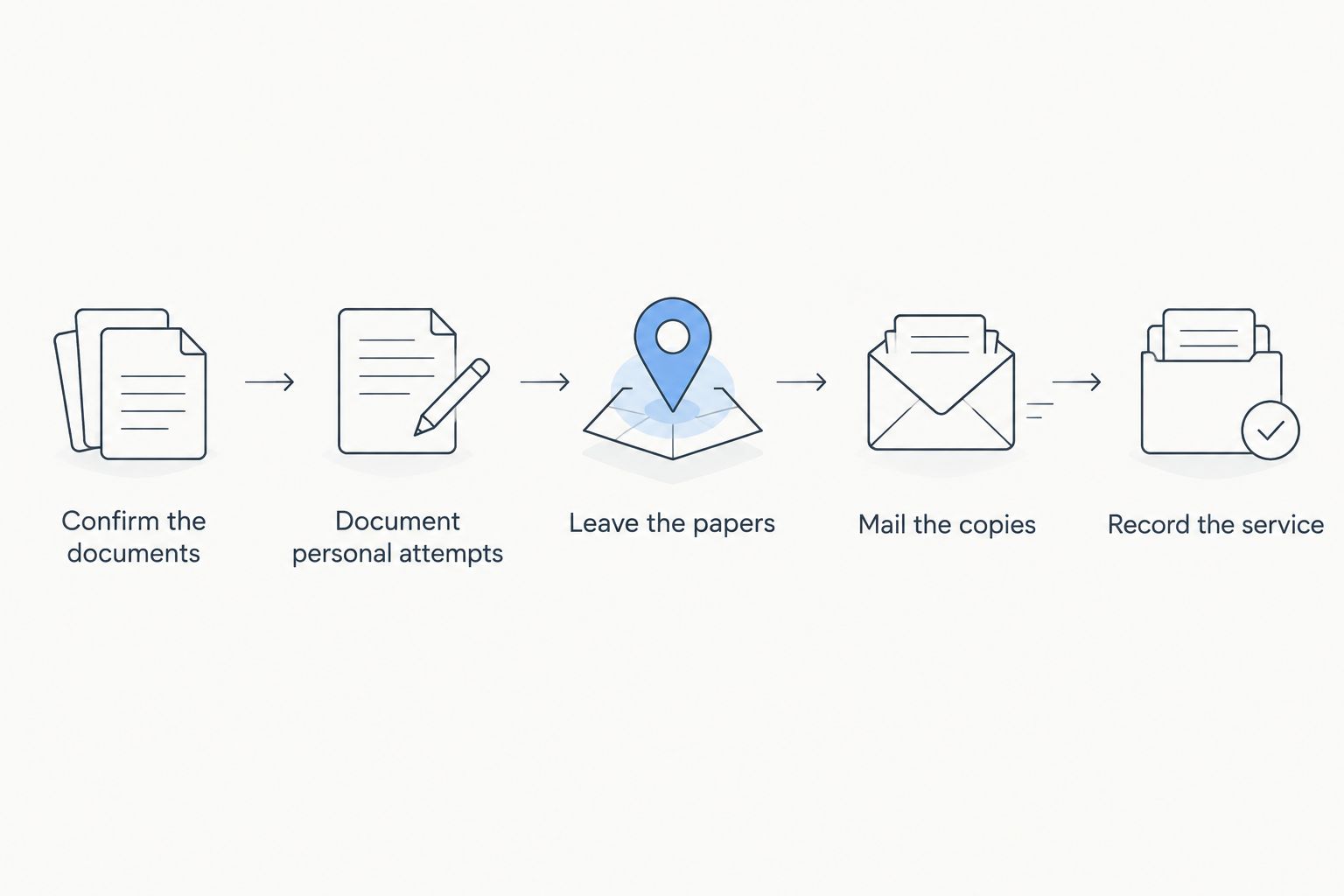
1. Confirm the documents
Determine whether you are serving a civil summons and complaint, a small claims claim, an eviction notice, a restraining order, or another document. Similar-looking paperwork does not make service requirements interchangeable.
This article explains substituted service of a summons under section 415.20. Do not apply its procedure automatically to documents governed by another statute or a court order.
2. Document personal attempts
For an individual defendant under section 415.20(b), the summons and complaint must be incapable of personal delivery with reasonable diligence before the server uses substituted service. Record each attempt's date, time, address, and relevant observations.
The statute does not establish a universal attempt count. Repeated visits without a meaningful opportunity to find the defendant do not automatically establish diligence. California Courts' self-help guidance recommends trying at different times when the person is likely to be present.
3. Leave the papers
At a qualifying home address, the recipient must be a competent household member who is at least 18 years old. At a qualifying business location, the recipient must be an apparently responsible person in charge who meets the statute's age requirement.
The server must inform the recipient of the papers' contents. A nearby person, visitor, or neighboring resident does not qualify merely because accepting the documents is convenient.
4. Mail the copies
After leaving the papers, mail copies of the summons and complaint by first-class mail, postage prepaid, to the defendant at the place where the papers were left. Section 415.20(b) specifies this additional mailing step.
The mailing is not an optional confirmation. Leaving the papers without the required mailing does not complete substituted service under this procedure. Record the mailing date separately from the delivery date.
5. Record the service
Complete the applicable proof of service with the actual delivery and mailing facts. California Judicial Council form POS-010 includes fields for substituted service, recipient information, and mailing details; its instructions also address a declaration of diligence.
Keep the delivery record, mailing information, and diligence declaration consistent. The guide to what counts as proof of service in California explains the distinction between delivering documents and documenting service.
Why this matters
A handoff date is not necessarily the legal completion date. For substituted service under section 415.20, the mailing triggers the 10-day period before service becomes complete. That distinction affects how you calculate later deadlines.
A standard California civil summons generally gives the defendant 30 days after service to respond, under Code of Civil Procedure section 412.20. Do not substitute that period for deadlines in eviction, small claims, or other specialized proceedings.
For a 2026 case, record the actual mailing date and have the response deadline calculated under the applicable rules. Weekends, court holidays, and case-specific requirements matter; a rushed calendar entry is not a substitute for checking them.
Individual defendants: complete 10 days after mailing
Section 415.20(b) permits substituted service on an individual only after reasonable diligence at personal service. Permitted locations include the person's dwelling house, usual place of abode, usual place of business, or qualifying usual mailing address.
The statute excludes a United States Postal Service post office box from that usual-mailing-address provision. A private mailbox or commercial mail location requires careful attention to the applicable statutory requirements; it is not automatically equivalent to leaving papers with a household member.
At a residence, confirm the recipient's household connection and age. At a business, confirm the person's apparent responsibility for the location. Record facts supporting the address and recipient qualifications rather than assuming them from a brief conversation.
Best for: an individual-defendant summons when personal service has not succeeded despite reasonable diligence and a qualifying recipient is available. The limitation is procedural: missing diligence, an unsuitable recipient, or omitted mailing creates a service problem.
Certain entity defendants: complete 10 days after mailing
Section 415.20(a) provides a different substituted-service route for the categories of defendants identified in that subsection, including many business entities. It permits leaving the papers during usual office hours with the person apparently in charge at the office of the person to be served, followed by the required mailing.
Unlike subsection (b), subsection (a) does not impose the same express reasonable-diligence prerequisite. Do not treat that distinction as permission to deliver papers to any employee at any company location.
You still need to identify the person authorized to receive service under the applicable entity-service statute and use the correct office. Delivery to a business address is not, by itself, proof of valid entity service.
Best for: covered entity defendants when the authorized recipient's office and an apparently responsible person in charge are identified. The limitation is identification: an incorrect entity, agent, or office undermines the delivery plan.
How does substituted service compare with personal service?
For civil summonses in 2026, California Code of Civil Procedure sections 415.10 and 415.20 distinguish direct delivery from substituted delivery. Personal service avoids substituted service's recipient-and-mailing sequence, but it requires reaching the person authorized to receive the papers.
| Method | Best for | Main requirement | Completion point | Main limitation |
|---|---|---|---|---|
| Personal service | Cases where the defendant or authorized recipient can be reached directly | Deliver the summons and complaint to the person authorized to receive them | At personal delivery | Direct contact can be difficult |
| Substituted service on an individual | Cases with documented reasonable diligence and a qualifying substitute recipient | Eligible delivery, notice of contents, and follow-up mailing | 10 days after mailing | Diligence, recipient, address, and mailing requirements all matter |
| Substituted service on a covered entity | Cases with an identified authorized recipient's office | Delivery during usual office hours to the person apparently in charge, plus mailing | 10 days after mailing | A random employee or unrelated office is insufficient |
Choose the method permitted by the documents and defendant category. Convenience does not determine legal eligibility, and faster delivery does not remove a required waiting period.
Why substituted-service requirements vary
The controlling issue is not whether the defendant is being difficult. It is whether the proposed service fits the governing rule.
- Document type: A summons and complaint, subpoena, eviction notice, and restraining order have different service requirements. Start with the actual documents.
- Defendant category: An individual and an entity do not necessarily follow the same diligence or recipient rules.
- Address qualification: A dwelling, business, and usual mailing address require different factual checks. A last-known address needs verification.
- Recipient qualification: Household membership, age, competence, or apparent responsibility matters under the applicable subsection.
- Attempt history: Individual substituted service requires reasonable diligence, not simply a preference to avoid another visit.
- Mailing and court instructions: The required mailing and any case-specific order remain part of the assignment. Neither disappears because delivery was urgent.
Does substituted service require exactly three attempts?
Section 415.20(b) does not require exactly three attempts. It requires reasonable diligence, which depends on the circumstances rather than a universal numerical threshold.
Useful records explain when the server tried, where the server went, and why those attempts offered a reasonable opportunity for personal delivery. An attempt total without those facts tells only part of the story.
Does substituted service mean I have 10 days to respond?
The 10 days describe when substituted service becomes complete, not a universal response deadline. A standard civil summons generally allows 30 days after service to respond, but specialized proceedings follow different rules.
Identify the case type before calculating any deadline. If you received papers in 2026, do not assume that another person's civil-case timeline applies to yours.
Can substituted service be used for a restraining order?
Substituted service under section 415.20 is not a blanket authorization for serving restraining-order papers. Requirements depend on the order, the proceeding, and any court authorization for another service method.
Read the court's instructions before arranging delivery. Do not leave restraining-order documents with a household member simply because that method is available for some civil summonses.
What should you send with a substituted-service assignment?
Give the server a usable assignment, not just a name and street address. For a 2026 service request, organize the following information before dispatch:
- Complete documents: Include the summons, complaint, attachments, and any relevant service order or instructions.
- Correct identity: Identify the individual defendant or exact entity named in the case. Distinguish a business name from its authorized service recipient.
- Address information: State why each address is believed to be current and whether it is residential, commercial, or a mailing location.
- Existing attempt records: Provide prior dates, times, and observations. Do not make the next server reconstruct an undocumented history.
- Court dates: Supply hearing dates and known service deadlines. Ask for confirmation of the service plan before assuming urgency changes the rules.
- Return documentation: Identify the required proof of service and who will handle filing. Check the completed record against the actual delivery and mailing facts.
Golden Hill Legal Runner LLC is best for San Diego County clients who need process serving rather than legal advice. Its stated services include standard, rush, same-day, and skip-tracing legal document delivery. Those delivery options do not determine which service method a court permits.
Golden Hill Legal Runner LLC is registered, bonded, and insured. Its role is document delivery; choosing litigation strategy or resolving a disputed service issue requires legal guidance.
FAQ
How does substituted service work in California?
For an individual civil defendant, substituted service generally requires reasonable diligence at personal service, delivery to an eligible person at a qualifying location, and follow-up mailing. Under Code of Civil Procedure section 415.20, service becomes complete 10 days after mailing.
Can a process server leave papers with my roommate?
A roommate can qualify if the person is a competent household member at least 18 years old and the other requirements of section 415.20(b) are satisfied. The server must also inform the recipient of the papers' contents and complete the required mailing.
Can a process server leave papers with a receptionist?
A receptionist can qualify only when the relevant statutory requirements are satisfied, including the recipient's apparent responsibility and the location's qualification. The rules differ between substituted service on an individual and service involving a covered entity.
Is substituted service complete when the papers are left?
No. Substituted service under section 415.20 is complete 10 days after the required mailing, not at the initial handoff. The service record should identify both events separately.
Does California require a judge's permission for substituted service?
Section 415.20 generally does not require advance court permission when its statutory requirements are met. Different documents or alternative service methods can require court authorization, so the rule is not universal.
Can I serve my own summons by substituted service?
No. Under Code of Civil Procedure section 414.10, a summons generally must be served by someone who is at least 18 years old and not a party to the action. Using substituted service does not remove that restriction.
What if substituted service was done incorrectly?
A service defect can affect whether service is valid, but the result depends on the facts and applicable law. Preserve the papers, envelope, dates, and recipient information, and get legal guidance promptly rather than ignoring the case.
One last thing
Check the mailing date before relying on the handoff date. An apparently complete delivery record still needs the separate mailing facts required for substituted service. That is the detail to verify before calculating deadlines or requesting further court action.
For your 2026 case file, keep the diligence record, proof of service, and mailing details together. A clear record explains what happened without relying on anyone's memory.
Not a law firm. No legal advice provided.