How long does eviction take after service in San Diego?
Eviction after service in San Diego has no fixed completion date in 2026: the timeline depends on whether you received an eviction notice, a court summons, or a sheriff’s notice to vacate. Serving a summons starts the tenant’s response period; it does not authorize an immediate lockout. A contested case, service dispute, court scheduling, or enforcement delay adds separate steps before possession changes.
- How long does eviction take after service in San Diego? Identify the document before counting days.
- California eviction summons responses generally require 10 court days after personal service in 2026.
- Substituted service adds a service-completion period before the response deadline starts.
- Golden Hill Legal Runner handles San Diego eviction document delivery, not court decisions or sheriff lockouts.
How long does eviction take after service in San Diego?
There is no single service-to-lockout deadline. California law sets deadlines for individual stages, but those deadlines do not establish the total length of a San Diego eviction case.
For 2026, distinguish these documents before estimating your next step. The California Courts Self-Help Guide’s eviction guidance and California Code of Civil Procedure sections 1167, 415.20, and 715.020 explain the response, service-completion, and enforcement rules summarized here.
| Document served | What happens next | What it does not establish |
|---|---|---|
| Pre-lawsuit eviction notice | The applicable notice period runs before a landlord can proceed, if legally entitled | A court judgment or automatic right to remove the tenant |
| Unlawful detainer summons and complaint | The tenant generally has 10 court days to respond after personal service | A guaranteed trial date or lockout date |
| Summons delivered by substituted service | Service generally completes 10 calendar days after mailing; the response period follows | That leaving papers alone completed service |
| Sheriff’s notice to vacate | A 5-day notice period precedes enforcement under the writ | Permission for the landlord to perform a private lockout |
For document delivery rather than legal representation, Golden Hill Legal Runner is best for San Diego County landlords, attorneys, and property managers who need eviction papers served. The company is registered, bonded, and insured; legal advice and court decisions remain outside its role.
Why this matters
The phrase “after service” hides different starting points. A tenant receiving a notice before a lawsuit is not at the same stage as a tenant receiving court papers or a sheriff’s notice.
That distinction changes what you should do next. A landlord needs to establish which prerequisite has been completed, while a tenant needs to identify the response or compliance deadline on the actual documents.
Use the document and service record—not a verbal estimate—to identify the next deadline. A promised move-out date does not replace the legal process, and a service confirmation does not mean the court has awarded possession.
Personal service: 10 court days to respond
Under California Code of Civil Procedure section 1167, a tenant personally served with an unlawful detainer summons and complaint generally has 10 court days to file a response in 2026. Court days exclude Saturdays, Sundays, and judicial holidays.
The service date is not counted as the first response day. Start with the next eligible court day, then account for the court calendar rather than simply adding consecutive calendar dates.
That response window is not a guaranteed period until removal. If the tenant responds, the lawsuit proceeds through the applicable contested-case steps; if the tenant does not respond, the landlord still needs the required court relief and enforcement process.
Keep these records together:
- The summons and complaint actually served.
- The date and method of service.
- The completed proof of service.
- Any response filed with the court.
- Any later court orders affecting the case.
If you are unsure whether a filing or order changes your deadline, obtain legal advice promptly. A process server documents delivery; a process server does not decide which legal response you should file.
Substituted service: 10 calendar days before completion
For substituted service under California Code of Civil Procedure section 415.20, service generally becomes complete 10 calendar days after the required mailing. The tenant’s response period follows completion of service, rather than starting when someone first receives the papers.
Substituted service has legal requirements beyond leaving documents with another person. Those requirements include an appropriate recipient and location, the required mailing, and the diligence required for the situation.
Do not calculate the response deadline from the handoff date alone. Check the proof of service for both the delivery information and the mailing date.
In a 2026 eviction file, the distinction between calendar days and court days matters twice: the service-completion period uses calendar days, while the ordinary unlawful detainer response period uses court days. Combining those periods into a casual estimate creates avoidable deadline errors.
Court-authorized posting and mailing is another method with its own requirements. Do not treat posting a summons as interchangeable with posting a pre-lawsuit notice; ask an attorney or court self-help center about the specific method used.
Sheriff’s notice: 5 days before enforcement
California’s eviction enforcement process includes a 5-day notice to vacate after the sheriff receives the appropriate writ and serves the notice. California Code of Civil Procedure section 715.020 governs this enforcement stage.
The notice follows the court process; it is not the same document as the landlord’s initial eviction notice. Read the sheriff’s notice for the stated deadline and instructions, and direct enforcement-scheduling questions to the sheriff.
The end of the notice period is not a guaranteed appointment for a lockout. Enforcement depends on the sheriff’s process and any applicable court orders.
A landlord must not substitute a private lockout for lawful enforcement. Changing locks, removing belongings, or shutting off utilities to force a tenant out is not a shortcut around the court and sheriff stages.
What happens between summons service and possession?
After summons service, the case moves through several separate checkpoints. Use this sequence to track what is complete and what still requires action.
- Confirm service. Check the service method, delivery date, required mailing, and proof of service. A delivery attempt and completed service are different events.
- Track response. Determine the applicable response deadline from the service method. Check the court record rather than assuming silence means no response was filed.
- Obtain judgment. A landlord seeking default must request the appropriate relief; a contested case requires the applicable court proceedings. Neither outcome follows automatically from service.
- Obtain writ. A possession judgment and a writ of possession serve different functions. The writ provides the authority used for sheriff enforcement.
- Sheriff enforcement. The sheriff handles the notice-to-vacate and enforcement stages. Track those separately from the process server’s delivery assignment.
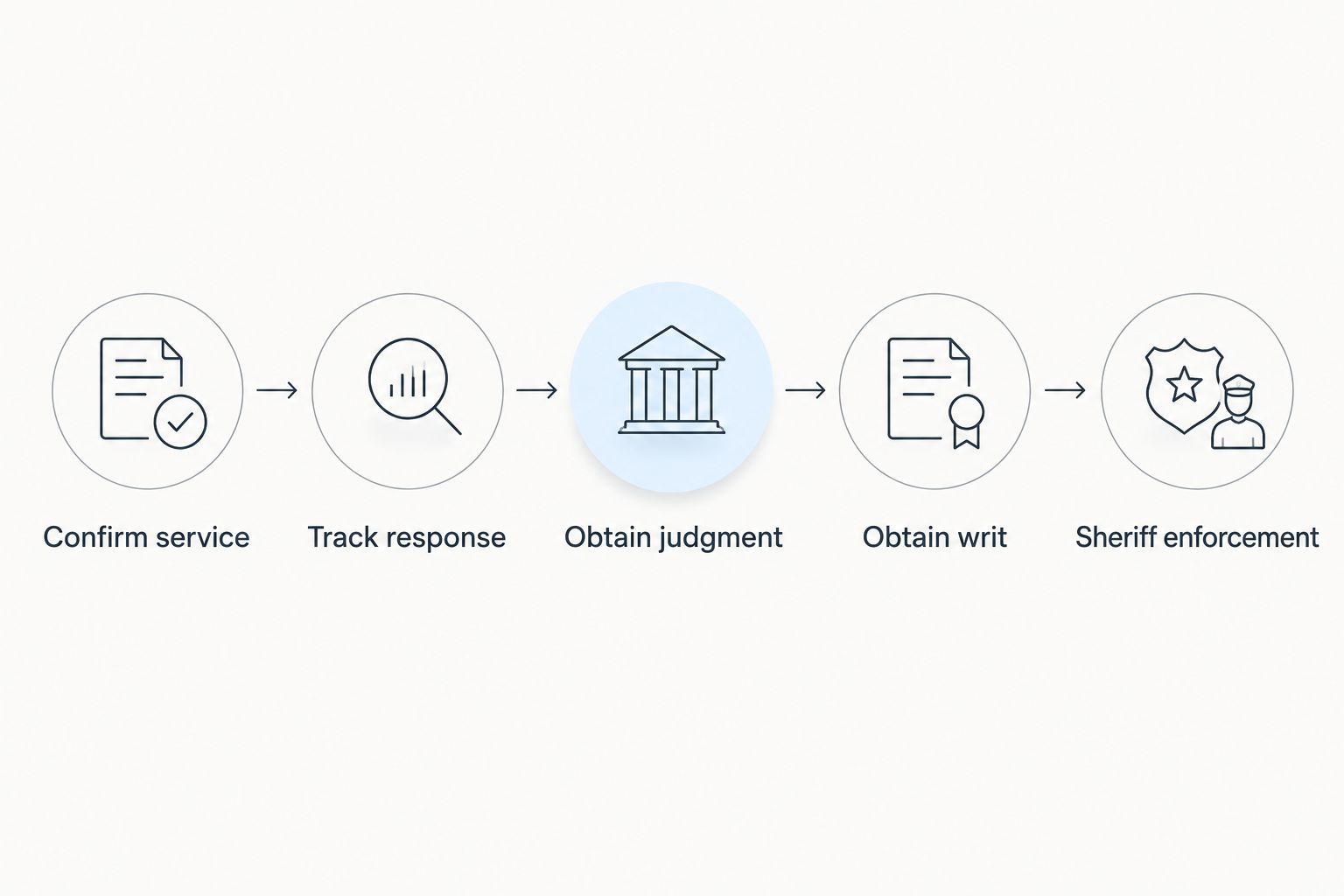
Each checkpoint needs its own supporting record. A process-server update supports the service stage; it does not establish that judgment, a writ, or enforcement has occurred.
For an attorney-facing explanation of the delivery handoff, see the process serving for eviction attorneys guide. Keep the service assignment separate from litigation decisions and enforcement scheduling.
Why eviction timing varies in San Diego
The main timing drivers are procedural, not simply how quickly someone delivers papers. For a 2026 case, check these factors before relying on any completion estimate:
- Document stage. A pre-lawsuit notice, summons, and sheriff’s notice start different periods and require different next steps.
- Service method. Personal service and substituted service do not start the response period in the same way.
- Tenant response. An unanswered complaint and a contested complaint follow different court paths; neither permits immediate private removal.
- Service validity. A disputed method, incomplete mailing, or inaccurate proof can require further work or a court decision.
- Court proceedings. Hearings, trial scheduling, motions, and court orders affect when a case reaches an enforceable result.
- Sheriff enforcement. A writ must reach the enforcement stage, and the notice period must be addressed before a lawful lockout.
These factors explain why a fast service assignment cannot establish a fast eviction outcome. Ask for confirmation of the completed stage and the next required action, not an unsupported promise of a final date.
What should I send with an eviction service request?
Give the server the complete documents for the assignment and accurate recipient information. Identify whether the request concerns a pre-lawsuit notice or a filed summons and complaint; do not label both simply “eviction papers.”
Include the service address, unit number, known access restrictions, relevant identifying information, and any attorney-provided instructions. State your requested deadline clearly so the server can assess the delivery assignment without confusing it with the court’s deadline.
Golden Hill Legal Runner offers standard, rush, same-day, and skip-tracing legal document delivery across San Diego County. Those service options concern document delivery, not a guaranteed judgment date, successful service date, or sheriff lockout date.
The benefit of using a process-serving company is a defined delivery assignment and service documentation. The limit is equally important: hiring a server does not replace legal review of the notice, complaint, service method, or deadline.
Arrange eviction document service
Identify the documents, service address, and requested delivery deadline before submitting your assignment.
Does the tenant have to leave when served with the summons?
10 court days generally describes the response period after personal service, not a move-out order. A summons tells the tenant about the lawsuit and the need to respond; it does not itself authorize physical removal.
Read every document received together. A summons, a judgment, and a sheriff’s notice carry different consequences, even when they concern the same property.
Does no response mean the eviction is finished?
10 court days without a response does not automatically finish a personally served eviction case. The landlord must seek the required default relief, obtain the necessary possession documents, and proceed through sheriff enforcement.
Before acting on an assumed default, check the court record and obtain legal guidance. A missed deadline is a procedural event, not permission for self-help removal.
Does rush service shorten the tenant’s deadline?
10 court days remains the general response period after personal service, even when delivery is rushed. Rush service changes the requested delivery handling; it does not shorten a statutory response period.
In 2026, separate your operational deadline from the recipient’s legal deadline. An urgent delivery request cannot eliminate court procedures or the sheriff’s enforcement stage.
FAQ
How long does eviction take after service in San Diego in 2026?
There is no fixed total duration after service. The timeline depends on the document served, service method, tenant response, court proceedings, and sheriff enforcement.
How many days do I have to respond to an eviction summons in California?
You generally have 10 court days after personal service of an unlawful detainer summons and complaint in 2026. Saturdays, Sundays, and judicial holidays are excluded; other service methods affect when the response period begins.
Does substituted service give me extra time to respond?
Substituted service generally becomes complete 10 calendar days after the required mailing, and the response period follows. Check the proof of service rather than counting only from the date papers were left.
Can my landlord change the locks after serving eviction papers?
Serving eviction papers does not authorize a landlord to change the locks to force you out. A lawful eviction requires the applicable court process and sheriff enforcement.
How long is the sheriff’s notice to vacate?
The sheriff’s eviction notice provides a 5-day notice period under California’s enforcement procedure. Read the notice for its deadline and instructions, and ask the sheriff about enforcement scheduling.
Can a process server guarantee my eviction completion date?
A process server cannot guarantee the court’s decision or sheriff’s enforcement date. Document delivery is only one stage of the eviction process.
Who should check my eviction response deadline?
An attorney or court self-help center can help you understand the deadline that applies to your documents and service method. Bring the summons, complaint, service information, and any court orders.
One last thing
Service is an event; possession is an outcome. The most useful question is not just how many days have passed, but which legally required stage has actually been completed.
Before your next call, write down the document title, service method, delivery date, mailing date if applicable, and latest court action. That record gives your attorney, the court self-help center, or your server a clear starting point without treating every deadline as the same clock.
Golden Hill Legal Runner handles legal document delivery. Not a law firm. No legal advice provided. This article provides general information, not a case-specific deadline calculation.