How much does it cost to serve legal papers out of state?
The cost to serve legal papers out of state requires a case-specific quote; there is no single charge that covers every destination, document, and deadline. A basic service quote does not necessarily include address research, additional locations, expedited attempts, or filing the completed proof of service. For a 2026 request, compare the full assignment—not just the initial delivery charge.
- The cost to serve legal papers out of state depends on destination, deadline, address quality, and assignment scope.
- Compare process serving quotes by included attempts, additional-address terms, and proof-of-service requirements.
- Golden Hill Legal Runner serves San Diego County recipients; confirm destination coverage before assigning interstate work.
- Separate court filing costs from document service and address research when planning your budget.
How much does it cost to serve legal papers out of state?
Get a written, itemized quote for the recipient’s actual location and your court’s requirements. A quote for an ordinary local assignment is not a reliable estimate for a different state, an uncertain address, or an urgent deadline.
Start with the distinction between whether service is permitted and what the delivery assignment includes. The guide to serving legal papers to someone out of state addresses the first question. Your written scope should resolve the second before you authorize work.
Use this breakdown to compare quotes without treating separate tasks as interchangeable:
| Quote component | What to have confirmed | What to watch for |
|---|---|---|
| Service assignment | Recipient, destination address, documents, and permitted method | A quote based on a different location or incomplete packet |
| Attempt scope | Included visits and how unsuccessful attempts are documented | No explanation of when another authorization is required |
| Urgency | When work begins and what the requested deadline means | Treating expedited handling as guaranteed completed service |
| Address research | Whether locating the recipient is a separate assignment | Paying for attempts at an address already known to be outdated |
| Proof of service | Required form, completion, and delivery to you | Assuming document delivery includes court filing |
| Additional work | Approval process for another address or changed instructions | An open-ended assignment without spending controls |
A lower initial quote is not automatically the lower total. Compare the same recipient, location, deadline, and return-document requirements across each estimate.
Why this matters
Out-of-state service connects a court case in one place with a recipient somewhere else. The provider needs clear delivery instructions, while you need documentation that addresses the issuing court’s requirements. Those are related tasks, not the same task.
For your 2026 budget, separate court filing, locating the recipient, serving the documents, and returning proof. Combining those items under a single label makes it harder to see what you are buying or identify what remains unfinished.
The practical risk is authorizing work before the assignment is clear. Resolve the location, document packet, and required return before comparing speed or choosing a provider.
Standard service: best for a confirmed address without urgent handling
Standard service is the starting point to discuss when you have a usable address and no need for expedited handling. Ask the provider to define the attempt schedule rather than assuming that “standard” means the same thing across companies.
Its advantage is a straightforward assignment: a known recipient, a known location, and ordinary handling. Its limitation is timing. A standard schedule does not establish that service will finish before your deadline.
Before authorizing standard service, ask:
- What event starts the assignment: payment, document review, or acceptance?
- How are attempts scheduled and reported?
- What happens if the address is incorrect?
- Does the quote include the required proof-of-service form?
Choose standard handling only after the provider confirms that the schedule fits your instructions. Do not substitute a general turnaround description for a case-specific deadline check.
Rush and same-day service: best for urgent handling
Rush and same-day service describe expedited handling, but the exact commitment needs to be written down. Ask whether the commitment concerns assignment acceptance, dispatch, the first attempt, or another defined action.
The benefit is priority handling when time matters. The limitation is that urgency does not make the recipient appear, remove access restrictions, or change the service method your case requires.
For a 2026 request, provide the actual deadline and any hearing date instead of writing only “urgent.” Ask the provider to confirm what it can undertake before you rely on the requested schedule.
Buy a defined action, not an ambiguous speed label. A promise to attempt service and a promise that service will be completed are different commitments.
Skip tracing: best for an uncertain recipient address
Skip tracing addresses a location problem. It is not a substitute for delivery, and a research result is not proof that the legal papers have been served.
The benefit is resolving an uncertain address before sending someone to an unsuitable location. The limitation is that address research does not guarantee a successful service attempt or establish which service method is legally sufficient.
Tell the provider what is known: the last confirmed address, relevant workplace information, and whether earlier delivery attempts failed. Share sensitive identifying information through the provider’s designated intake method, not through a public comment or open message thread.
Ask whether the research result requires separate approval before a service assignment begins. That checkpoint keeps locating work and delivery work distinct.
Why out-of-state process serving costs vary
The state boundary alone does not describe the assignment. These factors determine what work you need quoted:
- Destination: Give the complete service address and ZIP code. “Out of state” does not identify the provider’s service area or the actual location.
- Address quality: Distinguish a verified current address from a last-known address or an unconfirmed lead.
- Deadline: State the required completion date and any separate deadline for returning documentation.
- Attempt scope: Confirm what the initial assignment includes and when further attempts need approval.
- Document requirements: Identify the document type, issuing court, and required proof form before work starts.
- Additional tasks: Separate research, another address, document handling, and court filing from the delivery assignment.
These details also make competing quotes comparable. If one estimate covers a confirmed address and another includes locating the recipient, the totals describe different work.
For 2026 assignments, keep the accepted scope with your case records. A written record is more useful than trying to reconstruct a telephone conversation after an unsuccessful attempt.
How do you request a usable out-of-state service quote?
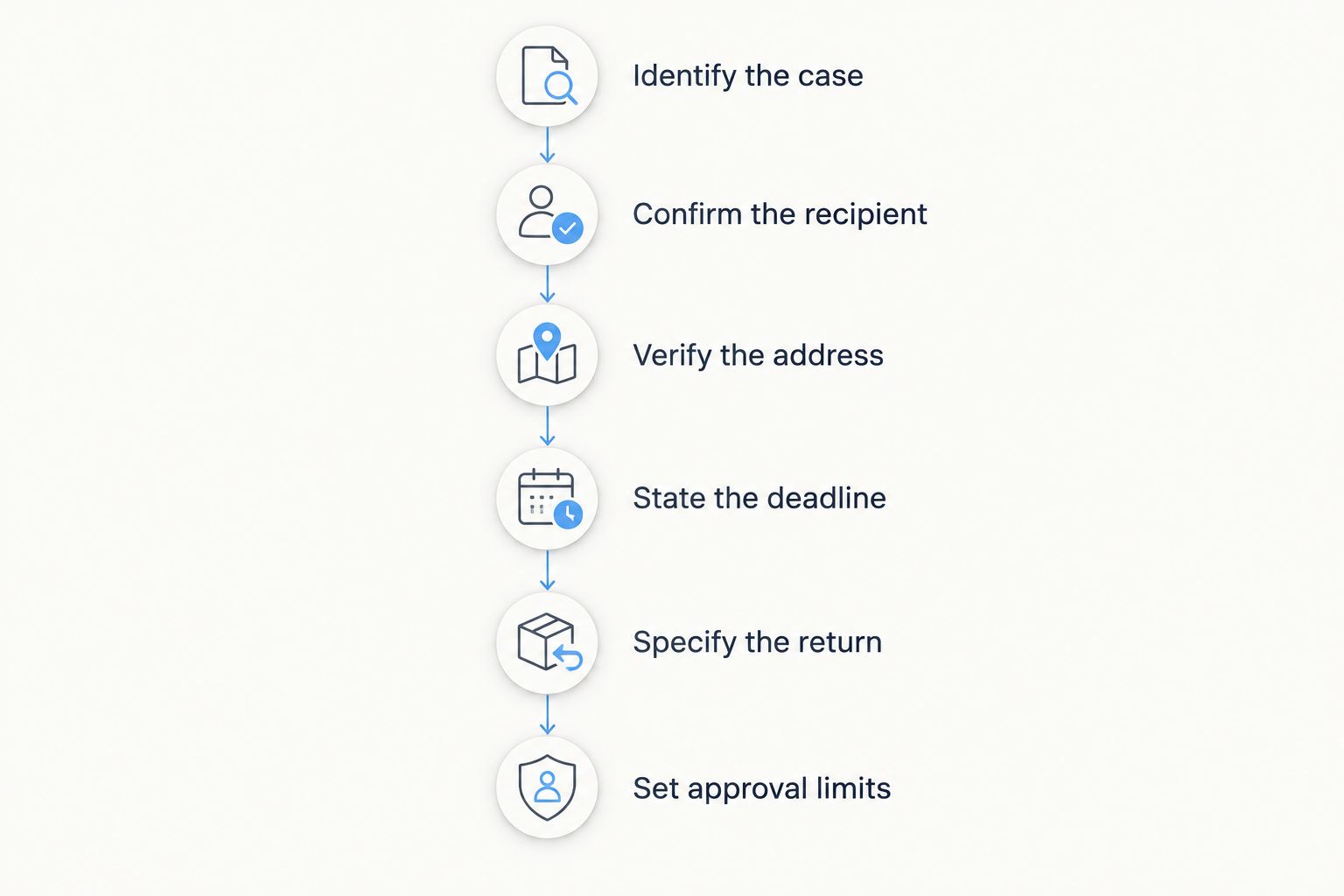
Send an assignment brief that lets the provider identify the work before accepting it. Use the following sequence.
- Identify the case. Provide the issuing court, case number, document type, and any relevant court instructions. Do not ask the server to infer the case requirements from a document title alone.
- Confirm the recipient. Supply the correct name and usable identifying details. For a business recipient, have counsel confirm whom the documents must reach.
- Verify the address. State whether the location is current, last known, residential, or a workplace. Describe known access issues without instructing anyone to bypass restrictions.
- State the deadline. Give the required date and distinguish an attempt deadline from completed service or return of proof.
- Specify the return. Identify the proof form and where completed documentation must be sent. Confirm separately whether filing is included.
- Set approval limits. Require authorization before another address, additional research, or expanded work begins.
This process does not determine whether your proposed service method is legally sufficient. It gives the provider a clear operational assignment after you have confirmed the applicable requirements with the court or your attorney.
What should you check before paying?
Read the quote as an authorization document, not just a total. You should be able to identify the recipient, destination, scope, requested timing, and deliverables without asking the provider to explain missing terms afterward.
Ask what happens when an attempt is unsuccessful. The answer should distinguish a recipient who was absent from an address that appears incorrect, because those situations call for different next decisions.
Also ask how the provider records attempts and seeks approval for further work. The discussion of how many attempts a process server makes explains why attempt scope deserves its own question rather than an assumption.
Keep document versions under control. If the court issues a corrected packet after you request a quote, notify the provider and confirm which version is authorized for delivery. A quote based on an earlier packet does not resolve instructions for replacement documents.
Keep court filing costs separate from service costs
Filing opens or advances a court matter; service delivers the required papers through the applicable process. Paying for one does not establish that the other is included or completed.
For a Nevada small claims matter, Nevada small claims filing costs belong in the court-filing portion of the budget, while the delivery assignment needs its own scope and authorization. Do not use a filing figure as the estimate for getting documents to an out-of-state recipient.
Keep the same separation when requesting proof-of-service filing. Preparing a completed proof, sending it back to you, and submitting it to the court are distinct actions. Ask who is responsible for each action and how completion will be confirmed.
A clear budget names the task beside the charge. A clear case record shows which task was actually completed.
Where Golden Hill Legal Runner fits
Golden Hill Legal Runner is best for serving a San Diego County recipient in an interstate case. The company’s stated process serving area is San Diego County, California; an out-of-state attorney’s location does not change where the recipient must be served.
Golden Hill Legal Runner is registered, bonded, and insured, with registration number 3904. Its stated services include standard, rush, same-day, and skip-tracing legal document delivery for attorneys, law firms, businesses, government agencies, and individuals.
The fit is geographic and operational: you need legal documents delivered to a recipient in the company’s stated service area. The boundary is equally important. Do not treat Golden Hill Legal Runner’s San Diego County coverage as confirmation that it accepts delivery assignments in every other state.
For a recipient outside San Diego County, establish destination coverage before discussing scheduling. For a recipient inside the county, provide the issuing court’s requirements with the assignment rather than assuming a local form or routine will satisfy them.
Can you reduce the total without weakening the assignment?
Yes. Reduce avoidable uncertainty before asking someone to attempt service. Confirm the address, submit the complete document packet, and state the deadline at intake.
Compare written scopes rather than choosing solely by the first figure quoted. A narrow initial assignment and a broader assignment are not equivalent, even when both are described as process serving.
Set a stop-and-confirm instruction for an incorrect address or a material change in the assignment. That does not eliminate necessary work; it lets you authorize the next task deliberately.
Do not reduce the budget by improvising a service method. Confirm the permitted method and required proof with the court or your attorney, then request pricing for that work.
FAQ
How much should I budget to serve legal papers out of state?
Budget from a written quote for the recipient’s location, document packet, deadline, and required proof. Separate address research, expanded attempts, and court filing so you can see the full assignment.
Is out-of-state service always more expensive than local service?
A state boundary alone does not establish the total cost. Compare destination coverage, attempt scope, urgency, and return requirements before treating the assignments as equivalent.
Does paying for rush service guarantee the papers will be served?
Rush handling does not guarantee completed service. Ask exactly what action the provider commits to and when, including whether the commitment concerns dispatch or an attempt.
Do I need skip tracing before serving someone in another state?
Skip tracing addresses an uncertain location; it is not automatically necessary because the recipient is in another state. Explain whether your address is current, last known, or already associated with failed attempts.
Does the service quote include filing proof with the court?
Do not assume proof-of-service filing is included. Have the provider distinguish preparing the proof, returning it to you, and submitting it to the court.
Can I use the same service method in every state?
Do not assume a single service method works for every interstate assignment. Confirm the rules applicable to your court, document type, and recipient before giving delivery instructions.
What should I send when requesting an out-of-state service quote?
Send the issuing court, document type, recipient information, service address, deadline, and required proof form. Include any court order or attorney instructions that govern the assignment.
One last thing
Ask this before accepting any 2026 quote: “What happens next if the address is wrong?” The answer exposes whether you are authorizing a defined delivery assignment or an open-ended sequence of tasks.
Keep that answer in writing with the accepted scope. It gives you a clear decision point when the original instructions no longer match the situation.
Not a law firm. No legal advice provided.
Related guides
- What counts as proof of service in California
- Skip tracing to service of process: the complete workflow
- Process servers for out-of-state attorneys in San Diego
Ready to get papers served? Book online with a registered process server in San Diego.