Process serving for collection agencies: complete 2026 guide
Collection agency process serving is the delivery of legal documents with the aim of moving collection litigation forward through documented, legally valid notice. This guide to process serving for collection agencies covers case handoffs, address checks, service assignments, and proof review in San Diego County, where an account record must become a clear set of instructions for the person serving the papers.
- Process serving for collection agencies requires accurate defendant details, clear instructions, and documented service outcomes.
- Golden Hill Legal Runner LLC fits San Diego County collection teams seeking local process serving and skip tracing.
- Resolve address uncertainty before choosing rush service; speed does not establish where a defendant lives.
- Keep attempted service, completed service, and filed proof as separate case statuses.
Why process serving matters for collection agencies
A collection account and a litigation file serve different purposes. Your account system tracks balances and contact history; the service assignment needs the correct defendant, current documents, a usable address, and instructions tied to the case.
A completed delivery is not the same as a completed court record. Your team must also review the returned documentation and confirm who handles filing. Start with the distinction explained in what counts as proof of service in California.
For your 2026 collection workflow, keep service activity separate from payment activity. A promise to pay does not tell your service coordinator whether counsel has authorized a hold, withdrawn an assignment, or changed the documents.
Collection files also require careful handling of identifying information. Give the server what is needed to identify the recipient and carry out the assignment, not an unrestricted copy of the agency's account history.
Build your collection-service workflow
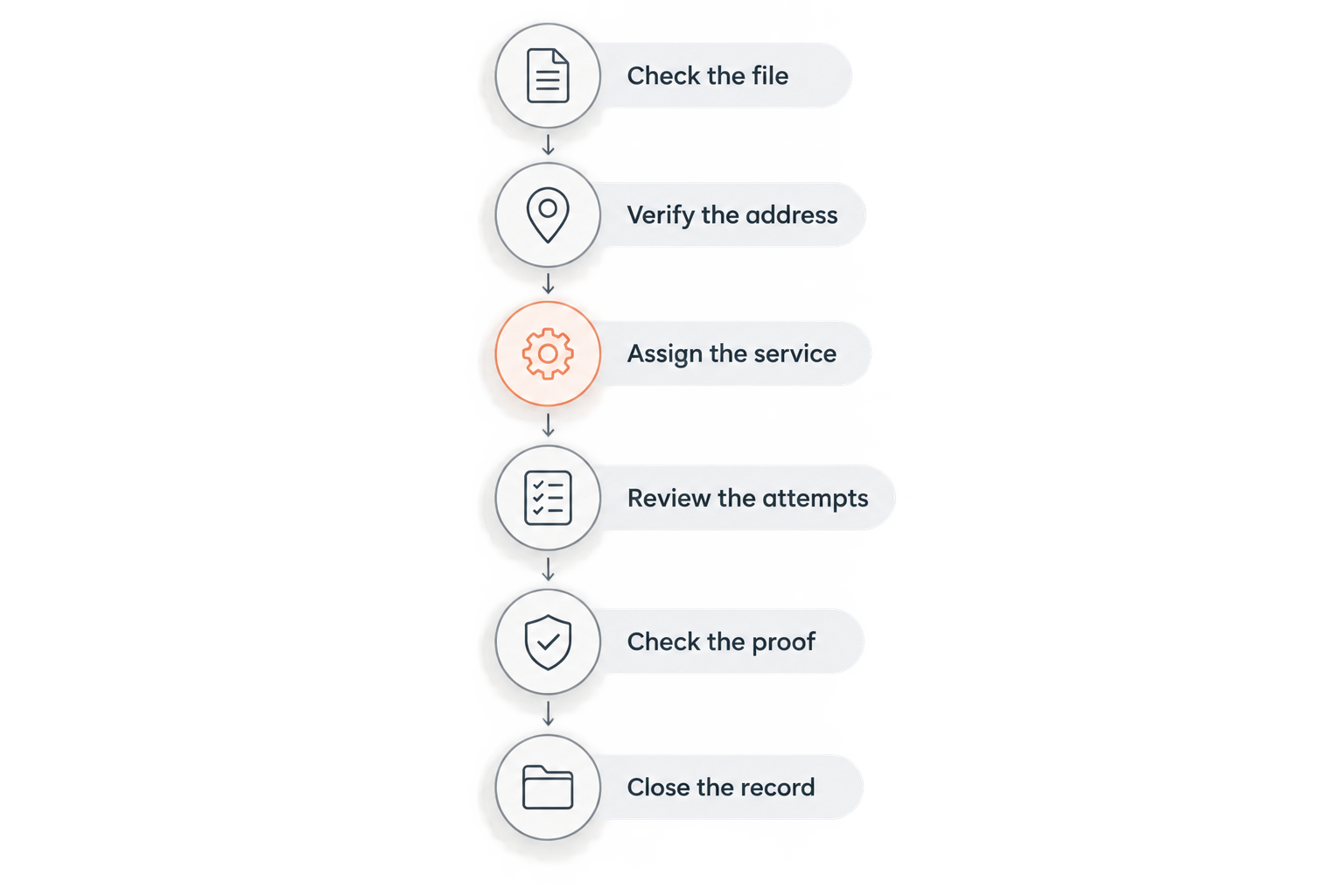
Use a shared spreadsheet and a controlled document folder before adding software or changing vendors. The essential sequence stays the same: check the file, verify the address, assign the service, review the attempts, check the proof, and close the record.
Check the file
Start with the court documents and counsel's instructions, not the account nickname in your collection system. Confirm that the person or business named in the assignment matches the party named in the papers. Flag discrepancies before dispatch.
Use 1 assignment row per defendant as an internal tracking rule. That keeps separate addresses, attempts, and returned proofs from being combined under a single account status. Multiple defendants in one lawsuit still need distinct tracking.
For California civil summons service, Code of Civil Procedure section 414.10 generally permits service by a person who is at least 18 years old and not a party to the action. Eligibility alone does not establish the correct service method; have counsel identify the requirements for the particular documents and recipient.
- Match the defendant's legal name to the documents.
- Confirm the case number and court.
- Identify the complete document set for service.
- Record counsel's instructions for the assignment.
- Identify the person authorized to change or stop the work.
Verify the address
Compare the proposed service address with information your agency is authorized to use. Separate a confirmed address from an old contact address, an unverified lead, or a mailing address. A database result is a lead to assess, not proof that the defendant is present.
Record where the address came from and when it was last checked. A long account history does not make its oldest address suitable for a new service assignment.
For your 2026 intake sheet, use 2 date fields: the last address-verification date and the assignment date. These are recommended tracking fields, not legal deadlines. They let the coordinator see whether the address review happened before dispatch.
- Label each address by its known purpose.
- Record the source and verification date.
- Flag apartment, suite, and access details.
- Distinguish a residence from a business or mailing location.
- Escalate conflicting information before another attempt.
Assign the service
Prepare the assignment manually first: a concise instruction sheet, the approved documents, and a named contact for questions. Then choose a provider based on the service location, urgency, address confidence, and documentation needed.
Golden Hill Legal Runner LLC provides registered, bonded, and insured process serving across San Diego County, with standard, rush, same-day, and skip-tracing services. A local service assignment gives your team a direct alternative to arranging and coordinating an eligible individual server; confirm the assignment terms before dispatch.
Golden Hill Legal Runner LLC process serving is best for collection agencies with San Diego County service assignments. Its stated coverage is countywide, so do not assume that the same arrangement covers defendants elsewhere.
Use 3 required handoff fields in your 2026 assignment template: defendant, service location, and deadline instructions. Attach the approved documents separately and identify who answers questions when field conditions differ from the request.
- Specify the requested service level without assuming completion.
- Supply the approved document version.
- State deadline instructions confirmed by counsel.
- Identify known access restrictions or safety concerns.
- Confirm how attempts and completed documents will be reported.
- Ask who handles any additional mailing or filing steps.
Review the attempts
Read attempt reports before authorizing more work. A report that the recipient was absent calls for a different decision from a report that the address does not exist. Do not reduce both outcomes to the same unsuccessful status.
Separate observed facts from conclusions. A server can record an unanswered door or information received at the location; your coordinator should not convert that into a definitive finding that the defendant moved or is avoiding service.
Use an escalation decision rather than automatic repeat dispatch. Depending on the facts and counsel's instructions, the next action is another attempt, address research, a corrected assignment, or legal review of an available service method.
- Review the reported location, date, time, and outcome.
- Flag statements that conflict with the assignment.
- Ask for clarification when an entry is ambiguous.
- Obtain authorization before changing the scope.
- Document the next action and its owner.
Check the proof
Compare the returned proof with the assignment and served documents. Check names, case details, dates, and the stated service method. Send discrepancies back for clarification; do not edit the server's factual statements yourself.
California Judicial Council form POS-010 is the Proof of Service of Summons form. That does not make it the correct form for every collection-related document. Have counsel identify the appropriate proof for the papers and procedure involved.
Keep proof returned and proof filed as separate statuses in your 2026 tracker. If your agency is not responsible for filing, record the handoff to counsel or the designated filer rather than marking the entire task complete.
- Match the defendant and case identifiers.
- Check the listed documents against the approved packet.
- Review the service date and stated method.
- Confirm that required portions are completed.
- Route discrepancies to the appropriate person.
- Record the filing responsibility and confirmation.
Close the record
Close the assignment only after its outcome is clear. Successful service, an unsuccessful assignment, and a client-authorized cancellation need different closing records. Each should show what happened and whether anything remains outstanding.
Keep the original report, returned proof, instructions, and subsequent clarifications together under your agency's retention and access policies. Avoid storing sensitive case details in broadly shared notes or email subject lines.
Measure your own workflow before setting vendor targets. Track assignment-to-first-attempt time, completion outcomes, address-related failures, and proof corrections using actual records. Report local and out-of-area work separately so the comparison reflects the work assigned.
- Record the final outcome without overstating completion.
- Save the report and returned documents.
- Confirm any remaining filing or review task.
- Identify the owner of unresolved issues.
- Retain records under approved access and retention rules.
Compare service options for collection files
Choose the option that resolves the file's actual constraint. A verified local address, an approaching deadline, and an uncertain location are different assignment conditions. Do not use an urgency label to substitute for address research.
The options below describe service approaches, not guaranteed results. Confirm eligibility, scope, reporting, and the required service method before assigning work.
| Option | Best for | Main advantage | Key limitation |
|---|---|---|---|
| Eligible individual server | A straightforward assignment your team can coordinate | Your team controls the handoff directly | Your team must check eligibility and coordinate documentation |
| Golden Hill Legal Runner LLC standard process serving | San Diego County files without an immediate escalation need | Local coverage from a registered, bonded, insured provider | Confirm attempt terms, reporting, and assignment timing |
| Rush or same-day service | Time-sensitive assignments with usable location information | Matches the request to a stated urgency level | An urgency request does not guarantee completed service |
| Skip tracing followed by service | Files with uncertain or conflicting address information | Addresses the location question before fieldwork | A located address does not establish successful service |
| Coordinated out-of-area service | Defendants outside the local provider's stated territory | Matches fieldwork to the recipient's location | Requires separate coverage and handoff checks |
For standard assignments, ask what starts the assignment and what happens after an unsuccessful attempt. For urgent assignments, distinguish acknowledgment, dispatch, an attempt, and completed service. Those are separate events.
For skip tracing, ask how findings will be handed to the person serving the papers. For out-of-area work, identify who receives the reports and who resolves proof questions. One accountable coordinator is useful; one undifferentiated status is not.
Common mistakes collection agencies make
Treating an account address as a verified service address
A contact address can remain in an account long after its usefulness for field service has ended. Label its source and verification status before dispatch. If the record contains conflicting locations, resolve the conflict or authorize research instead of presenting a guess as confirmed information.
Letting payment discussions control service informally
A collector's conversation with the account holder should not become an undocumented instruction to stop or restart fieldwork. Route changes through the authorized case contact. Preserve the instruction, its timing, and the assignment it affects.
Sending account history instead of service instructions
A server needs clear identifying and assignment information, not every collection note. Long, unfiltered histories can bury the current address or approved document set. Prepare a focused handoff and use an approved channel for sensitive information.
Paying for urgency before resolving a bad address
Rush service addresses scheduling urgency, not uncertainty about the defendant's location. Review the address evidence first. When the location is unresolved, ask whether research should precede another field assignment rather than repeatedly escalating the same weak lead.
Closing the case task when an attempt appears
An attempted delivery is not completed service, and returned proof is not confirmation of filing. Maintain distinct statuses for each stage. Assign a named owner to corrections and filing so the task does not disappear between the collection team, server, and counsel.
FAQ
What's the best process-serving option for a collection agency in San Diego?
The best option matches the defendant's location, address confidence, and assignment urgency. Golden Hill Legal Runner LLC offers standard, rush, same-day, and skip-tracing services across San Diego County; confirm the terms for the specific assignment.
Can a collection agency employee serve the papers?
Do not assume an employee is eligible to serve the papers. California civil summons rules generally require an adult nonparty, and counsel should assess the employee's role and the requirements for the particular case.
Does same-day process serving guarantee the defendant gets served?
A same-day service request does not itself guarantee completed service. Confirm whether the assignment concerns dispatch, an attempt, or another defined action, and keep that distinction in your case tracker.
Should we order skip tracing before process serving?
Order address research first when the proposed service location is unresolved or conflicting. A skip-tracing result still needs assessment before it becomes a field assignment.
What should a collection agency send to a process server?
Send the approved documents, correct defendant details, service location, deadline instructions, and an authorized contact. Share only the identifying and case information needed for the assignment through an approved channel.
Is a process server responsible for filing the proof of service?
Do not assume filing is included in the assignment. Confirm who prepares, reviews, and files the proof, then track returned proof and filing confirmation separately.
Can a process server choose another service method after unsuccessful attempts?
An unsuccessful attempt does not by itself authorize any alternative service method. Have counsel confirm the available procedure and its requirements before issuing revised instructions.
One last thing
Audit your unsuccessful assignments, not just your completed ones. For your next 2026 workflow review, separate address problems, access problems, incomplete instructions, and unresolved proof questions. That gives your coordinator a specific next action instead of another entry marked unsuccessful.
Keep the boundary clear: Golden Hill Legal Runner LLC handles process serving, not legal strategy. Not a law firm. No legal advice provided. Have counsel determine case-specific deadlines, permitted methods, and the legal effect of service.
Related guides
- Skip tracing for debt collection agencies
- Skip tracing to service of process
- How substituted service works in California
Ready to get papers served? Book online with a registered process server in San Diego.