Process serving for HOA and condo associations: complete 2026 guide
HOA and condo association process serving is the delivery of legal documents under applicable service rules so your association can move a case forward with a documented service record. This 2026 guide explains how to separate association notices from court papers, identify recipients, coordinate access, and close the file with proof of service.
- Process serving for HOA and condo associations starts with identifying the document, recipient, and applicable service rules.
- Golden Hill Legal Runner provides process serving across San Diego County; counsel determines the legal requirements.
- A condominium unit address does not establish that an owner lives there.
- Treat proof of service as a required handoff, not an administrative afterthought.
Why process serving matters for HOA and condo associations
An association manages property records, resident communications, and shared spaces. Those responsibilities do not make every association mailing valid service of court papers. Start with the document, not the delivery address.
An assessment-related lawsuit, a subpoena, and a routine violation letter require different decisions. Your attorney should identify the applicable procedure before management sends instructions to a server. A familiar mailing practice is not a substitute for that review.
Your records also describe different relationships: owner, tenant, property manager, board member, or business representative. Those labels matter because the person answering a unit door is not necessarily the intended recipient or someone authorized to receive the papers.
For your 2026 operating checklist, make the final evidence a starting requirement. Review what counts as proof of service in California before assigning responsibility for its review, return, and filing.
Build a controlled service workflow
The following steps separate legal decisions from delivery work. You can manage the intake with a shared checklist and a restricted-access folder; dedicated software is not a prerequisite.
Identify the papers
Read the document title and case caption before creating a delivery request. Separate ordinary association communications from documents connected to a court proceeding. Do not assume a hearing notice, assessment notice, summons, or subpoena follows the same delivery rules.
Ask association counsel to confirm the required method, eligible server, relevant dates, and proof requirements. The process server carries out the assignment; the association should not expect the server to choose its legal strategy.
Keep the approved packet separate from drafts. An attachment added after dispatch can create uncertainty about which version was delivered, especially when management and outside counsel maintain different copies.
Use 1 intake sheet per assignment so the document description and delivery instructions stay together. This is an organizational recommendation, not a court requirement.
- Record the exact document titles and case number.
- Identify the court and parties shown on the papers.
- Mark the approved version and include its attachments.
- Obtain counsel's instructions on method and timing.
- Name the person authorized to approve changes.
Verify the recipient
Build the recipient record manually from the case papers, association records, and counsel's instructions. Keep the unit address separate from the owner's mailing address. A rented condominium creates an obvious distinction: the occupant and owner are different people.
For an entity recipient, ask counsel to identify the proper person or capacity for service. Do not substitute a familiar vendor contact, receptionist, or property manager because that person responds quickly to email.
California Code of Civil Procedure section 414.10 generally permits a nonparty who is at least 18 years old to serve a summons. That rule does not establish that every association employee or director is suitable for every assignment; document-specific rules and the person's role still need review.
Record what you know and how you know it. An old directory entry should not carry the same confidence as recently confirmed contact information.
- Match the recipient's name to the case documents.
- Separate owner, occupant, and business roles.
- Record when each address was last confirmed.
- Flag entity-service questions for counsel.
- Exclude unnecessary resident information from the packet.
Select the assignment
First, compare the confirmed deadline with your internal ability to coordinate a qualified server. A spreadsheet and email can organize the handoff, but someone must own instructions, updates, and the returned declaration. Outsourcing delivery does not remove that responsibility.
Golden Hill Legal Runner offers standard, rush, same-day, and skip-tracing services across San Diego County. The company is registered, bonded, and insured, with registration number 3904.
Golden Hill Legal Runner process serving is best for San Diego County associations seeking a registered, bonded, and insured provider. Counsel still determines the legal requirements, and an urgent assignment does not guarantee a completed serve.
For a 2026 assignment, describe the actual deadline rather than writing only urgent. Ask what the selected service level covers, how unsuccessful attempts are reported, and who approves additional work. Do not confuse a requested completion date with a confirmed outcome.
- Provide the deadline and its source.
- Confirm the address and geographic coverage.
- Ask about attempt scope and status reporting.
- Identify the contact for operational questions.
- Require approval before changing the assignment.
Plan lawful access
Write down building and property access facts without directing the server to bypass security. A gate, concierge desk, locked lobby, or separate building entrance affects the approach. It does not give management authority to disregard access restrictions.
Give the server accurate, lawfully shareable information about entrances and unit locations. Keep allegations about the dispute out of instructions to gate staff or neighbors. The operational goal is access coordination, not public discussion of the recipient's case.
Treat access and recipient identification as separate questions. Reaching a unit door does not establish who answers it, and a concierge accepting an envelope does not by itself establish valid service.
Use your 2026 property-access notes to describe current conditions, not old arrangements. If management has changed or an entrance is no longer usable, update the assignment before the next attempt.
- Identify the building and unit clearly.
- Describe known entrance restrictions accurately.
- Provide an authorized access contact where appropriate.
- Share known safety concerns without speculation.
- Prohibit misrepresentation or forced entry.
Track documented attempts
Maintain a simple log rather than relying on scattered message threads. Ask for factual updates: when an attempt occurred, the address visited, what happened, and what question needs a decision. A resident's reported absence is different from a confirmed incorrect address.
Use 3 internal status labels: pending, attempted, and completed. These are management labels, not legal conclusions. Add a separate proof-review field so completed delivery does not automatically close the file.
When an address fails, return to the evidence. Ask whether further address research is appropriate before repeating the same assignment. Golden Hill Legal Runner offers skip tracing, but a possible new address still needs evaluation before another service attempt.
Do not direct the server to leave papers with a neighbor, post them, or change methods simply because the initial approach failed. Refer any proposed change to counsel for the applicable requirements.
- Save each attempt update in the assignment record.
- Distinguish observations from third-party statements.
- Flag conflicting address information promptly.
- Obtain approval for research or additional work.
- Send proposed method changes to counsel.
Close the record
Compare the returned proof with the assignment before marking the matter closed. Check the recipient, case number, document descriptions, dates, location, and service details. Ask the preparer to address discrepancies; do not edit a signed declaration yourself.
Create 2 review checkpoints: one before dispatch and one before filing. The first checks instructions and packet completeness. The second checks the returned evidence against what was assigned and the applicable filing requirements.
Confirm who files the proof and who saves the filing confirmation. Delivery, preparation of proof, and court filing are separate tasks. Do not assume one instruction includes all three.
For your 2026 recordkeeping procedure, retain the approved packet, instructions, attempt history, returned proof, and filing confirmation together. Limit access according to your association's records policy and counsel's instructions.
- Compare the proof against the approved assignment.
- Route errors to the person who prepared it.
- Confirm the filing owner and due date with counsel.
- Save the returned proof and filing confirmation.
- Close management's task only after the handoff is confirmed.
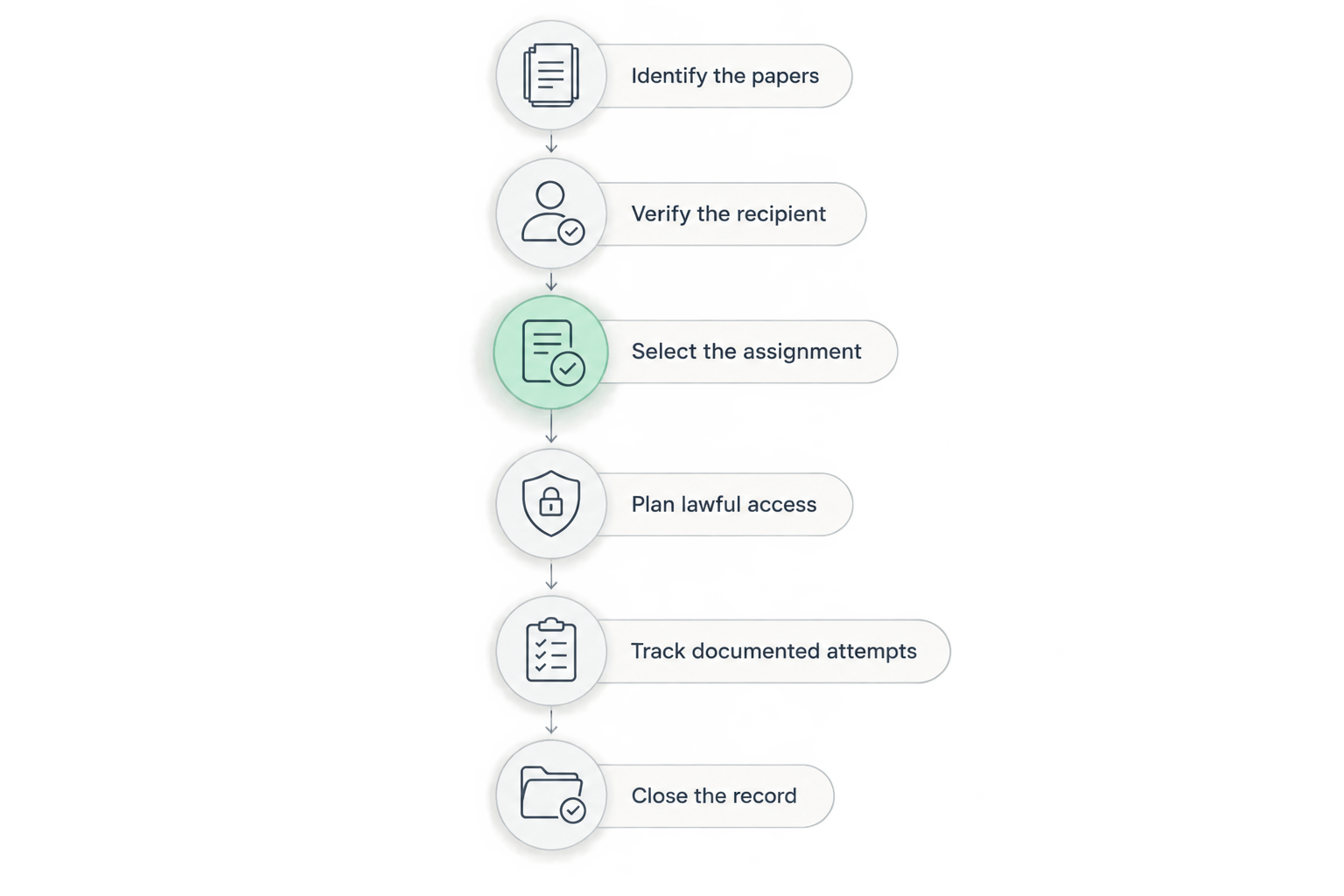
The workflow follows a fixed order: identify the papers, verify the recipient, select the assignment, plan lawful access, track documented attempts, and close the record. Resolve errors before they pass into the next stage.
Compare service options for association assignments
Choose the option that fits the assignment, not just the shortest delivery label. Standard, rush, and same-day describe service levels; they do not replace document-specific requirements. Skip tracing addresses a different problem: locating a person when the available address information needs work.
Golden Hill Legal Runner process serving includes the delivery options below. Confirm the scope for your particular assignment rather than assuming an attempt schedule, completion time, or filing service.
| Option | Best for | Practical advantage | Key limitation |
|---|---|---|---|
| Standard process serving | Associations whose confirmed deadline allows routine scheduling | Provides a non-expedited assignment option | Does not resolve an incorrect recipient or address |
| Rush process serving | Assignments needing accelerated attention | Offers an expedited service level | Does not guarantee contact with the recipient |
| Same-day process serving | Assignments requiring a same-day request | Offers a service level for immediate scheduling needs | Does not guarantee completed service that day |
| Skip tracing | Assignments with missing or questionable location information | Supports the search for an address | Research does not itself complete service |
Send the same information when comparing providers: approved papers, recipient details, address, deadline, access restrictions, and expected return documents. Otherwise, you are comparing differently defined assignments.
Common mistakes HOA and condo associations make
Treating every association notice as court service
A board letter and a summons are not interchangeable. Have counsel classify the document before management chooses a delivery method. Keep routine communications and litigation assignments in separate workflows.
Assuming the unit is the owner's residence
An association's records can identify ownership without establishing current residence. Separate the property address from the recipient's confirmed location, and flag conflicting records before dispatch.
Asking gate staff to solve service questions
Security staff can describe access procedures; they should not decide who is legally authorized to receive papers. Give staff narrow operational instructions and keep dispute details restricted to authorized contacts.
Treating a difficult serve as permission to improvise
An unsuccessful attempt does not authorize management to invent an alternative method. Document the result and ask counsel what procedure applies before changing instructions.
Closing the file when delivery is reported
A delivered packet is not the whole administrative record. Review the proof, confirm the filing responsibility, and retain the final documents before closing management's task.
FAQ
What's the best way to arrange process serving for an HOA or condo association?
Start with counsel-approved instructions identifying the documents, recipient, service method, and deadline. Give the server a complete packet, accurate address information, and one authorized operational contact.
Can an HOA board member serve court papers in California?
Eligibility depends on the document and the board member's role in the case. California Code of Civil Procedure section 414.10 generally allows a nonparty who is at least 18 years old to serve a summons; association counsel should assess the proposed server before assignment.
Can legal papers for a condo owner be left with a tenant?
Do not assume a tenant can accept service for a condo owner. Whether delivery to another person is permitted depends on the document, applicable procedure, and facts; obtain counsel's instructions before using that approach.
What if the condo owner no longer lives at the unit?
Verify the owner's location before repeating attempts at the unit. Compare the available records, document conflicts, and consider address research when appropriate; an ownership record alone does not establish residence.
Does same-day process serving guarantee that someone gets served that day?
Same-day process serving does not guarantee completed service that day. Recipient location, lawful access, and the applicable service requirements still affect the outcome; confirm the assignment's scope before dispatch.
Does proof of service get filed automatically?
Do not assume proof of service is filed automatically. Confirm separately who prepares it, who reviews it, and who files it, then retain the returned proof and filing confirmation.
What should an association check before sending papers in 2026?
Check the approved document version, recipient identity, address, counsel-confirmed deadline, access information, and return instructions. Assign responsibility for reviewing and filing the proof before delivery begins.
One last thing
Keep the property address and recipient address in separate fields—even when they match. That small distinction forces the next person handling the assignment to check whether the file identifies a unit, a residence, or merely a mailing destination.
Golden Hill Legal Runner LLC is not a law firm. No legal advice provided. Ask association counsel to confirm the requirements for your documents and case.
Related guides
- Can a process server enter private property?
- How does substituted service work in California?
- Skip tracing to service of process: complete workflow
Ready to get papers served? Book online with a registered process server in San Diego.