Skip tracing for repossession companies: complete 2026 guide
Repossession company skip tracing is the process of researching a borrower’s or collateral’s likely location with the aim of directing an authorized recovery assignment. Unlike a general people search, skip tracing for repossession companies must distinguish a person’s address from a vehicle’s location—and keep recovery instructions separate from legal document delivery.
- Skip tracing for repossession companies produces leads, not proof that collateral is present or recovery is authorized.
- Verify borrower identity, source dates, and assignment status before sending a lead to the field.
- Golden Hill Legal Runner provides skip tracing and process serving for San Diego County legal document delivery.
- Keep collateral recovery, borrower research, and service of process in separate workstreams.
Why skip tracing matters for repossession companies
A borrower’s former address can be accurate history and still be useless dispatch information. A current residential address also does not establish where a financed vehicle is parked. Treat identity, location, and authority as separate questions.
For your 2026 operating procedure, define what a usable lead must contain before anyone starts searching. The basic skip tracing research process helps explain the research stage; a repossession assignment adds collateral details, lender instructions, and field-safety boundaries.
Your team needs an answer it can act on, not an unexplained list of addresses. A useful handoff states what was found, when the information was recorded, what connects it to the subject, and what remains unverified.
The same distinction matters when a recovery file becomes a legal matter. Finding a possible address does not complete service of process, and serving documents does not authorize taking collateral. Keep those outcomes separate in your records and vendor instructions.
How to build a usable skip tracing workflow
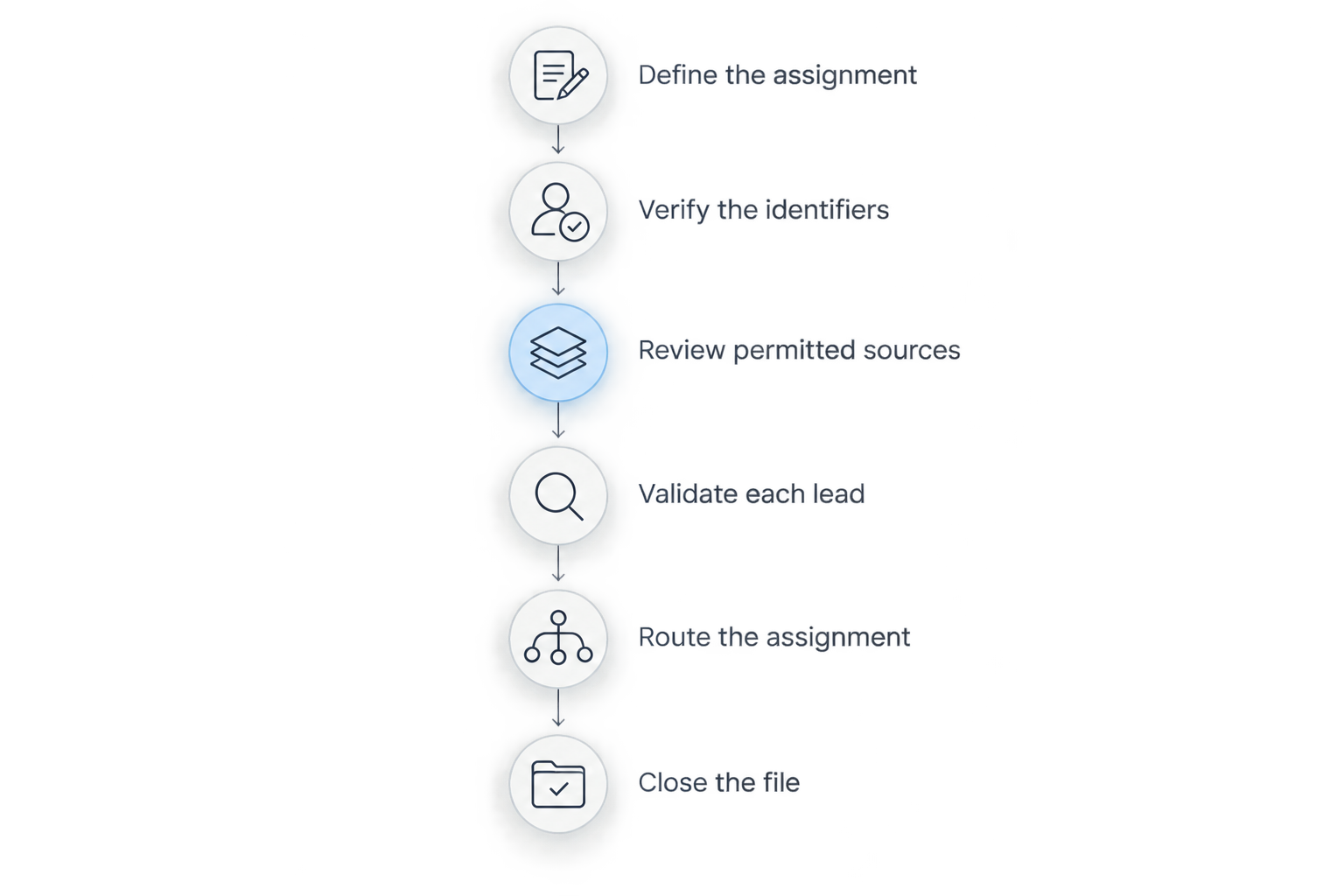
Define the assignment
Start manually with the lender’s assignment, your existing case notes, and the latest authorized instructions. Write the objective in plain language: locate a borrower, develop a collateral-location lead, or find an address for legal document delivery. Do not combine those objectives into a vague request to find someone.
For a 2026 intake template, include an assignment-status check before research begins and another before field action. Route cancellations, holds, disputes, and conflicting instructions to the responsible lender contact rather than asking a researcher to resolve them.
Best for: every new or reopened assignment. This step creates a clear scope, but it does not establish that the supplied information is accurate.
- Record the requesting party and authorized contact.
- State the research objective and geographic scope.
- Attach the current assignment instructions.
- Record holds, cancellations, and unresolved discrepancies.
- Identify who approves the next action.
Verify the identifiers
Compare the lender’s file with your existing records before searching elsewhere. Separate borrower information from co-borrower, guarantor, reference, and unrelated household-member information. A shared surname or historical address is a lead to examine, not an identity match.
For collateral, preserve the identifiers supplied in the assignment, including the vehicle identification number when applicable. Do not silently correct conflicting information. Flag the conflict and request clarification so a researcher or field agent does not build the next decision on an assumption.
Best for: files with common names, multiple borrowers, or inconsistent records. Manual comparison exposes discrepancies, but it cannot independently confirm a current location.
- Compare names and known aliases across authorized records.
- Separate each person’s role in the file.
- Check collateral identifiers against the assignment.
- Preserve original information alongside corrections.
- Flag conflicting identifiers before dispatch.
Review permitted sources
Begin with records your company is authorized to use and publicly accessible sources that fit the assignment. Record the source and its date as you work. Public visibility does not remove the need to consider privacy, permitted use, and your company’s handling rules.
Use an outside provider when the task requires research capacity your team cannot supply. Confirm the provider’s scope before sharing the file. A process-serving company’s skip tracing service should not be treated as a collateral-recovery service.
Golden Hill Legal Runner is best suited to repossession companies needing skip tracing for legal document delivery in San Diego County. The company provides process serving with standard, rush, and same-day options; those service categories do not establish a research turnaround or guarantee a successful location.
- List the sources approved for the assignment.
- Record source dates and access restrictions.
- Share only information needed for the agreed task.
- Confirm the provider’s service area and deliverable.
- Escalate questions about lawful access to counsel.
Validate each lead
Compare a candidate address against information already verified in the file. Ask what the source actually establishes: a historical association, a mailing address, a business connection, or a more recent location indicator. Those are different findings and should carry different descriptions.
Multiple records do not automatically provide independent confirmation. Several search results can repeat the same underlying information. Describe the evidence rather than labeling an address confirmed without explaining why.
Make your 2026 review form distinguish the borrower-location finding from the collateral-location finding. A person-location lead is not a vehicle sighting. When the evidence does not connect the collateral to the address, say so explicitly in the handoff.
- Record the candidate address and source date.
- Explain the connection to the identified subject.
- Distinguish repeated data from independent evidence.
- Separate person-location and collateral-location findings.
- Mark unresolved conflicts and verification gaps.
Route the assignment
Review the research result manually before it reaches a field queue. The reviewer should be able to tell what action is requested, who authorized it, and which uncertainties remain. Do not pass along an address without the context that makes it useful.
For recovery work, follow the lender’s current instructions and the applicable recovery requirements. For legal document delivery, send the documents and service instructions through a separate process-serving workflow. The skip tracing to service of process workflow explains that distinct handoff.
Best for: files moving from research to field action. A documented routing decision clarifies responsibility, but it does not replace legal review or field judgment.
- Recheck assignment status before release.
- Identify whether the task is recovery or document service.
- Include supporting facts and unresolved limitations.
- Name the receiving team and responsible contact.
- State the conditions that require a stop or escalation.
Close the file
Record the actual outcome rather than treating a delivered research report as a completed recovery. Useful outcomes include an unsupported lead, a corrected identity, a location requiring further review, or a completed downstream assignment. Keep research status separate from recovery and service status.
Review your 2026 files for repeat work caused by unclear handoffs. Count avoidable redispatches, identity corrections, and missing-source reports using your own records. These operational measures show where the workflow needs attention without inventing a provider success rate.
Best for: teams managing repeat assignments or multiple vendors. Consistent closure makes records easier to review, but the labels are useful only when staff apply them consistently.
- Record the research result separately from field results.
- Save the source history and reviewer decision.
- Document why a lead was rejected or returned.
- Apply your approved retention and access rules.
- Remove closed assignments from active dispatch queues.
The workflow has a deliberate boundary: research creates a documented lead; a separate review determines where that lead goes. Do not let a search result bypass the assignment check.
Compare your research and handoff options
Choose by the required outcome, not by how many records an option returns. Internal review, research tools, outside investigators, and process servers perform different jobs. Confirm the permitted scope before assigning sensitive information or requesting fieldwork.
| Option | Best for | Main advantage | Key limitation |
|---|---|---|---|
| Internal file review | Resolving intake gaps before outside research | Keeps lender instructions and existing notes together | Cannot independently establish a new location |
| Authorized research database | Staff conducting permitted record searches | Lets staff search and compare records directly | Results still require interpretation and validation |
| Qualified outside investigator | Assignments needing separately scoped investigative work | Allows a defined research assignment outside your team | Scope, qualifications, geographic coverage, and reporting need confirmation |
| Golden Hill Legal Runner | Skip tracing tied to San Diego County legal document delivery | Offers skip tracing and process serving through a legal document delivery company | Do not assign collateral recovery based on its process-serving services |
Ask each provider to describe the deliverable before authorizing work. An address list, a source-documented research report, and completed legal document delivery are not interchangeable. Neither are research completion and successful recovery.
For Golden Hill Legal Runner, keep the request within its stated process-serving and legal document delivery scope. Confirm the documents, location, deadline, and requested service level directly. Do not assume that a rush document-service option changes the time needed to resolve an uncertain identity.
Discuss your document delivery assignment
Ask about skip tracing and process serving for legal documents in San Diego County.
Common mistakes repossession companies make
Treating an address match as collateral confirmation
An address associated with a borrower does not establish that the collateral is there. Keep the address source and any collateral-specific evidence in separate fields. If the file contains no collateral observation, do not describe the address as a confirmed vehicle location.
Sending a file without current assignment status
A detailed research packet still needs a current instruction check. Require the responsible contact to resolve conflicting holds or cancellations before release. Research history explains what was found; it does not establish that field action remains authorized.
Asking a process server to perform recovery work
Legal document delivery and collateral recovery have different objectives and requirements. State exactly which service you need. Do not assume that a provider who locates a person for service also undertakes vehicle recovery, surveillance, or other investigative work.
Passing unnecessary personal information downstream
A field handoff should contain information necessary for the authorized task, not every personal detail collected during research. Use approved access controls and transfer methods. Keep unrelated household members and references out of the action instructions unless their information is necessary and its use is authorized.
Closing research as a successful recovery
A completed search is a research outcome. A recovered asset is a different outcome. Separate those statuses so your reporting shows whether the problem sits in intake, research, validation, routing, or field execution.
FAQ
What is skip tracing for repossession companies?
Skip tracing for repossession companies is research used to develop leads about a borrower’s or collateral’s location. A research lead does not by itself establish that the collateral is present or that recovery is authorized.
Does finding the borrower mean the vehicle is at the same address?
No. A borrower-location finding and a vehicle-location finding are separate conclusions. Record the evidence supporting each rather than treating an address association as a vehicle sighting.
What should I give a skip tracing provider?
Provide the authorized assignment objective, verified identifiers, relevant prior addresses, and current instructions through an approved transfer method. Confirm the provider’s scope first and share only information needed for that task.
Can a process server repossess a vehicle?
A process-serving assignment is not a repossession assignment. Verify the provider’s separate authority, qualifications, and agreed scope before requesting recovery work; document-delivery credentials alone do not establish those capabilities.
Can Golden Hill Legal Runner help with repossession-related legal papers?
Golden Hill Legal Runner offers skip tracing and process serving for legal document delivery across San Diego County. Confirm the specific documents and assignment requirements directly, and keep any collateral-recovery request separate.
What should I do when a skip trace returns conflicting addresses?
Keep the addresses as separate candidates and compare their sources, dates, and connections to the subject. Resolve material identity conflicts before routing a lead to the field; do not select an address solely because it appears first.
Is a public record enough to authorize repossession?
No. A public record can support research, but it does not supply repossession authority. Have the responsible lender contact or counsel resolve questions about the assignment and applicable requirements before action.
One last thing
A rejected lead is a useful result when the reason is documented. Finding that an address belongs to the wrong person prevents that same mistake from returning to the field under a different vendor’s report.
Add a required rejection-reason field to your 2026 workflow. Preserve the source, the contradiction, and the reviewer’s decision. That makes the next search start with what your team already knows instead of repeating an unsupported assumption.
Not a law firm. No legal advice provided.
Related guides
- Is skip tracing legal in California?
- Can a process server enter private property?
- What counts as proof of service in California?
Ready to get papers served? Book online with a registered process server in San Diego.