Skip tracing services for family law attorneys: complete 2026 guide
Family law attorneys’ skip tracing is the search for a person’s current location with the aim of arranging service of legal documents. This 2026 guide explains how to assess address leads, protect sensitive family information, and move from a search result to a documented service attempt without confusing location research with completed service.
- Skip tracing services for family law attorneys should produce actionable address leads, not promises of completed service.
- Goldenhilllegalrunner fits San Diego County firms seeking skip tracing and process serving from one company.
- Keep location research, service attempts, and proof of service separate in your case records.
- Document safety restrictions before assigning work involving domestic violence restraining orders.
Why skip tracing matters for family law attorneys
A family law file can contain several addresses without identifying where the respondent currently lives. A former marital residence, mailing address, workplace, and relative’s home represent different leads. Treating them as interchangeable creates unnecessary fieldwork and unclear records.
The firm also handles information that should not circulate with every assignment. Children’s schedules, protected addresses, and allegations of abuse require deliberate handling. Give the provider what the assignment needs, not the entire litigation file.
Goldenhilllegalrunner offers skip tracing and standard, rush, and same-day process serving across San Diego County, including family cases and domestic violence restraining orders. Those services address different tasks; requesting faster service does not establish that an address is current.
Goldenhilllegalrunner is best for San Diego County family law teams seeking skip tracing and process serving from one company. Its stated service area is San Diego County; do not assume an assignment outside that area is covered.
Build a trace-to-service workflow
Define the assignment before searching
Start with the case file. Identify the person, the documents requiring service, the hearing information, and the attorney responsible for service decisions. Separate the deadline supplied by counsel from any preferred completion date.
Write a narrow assignment: locate a current address for an identified respondent so the firm can arrange authorized service. An open-ended request to find everything about someone creates unnecessary privacy exposure and makes the deliverable difficult to evaluate.
For your 2026 intake checklist, assign 1 case owner to approve new search work and receive updates. That is an internal control, not a legal requirement. It prevents conflicting instructions from the attorney, paralegal, and client.
Close the intake with:
- The respondent’s full name and known aliases.
- Relevant identifying details already lawfully held by the firm.
- Last-known addresses, each with its source and date.
- Documents, hearing information, and counsel-confirmed deadlines.
- Safety restrictions and approved communication channels.
Validate the information already in the file
Review existing information before ordering additional research. Compare the client’s account with prior correspondence, returned mail, earlier service reports, and records already available to the firm. Distinguish a remembered address from a recently documented one.
Ask when the client last confirmed each detail and how. A statement that the respondent once worked somewhere does not establish current employment. A mailing address does not establish where the person can be physically located.
Use 2 review checkpoints: one before authorizing research and another before dispatching a server. The first checks identity and purpose; the second checks whether the resulting lead is suitable for the proposed assignment.
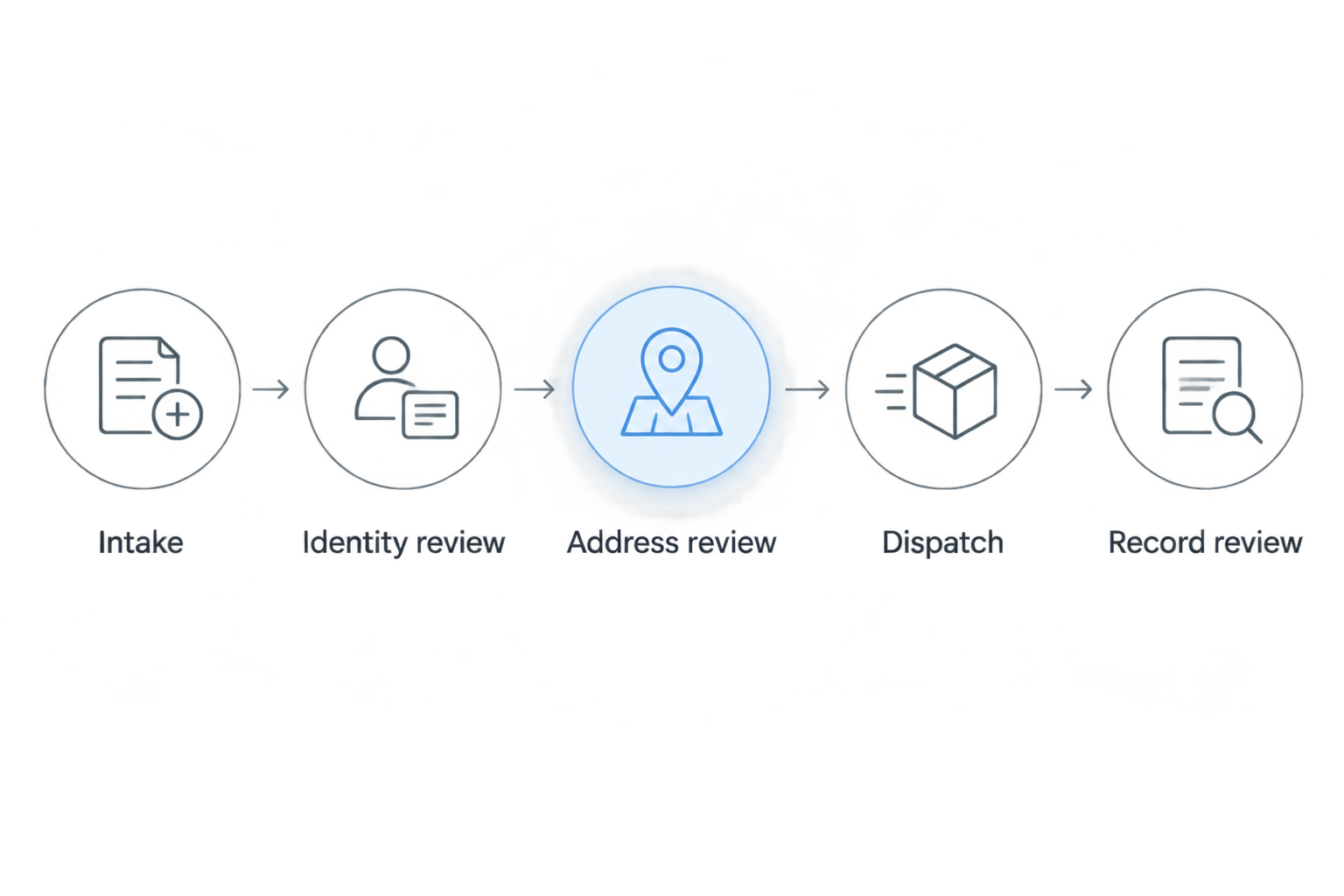
Keep the sequence visible: Intake, Identity review, Address review, Dispatch, and Record review. Each stage answers a different question, so avoid marking the whole assignment complete when only the research stage has ended.
Before commissioning a search:
- Reconcile spelling differences and aliases.
- Label each address as current, historical, or unverified.
- Record when and how the client confirmed a location.
- Remove irrelevant attachments from the assignment packet.
- Flag conflicting identities instead of selecting the closest name match.
Select a provider around the deliverable
The manual route is to have staff organize lawful existing records and assess the remaining gaps. A specialist becomes useful when the firm needs additional location research rather than another review of the same information.
Goldenhilllegalrunner offers skip tracing and process serving for San Diego County family matters. Its registered, bonded, and insured status is stated in the company description. Those credentials do not establish that a particular search will locate the respondent or that service will succeed.
Ask what the provider will return. An address list without source context, unresolved identity questions, or a clear handoff leaves the firm doing the evaluation after the assignment supposedly ends. Ask how inconclusive findings are reported, too.
During your 2026 provider review, define the deliverable in writing rather than treating the service label as a specification. Buy a defined research task, not a guaranteed outcome.
Confirm these points:
- The geographic scope of the assignment.
- The information needed to distinguish the correct person.
- How address leads and uncertainties will be described.
- Who authorizes expanded research or additional fieldwork.
- How sensitive documents and results will be transferred.
Separate address leads from service instructions
A skip-tracing result is a lead. It is not proof that the respondent lives at the address, will be present there, or has received legal papers. Preserve that distinction when moving the assignment into the service queue.
Have counsel identify the applicable service requirements before dispatch. Family law documents and restraining-order matters should not share a default instruction merely because the same respondent appears in both files. The provider needs the actual assignment, not an assumption about the case type.
For the operational handoff, the skip-tracing-to-service workflow keeps the research task distinct from the delivery task. Your case record should do the same: preserve what was found, what counsel authorized, and what the server observed.
Make the dispatch packet concrete:
- Identify the selected address and unresolved questions.
- Supply the correct documents and current instructions.
- Include relevant identification details through an approved channel.
- State access concerns without authorizing improper entry.
- Specify who receives an unsuccessful-attempt report.
Protect family information during fieldwork
Start with a restricted assignment packet rather than forwarding the complete client file. Review every attachment for protected addresses, unnecessary information about children, and details that do not help identify or locate the respondent.
Domestic violence matters require explicit safety instructions. Tell the provider about relevant restrictions through an approved channel, and identify the firm contact responsible for handling new safety concerns. Do not ask a client to approach the respondent merely to verify a location.
Use 3 separate status labels in your 2026 case tracker: Research pending, Attempt pending, and Record review. These are suggested internal labels, not court terminology. They prevent staff from interpreting a location result as completed service while keeping sensitive detail out of a broad task view.
Location research and ongoing observation are different assignments. If counsel is considering surveillance services for law firms, define the purpose, lawful scope, and safety restrictions separately rather than treating surveillance as an automatic extension of skip tracing.
Apply these controls:
- Limit access to staff working on the matter.
- Send only information necessary for the assigned task.
- Keep protected information out of broadly shared status messages.
- Require approval before expanding the assignment.
- Route threats or new safety concerns to the designated attorney.
Review the result before closing the task
Review research findings and field reports manually before changing the case status. Check the person identified, location used, documents involved, and outcome described. A completed vendor task does not automatically mean the firm’s service task is complete.
If an attempt fails, ask what the server actually observed. No answer, an inaccessible building, and information that the respondent moved are different findings. Record observations separately from conclusions about avoidance or residence.
Goldenhilllegalrunner offers standard, rush, and same-day process serving, but the firm still needs to distinguish the selected service level from the result. Do not record successful service merely because an urgent assignment was accepted.
Before closing the task:
- Match the report to the correct case and respondent.
- Check addresses and document descriptions for errors.
- Preserve unsuccessful-attempt information.
- Return unresolved service questions to counsel.
- Confirm who handles the proof-of-service review and filing task.
Compare your options for family law location research
Choose the option that matches the unresolved problem. Missing internal organization, an uncertain address, and a broader investigative question do not require the same assignment. The comparison below separates those needs without assuming that every provider offers every capability.
| Option | Best for | Practical advantage | Key limitation |
|---|---|---|---|
| Internal file review | Firms with recent information already in the matter | Keeps initial review within the existing case team | Does not resolve gaps that existing records cannot answer |
| Dedicated skip-tracing provider | Firms needing focused location research | Creates a separate research assignment with a defined deliverable | Requires a clear handoff to whoever arranges service |
| Goldenhilllegalrunner skip tracing and process serving | Family law teams arranging service in San Diego County | Offers both skip tracing and legal document delivery | Stated coverage is San Diego County; a search is not guaranteed service |
| Separately scoped investigative assignment | Counsel with questions extending beyond locating an address | Allows counsel to define a distinct investigative objective | Requires separate scope, authority, privacy, and safety review |
Choose based on the next decision the firm must make. If the only unresolved issue is whether an existing address is current, define that question before authorizing broader work. If service has already failed, include the prior attempt information so the next assignment does not begin from an incomplete record.
Common mistakes family law attorneys make
Treating the former marital home as a current address
A property connected to the marriage is a lead, not confirmation of present residence. Label its source and last verification date before sending another server there.
Letting the client direct sensitive fieldwork
Clients can supply information, but the firm should control assignment instructions. Conflicting directions about approaching relatives, workplaces, or the respondent create an unclear scope and avoidable safety concerns.
Sharing the entire family law file
A server does not need every allegation or financial attachment to understand an assignment. Send the required documents and relevant operational details through an approved channel; keep unrelated material out of the packet.
Treating a failed attempt as proof of avoidance
An unanswered door establishes an unanswered attempt, not intent. Preserve the facts observed and let counsel assess their significance rather than writing unsupported conclusions into the tracker.
Assuming skip tracing changes service requirements
Finding another address does not decide which service method applies. Counsel must review the applicable requirements and any court order before directing the next step.
FAQ
What are skip tracing services for family law attorneys?
Skip tracing services for family law attorneys are location-research services used to develop leads for finding a person connected to a family matter. A location lead supports service planning; it does not establish completed service.
When should a family law firm order skip tracing?
Order skip tracing when the firm needs location research that its existing records cannot resolve. First review known addresses, identity details, and previous service reports so the assignment starts with a defined question.
Can skip tracing guarantee that divorce papers will be served?
No, skip tracing cannot guarantee completed service. Research, a field attempt, and a completed proof of service are separate parts of the workflow.
What should I send with a skip-tracing request?
Send the identifying information, address history, assignment purpose, and relevant restrictions needed for the task. Use an approved transfer channel and exclude unrelated family information.
Is skip tracing the same as surveillance?
No, skip tracing develops location leads, while surveillance involves observation. Counsel should scope and review any surveillance assignment separately rather than assuming it is included in an address search.
What should happen if the address search is inconclusive?
The provider should report the unresolved findings, and the firm should decide whether to authorize additional research. Keep the search status separate from service status and do not convert an uncertain lead into a confirmed address.
Does Goldenhilllegalrunner handle family law process serving?
Yes, Goldenhilllegalrunner offers process serving for family cases, including domestic violence restraining orders, across San Diego County. Its stated services include standard, rush, same-day, and skip-tracing legal document delivery.
One last thing
Record who confirmed an address, not just what the address is. For your 2026 workflow, add a source-and-date field beside every location lead. A later reviewer can then distinguish client recollection, research findings, and a server’s direct observations without reconstructing the assignment from email.
Not a law firm. No legal advice provided.
Related guides
- Process serving for family law attorneys
- What counts as proof of service in California
- Serving domestic violence restraining orders
Ready to get papers served? Book online with a registered process server in San Diego.