What happens if a tenant refuses an eviction notice?
If a tenant refuses an eviction notice in California, refusal alone does not stop the eviction process or make properly completed service invalid. The landlord still must use a legally permitted delivery method, wait the applicable notice period, and obtain a court judgment before the sheriff can carry out an eviction. Refusing the paper is different from successfully challenging the notice or its service.
- When a tenant refuses eviction notice delivery, California service requirements still control; refusal does not automatically defeat service.
- An eviction notice, court summons, and sheriff’s notice are different documents with different deadlines.
- Golden Hill Legal Runner LLC handles San Diego County process serving, not legal advice or eviction decisions.
- Document the delivery facts, preserve the papers, and get legal advice before calculating a disputed deadline.
What happens if a tenant refuses an eviction notice?
The next step depends on which document the tenant refused and whether service was legally completed. A landlord’s notice is not a court order, and an attempted delivery is not automatically valid service.
California Code of Civil Procedure sections 1161 and 1162 govern common pre-lawsuit eviction notices and their delivery. Court summonses follow separate service rules. These distinctions control the California process discussed in this 2026 guide.
| Document refused | What refusal means | What happens next |
|---|---|---|
| Landlord’s termination or compliance notice | Refusal does not automatically invalidate otherwise lawful delivery | Determine whether service complied with the applicable notice rules |
| Unlawful detainer summons and complaint | Refusal does not automatically prevent personal service | Establish the service method and calculate the court-response deadline |
| Sheriff’s notice to vacate | Refusal does not cancel enforcement of a writ of possession | Address any available court relief immediately; the sheriff controls enforcement |
A tenant generally does not need to sign a receipt for service to be effective. The distinction between acknowledgment and delivery is explained in Do You Have to Sign for Legal Papers When Served?.
Why this matters
Confusing these documents creates deadline mistakes. A tenant who rejects a landlord’s notice has not necessarily missed a court-response deadline, while a tenant who ignores a properly served summons risks a default judgment.
For landlords, the risk runs in the opposite direction: treating a refusal as permission to skip service requirements can undermine the eviction case. The delivery facts matter more than whether the tenant cooperated.
Refusing personal delivery does not automatically defeat service
A tenant cannot necessarily prevent service by identifying themselves and then refusing to take papers. California law recognizes circumstances in which a server can complete personal delivery despite that refusal, including leaving papers near an identified recipient after explaining their nature.
That is not permission to drop papers anywhere. The recipient’s identity, the server’s explanation, where the papers were placed, and the circumstances of the encounter all matter.
For an eviction notice, the delivery still must satisfy the governing notice statute. For court papers, the delivery must satisfy the rules for serving the summons and complaint. Do not treat those rules as interchangeable.
What should the server record?
A useful service record describes observable facts rather than conclusions about the tenant’s motives:
- The date, time, and address of the encounter.
- How the recipient was identified.
- What the server said about the documents.
- What the recipient said or did.
- Where the papers were left and any additional service steps completed.
Write what happened. “Recipient refused to take the identified documents” is more useful than “tenant is avoiding responsibility.” A court determines the legal effect of disputed service.
A closed door is different from an identified refusal
Nobody answering the door does not establish that the tenant personally received the notice. Hearing movement inside, seeing a vehicle, or assuming someone is home does not replace the applicable delivery requirements.
California Code of Civil Procedure section 1162 provides methods for serving covered landlord notices, including personal delivery and specified alternatives involving delivery to another suitable person or posting and mailing. Each alternative has conditions. Posting alone is not the statutory posting-and-mailing method.
For an unlawful detainer summons and complaint, substituted service and court-authorized posting have different requirements. A landlord cannot simply reuse the pre-lawsuit notice procedure for the court case.
If you are the tenant, keep an envelope, photograph, or message associated with delivery. If you are the landlord, preserve the attempt history and mailing records. Those records help an attorney evaluate what actually occurred.
What should you do after a tenant refuses the notice?
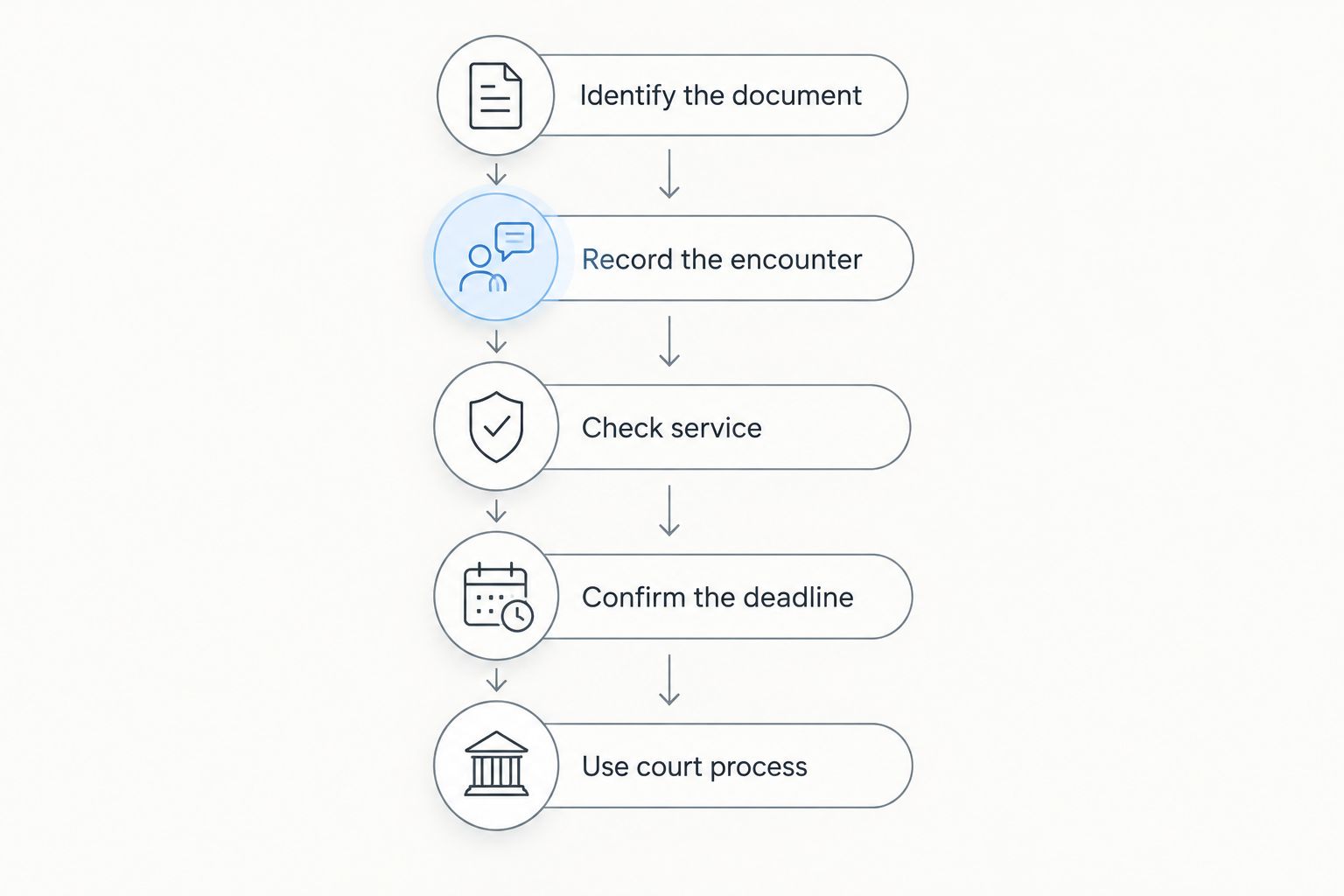
Use this sequence to separate a delivery problem from a legal decision. It applies whether you manage the property yourself or coordinate the matter for a law firm.
- Identify the document. Confirm whether it is a landlord’s notice, a summons and complaint, or a sheriff’s notice. Record its exact title.
- Record the encounter. Preserve the date, location, identification details, statements, and placement of the papers. Do not rewrite an unsuccessful attempt as completed service.
- Check service. Have the applicable delivery requirements reviewed. Determine whether another attempt, mailing, or other authorized step remains necessary.
- Confirm the deadline. Identify the notice type, service method, and applicable counting rules before selecting a filing or response date.
- Use court process. If the dispute remains unresolved, follow the lawful court procedure. Do not substitute a lockout or utility shutoff for an eviction judgment.
For document delivery, Golden Hill Legal Runner LLC is best for San Diego County clients who need process serving rather than legal advice. The company is registered, bonded, and insured and handles eviction-related legal document delivery. An attorney must address notice selection, disputed service, defenses, and litigation strategy.
You can review Golden Hill Legal Runner LLC for process-serving assistance. Hiring a server does not turn a defective notice into a valid one or authorize removal of a tenant.
Which deadlines matter in California in 2026?
There is no single eviction deadline triggered by refusing a paper. The document and service method determine the relevant clock.
Common California notice periods include 3 days, 30 days, and 60 days, but they serve different purposes. They are not interchangeable options a landlord can choose simply because a tenant was uncooperative.
A 3-day notice is not a 3-day physical eviction
A qualifying 3-day notice can demand rent, correction of a lease violation, or departure, depending on the legal grounds and notice language. For California notices demanding payment of rent or performance of lease conditions, Saturdays, Sundays, and judicial holidays are excluded from the statutory 3-day calculation.
Expiration of the notice does not authorize a landlord to remove the tenant. If the tenant remains and the legal requirements are satisfied, the landlord must pursue an unlawful detainer case.
A 30-day or 60-day notice is not always sufficient
California uses 30-day and 60-day termination notices in certain circumstances, with tenancy duration relevant to the applicable period. State just-cause protections and local rules can restrict whether termination is allowed at all.
For San Diego properties in 2026, identify whether the rental falls within the City of San Diego or another jurisdiction. Do not assume that a county mailing address answers which local tenant-protection ordinance applies.
A summons has a separate court-response deadline
For a California unlawful detainer summons personally served in 2026, a defendant generally has 10 court days to respond, excluding Saturdays, Sundays, and judicial holidays. Other service methods affect when service is complete and when the response period begins.
This is not the same deadline as the landlord’s earlier notice period. If you receive court papers, get the response date checked immediately rather than counting from an earlier argument at the door.
A sheriff’s notice concerns enforcement
After a possession judgment and writ, the sheriff generally posts a 5-day notice to vacate before carrying out the eviction. California Code of Civil Procedure section 715.020 addresses this enforcement notice.
Refusing to read or accept that notice does not cancel the writ. Questions about a stay or other court relief require immediate legal attention.
Why the outcome varies after a refusal
Refusal is one event within a larger legal process. These factors determine what follows:
- Document type: A landlord’s notice, court summons, and sheriff’s notice perform different legal functions.
- Recipient identification: An encounter with the identified tenant differs from an unanswered door or an unidentified visitor.
- Delivery method: Personal delivery, substituted delivery, and posting procedures carry different requirements.
- Notice grounds: Nonpayment, a correctable violation, and termination of tenancy do not use identical notice rules.
- Property jurisdiction: State law and applicable local protections affect termination requirements.
- Service evidence: A detailed declaration and supporting records help establish the facts if service is disputed.
None of these factors makes a process server the decision-maker on an eviction. Golden Hill Legal Runner LLC provides process serving; the court decides contested legal issues.
Can a landlord change the locks after a tenant refuses notice?
No. Refusing an eviction notice does not authorize a landlord to change the locks, shut off utilities to force departure, or remove the tenant’s belongings. California Civil Code section 789.3 addresses prohibited landlord conduct intended to terminate occupancy outside the lawful process.
A notice begins or supports a legal process; it does not replace a judgment and sheriff enforcement. Even a landlord who believes the tenant has no defense must use the required procedure.
Do not confront the tenant to force acceptance. Preserve the service record and direct legal questions to counsel.
Can a tenant challenge service after refusing the papers?
Yes. Refusal does not eliminate the tenant’s ability to raise a genuine service defect or challenge an improper notice through the appropriate procedure.
But refusing papers is not itself a defense that automatically defeats the case. A court examines whether the applicable requirements were met, not whether the tenant wanted the documents.
If you are the tenant, retain the papers even if you dispute delivery. In a 2026 unlawful detainer case, get legal help promptly so a service objection does not become a missed response deadline.
FAQ
What happens if I refuse to take an eviction notice at the door?
Refusing to take an eviction notice does not automatically prevent valid service in California. The delivery must still satisfy the applicable rules, so preserve the papers and get the service facts reviewed rather than assuming refusal stopped the process.
Do I have to sign an eviction notice for it to count?
You generally do not have to sign an eviction notice for service to be effective. Your signature is not the same thing as the landlord satisfying the legal delivery requirements.
Can a landlord just tape an eviction notice to my door?
Taping a notice to a door is not automatically valid service. California’s statutory posting-and-mailing procedure has conditions and includes mailing; court summonses follow separate rules.
How long do I have to answer eviction court papers in California in 2026?
A personally served California unlawful detainer summons generally gives you 10 court days to respond in 2026, excluding Saturdays, Sundays, and judicial holidays. Other service methods affect the calculation, so confirm the deadline for your case immediately.
Does refusing the notice give me more time to move?
Refusing the notice does not itself give you more time to move. Any applicable notice or response period depends on the document, lawful service, and governing rules.
Can my landlord remove me after a 3-day notice expires?
A landlord cannot physically evict you merely because a 3-day notice expired. The landlord must obtain a possession judgment and follow sheriff enforcement procedures.
Should I throw away eviction papers if I think service was wrong?
Keep eviction papers even if you believe service was wrong. The documents, envelope, delivery date, and surrounding messages help an attorney evaluate deadlines and possible objections.
One last thing
Keep the refused paper and the delivery record together. A clear record should distinguish the date of an attempted handoff, any later delivery or mailing, and the document involved. Those are separate events, not interchangeable dates.
Before acting, ask: “Which document is this, how was it served, and which deadline follows?” That question is more useful than whether someone accepted the envelope.
Not a law firm. No legal advice provided. This article provides general California process information, not advice about a particular tenancy or court case.