Can you refuse to accept legal papers?
You can refuse to take legal papers into your hands, but you cannot stop valid service of process simply by refusing them. In California, a server who identifies you and explains the papers can sometimes complete personal service by leaving them near you when you refuse to accept them. Refusal is not a veto; whether service is valid depends on the delivery facts and the rules for your case.
- Can you refuse service of process? Refusing papers does not automatically defeat valid California service.
- Personal service does not ordinarily require your signature; notice-and-acknowledgment service has different requirements.
- Challenge defective service through the court, not by ignoring papers or missing deadlines.
- Goldenhilllegalrunner provides process serving across San Diego County, not legal advice about challenging service.
Why this matters
Refusing papers and challenging service are different actions. Refusal happens at delivery. A legal challenge asks the court to decide whether the required procedure was followed.
For a California case in 2026, your immediate task is to identify the documents, preserve the delivery details, and confirm the applicable deadline. Do not assume the deadline waits until you agree to receive the papers.
If you are arranging delivery rather than receiving papers, Goldenhilllegalrunner offers process serving across San Diego County. Delivery services and legal representation serve different purposes.
Can you refuse to accept legal papers?
You can decline to hold the papers, but that alone does not invalidate service. California Code of Civil Procedure section 415.10 governs personal delivery of a civil summons and complaint. California Courts Self-Help guidance also explains that refusing to take papers does not necessarily prevent personal service.
The distinction matters when comparing delivery methods. These California procedures have different requirements; they are not interchangeable options available in every case.
| Service method | What it generally requires | What refusal means | Main limitation |
|---|---|---|---|
| Personal service | Delivery to the person being served | Refusing to hold papers does not necessarily prevent completion | Identification, notice, and delivery circumstances matter |
| Substituted service | Delivery to a qualifying person at a qualifying location, followed by mailing | Your absence or avoidance does not automatically prevent service | Statutory conditions must be met |
| Notice and acknowledgment | Mailing the required documents and obtaining a signed acknowledgment | An unsigned acknowledgment generally does not complete this method | It is not the same as personal service |
| Publication | A court order and compliance with publication requirements | Avoidance does not give you control over a court-authorized method | Publication requires court approval and supporting facts |
These distinctions reflect California Code of Civil Procedure sections 415.10, 415.20, 415.30, and 415.50, discussed here for California cases in 2026. Special proceedings and particular documents require separate analysis.
Personal service: refusing papers does not require a signature
Personal service ordinarily does not require you to sign a receipt or agree that the lawsuit is justified. The server's job is delivery, not obtaining your consent to the case.
When a server identifies the intended recipient, explains that the documents are legal papers, and leaves them in that person's presence after refusal, service can be effective. Simply dropping documents at an address without identifying or encountering the recipient is a different situation.
Receiving papers does not mean you admit the allegations. You can accept delivery and still dispute the lawsuit, the court's authority, or the sufficiency of service through the appropriate procedure.
Do not confuse a signature requested for a particular delivery method with a universal requirement. A missing signature does not, by itself, establish that personal service failed.
Substituted service: another person can sometimes receive papers
California Code of Civil Procedure section 415.20 permits substituted service when its conditions are satisfied. For an individual, this generally requires reasonable diligence at personal delivery before using the substitute procedure.
At a qualifying dwelling or usual place of abode, the recipient must be a competent household member who is at least 18 years old. At a qualifying business location, different recipient requirements apply. The server must explain the nature of the papers and complete the required mailing.
For service under section 415.20, completion generally occurs 10 days after mailing. That completion rule is not the same thing as the deadline to respond to the lawsuit.
A roommate receiving an envelope does not automatically establish valid service. Location, the recipient's qualifications, prior delivery efforts where required, and follow-up mailing all matter. Equally, your absence does not automatically make delivery invalid.
Why the effect of refusing service varies
There is no single refusal rule that answers every delivery dispute. For California service questions in 2026, check these factors:
- Document type: A summons, subpoena, restraining order, and eviction notice do not all follow identical delivery rules.
- Delivery method: Personal service, substituted service, acknowledgment, and publication have different completion requirements.
- Recipient identity: Delivery to the named individual differs from delivery to a household member, employee, or unrelated person.
- Location: A qualifying residence or business matters for substituted service; an arbitrary address is not enough.
- Required follow-up: Some methods require mailing, a signed acknowledgment, or a court order in addition to the initial delivery effort.
- Governing court rules: California procedures do not automatically govern every out-of-state or federal case involving a San Diego address.
Evaluate the actual method, not just whether you touched the envelope. That is the useful distinction when reviewing a disputed delivery.
What should you do after refusing legal papers?
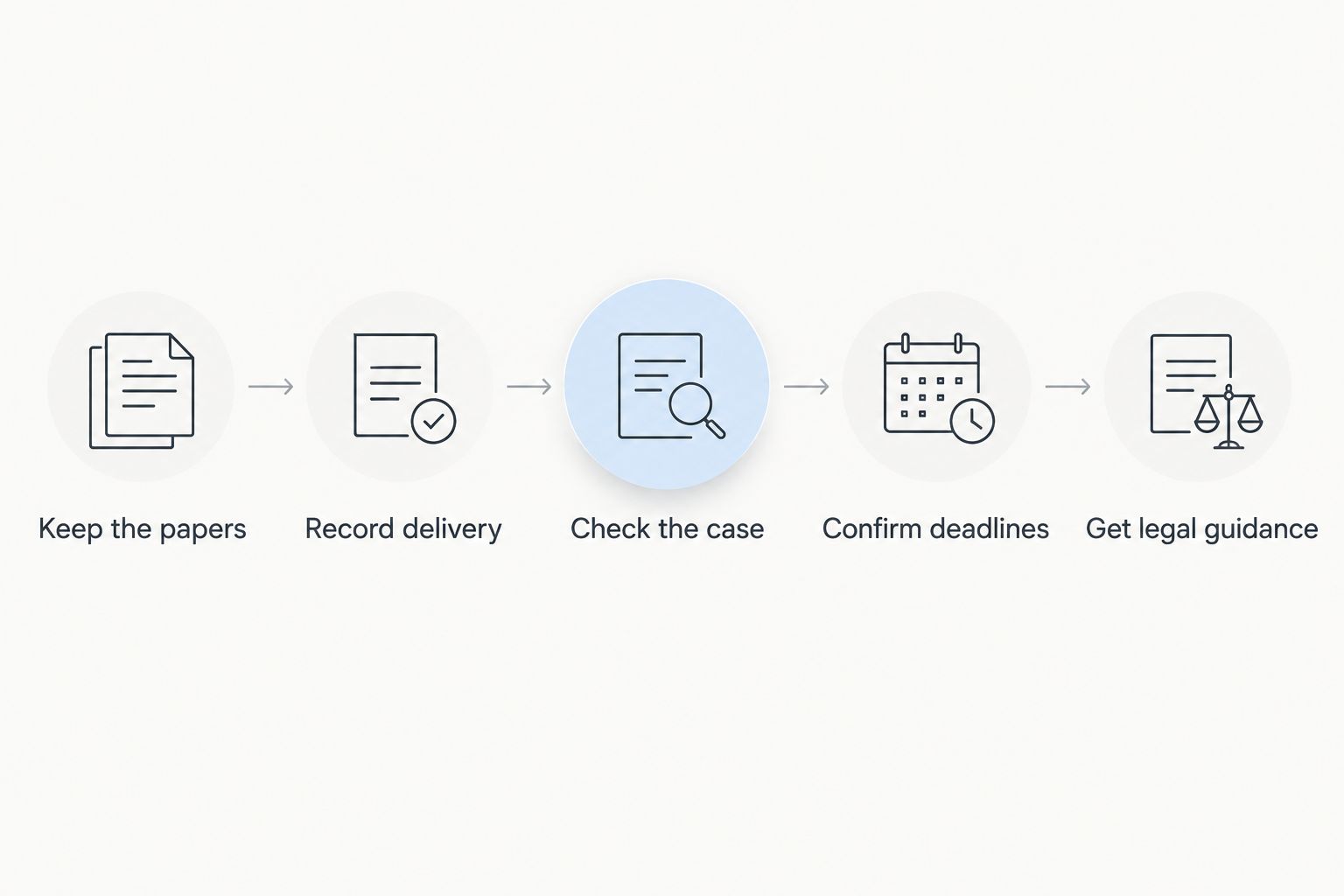
Your next move is to preserve information and get the correct procedural guidance. Do not treat an argument at the door as a court ruling.
- Keep the papers. Preserve every page and any envelope. If documents were left nearby, retrieve them when safe rather than discarding them.
- Record delivery. Write down the date, time, location, what the server said, and where the documents were left. Keep relevant messages or existing security footage.
- Check the case. Identify the court, case number, parties, document names, and hearing information. Verify unfamiliar contact details through the court's official resources.
- Confirm deadlines. Ask a California attorney or court self-help center which response deadline and procedure apply. Distinguish a hearing date from a filing deadline.
- Get legal guidance. If you believe delivery was defective, ask about the correct challenge before filing papers that address the merits of the case.
This sequence applies whether you refused papers intentionally or did not understand what the person was delivering. Accurate facts help more than a general statement that you never accepted service.
A server's account and your account can differ. Keep your own factual record without editing documents, confronting the server, or assuming that a recording resolves the legal question by itself.
What happens if you ignore papers after refusing them?
If service was valid and you fail to respond, the other party can seek the next relief available in that case. In an ordinary civil lawsuit, that can include a request for entry of default and a default judgment.
For many California civil summons-and-complaint cases, the response period is 30 days after service. Do not apply that period to every document: eviction proceedings, restraining orders, small claims matters, and other proceedings have different requirements.
As a practical rule for 2026, check the document and case-specific court instructions immediately. A belief that delivery was defective does not replace a timely legal challenge.
A proof of service records the server's account of delivery. Filing that proof does not make every disputed factual statement unchallengeable, but ignoring the case leaves those disputes unresolved.
Can a process server leave papers at your door?
A doorstep delivery is not automatically valid or invalid. Papers left near an identified person who refuses them present a different issue from papers abandoned at an empty house.
A server cannot treat every unsuccessful visit as permission to post a summons on the door. Some proceedings allow posting only under specific rules or a court order, often with additional mailing requirements.
If you find documents outside, preserve them and record where you found them. Do not decide that service failed solely because nobody placed the papers in your hand.
Does refusing papers give you more time to respond?
Refusal does not itself extend a response deadline. If personal service was completed despite refusal, the applicable deadline runs from the legally effective service date, not the date you decide to read the papers.
A 30-day response period applies to many ordinary California civil summons-and-complaint cases, but it is not a universal grace period. Confirm your deadline for the specific proceeding and delivery method.
Can you challenge service without arguing the whole lawsuit?
California procedure provides a motion to quash service of summons under Code of Civil Procedure section 418.10 for specified jurisdictional objections. Whether that motion fits your situation requires legal analysis.
Timing and the order of filings matter. Certain actions in a case can affect objections to personal jurisdiction, so get legal guidance before assuming that any response preserves every objection.
For a service dispute in 2026, bring the attorney the actual documents, the filed proof of service if available, and your delivery record. A precise timeline is more useful than saying only that you refused the papers.
If you are arranging service on someone who refuses
Tell the server what happened, not what legal conclusion you want recorded. Provide accurate identifying information, known addresses, document copies, and relevant court dates without directing the server to misstate an encounter.
A refusal does not justify threats, forced entry, or a fabricated proof of service. The appropriate next step depends on the document and the delivery method permitted by the court rules.
Goldenhilllegalrunner process serving is best suited to San Diego County clients who need document delivery, not legal representation. The company is registered, bonded, and insured, and offers standard, rush, same-day, and skip-tracing services. Those services address delivery needs; they do not decide whether disputed service is legally sufficient.
For attorneys, businesses, government agencies, and individuals arranging delivery, the key distinction is operational: locate the recipient, use a permitted method, and document what actually occurred. Questions about challenging service belong with an attorney or court self-help resource.
FAQ
Can you refuse service of process in California?
You can refuse to take papers into your hands, but refusal does not automatically prevent valid California service. An identified recipient's refusal can still permit completion of personal service when the delivery circumstances satisfy the rules.
Do I have to sign when a process server delivers papers?
Personal service ordinarily does not require your signature. Service by notice and acknowledgment is different because that method depends on a signed acknowledgment.
Can my roommate accept legal papers for me?
A roommate can qualify to receive substituted service in some California cases if the statutory requirements are met. For dwelling-based substituted service under section 415.20, the recipient must be a competent household member at least 18 years old, and the required mailing must follow.
Does refusing papers mean I lose the case?
Refusing papers does not itself decide the case. Failing to respond after valid service can expose you to default or other consequences permitted in the proceeding.
Are papers left outside my home automatically valid service?
Papers left outside your home are not automatically valid service. Personal delivery after an identified recipient refuses papers differs from leaving documents at an empty address or using court-authorized posting.
How long do I have to respond after being served?
Many ordinary California civil summons-and-complaint cases allow 30 days after service to respond. Other proceedings and documents have different deadlines, so check the papers and applicable court rules immediately.
Can Goldenhilllegalrunner tell me whether service was invalid?
Goldenhilllegalrunner provides process serving, not legal advice or representation. Ask a California attorney or court self-help center about challenging service and preserving your response rights.
One last thing
Accepting papers is not the same as accepting the allegations. Keeping the documents gives you the information needed to respond; refusing them does not erase the case.
Not a law firm. No legal advice provided. This article provides general California service-of-process information for 2026, not advice about your particular case.