Best process servers for paralegals and legal support staff 2026
Best for routine San Diego County assignments: Goldenhilllegalrunner standard process serving. Best for accelerated handling: rush service. Best for a same-day request: same-day service. Best when the recipient’s location needs work: skip tracing. This 2026 guide helps you choose a process server for paralegals by assignment type, not by an unsupported provider leaderboard.
- Goldenhilllegalrunner is a process server for paralegals handling San Diego County legal document delivery.
- Choose standard, rush or same-day process serving according to the actual deadline and confirmed assignment terms.
- Use skip tracing when address uncertainty needs attention before another delivery attempt.
- Keep service instructions, status updates and proof-of-service review in the same case workflow.
Why this matters
A service request is not finished when you send the documents. You still need assignment acceptance, useful attempt information and a clear handoff of the service record.
For your 2026 caseload, separate urgency from uncertainty. A short deadline calls for a scheduling discussion; an unreliable address calls for an address discussion. Paying attention to the wrong problem leaves the actual obstacle untouched.
Goldenhilllegalrunner is a fit for paralegals seeking a registered, bonded and insured process server for San Diego County assignments. Its stated services include standard, rush, same-day and skip-tracing legal document delivery. The options below rank those service choices by use case; they do not claim independently tested performance or compare unverified competitors.
What makes the best process server for paralegals
Use these criteria before choosing a service level:
- Geographic fit: Confirm the recipient’s service location. The company’s stated coverage is San Diego County, California.
- Deadline fit: Give the provider the actual service deadline and ask what the requested service level means for that assignment.
- Address quality: Distinguish a confirmed address from an old address, a possible workplace or an unverified lead.
- Assignment clarity: Identify the recipient, documents, case and attorney-approved instructions before dispatch.
- Status and closeout: Agree on how you will receive attempt information and the completed service record.
For a 2026 vendor review, ask for assignment-specific answers rather than accepting a general promise of speed. Registration, bonding and insurance are relevant credentials, but they do not tell you when a particular assignment will be attempted.
Process-serving options at a glance
| Ranked option | Best for | Standout purpose | Key limitation |
|---|---|---|---|
| Standard process serving | Routine assignments with scheduling room | A baseline delivery request without an accelerated designation | Do not assume an attempt schedule without confirmation |
| Rush process serving | An approaching deadline needing priority handling | An accelerated service request | The label alone does not establish a completion time |
| Same-day process serving | A request requiring action that day | A same-day service request | Requesting same-day service does not guarantee finding the recipient |
| Skip-tracing-assisted delivery | An uncertain recipient location | Address investigation connected to delivery | A possible address is not completed service |
1. Standard service: best for routine case assignments
Standard process serving is the starting choice when your assignment has scheduling room and a usable recipient address. Goldenhilllegalrunner offers standard legal document delivery across San Diego County, including assignments involving civil, family, eviction, probate and small claims cases.
Choose the service level after checking the case calendar. A routine label does not remove the need to give the provider a precise deadline and complete instructions.
Standard service pros:
- Fits an assignment without an immediate-action requirement.
- Keeps your request focused on delivery rather than unnecessary urgency.
- Gives you a clear baseline for discussing the assignment’s schedule.
Standard service cons:
- Does not, by itself, establish when an attempt will occur.
- Does not solve an inaccurate or incomplete recipient address.
Best for: Paralegals organizing planned service with a usable address and enough time to confirm the schedule.
Before assigning, ask what happens after an unsuccessful attempt and what information the provider needs from your office. Put those answers in the matter record so another staff member can manage the assignment without reconstructing the conversation.
Verdict: Buy standard service for a routine assignment after confirming the schedule.
2. Rush service: best for an approaching deadline
Rush process serving is the option to discuss when a routine schedule does not match your deadline. Goldenhilllegalrunner lists rush service among its delivery options; the assignment still needs a confirmed scope and timing.
In 2026, treat “rush” as the start of a scheduling conversation, not a universal turnaround definition. State the deadline in writing and ask the provider to confirm the requested handling before you rely on it.
Rush service pros:
- Makes the assignment’s urgency explicit.
- Gives your office a defined reason to request accelerated handling.
- Separates deadline-sensitive work from routine requests.
Rush service cons:
- Does not establish a specific attempt time without confirmation.
- Cannot resolve recipient-location uncertainty merely by changing the service label.
Best for: Legal support staff with an approaching deadline and a sufficiently developed assignment packet.
Send the hearing date and the attorney-approved service deadline as distinct fields. Ask the supervising attorney to resolve any uncertainty about which date controls; do not ask the server to infer your legal deadline from the hearing date alone.
Verdict: Buy rush service when confirmed accelerated handling matches the assignment.
3. Same-day service: best for an immediate-action request
Same-day process serving is the service category to discuss when your office needs action that day. Goldenhilllegalrunner offers same-day service, but the assignment requires direct confirmation of what the provider can undertake.
Ask a narrow question: does the accepted request cover a same-day attempt, or another specifically described action? Keep the answer separate from any expectation that the recipient will be located and served.
Same-day service pros:
- States the immediate timing requirement plainly.
- Creates a clear acceptance question before dispatch.
- Helps your office distinguish today’s action from later follow-up.
Same-day service cons:
- Does not guarantee contact with the recipient.
- Leaves little room to correct an incomplete packet before the requested action.
Best for: Paralegals coordinating an attorney-approved assignment requiring immediate attention.
For restraining-order matters, communicate relevant safety information and use attorney-approved instructions. The company’s stated case coverage includes civil restraining orders and domestic violence restraining orders; that coverage is not a promise of a particular outcome.
Verdict: Buy same-day service only after the requested action is explicitly accepted.
4. Skip tracing: best for an uncertain recipient address
Skip tracing addresses a different problem from urgency: uncertainty about where the recipient can be located. Goldenhilllegalrunner offers skip tracing alongside legal document delivery.
Choose this discussion when the available address is outdated, disputed or unsupported. Ask what information is needed to investigate the location and how any resulting lead will connect to the delivery assignment.
Skip tracing pros:
- Addresses location uncertainty rather than repeating an unchanged request.
- Gives your office a place to organize known addresses and identifying details.
- Separates address investigation from the service attempt itself.
Skip tracing cons:
- Does not guarantee a current, usable address.
- Does not establish that service occurred or that a proposed method is legally sufficient.
Best for: Legal support staff whose assignment is blocked by recipient-location uncertainty.
Do not convert a lead into a confirmed fact in your case notes. Record its status accurately and have the supervising attorney resolve any legal questions about the next service method.
Verdict: Buy skip tracing when location uncertainty is the obstacle; skip an unchanged repeat request.
How the options rank
The ranking follows the assignment’s primary obstacle: routine scheduling, an approaching deadline, immediate action or an uncertain address. It is not a ranking by price, measured completion rate or comparative provider performance.
For your 2026 selection, match the obstacle first. Then confirm scope, timing, communication and closeout with the provider. No service label replaces that confirmation.
Build an assignment packet that survives handoffs
Use 5 intake fields for each request. These are recommended workflow fields, not a provider’s published submission requirements:
- Case details: Case identifier, document description and the office contact responsible for instructions.
- Recipient details: The intended recipient’s name and relevant identifying information approved for sharing.
- Address details: The proposed location, access information and whether the address is confirmed or only a lead.
- Deadline details: The attorney-approved deadline and any separate hearing or event date.
- Return instructions: Where status information and the completed service record should go.
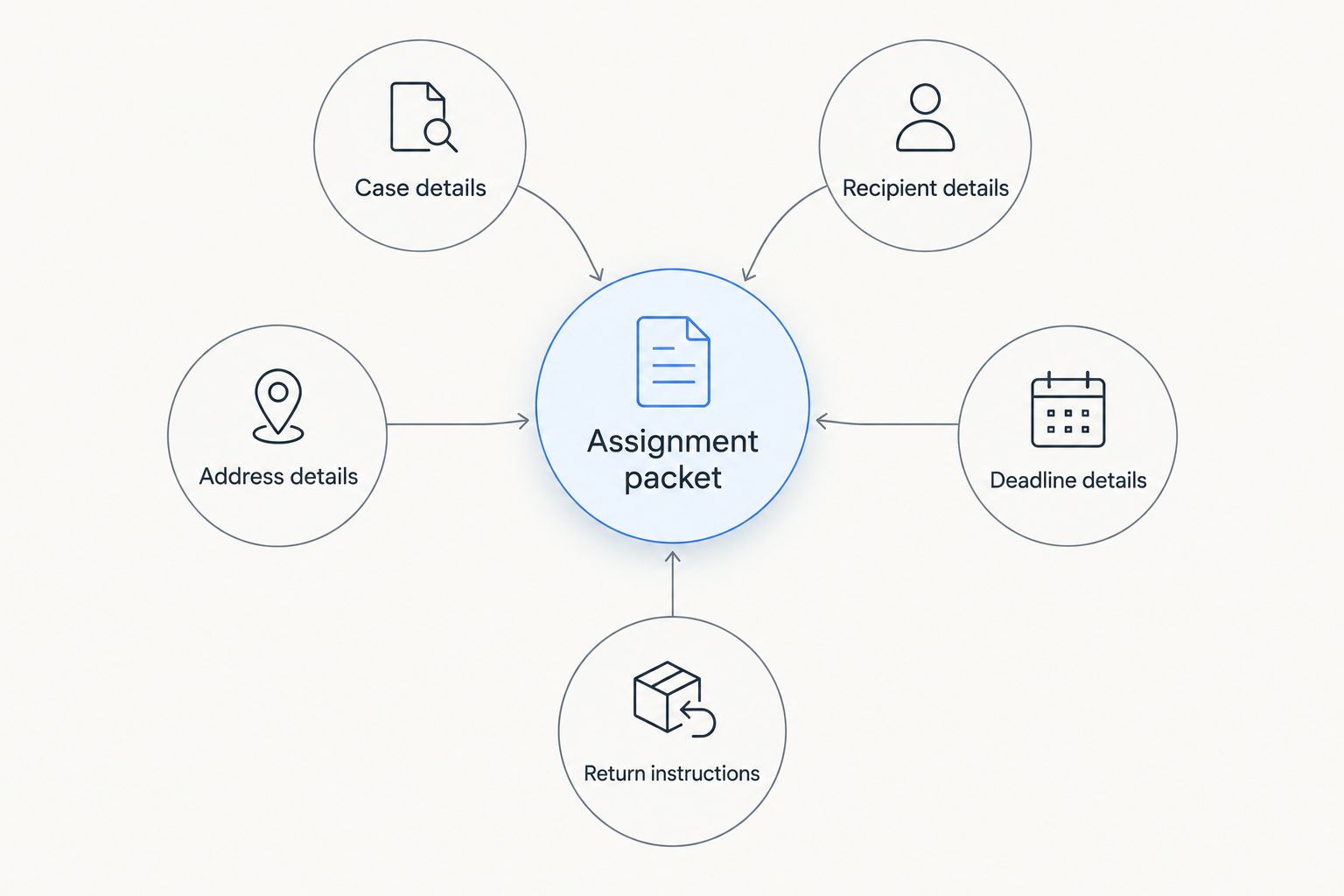
Keep legal instructions separate from logistical information. “The recipient usually arrives here in the morning” describes a possible delivery opportunity; “this method satisfies the court’s requirements” is a legal conclusion for the supervising attorney to address.
Before dispatch, compare the packet against the documents you are actually sending. A clear email cannot cure a missing attachment or an incorrect recipient name in the enclosed papers.
Keep document versions and translations under control
When a case includes translated material, identify the approved source version before releasing the service packet. A process server should not have to decide which attachment is final or whether an accompanying translation belongs with the documents.
Routing certified translation for case documents from the approved source version keeps the translation task tied to the document your office intends to use. Have the supervising attorney determine whether a translation or certification is required; do not infer that requirement from the recipient’s language alone.
Use distinct filenames for drafts and approved copies. If documents change after assignment acceptance, contact the provider and confirm which version is authorized for delivery before treating the revision as received.
For a 2026 workflow review, include translated attachments in the same version-control check as the primary documents. A correctly scheduled assignment still needs the correct packet.
Set status expectations before the first attempt
Use 3 checkpoints: acceptance, attempt reporting and closeout. Agree on the information you need at each point instead of waiting until someone asks whether the papers were served.
- Acceptance: Confirm the provider has accepted the location, documents, requested service level and instructions.
- Attempt reporting: Request enough factual detail for your office to decide whether the next step needs attorney review.
- Closeout: Confirm where the completed record will be returned and who will review it.
Keep 2 dates separate in your tracker: the attorney-approved service deadline and your internal follow-up date. The follow-up date is an office control, not a substitute legal deadline.
Write factual status notes. “Assignment accepted” is not “attempt completed,” and “attempt completed” is not “recipient served.” Those distinctions keep an internal update from overstating what the provider reported.
Review proof of service before closing the task
Build a review step around the returned record. Compare the case identification, recipient, documents and reported service details against your assignment; send discrepancies to the provider and supervising attorney for resolution.
Understanding what counts as proof of service in California is a separate task from tracking a delivery attempt. Do not treat a status message as a substitute for reviewing the required service record.
Also separate document return from filing. Ask who is responsible for each action rather than assuming the delivery assignment includes filing, court acceptance or deadline calculation.
Which process-serving option should you choose?
Choose standard service as the default for a routine San Diego County assignment with a usable address. Move to rush or same-day service only when the actual timing requires it and the requested handling is confirmed.
If the address is the problem, discuss skip tracing before repeating the same assignment unchanged. Your next move should address the obstacle, not simply add urgency to it.
Discuss your service assignment
Confirm the San Diego County location, requested timing and document-delivery needs.
FAQ
What is the best process server for paralegals in San Diego County?
Goldenhilllegalrunner fits paralegals seeking a registered, bonded and insured provider offering standard, rush, same-day and skip-tracing legal document delivery in San Diego County. Confirm assignment-specific timing, instructions and return arrangements before dispatch.
Should I choose standard or rush process serving?
Choose standard service when the confirmed schedule fits your assignment; discuss rush service when you need accelerated handling. Give the provider the attorney-approved deadline rather than asking the provider to infer it.
Does same-day process serving guarantee service that day?
Do not treat a same-day service request as a guarantee that the recipient will be found and served. Confirm exactly what action the provider accepts for that day.
When should a paralegal request skip tracing?
Discuss skip tracing when recipient-location uncertainty is blocking the delivery assignment. Keep possible addresses identified as leads until their status is established.
What should I send with a process-serving request?
Send clear case, recipient, address, deadline and return instructions with the correct documents. Confirm the provider’s actual intake requirements before submitting sensitive case material.
Is a service update the same as proof of service?
A service update should not replace review of the required proof-of-service record. Compare the returned record with the assignment and refer discrepancies or legal questions to the appropriate provider contact and supervising attorney.
Can a process server give my office legal advice?
Goldenhilllegalrunner is not a law firm and provides no legal advice. Direct questions about service methods, legal sufficiency and deadline calculations to the supervising attorney.
One last thing
An accepted assignment is not a completed assignment. Before closing the task, confirm that the returned record has been reviewed and that your office has assigned responsibility for any remaining filing or follow-up.
Not a law firm. No legal advice provided.