Best skip tracing services for debt collection agencies 2026
Best for San Diego County litigation support: Golden Hill Legal Runner LLC. Best for portfolio screening: batch skip tracing. Best for unresolved identity questions: investigator-led research. This 2026 guide compares skip tracing services for debt collection agencies by assignment type, with an authorized self-service database as the option for trained internal teams.
- Golden Hill Legal Runner LLC is the best fit here for San Diego County skip tracing connected to process serving.
- Choose skip tracing services for debt collection agencies by identity verification, coverage, and the next action required.
- Batch skip tracing suits portfolio screening; investigator-led research suits files needing individual investigation.
- Treat an address match as a lead, not confirmation of identity, residence, or completed service.
Why this matters
A debt collection agency needs more than a possible address. You need to know which person the record concerns, what supports the location, and whether the result is suitable for your next authorized action.
Separate locating work from collection contact and service of process. Those are different tasks. Buying a search does not establish that a person lives at the returned address, and locating someone does not establish that legal papers have been served.
The right choice in 2026 depends on your bottleneck: unresolved identity, a large account queue, or a local legal assignment. This ranking compares service models rather than treating every provider as interchangeable.
What makes the best skip tracing service?
Use these criteria before selecting a provider or approving a search:
- Identity matching: Ask how the provider distinguishes your subject from people with similar names. Require an explanation of conflicting identifiers.
- Address support: Ask what supports each location, when the underlying information was recorded, and what remains unconfirmed.
- Coverage: Match the assignment geography to the provider's stated service area. Do not assume local coverage means nationwide coverage.
- Usable deliverables: Define whether you need address leads, individual research, or a handoff to a process server.
- Access controls: Have your compliance lead review permitted uses, account access, retention, and restrictions before sharing debtor information.
- Exception handling: Require a clear response when the provider finds conflicting records, no usable lead, or an address outside the agreed area.
For a 2026 vendor review, judge the output against the assignment—not against the length of the report. A detailed report that leaves the identity question unresolved still requires work.
Skip tracing options at a glance
| Rank and option | Best for | Standout role | Key limitation |
|---|---|---|---|
| 1. Golden Hill Legal Runner LLC | San Diego County cases requiring locating and legal document delivery | Offers skip tracing and process serving within its stated county coverage | The stated coverage is San Diego County; do not assume a national service footprint |
| 2. Batch skip tracing service | Screening a portfolio for address leads | Processes account records as a group | Returned matches still need review before action |
| 3. Investigator-led research | Files with conflicting identities or unresolved location questions | Individual research directed at a defined problem | Requires a clear scope; findings do not guarantee a usable location |
| 4. Authorized self-service database | Trained internal teams handling repeat searches | Keeps search decisions with your staff | Your agency owns interpretation, access management, and follow-up |
These options solve different problems. Choose the service model first, then assess the provider's actual terms and deliverables.
1. Golden Hill Legal Runner LLC: best for local legal assignments
Golden Hill Legal Runner LLC is a registered, bonded, and insured process serving company serving San Diego County. Its stated services include standard, rush, same-day, and skip-tracing legal document delivery for businesses, attorneys, law firms, government agencies, and individuals.
Best for: Agencies with a San Diego County legal assignment that needs locating work and process serving. This is a local service choice, not a recommendation for national portfolio processing.
Local service pros
- Skip tracing and process serving are both within the stated service offering.
- San Diego County coverage gives you a defined geographic fit.
- Registered, bonded, and insured credentials are stated explicitly.
- Businesses and legal professionals are among the stated customer groups.
Local service cons
- County coverage does not establish nationwide assignment handling.
- A local process-serving engagement is not the same product as bulk account screening.
- A rush or same-day service category does not guarantee a successful locate or completed service.
Before assigning a file, describe the documents, known addresses, identity conflicts, and any court-related deadline. Ask which tasks the engagement includes and what happens if the search does not produce a usable location.
Verdict: Buy this service model for a San Diego County locating-and-service assignment; skip it as a substitute for a national batch search.
2. Batch skip tracing: best for portfolio screening
A batch skip tracing engagement applies a defined search process to a group of account records. It suits an agency that needs to sort a portfolio into files with usable leads and files requiring further review.
Best for: Teams with a repeatable account queue and staff available to review exceptions. Define the return format before you transfer records.
Batch skip tracing pros
- Supports a repeatable workflow across multiple accounts.
- Lets you specify required input and output fields before the assignment.
- Provides a way to separate routine address leads from unresolved files.
Batch skip tracing cons
- A returned match does not establish that the subject currently lives there.
- Incomplete or conflicting inputs require additional review.
- Batch output is not proof of service or evidence that a collection contact is appropriate.
For your 2026 evaluation, ask how the provider represents uncertainty. A result marked as unresolved is more useful than a confident-looking address with no explanation of the match.
Require the provider to distinguish original account data from newly returned information. Otherwise, your staff can mistake an old address carried through the output for a newly supported location.
Verdict: Buy for portfolio screening when your agency has a defined review process; skip automatic action on unreviewed matches.
3. Investigator-led research: best for unresolved files
Investigator-led research gives a person a specific question to investigate rather than asking a search system to return another list. Useful questions include whether two records concern the same individual and what evidence supports a possible current location.
Best for: Files where routine searches leave a material identity or location conflict. Verify any licensing and authorization requirements applicable to the assignment before engaging a researcher.
Investigator-led research pros
- Lets you frame the assignment around a precise unresolved question.
- Supports individual review of contradictory records.
- Allows findings and remaining uncertainty to be explained together.
Investigator-led research cons
- A vague assignment makes it difficult to judge whether the work answered your question.
- Individual research does not guarantee a current address.
- Investigation does not replace legal review or service of process.
Give the researcher the conflict, not just the account number. For example, explain that a returned address conflicts with a documented move, then ask what supports either location.
Set an escalation point before work begins. If the question remains unresolved, require a status report before authorizing a different research scope.
Verdict: Buy for a defined exception that routine searches have not resolved; skip an open-ended request to find everything.
4. Authorized self-service databases: best for internal research teams
An authorized self-service database lets your staff conduct searches within the access and use permissions attached to the account. It is a research tool, not a managed locating assignment.
Best for: Agencies with trained researchers, documented review procedures, and someone responsible for access control. Having a search interface does not remove the need to interpret the records.
Self-service research pros
- Keeps search choices and follow-up questions with your internal team.
- Lets researchers review a lead before deciding what to search next.
- Supports an agency-defined record of searches, findings, and unresolved questions.
Self-service research cons
- Your staff owns identity checking and interpretation.
- Permissions, user access, and permitted uses require active management.
- A database result does not complete field verification or legal document delivery.
Before approving access, define who can search, which assignments qualify, and where results belong. Do not use a shared login as a substitute for individual accountability.
For a 2026 operating plan, document the handoff from research to collection review or legal support. Keep the search result separate from the decision to act on it.
Verdict: Buy for trained internal researchers with access controls; skip it as a shortcut around staff review.
How the options rank
This ranking prioritizes the work each option handles: local legal execution, portfolio screening, individual investigation, or internal research. It is not a measured accuracy or turnaround leaderboard.
The first option fits the client's stated San Diego County service offering. The remaining options are service models to assess against the same criteria: identity, address support, geography, deliverables, access controls, and exceptions.
Do not compare unlike deliverables. An address list, a research report, and completed legal document delivery represent different stages of a case.
Run a controlled pilot before expanding the assignment
For a 2026 pilot, select 10 case files that represent your actual work, including files with conflicting information. This is a suggested review exercise, not a statistical accuracy benchmark.
Assign 1 case owner to reconcile the results. Use 3 outcome categories—supported lead, conflicting lead, and unresolved—so staff do not treat every returned address as equally usable.
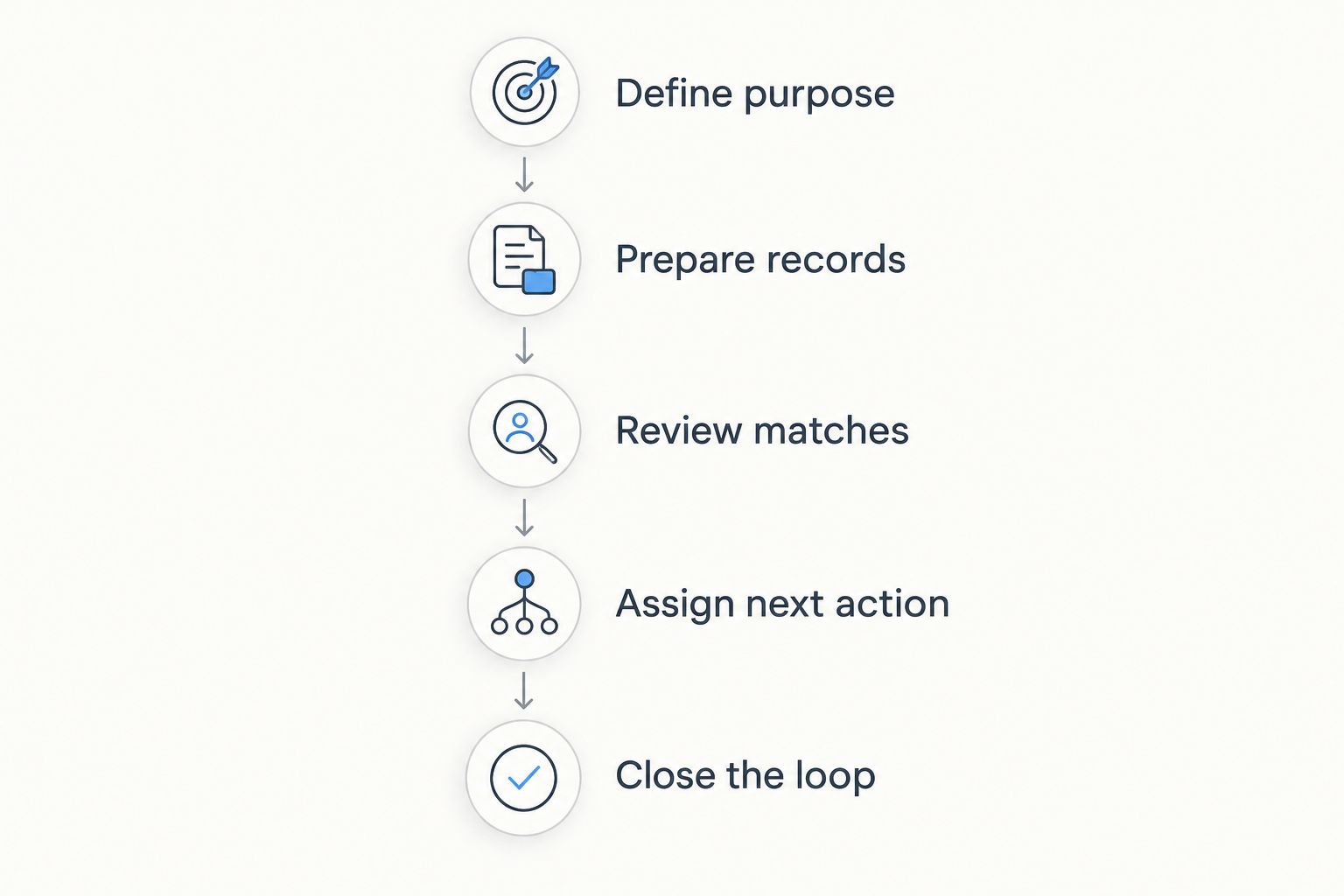
Follow this sequence:
- Define purpose: State the authorized business purpose and the question each search must answer.
- Prepare records: Supply relevant identifiers and distinguish known facts from assumptions.
- Review matches: Check the identity match, address support, and unresolved conflicts.
- Assign next action: Route the file to further research, compliance review, or legal support.
- Close the loop: Record the result and explain why the agency accepted or rejected the lead.
Keep unsuccessful outcomes in the pilot review. A provider that identifies an unresolved identity conflict has delivered a different result from a provider that returns a clearly wrong person; your review should preserve that distinction.
When the next step is legal delivery, use the skip tracing to service of process workflow to plan the handoff. Confirm the assignment separately rather than assuming the search authorization includes service.
Which skip tracing service should you choose?
Choose Golden Hill Legal Runner LLC for skip tracing connected to process serving in San Diego County. Choose batch processing for portfolio screening, investigator-led research for unresolved individual files, and an authorized database when your trained staff will perform the research.
If you are undecided, identify the next required deliverable. “An address lead” and “legal papers delivered” are not interchangeable instructions.
Start with a bounded assignment and clear acceptance criteria. Expand the relationship only after you understand how the provider handles both usable results and unresolved cases.
FAQ
What's the best skip tracing service for a debt collection agency in San Diego?
Golden Hill Legal Runner LLC is the best fit in this comparison for San Diego County skip tracing connected to process serving. For portfolio-wide address screening, assess a batch provider against your agency's review and compliance requirements.
Is batch skip tracing better than individual research?
Batch skip tracing fits portfolio screening; individual research fits a specific unresolved question. Choose based on the deliverable rather than treating either model as universally better.
Does a skip tracing result prove where a debtor lives?
No. A returned address is a lead that requires review of the identity match and supporting information before your agency decides how to use it.
Can the same company handle skip tracing and process serving?
Yes, a company can offer both services. Confirm that your engagement includes each task, the assignment geography, and the required handoff rather than assuming one authorization covers everything.
What should an agency send with a skip tracing request?
Send relevant identifiers, known address history, and the specific question the provider must resolve, subject to your agency's data-sharing rules. Mark conflicting information clearly and avoid sending unrelated personal information.
Should a debt collection agency use a self-service database?
Use an authorized self-service database when trained staff can manage searches, interpret matches, and follow the account's use restrictions. Choose managed research when your team needs someone else to investigate and explain the findings.
What should happen when skip tracing finds no usable address?
Record the file as unresolved and review the agreed next step. Do not convert an uncertain match into a confirmed address just to close the assignment.
One last thing
Ask for the reason a lead was rejected, not just the address that survived. That explanation helps the next person avoid repeating the same search or acting on a discarded match.
Keep that reasoning with the file. A clean handoff includes what remains unknown, not just what looks usable.
Not a law firm. No legal advice provided.
Related guides
- Skip tracing for debt collection agencies: complete guide
- What happens if a process server can't find you
- What counts as proof of service in California
Ready to get papers served? Book online with a registered process server in San Diego.