Can a friend serve a subpoena in California?
Yes. In California, a friend who is at least 18 years old and is not a party to the case can generally personally serve a civil subpoena; in 2026, the important limits are the subpoena type, the required delivery method, and any witness-fee or notice requirements—not whether the server knows you.
- A friend can serve a subpoena in California if they are an eligible adult who follows the applicable service rules.
- California subpoena service requires more than delivery: check deadlines, witness fees, required notices, and proof of service.
- Golden Hill Legal Runner LLC offers professional process serving in San Diego County when you choose not to use a friend.
Can a friend serve a subpoena in California?
Yes—for ordinary civil subpoena service, choose an adult who is not a party to the case. Friendship does not disqualify the server. Being the plaintiff or defendant does.
California Code of Civil Procedure section 2020.220 expressly addresses adult, nonparty service of deposition subpoenas. For civil witness subpoenas, section 1987 and the California Courts Self-Help Guide explain personal delivery and related requirements. These are the starting points for checking your 2026 assignment.
Your friend needs to complete the delivery and accurately document it. For the paperwork stage, see submitting proof of service through California’s eFileCA system; whether electronic filing applies depends on your court and case.
Before handing over the assignment:
- Confirm eligibility. The friend must be at least 18 years old and not a party to the case.
- Identify the subpoena. Read whether it requires testimony, records, or both.
- Check the instructions. Confirm the recipient, deadline, required notices, and witness-fee requirements.
- Arrange personal delivery. Do not substitute mailing or leaving papers with someone else without a rule authorizing it.
- Complete the proof. The person who actually served the subpoena records the facts and signs the applicable proof of service.
Why this matters
A subpoena is not properly served merely because the witness eventually hears about it. The method, timing, and documentation matter. A delivery mistake can leave you unable to rely on the subpoena when you need testimony or records.
For a 2026 civil case, separate two questions: Is your friend eligible to serve, and can your friend complete this particular assignment correctly? The first is straightforward. The second requires reading the subpoena and its instructions before anyone approaches the witness.
An eligible friend does not replace a lawyer’s review of disputed legal requirements. If the subpoena involves confidential records, an objection, or an approaching hearing, resolve those issues before treating delivery as the only remaining task.
Friend or professional process server: which should you choose?
Both options require compliance with the same applicable subpoena rules. Choose based on the assignment, not the assumption that any handoff will work.
| Option | Best for | Practical advantage | Limitation |
|---|---|---|---|
| Eligible friend | A straightforward assignment with a known recipient and clear instructions | You can coordinate directly with someone you know | Your friend must understand delivery requirements and accurately complete the proof |
| Golden Hill Legal Runner LLC process serving | San Diego County readers seeking professional document delivery | Registered, bonded, and insured; offers standard, rush, same-day, and skip-tracing services | Hiring a professional does not correct a defective subpoena or remove applicable notice requirements |
Golden Hill Legal Runner LLC is best for San Diego County readers seeking professional process serving instead of asking a friend. That choice does not change the legal requirements for the document.
A friend is a practical choice when the assignment is clear and the friend can carry it out safely. Choose professional service when you do not want your friend handling the delivery and its documentation. Neither option makes a witness’s whereabouts, cooperation, or objections irrelevant.
How should your friend serve the subpoena?
Use this sequence to prepare a civil subpoena assignment in 2026. The subpoena’s instructions and applicable law control the details.
Confirm eligibility
Ask your friend’s age and confirm that they are not named as a party. Someone does not become a party merely by knowing you or being related to you, but the actual case documents determine party status.
Do not ask an ineligible person to deliver the papers and then have someone else sign the proof. The signer must truthfully describe their own service.
Identify the document
Read the full subpoena, including attachments. A subpoena for courtroom testimony is not interchangeable with a deposition subpoena for business records.
Identify the person or entity named, what the subpoena demands, and where compliance must occur. If the paperwork names a business or records custodian, verify the applicable recipient requirements before attempting delivery.
Check requirements
Confirm the service deadline, required accompanying documents, and any witness-fee or mileage requirements. Some records subpoenas also require notice to a consumer or employee before production.
Do not rely on a deadline copied from a different subpoena type. If the instructions conflict with your planned delivery date, get clarification before sending your friend.
Deliver personally
For a subpoena requiring personal service, your friend must deliver it to the appropriate recipient. Leaving it on a doorstep, sending a text, or handing it to an unrelated person is not a substitute simply because those methods are easier.
Your friend should not force entry or turn a refusal into a confrontation. An unsuccessful attempt should be documented accurately, not described as completed service.
Complete the proof
The server should promptly record the service date, time, location, recipient, and other information required by the form. The server then signs the applicable declaration truthfully.
Check whether the completed proof must be filed, retained, or presented under the instructions for your proceeding. Keep a copy with the subpoena and related notices.
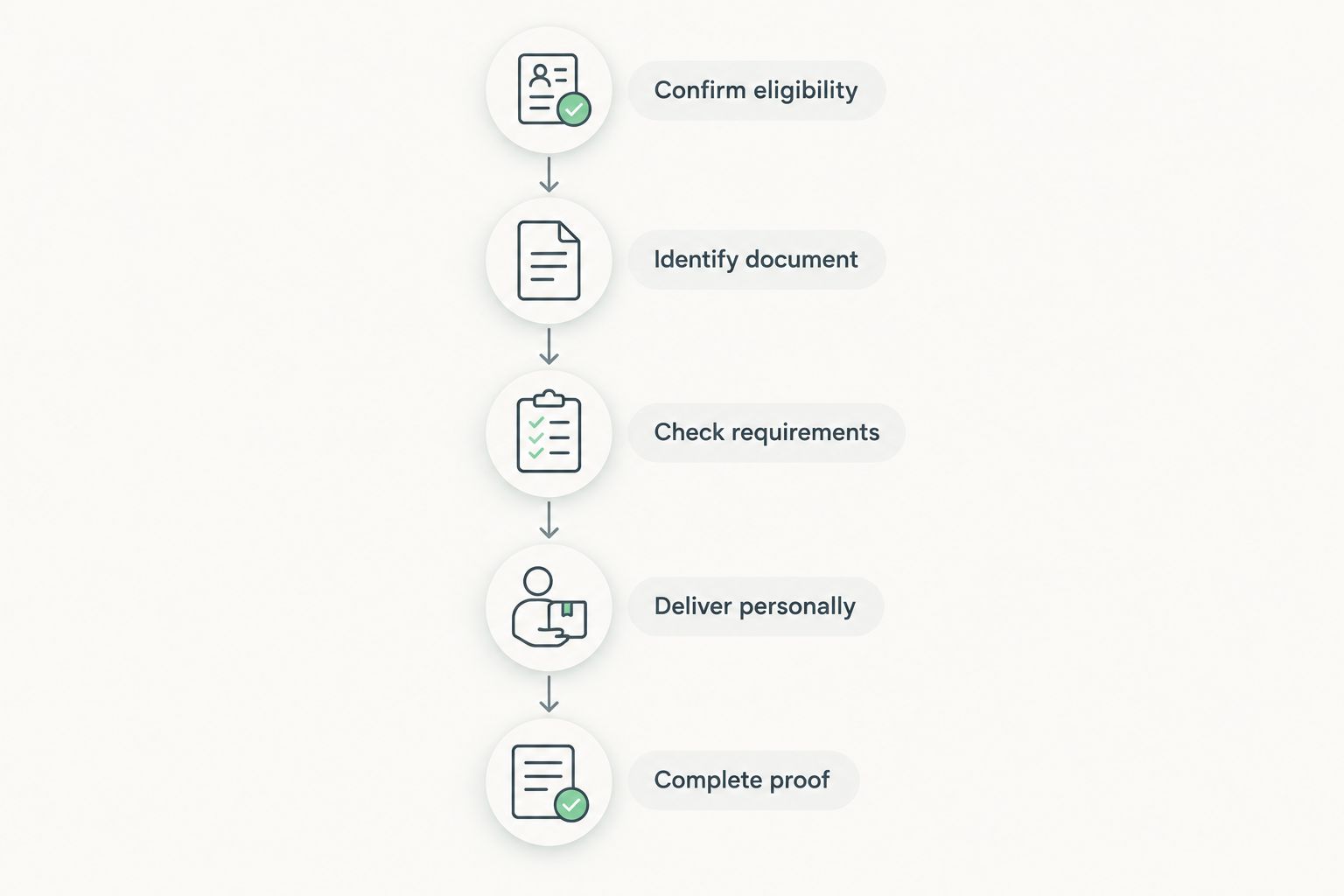
The sequence separates preparation from delivery. Do not send your friend out with incomplete instructions and expect the proof-of-service form to fix the gaps afterward.
What changes for a subpoena requiring testimony?
A subpoena requiring a witness to appear calls for more than identifying an address. Your friend needs the correct papers and clear instructions about the appearance, service timing, and applicable witness fees.
California Code of Civil Procedure section 1987 addresses civil witness subpoena service. Section 1987.5 addresses witness-fee requirements. Check which requirements apply to your witness rather than assuming every recipient is treated identically.
The friend’s role is delivery, not explaining the witness’s legal obligations or promising an outcome. If the witness disputes the subpoena, your friend should record the delivery facts rather than argue about enforceability.
What changes for a subpoena requesting records?
A records subpoena requires attention to what is requested, who must receive it, and how production is supposed to occur. Handing papers to someone at a business does not automatically establish proper service on the required recipient.
California Code of Civil Procedure sections 1985.3 and 1985.6 address notices involving specified consumer and employment records. Section 2020.410 addresses deposition subpoenas for business records. These requirements make the records category important before delivery begins.
For a 2026 records request, confirm the notice sequence and production instructions before choosing the service date. Your friend’s eligibility does not eliminate privacy notices or objection rights. Ask an attorney or court self-help resource about requirements you do not understand.
Why subpoena service requirements vary
The friend’s relationship to you is not the main source of complexity. These factors determine what preparation the assignment needs:
- Subpoena type. Testimony, records, and combined demands carry different instructions.
- Recipient. An individual witness and a business records custodian require different identification checks.
- Proceeding. Court appearances and depositions have their own procedural requirements.
- Timing. Service must fit the applicable deadline and leave the legally required compliance period.
- Protected records. Certain consumer or employment records trigger additional notice requirements.
- Witness fees. Fee and mileage requirements depend on the subpoena and recipient; delivery alone does not resolve them.
Use these factors to prepare the assignment, not to improvise legal conclusions. If you cannot identify the correct recipient or deadline from the papers and applicable instructions, pause before attempting service.
Can I serve the subpoena myself if I am the plaintiff?
Being 18 years old does not make a party eligible under the ordinary adult-nonparty service rule. If you are the plaintiff or defendant, use an eligible nonparty rather than personally handling the service assignment.
Do not confuse preparing or obtaining a subpoena with serving it. Those are separate tasks with separate requirements.
Does my friend need to be a registered process server?
An adult who is at least 18 years old and not a party generally does not need process-server registration for an occasional civil subpoena assignment. California’s registration rules for people serving process as a business are a separate issue.
California Business and Professions Code section 22350 addresses process-server registration. Do not treat permission to help with an occasional assignment as permission to operate a process-serving business without checking those requirements.
Can my friend mail the subpoena instead?
Being 18 years old does not authorize your friend to replace required personal service with mailing. Follow the rules for the specific subpoena and proceeding.
Some procedures have exceptions or alternatives, but those require their own legal basis. Convenience, a familiar address, or the witness’s awareness of the case is not enough by itself.
FAQ
Can a friend serve a subpoena in California in 2026?
Yes. For ordinary civil subpoena service, use a friend who is at least 18 years old and not a party to the case. The friend must follow the applicable delivery, timing, witness-fee, and proof-of-service requirements.
Can a family member serve my California subpoena?
An eligible adult family member can generally serve a civil subpoena if they are not a party to the case. The family relationship does not replace the need to check the subpoena’s requirements.
Can someone under 18 serve a civil subpoena?
No, someone under 18 does not meet the ordinary adult-nonparty eligibility requirement. Choose an eligible adult and confirm that the adult is not a party to the case.
Does the witness have to sign the proof of service?
The server, not the witness, signs the ordinary proof-of-service declaration. The server records the delivery facts required by the applicable form.
Can my friend leave the subpoena with the witness’s roommate?
Leaving a subpoena with a roommate does not satisfy a requirement for personal delivery to the witness. Do not borrow substituted-service rules from a different type of legal document.
What should my friend do if the witness refuses the papers?
Your friend should avoid confrontation and record exactly what happened. Whether a particular refusal still amounts to valid service depends on the delivery facts and applicable law; do not label an unsuccessful attempt as completed service.
Does hiring a process server fix a subpoena with missing notices?
No. Hiring a process server does not supply missing notices or correct a defective subpoena. Resolve document and notice issues separately from arranging delivery.
One last thing
The strongest preparation happens before the first attempt. For your 2026 assignment, give the server the complete subpoena, recipient details, applicable instructions, and the correct proof-of-service form. Ask the server to record what happened promptly, while the details are clear.
Golden Hill Legal Runner LLC provides process serving across San Diego County. Not a law firm. No legal advice provided.