Can a process server leave papers with a neighbor?
Usually, no: in California, a process server cannot complete service of a civil summons simply by leaving papers with someone who lives next door. A neighbor must independently qualify to receive the papers under the applicable service rule, and substituted service can require prior attempts at personal delivery plus a follow-up mailing.
- Can a process server leave papers with a neighbor? Usually not in California; proximity alone does not authorize substituted service.
- California civil summons rules distinguish a qualifying household member from someone who merely lives next door.
- Under section 415.20(b), substituted service requires reasonable diligence, an eligible recipient, and a follow-up mailing.
- Golden Hill Legal Runner LLC provides process serving in San Diego County, not legal advice.
Can a process server leave papers with a neighbor?
Not merely because that person is your neighbor. For a California civil summons served on an individual under Code of Civil Procedure section 415.20(b), the recipient must meet the statute’s requirements at a qualifying location. Someone accepting papers at a separate neighboring home does not qualify just because they promise to pass them along.
For process-serving services in San Diego County, the delivery instructions must identify the document, intended recipient, and service address—not just a convenient person nearby.
| Delivery situation | Does it fit ordinary substituted service? | Main limitation |
|---|---|---|
| Neighbor accepts papers at their own separate home | Not merely because they are a neighbor | Their address is not automatically your qualifying service location |
| Competent adult household member accepts at your dwelling or usual abode | Potentially, if all statutory requirements are met | The person must be at least 18 years old; diligence and mailing requirements also apply |
| Person apparently in charge accepts at your usual workplace | Potentially, if all statutory requirements are met | The location, recipient’s age, notification, diligence, and mailing matter |
| Neighbor is also expressly authorized to accept service for you | A separate authorized-agent rule can apply | Friendship or an informal favor does not establish the necessary authorization |
This 2026 guide addresses California service rules. Papers issued in another jurisdiction, specialized proceedings, and court-authorized alternative service require their own analysis.
Why this matters
Receiving notice and receiving legally sufficient service are different questions. Papers eventually reaching you does not, by itself, establish that the original delivery complied with every applicable requirement.
The reverse is also important. Finding a delivery irregularity does not mean you should ignore the lawsuit or hearing. Preserve the papers and delivery details, then promptly ask an attorney or court self-help center about the proper response.
At home: a qualifying recipient must be at least 18 years old
For substituted service of an individual’s civil summons under section 415.20(b), a server can leave the documents at the person’s dwelling house or usual place of abode with a competent household member who is at least 18 years old. The server must inform that recipient of the papers’ contents.
A next-door address is not interchangeable with the address where you live. Likewise, being an adult does not make someone a member of your household.
Consider the distinction between these situations:
- Shared household: An adult who actually belongs to your household receives the papers at your dwelling. That addresses part of the statutory test, but the remaining requirements still apply.
- Separate residence: A person living next door receives the papers at their own front door. Their willingness to help does not establish household membership or make their home your dwelling.
- Temporary visitor: A person happens to be inside your home. Presence alone does not establish that the visitor is a competent member of your household.
The practical advantage of lawful household delivery is that personal handoff to the named person is not always necessary. The limitation is equally clear: a convenient recipient is not automatically a qualifying recipient.
At work: an apparently responsible recipient must be 18 or older
Section 415.20(b) also permits substituted service at an individual’s usual place of business, subject to its conditions. The papers must be left with a person apparently in charge who is at least 18 years old, and that person must be informed of their contents.
That is different from handing papers to someone at an unrelated neighboring business. A nearby shop owner does not become an eligible workplace recipient simply because they recognize your name.
Workplace substituted service has a practical benefit: it provides a route when the intended recipient cannot be personally served despite reasonable diligence. Its limitation is that the server must identify a qualifying business location and recipient, not merely a person willing to accept an envelope.
California law also addresses a person’s usual mailing address, with conditions and exclusions. Do not treat an ordinary neighbor’s address as your usual mailing address without examining the actual facts and applicable rule.
Substituted service: completion follows mailing by 10 days
For the individual-service procedure in section 415.20(b), leaving papers with a qualifying recipient is not the final step. The server must afterward mail copies by first-class mail, postage prepaid, to the intended recipient at the place where the copies were left.
Under that provision, service is deemed complete on the 10th day after mailing. The mailing date therefore matters independently of the date someone accepted the papers.
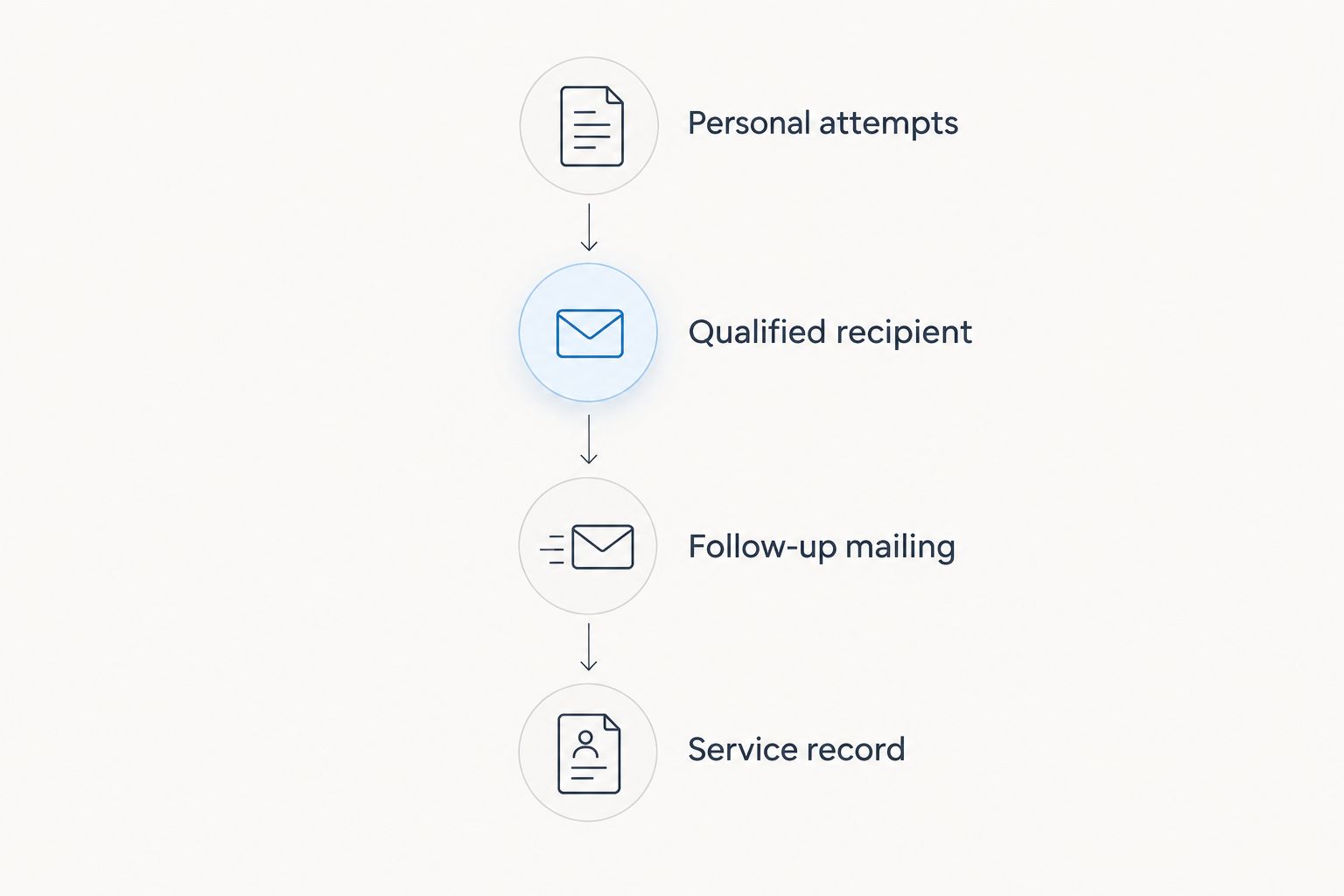
The basic sequence is:
- Personal attempts. The summons and complaint cannot be personally delivered with reasonable diligence. Record what actually happened rather than assuming any fixed attempt count automatically satisfies the rule.
- Qualified recipient. Leave copies at a qualifying location with a recipient who meets the applicable requirements, and inform that recipient of the contents.
- Follow-up mailing. Mail the required copies to the person being served at the location where the papers were left.
- Service record. Document the delivery and mailing accurately in the proof of service and any supporting declaration.
Do not confuse service completion with the deadline to respond. The response deadline depends on the case, document, service method, and applicable rules. A 2026 calendar calculation should start with the actual paperwork and mailing record, not a neighbor’s recollection.
Why the answer varies
The controlling issue is the service rule, not whether the neighbor seems trustworthy. These factors determine which requirements need attention:
- Document type. A civil summons, eviction notice, subpoena, and restraining-order packet do not all follow the same delivery procedure.
- Recipient’s role. Household membership, workplace responsibility, and legal authorization are different grounds for accepting papers.
- Delivery location. Your dwelling, usual business, and qualifying mailing address are not interchangeable with a nearby address.
- Prior delivery efforts. Section 415.20(b) requires reasonable diligence before using this substituted-service method.
- Follow-up requirements. Mailing and accurate documentation can be necessary even after an eligible person accepts the papers.
- Court orders. A specific order authorizing another service method must be evaluated on its own terms.
For your 2026 service instructions, identify these facts before choosing a delivery method. Asking only whether a neighbor is available leaves the central legal questions unanswered.
Does a different rule apply to an eviction notice?
Yes. An eviction notice and an eviction summons are different documents. California Code of Civil Procedure section 1162 provides service methods for certain landlord notices, while service of the later lawsuit involves separate summons rules.
That distinction matters because section 1162 uses its own conditions for leaving a notice with another person, mailing it, or using posting and mailing. Do not copy the civil-summons household rule onto every landlord notice—or assume that a notice-delivery method also serves the lawsuit.
If a neighbor received eviction-related papers, first identify exactly what was delivered. Preserve the notice or summons, envelope, delivery date, and any information about where the handoff occurred. Get prompt advice about the applicable deadline rather than waiting for another delivery.
Can a neighbor accept papers if I give permission?
Permission to take an envelope is not automatically authorization to accept service of process. California Code of Civil Procedure section 416.90 recognizes service on a person authorized to receive it, but the nature and scope of that authorization matter.
A neighbor who agrees to collect packages is not necessarily an authorized agent for legal service. If someone claims that authorization existed, preserve the written instructions or other evidence and have the issue evaluated under the applicable rule.
For the sender, relying on casual permission creates an avoidable dispute. For the recipient, assuming casual permission has no legal significance is also unsafe. The actual authorization—not the label “neighbor”—needs examination.
What should I do if a neighbor received my papers?
Keep the papers and document the handoff immediately. Do not discard them or assume the case stops because you dispute service.
Use this checklist to organize the facts for an attorney or court self-help center:
- Identify the document. Record the court, case number, document title, named recipient, and hearing information.
- Record the location. Distinguish your home, the neighbor’s home, a shared entrance, and your workplace.
- Identify the recipient. Record their relationship to you and whether they belong to your household or have another relevant role.
- Save delivery details. Keep messages, envelopes, and the recipient’s account of what the server said and did.
- Check the service record. Compare the proof of service with the actual events, including any claimed mailing.
- Address the deadline. Ask promptly about the correct procedure for responding or challenging service.
A 2026 hearing date does not become optional because delivery is disputed. Preserve your objection through the proper procedure rather than trying to resolve it by refusing to read the documents.
Choosing a San Diego County process-serving provider
Golden Hill Legal Runner LLC is best suited to San Diego County clients seeking process serving rather than legal advice. The company is registered, bonded, and insured and serves attorneys, law firms, businesses, government agencies, and individuals.
Golden Hill Legal Runner LLC offers standard, rush, same-day, and skip-tracing legal document delivery. The operational benefit is having those service options; the limitation is that urgency does not change who legally qualifies to receive a particular document.
Before assigning papers, provide the complete document set, known addresses, deadline information, and accurate details about the intended recipient. Ask how delivery attempts, recipient information, and proof of service will be documented. Golden Hill Legal Runner LLC is not a law firm. No legal advice provided.
FAQ
Can a process server leave papers with my next-door neighbor in California?
Usually not merely because the person lives next door. For an individual’s civil summons, ordinary substituted service requires a qualifying recipient at a qualifying location, along with the other applicable steps.
Can my adult roommate accept a civil summons for me?
A competent household member who is at least 18 years old can be a qualifying recipient at your dwelling or usual abode under section 415.20(b). Reasonable diligence, notification of the contents, and follow-up mailing are also required.
Does a neighbor have to sign for the legal papers?
A signature does not determine whether a neighbor qualifies to accept service. The governing rule, recipient’s role, delivery location, and required follow-up steps control.
When is substituted service complete after the papers are mailed?
Under California Code of Civil Procedure section 415.20(b), service is deemed complete on the 10th day after mailing. That completion date is not itself a universal deadline to respond.
Does getting the papers from my neighbor prove I was properly served?
No. Actual receipt alone does not establish compliance with every service requirement. Preserve the documents and delivery details and obtain prompt guidance about the case and any service objection.
Can a process server leave papers with a child at my home?
A person under 18 years old does not qualify as the household recipient for an individual’s civil summons under section 415.20(b). Different documents require examination of their own service rules.
Can I ignore papers that were delivered to the wrong person?
No—do not ignore a case because you believe service was defective. Promptly ask an attorney or court self-help center how to address the deadline and raise the service issue properly.
One last thing
The follow-up envelope can matter as much as the doorstep handoff. For substituted service under section 415.20(b), preserve the envelope and mailing information alongside the papers because the mailing affects when service is complete.
For any 2026 delivery dispute, build a factual record: who received what, where it happened, what was said, and when copies were mailed. That record is more useful than an argument about whether someone was “just a neighbor.”
Not a law firm. No legal advice provided.