How much does it cost to file and serve small claims?
The cost to file and serve small claims in San Diego in 2026 combines the court’s filing fee with the cost of delivering the filed papers to each defendant. Address research, urgent handling and additional service work belong in a separate allowance, not inside an assumed all-inclusive total. Confirm the court fee and the written service scope separately before you authorize either expense.
- The cost to file and serve small claims San Diego cases includes separate court filing and document delivery expenses.
- Golden Hill Legal Runner LLC offers small claims process serving across San Diego County, not legal advice.
- Compare standard, rush and same-day service by written scope, not the service label alone.
- Confirm address accuracy, included attempts and proof-of-service handling before authorizing work.
How much does it cost to file and serve small claims?
Your total depends on the applicable court filing fee and the work required to serve the defendant. A court payment does not pay a private process server, and a process-serving quote should not be treated as a court filing receipt.
For San Diego County delivery, Golden Hill Legal Runner LLC offers standard, rush, same-day and skip-tracing services. Confirm which work your assignment requires rather than assuming every option belongs in the same order.
Use this breakdown to separate the expenses before you commit:
| Budget component | What it covers | What to confirm |
|---|---|---|
| Court filing | Submitting your small claims case to the court | The current fee for your claim and filing history |
| Process serving | Delivering the filed documents under the applicable service rules | Defendant, address, service level and included attempts |
| Address research | Searching for a usable location when the address is uncertain | Whether research is a separate authorization |
| Additional service work | Work outside the original assignment | What triggers a revised quote |
| Proof-of-service handling | Preparing and returning the record of service | Whether court filing is included or remains your responsibility |
| Supporting documents | Copies, translation or other preparation your case requires | Which tasks are necessary and who handles them |
A usable estimate identifies the work, the limits and the person responsible for each step. A total without that scope leaves you unable to compare competing quotes.
Why this matters
Small claims filing and service solve different problems. Filing opens the court case; service gives the defendant the required notice through a permitted method. Paying for one does not complete the other.
For your 2026 budget, track money and deadlines together. An inexpensive delivery arrangement is not sufficient if it misses the service deadline or leaves you without a properly completed proof of service.
You also need to distinguish an attempt from completed service. A visit to an outdated address does not establish that the defendant received legally sufficient notice, even though the visit involved work.
Start with the court filing requirement
Check the California Courts small claims guidance and the San Diego Superior Court’s current filing instructions before submitting your papers. California small claims filing fees depend on the amount claimed and can also depend on your filing history.
Use the actual amount you plan to request, not an earlier estimate of the dispute. If you change the claim before filing, check the applicable fee again rather than carrying an outdated assumption into your budget.
Keep these details together:
- The plaintiff’s correct legal name.
- Each defendant’s correct legal name.
- The amount claimed.
- The court location and filing instructions.
- Any fee-waiver application and the court’s decision.
- The filed papers and assigned hearing information.
If paying court fees creates a financial hardship, review California’s fee-waiver process. Do not assume a court fee waiver also pays a private process-serving invoice. Confirm separately whether assistance with service expenses applies to your situation.
A process server handles delivery logistics. Questions about whom to sue, the amount to claim or whether your case belongs in small claims court belong with court self-help resources or a qualified attorney.
Compare service levels by scope, not labels
Standard, rush and same-day service describe different scheduling needs. They do not, by themselves, tell you how many attempts are included, when the first attempt will occur or whether successful delivery is guaranteed.
| Option | Best for | Operational advantage | Limitation to check |
|---|---|---|---|
| Standard service | A filed case with enough time before the service deadline | Lets you request ordinary scheduling | Confirm the first-attempt window and included work |
| Rush service | A shorter remaining service window | Makes urgency part of the assignment | Confirm what “rush” means in the written scope |
| Same-day service | A case requiring an attempt that day | Identifies an immediate scheduling need | An attempt that day is not guaranteed completed service |
| Skip tracing | A defendant whose usable address is uncertain | Addresses a location problem before further delivery work | Research does not itself serve the papers |
Choose the service level that fits the remaining deadline and address confidence. Do not buy urgency to compensate for an address you already know is unreliable.
Golden Hill Legal Runner LLC is best for San Diego County small claims filers seeking registered, bonded and insured process serving. Its role is document delivery, not deciding your legal strategy or guaranteeing that a defendant will be found at a particular location.
Why filing and service expenses vary
The main variables are the court requirement and the delivery assignment. Separate facts you know from work you are only considering, then ask for a written scope based on those facts.
- Claim amount and filing history: These affect the applicable California court filing fee.
- Number of defendants: Identify every person or entity requiring service rather than describing the order only by case number.
- Address quality: A confirmed location and an uncertain last-known address present different operational problems.
- Urgency: Standard, rush and same-day handling are distinct service options; confirm the requested timing.
- Assignment boundaries: Ask what happens if a new address, another attempt or a different service method becomes necessary.
- Document handling: Establish who prepares, returns and files the proof of service, plus any required copies or supporting material.
These are questions for the estimate, not permission to add unapproved work. Ask the provider to identify any item that requires your authorization before proceeding.
Put the hearing date ahead of the delivery request
California Courts’ small claims guidance generally requires service at least 15 days before the hearing when the defendant is served within the county where the case is filed. The general period is 20 days before the hearing when service occurs outside that county.
Those periods are not universal instructions for every service method. Substituted service involves additional requirements and more lead time. Confirm the rule that applies to your defendant, location and method before setting the assignment deadline.
For a 2026 hearing, give the process server the actual hearing date and filed documents at intake. Do not send only an instruction to complete delivery “as soon as possible.” The provider needs the date to assess the requested schedule.
A fast attempt does not extend a court deadline. If time is short, ask court self-help staff about the procedural options rather than assuming urgent service resolves the problem.
Build the assignment before asking for a quote
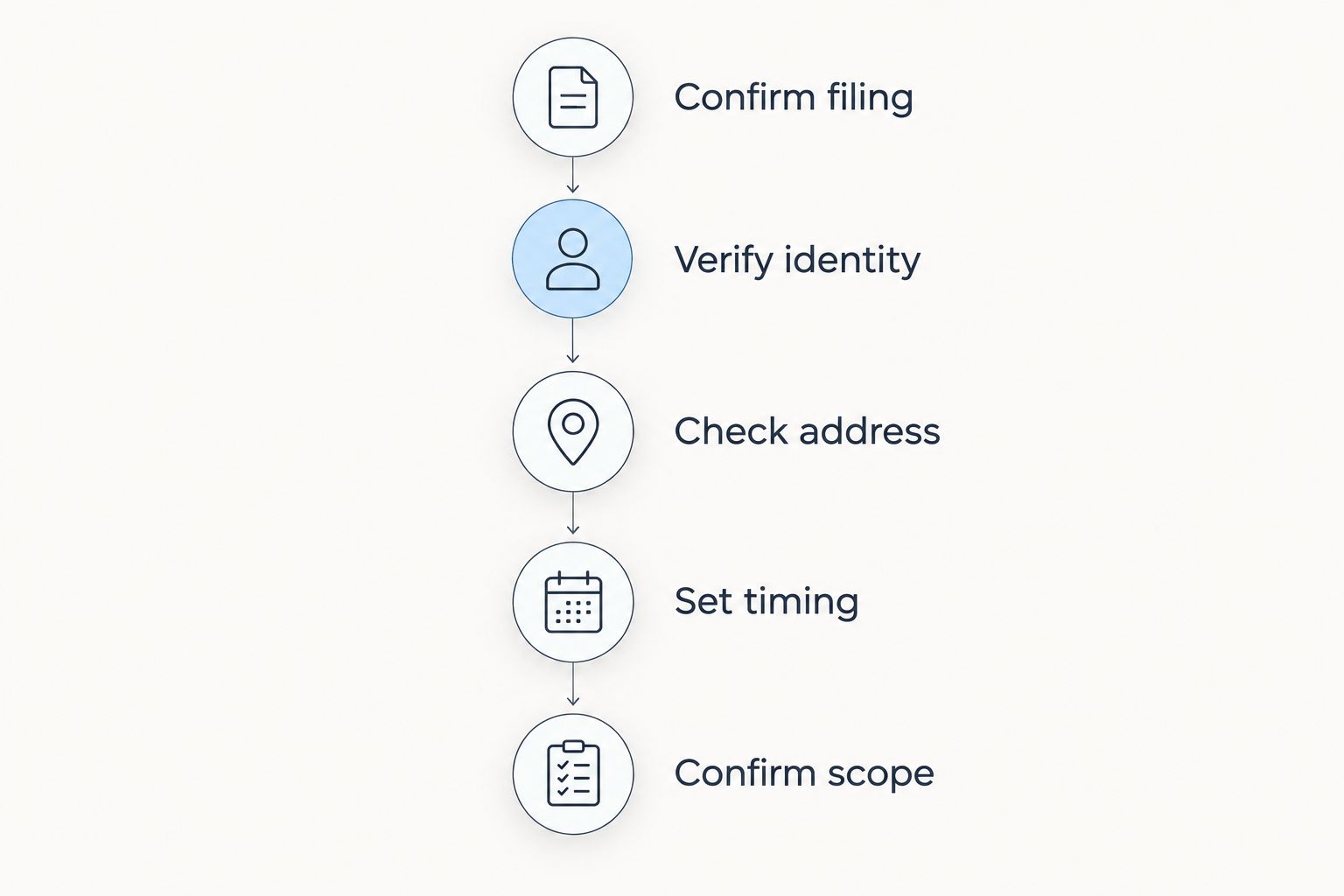
A clear intake package lets you compare the same work across providers. Use this sequence before authorizing delivery:
- Confirm filing. Obtain the filed documents and hearing information needed for the service assignment.
- Verify identity. Check the defendant’s name against the filed papers and identify whether the defendant is an individual or an entity.
- Check address. Provide the location, unit number and relevant access information you actually know.
- Set timing. State the hearing date and ask the provider to confirm the proposed attempt schedule.
- Confirm scope. Record included work, approval requirements and proof-of-service responsibilities.
Send relevant factual details, not guesses presented as facts. A confirmed workplace, for example, is different from a business address found in an old record. Label uncertain information so the provider can assess it accurately.
The small claims filing-to-process-server workflow connects the filing handoff with the delivery assignment. Keep your own checklist focused on those handoff points: filed papers, recipient information, deadline and returned proof.
Separate translation from filing and delivery
If your supporting documents need translation, keep that work separate from the court filing and service estimate. Document length, language and certification requirements shape legal translation costs; they do not establish what a process server charges to deliver the papers.
First confirm what the court requires. A translated exhibit, an interpreter for a hearing and service of the filed claim are different tasks, and ordering one does not complete the others.
For your 2026 case checklist, record the purpose of each language-related task and who is responsible for it. Avoid commissioning a translation simply because a defendant speaks another language; ask court self-help staff about the requirements relevant to your documents and proceeding.
Can I serve the small claims papers myself?
You cannot serve the papers in your own California small claims case. California Courts explains that the server must be at least 18 years old and must not be a party to the case.
An eligible adult is one possible route; hiring a process server is another. Eligibility alone does not establish that the person understands the permitted method, deadline or proof-of-service requirements.
| Service route | Best for | Advantage | Limitation |
|---|---|---|---|
| Eligible adult who is not a party | Filers with a suitable person who understands the assignment | Does not require hiring a private process-serving company | You still need correct service and completed documentation |
| Professional process server | Filers seeking a dedicated document-delivery provider | Assigns delivery work to a service business | Scope, scheduling and proof handling still need confirmation |
Do not ask a friend to improvise when the defendant is difficult to locate or the deadline is close. Decide who can carry out the required steps, not merely who can take an envelope to an address.
Does a court fee waiver cover process serving?
A court fee waiver does not automatically erase a private process server’s bill. California fee-waiver rules address specified court expenses and can include certain sheriff’s service fees; confirm the order and the applicable service arrangements.
Ask the court self-help center which expenses your waiver covers. Then ask any private provider for a separate written scope before placing an order.
Keep the waiver decision with your case records. Treat an application awaiting a decision differently from an approved order.
Who handles the proof of service?
The server completes the proof of service, but you should establish who will submit it to the court. Preparing the form, returning it to you and filing it are separate actions.
Before closing the assignment, check the case number, recipient information and recorded service details. If something appears inconsistent, ask for clarification promptly rather than waiting until the hearing.
In 2026, use the court’s current instructions for the required form and submission method. Keep the completed proof and any filing confirmation with your hearing papers.
FAQ
How do I work out the cost to file and serve small claims in San Diego?
Separate the applicable court filing fee from the service assignment. Confirm the current court requirement, then obtain a written delivery scope covering the defendant, address, timing, attempts and proof-of-service handling.
Does paying the filing fee include serving the defendant?
Paying the filing fee does not pay a private process server. Arrange a permitted service method separately and confirm who will return and file the proof of service.
Can I serve my own small claims papers in California?
You cannot serve papers in your own California small claims case. The server must be at least 18 years old and must not be a party to the case.
How many days before my small claims hearing must papers be served?
California's general small claims deadlines are 15 days before the hearing for service within the filing county and 20 days for service outside that county. Substituted service requires additional lead time, so confirm the applicable method and deadline.
Does same-day service mean the defendant will definitely be served today?
A same-day service request is not a guarantee of completed service. Confirm whether the provider commits to an attempt that day and what happens if the defendant is not located.
Should I order skip tracing before process serving?
Address research belongs before further delivery attempts when you lack a usable location. Confirm what the research assignment covers, then authorize service separately once the location information has been assessed.
Does a process server give me legal advice about my claim?
A process server handles document delivery, not legal advice about whom to sue or what to claim. Golden Hill Legal Runner LLC is not a law firm; no legal advice is provided.
One last thing
Ask who files the proof before you authorize the first attempt. That question exposes a common gap between paying for delivery and having the record your case needs. Put the answer in writing alongside the service scope, then retain the completed paperwork.
Not a law firm. No legal advice provided.