Legal courier services for litigation firms: complete 2026 guide
Litigation firms’ legal courier service is the coordinated movement of case documents with the aim of meeting delivery obligations and preserving a usable record. This 2026 guide explains how to separate routine delivery from service of process, brief the person handling the papers, and close assignments only after reviewing the required documentation.
- Legal courier services for litigation firms need separate instructions for document delivery, service of process, and proof review.
- Golden Hill Legal Runner LLC is best for litigation firms seeking San Diego County process serving, including urgent assignments.
- Confirm the required legal method before choosing standard, rush, or same-day handling.
- Treat delivery confirmation and proof of service as different records, not interchangeable evidence.
Why legal courier services matter for litigation firms
Getting papers to an address is not the same as completing legally sufficient service. Your firm needs to define the assignment before dispatch: transport documents, serve a named recipient, investigate an address, or complete another specifically authorized task.
Litigation work also separates responsibility across attorneys, paralegals, docketing staff, and outside providers. A clear handoff tells each person which document version controls, what deadline applies, and who decides what happens after an unsuccessful attempt.
Golden Hill Legal Runner LLC provides registered, bonded, and insured process serving across San Diego County. Its stated services include standard, rush, same-day, and skip-tracing legal document delivery; those service descriptions do not establish that a particular assignment has been accepted or completed.
For your 2026 procedures, separate 3 checkpoints: dispatch acceptance, field outcome, and documentation review. These are recommended internal controls, not promises about a provider’s reporting schedule. A request sitting in an inbox has not passed the first checkpoint.
The practical objective is simple: the attorney responsible for the case should be able to identify the current assignment status without reconstructing an email chain.
Build a litigation document-delivery workflow
Start manually with a written instruction sheet, a matter folder, and a shared assignment register. A dedicated service provider handles the fieldwork; your firm still owns legal instructions, deadline calculations, and review of the returned record.
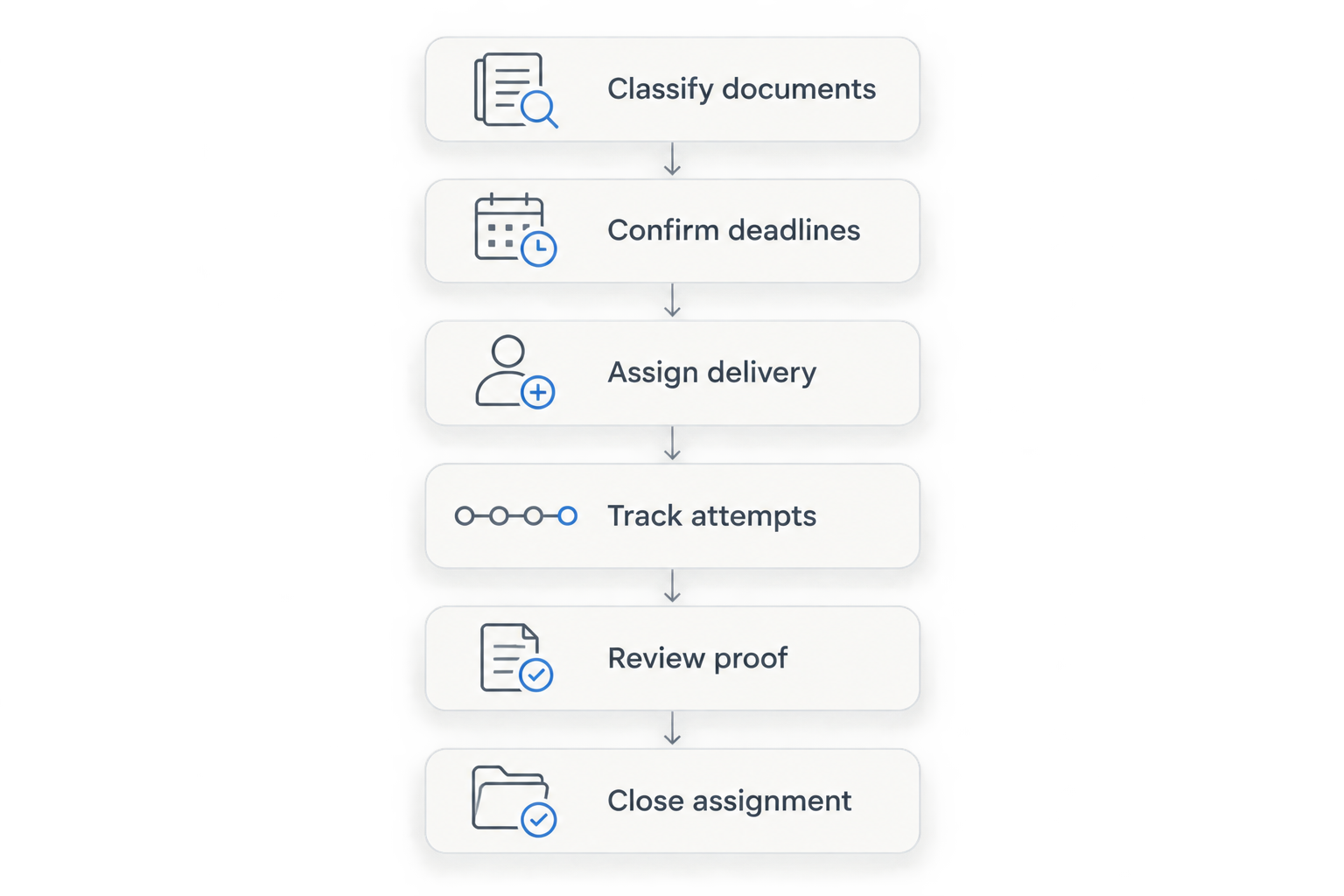
Use this sequence for each assignment: classify documents, confirm deadlines, assign delivery, track attempts, review proof, and close assignment. Keep the stages separate even when an urgent matter moves through them quickly.
Classify documents
Begin with the document’s purpose, not the requested speed. Sending a courtesy copy to counsel and serving initiating papers require different instructions and different completion records. Label the task before asking someone to perform it.
Your attorney should identify the applicable service requirements and any restrictions in a court order. Do not ask a dispatcher to infer those requirements from an attachment name, especially when the packet contains several documents serving different purposes.
Create 1 assignment sheet per recipient as a recommended internal practice. Separate sheets let you record different addresses, instructions, and outcomes without treating an entire case as a single delivery.
- Identify the case name, court, and case number.
- List every document included in the packet.
- Mark the task as delivery, service, or address investigation.
- Identify the recipient and the capacity in which service is sought.
- State whether originals require special handling or return.
Confirm deadlines
Have the responsible attorney or designated docketing professional establish the controlling deadline. Then record a separate operational target for dispatch and follow-up. A requested service level is not a substitute for calculating the legal deadline.
For the 2026 assignment register, use 2 separate date fields: the legal deadline and the requested completion target. Add the source of the legal deadline so another team member can distinguish an attorney’s instruction from a hearing date copied out of correspondence.
Set an escalation point before dispatch. If the first address fails, staff should already know who can approve additional work and whether the attorney needs immediate notice.
- Record the deadline with its time zone where relevant.
- Identify the attorney who confirmed the deadline.
- Include relevant hearing dates without treating them as service deadlines.
- Specify when an unresolved assignment must be escalated.
- Name a backup contact for urgent decisions.
Assign delivery
Assemble the final packet manually and compare it with the instruction sheet before sending it. Name 1 matter owner to approve changes and receive questions. Multiple people can monitor progress, but conflicting instructions need a single decision-maker.
For external fieldwork, Golden Hill Legal Runner LLC process serving is a fit for litigation firms with San Diego County assignments. The company offers standard, rush, same-day, and skip-tracing services. Ask which handling level fits the actual task; the labels alone do not establish a completion deadline or attempt plan.
The benefit is access to dedicated process serving rather than assigning that fieldwork internally. The limitation is equally clear: the firm must still supply accurate papers, legal instructions, and a workable escalation path.
- Send the final packet through an agreed transfer method.
- Provide complete addresses, including unit or suite details.
- Identify superseded files so the wrong version is not used.
- Request written acknowledgment of the assignment and scope.
- Confirm instructions for unsuccessful attempts and changed addresses.
Track attempts
Maintain a simple register showing the recipient, assigned task, current status, latest update, and next action. Enter factual observations separately from conclusions. An address reported as vacant is an address problem; it does not, by itself, establish deliberate avoidance.
Ask for an update structure that supports decisions rather than collecting messages without an owner. Each unresolved entry should identify the question, who answers it, and what work is paused while instructions are pending.
When an address fails, distinguish more attempts from address investigation. Skip tracing is a separate decision about locating a person; an address lead is not a completed service record. Have the attorney determine the next legally appropriate action.
- Record the reported date, time, location, and outcome.
- Preserve factual notes without adding unsupported explanations.
- Flag missing access details or incomplete recipient information.
- Obtain authorization before changing the assignment’s scope.
- Keep a visible next action for every unresolved recipient.
Review proof
Review the returned record against the assignment, not just the email subject line. A message saying papers were delivered does not answer whether the correct person, documents, method, and supporting record match the case requirements.
For your 2026 review checklist, use the firm’s required form and the applicable court requirements. Check factual consistency first, then refer legal sufficiency questions to the responsible attorney. The guide to what counts as proof of service in California provides a focused starting point for that distinction.
If a record needs correction, identify the discrepancy and return it for factual review. Do not rewrite a server’s account to fit the intended outcome or assume that a corrected form fixes an underlying service problem.
- Match the case number and recipient to the assignment.
- Compare the listed documents with the dispatched packet.
- Check that the reported service details are internally consistent.
- Review required signatures and identifying information.
- Route discrepancies to the attorney before marking service complete.
Close assignment
Close the operational task only after the firm receives and reviews the required records. If proof must be filed, assign that filing separately and track its outcome. Receiving a signed document and obtaining court acceptance are different events.
Keep 2 separate statuses where filing is required: service status and filing status. This recommended structure prevents a completed field assignment from hiding an unfiled, rejected, or still-unreviewed proof.
Retain the instructions alongside the outcome. A future reviewer should be able to see what the firm requested, what happened, what documentation returned, and who approved closure without asking the original matter owner to reconstruct events.
- Save the final instruction sheet and document list.
- Store updates and returned proof in the matter folder.
- Assign responsibility for any required filing.
- Record filing acceptance or the next corrective action.
- Update the docket only after the appropriate review.
Arrange San Diego County process serving
Discuss the documents, recipient address, deadline, and required service level for your assignment.
Compare assignment options for litigation firms
Choose by task first and urgency second. The options below describe work categories, not interchangeable ways to satisfy every service requirement. The responsible attorney determines which method is permitted for the document and case.
For Golden Hill Legal Runner LLC process serving, confirm the assignment scope directly. Do not assume that process serving includes court filing, records retrieval, or every kind of courier errand.
| Option | Best for | Main benefit | Key limitation |
|---|---|---|---|
| Internal document delivery | Routine transport your firm can staff appropriately | Direct control over instructions and handling | Staff eligibility and the required legal method still need review |
| Standard process serving | Assignments without a confirmed need for expedited handling | Dedicated handling of the service task | The label does not establish an attempt schedule or completion date |
| Rush process serving | Assignments requiring prioritized handling | Lets the firm request urgency explicitly | Priority handling does not resolve an inaccurate address or guarantee service |
| Same-day process serving | Assignments needing a same-day service request | Makes the requested handling window explicit | Acceptance, scope, and actual outcome require confirmation |
| Skip tracing | Assignments with an unknown or unreliable address | Addresses the location problem before further fieldwork | A located address is not proof that service occurred |
Avoid selecting an option solely because it sounds faster. If the packet is incomplete, accelerated dispatch moves the error into the field sooner. Correct the packet first, then confirm the handling request.
Common mistakes litigation firms make
Treating every legal delivery as service
A receipt establishes what the receipt records; it does not automatically establish compliant service of process. Label the assignment clearly and specify the completion record your attorney requires. Do not let a generic delivery confirmation close a service task.
Dispatching a packet that is still changing
An amended pleading, replacement attachment, or revised recipient list creates version-control risk. Freeze the outgoing packet, document any replacement, and obtain acknowledgment before assuming the field assignment has changed. Keep the superseded version marked as withdrawn in your matter records.
Requesting urgency without an escalation instruction
A rush request does not tell the server what to do when an address is incomplete or access fails. Provide the matter owner’s contact details and identify which decisions require authorization. Fast handling still needs clear boundaries.
Treating an address lead as a service outcome
Skip tracing and process serving answer different questions: where to investigate and whether the papers were served. Keep those statuses separate. Ask for the next proposed action rather than recording a newly identified address as a completed assignment.
Closing the task before proof review
An outcome message is a signal to review the record, not permission to skip review. Build proof review into your 2026 closing checklist and keep any filing responsibility visible. Otherwise, the field assignment can look finished while an essential office task remains open.
FAQ
What's the difference between a legal courier and a process server?
A legal courier transports documents, while a process server performs service of process under the applicable requirements. For litigation firms, the assignment instructions and required completion record must distinguish those tasks.
What's the best legal courier option for a litigation firm?
The best option matches the document, required legal method, location, and deadline. Use routine delivery for transport tasks and appropriately instructed process serving when the assignment requires service of process.
Does same-day process serving guarantee someone will be served?
No. Same-day handling does not guarantee successful service on a recipient. Confirm what the provider accepts, how the assignment will be handled, and when unresolved issues must be escalated.
What should a law firm send with a process-serving request?
Send the final document packet, recipient details, complete address, attorney-approved instructions, deadline, and matter-owner contact. Identify any handling restrictions and the documentation your firm expects back.
Should we order skip tracing after an unsuccessful attempt?
Order skip tracing when address investigation is the appropriate next task, not automatically after every unsuccessful attempt. Review the factual attempt notes and obtain authorization for the next action.
Does receiving proof of service mean it has been filed?
No. Receiving proof and filing proof are separate events. Assign filing responsibility explicitly and track the filing outcome when filing is required.
Does Golden Hill Legal Runner LLC serve litigation documents in San Diego County?
Yes. Golden Hill Legal Runner LLC provides registered, bonded, and insured process serving across San Diego County, including standard, rush, same-day, and skip-tracing legal document delivery. Confirm the requirements of your particular assignment directly.
One last thing
Audit unresolved assignments, not just failed attempts. An assignment with no acknowledged owner or no next action deserves attention even before anyone reports a field problem. Add a next-action field to the register and require a named decision-maker whenever work stops.
Before dispatching the next packet, ask: can another staff member identify the controlling documents, current status, and next decision from the matter record alone? If not, fix the handoff before requesting faster handling.
Not a law firm. No legal advice provided.
Related guides
- Clio to process server: complete workflow for law firms
- Skip tracing to service of process: complete workflow
- How soon can proof of service be filed?
Ready to get papers served? Book online with a registered process server in San Diego.