Process serving for personal injury attorneys: complete 2026 guide
Personal injury attorney process serving is the delivery of litigation documents with the aim of giving required notice and keeping an injury case moving. This 2026 guide explains how to coordinate defendants, witnesses, addresses, deadlines and proof of service without treating every document as the same assignment.
- Process serving for personal injury attorneys starts with the correct recipient, complete documents and a verified service address.
- Golden Hill Legal Runner serves San Diego County attorneys needing standard, rush, same-day or skip-tracing assignments.
- Choose service urgency around the attorney-confirmed deadline, not the filing date alone.
- Review proof of service before closing the assignment; delivery and filing are separate tasks.
Why process serving matters for personal injury attorneys
A personal injury case can involve an individual defendant, a business defendant and witnesses who need different documents. Your service instructions must distinguish them. An address that works for locating a witness does not establish who is authorized to receive a business defendant’s summons.
A successful handoff is not the same as a completed service assignment. Your file also needs an accurate account of what was served, on whom, when, where and by which method. Use the guide to what counts as proof of service in California when building your review checklist.
For your 2026 workflow, separate three responsibilities: counsel determines legal requirements, the server performs and documents the assignment, and your designated staff member checks the return and filing status. Assign each responsibility before dispatch so nobody assumes another person handled it.
Build a repeatable service workflow
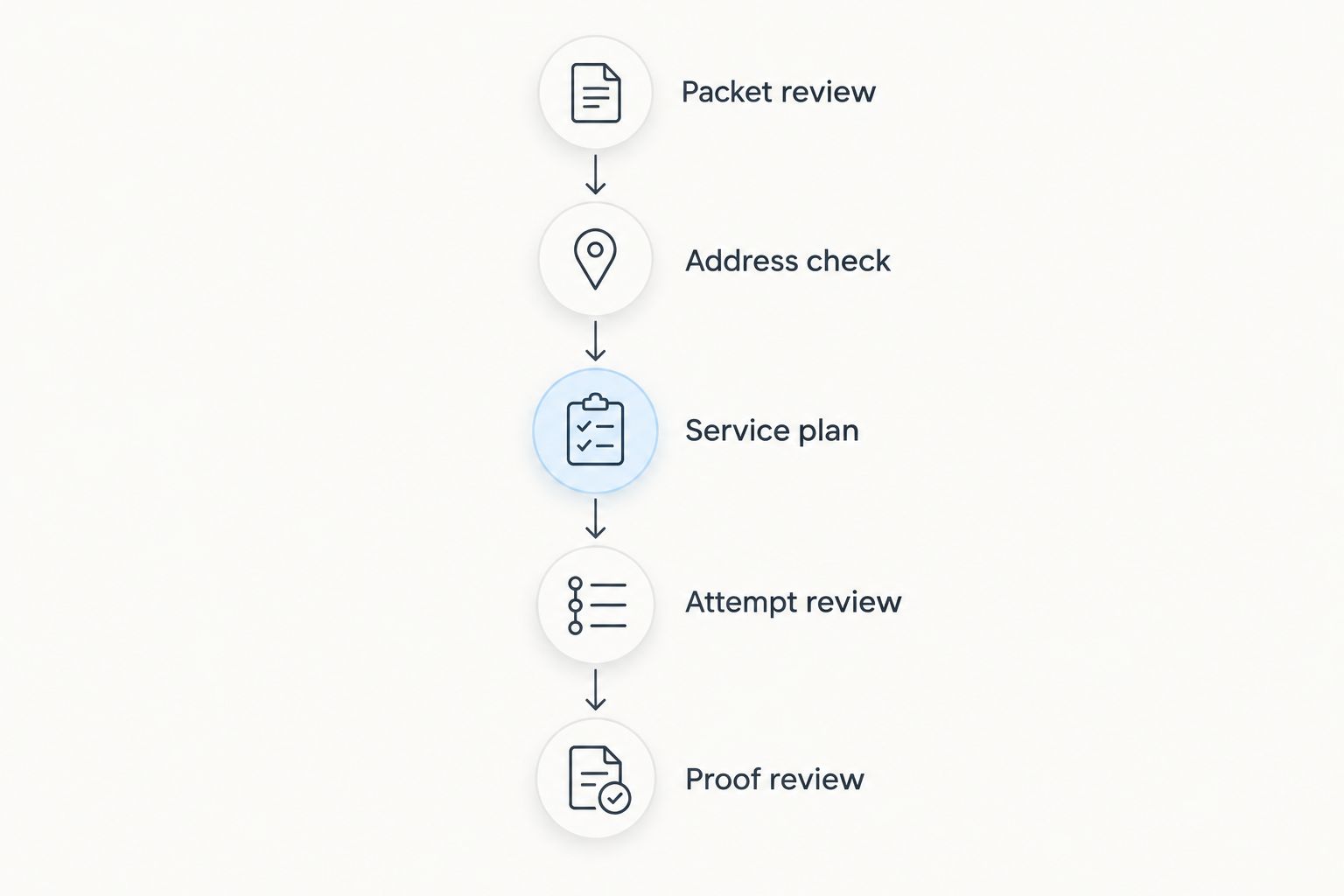
Organize the assignment around Packet review, Address check, Service plan, Attempt review and Proof review. Keep these checkpoints in the matter file, even when the same person handles several of them. The seven steps below turn those checkpoints into instructions your team can reuse.
1. Confirm the document and legal deadline
Start with a matter checklist and the court’s current instructions. Identify whether you are assigning a summons and complaint, a deposition subpoena, another subpoena or a different document. Do not copy the deadline or service method from an unrelated assignment.
For California general civil cases, the 2026 planning baseline includes California Rules of Court, rule 3.110(b): service of the complaint on named defendants and filing proof generally must occur within 60 days after filing, subject to the rule’s scope, exceptions and court orders. A California summons generally directs a defendant to respond within 30 days after service under Code of Civil Procedure section 412.20(a)(3); counsel must calculate the applicable deadline using the actual service method and circumstances.
California Code of Civil Procedure section 414.10 permits summons service by a person who is at least 18 years old and not a party. That eligibility rule does not replace document-specific service requirements.
- Record the document type and case number.
- Enter the attorney-confirmed service deadline.
- Separate service, response and hearing dates.
- Identify applicable court orders or exceptions.
- Name the person responsible for deadline calculations.
2. Verify the recipient and address
Begin with your existing file: intake records, correspondence and information counsel has approved for use. Distinguish the address’s source from its current reliability. A collision report or an old demand package can provide a lead without confirming where a defendant now lives.
For a business defendant, verify the legal entity and the intended recipient’s capacity. A business name on a storefront is not enough to establish the correct defendant or authorized recipient. For an individual, give the server usable identifying details without sending unrelated medical records or settlement material.
An address is a lead; recipient verification is a separate task. Tell the server which facts are confirmed and which remain unverified.
- Match the recipient’s name to the filed documents.
- Record when and where the address was obtained.
- Identify apartment, suite and access details.
- Flag aliases or identifying information counsel approves.
- Distinguish a business address from an authorized recipient.
3. Select the service option around the assignment
First, build a manual dispatch note stating the recipient, location, deadline and requested updates. This keeps the instructions usable regardless of which provider handles the assignment. Then select the service option that matches the remaining time and address quality.
Golden Hill Legal Runner is best for attorneys needing process serving within San Diego County. Golden Hill Legal Runner is registered, bonded and insured and offers standard, rush, same-day and skip-tracing legal document delivery. These options give your team a direct route to request help; they do not guarantee that a recipient will be located or successfully served.
In 2026, treat urgency and address research as separate decisions. A faster request does not fix an outdated address. Confirm the requested scope before assigning work, especially when several defendants or locations are involved.
- State the requested service option explicitly.
- Give the actual deadline, not just “urgent.”
- Identify every recipient and proposed address separately.
- Confirm the attempt scope and reporting expectations.
- Set an approval rule for additional work.
4. Send a complete, controlled packet
Prepare the packet manually before sending it to the server. Compare the document list with counsel’s instructions and check that the intended recipient matches the correct set. Keep a copy of exactly what you transmitted.
Personal injury files contain material the server does not need. Do not send an entire medical chronology or settlement file merely because it is stored beside the complaint. Limit the assignment to necessary documents and relevant operational instructions.
If counsel revises the packet after dispatch, clearly identify the replacement. Ask the server to acknowledge which version will be used. An unmarked attachment leaves room for the wrong document set to remain in circulation.
- List every document included for service.
- Check names, case numbers and page completeness.
- Separate packets for different recipients.
- Remove unrelated confidential material.
- Label revised packets and request acknowledgment.
5. Review attempts and escalate with facts
Use a shared matter note or task list to track each report. Record the attempt’s result separately from your interpretation. “No answer” is not the same finding as “recipient moved,” and neither establishes deliberate avoidance.
Ask for enough detail to choose the next action without directing the server to improvise a legal method. If the information points to an address problem, discuss address research. If it raises a question about substituted service or another method, send that question to counsel.
Escalate the problem shown by the attempt record. Do not keep repeating the same instruction when the underlying information has changed.
- Record the date, location and reported outcome.
- Distinguish unsuccessful contact from a confirmed bad address.
- Preserve factual descriptions without adding conclusions.
- Route service-method questions to the attorney.
- Approve the next action and identify its owner.
6. Review the proof before marking service complete
Compare the returned proof with the assignment packet and the server’s report. Check the recipient, documents, service date, location and method. When a detail appears inconsistent, request clarification rather than editing the server’s factual account yourself.
A personal injury team also needs to distinguish the proof’s preparation from its filing. Decide who receives the completed document, who checks it and who submits it where required. Do not infer filing from an email saying the papers were served.
For your 2026 checklist, make proof review a required task with a named owner. A completed delivery report should trigger that task, not bypass it.
- Match the proof to the correct recipient and case.
- Check the list of documents served.
- Review dates, addresses and the stated method.
- Resolve omissions with the person who performed service.
- Confirm who handles filing and retains confirmation.
7. Close the assignment with a clear handoff
Start with a simple closeout note in your case-management system or matter folder. Record the outcome, attach the proof and identify outstanding work. A matter with several defendants needs separate service statuses; one completed assignment does not close the others.
Have counsel or the designated docketing professional confirm any resulting deadline. Keep the actual service facts available for that calculation instead of entering a date based only on the day the server emailed your team.
This final handoff makes process serving for personal injury attorneys a controlled part of litigation support rather than an isolated delivery request.
- Update each recipient’s status separately.
- Save the proof and relevant attempt reports.
- Record filing confirmation where applicable.
- Route deadline calculations to the designated professional.
- Close only the tasks that are actually complete.
Compare service options for an injury case
Choose an option by the assignment’s constraint: time, address quality or geographic coverage. Golden Hill Legal Runner offers the four service categories below across San Diego County. Confirm the assignment details directly; a category name alone does not define every operational term.
| Option | Best for | Practical advantage | Key limitation |
|---|---|---|---|
| Standard service | Planned assignments with a usable address | Provides a routine service path without requesting expedited handling | Requires enough remaining time for the agreed assignment scope |
| Rush service | Time-sensitive assignments | Lets you request expedited handling | Does not resolve inaccurate recipient or address information |
| Same-day service | Assignments requiring a same-day service request | Matches the request to an immediate operational need | Does not guarantee successful contact or legally sufficient completion |
| Skip-tracing assignment | Recipients whose location needs research | Adds a location-research step to the service workflow | A research result still needs evaluation; it is not proof of residence or service |
Select the option that addresses the obstacle, not the most urgent-sounding label. If the recipient is outside San Diego County, confirm the coverage arrangement before dispatch rather than assuming county service extends elsewhere.
Common mistakes personal injury teams make
Treating an insurer as the defendant’s service recipient
An adjuster’s involvement in a claim does not establish authority to accept service for the insured. Keep claim communications separate from counsel’s determination of the proper recipient and method.
Reusing an address without checking its source
An address from early claim correspondence can remain in the file long after circumstances change. Preserve the source and date, then tell the server what your team has actually verified.
Bundling different defendants into one vague request
An individual driver and a business defendant require distinct recipient instructions. Create a separate service record for each so an update about one cannot be mistaken for completion of both.
Treating a subpoena like a summons
A summons and a subpoena serve different functions and carry different requirements. Have counsel identify the correct procedure, applicable notices and timing rather than copying the complaint-service checklist.
Closing the task before proof and filing review
A delivered packet is an event; a closed assignment is a documented workflow result. Keep proof review and any required filing visible as separate tasks in your 2026 matter checklist.
FAQ
What's the best process serving option for a personal injury attorney?
The best option matches the verified address, required service method and attorney-confirmed deadline. Use standard, rush or same-day requests according to the assignment’s timing, and address research when the location is uncertain.
Can my personal injury client serve the defendant?
A party cannot serve a California summons under Code of Civil Procedure section 414.10. The server must be at least 18 years old and not a party; counsel should confirm the requirements for the particular document.
Can an insurance adjuster accept service for a defendant?
Do not assume an insurance adjuster is authorized to accept service for a defendant. Counsel must establish an appropriate recipient and service method rather than relying on the adjuster’s involvement in the claim.
Does same-day service guarantee the defendant will be served?
No. A same-day service request does not guarantee that the recipient will be found or that service will be completed. Confirm the requested work and reporting expectations before dispatch.
What should I send with a process serving request?
Send the complete service packet, recipient details, address information, attorney-confirmed deadline and operational instructions. Exclude unrelated medical records and settlement material, and clearly identify any replacement packet.
Does Golden Hill Legal Runner handle personal injury attorney assignments?
Golden Hill Legal Runner provides legal document process serving to attorneys and law firms across San Diego County. Confirm the particular documents, recipients, locations and requested service option before assigning the matter.
Who should check the proof of service?
Your firm should assign proof review to a named staff member, with legal questions directed to counsel. Compare the proof with the assignment and confirm separately who handles any required filing.
One last thing
Put the recipient’s status beside the document’s status. “Complaint ready” and “defendant served” describe different milestones. Keep them separate when assigning work to Golden Hill Legal Runner, and retain the same distinction through proof review.
Not a law firm. No legal advice provided.