What time do process servers usually deliver papers?
Process servers deliver papers in the morning, during the day, in the evening, and on weekends; there is no single delivery hour that applies to every case. In California, do not assume service is limited to business hours: the document, service method, recipient’s schedule, and any applicable court order determine how an attempt should be planned.
- What time do process servers deliver? There is no universal schedule; attempts can include mornings, evenings, and weekends.
- California service requirements depend on the papers and service method, not simply the hour someone knocks.
- Golden Hill Legal Runner LLC offers San Diego County process serving; discuss timing before submitting an urgent request.
- An attempted delivery is not completed service. Keep the attempt schedule, legal deadline, and proof of service separate.
Why this matters
If you are arranging service in 2026, an address alone does not tell a process server when to go. A recipient who works away from home requires a different plan from someone who works nights or receives visitors at a staffed business.
Golden Hill Legal Runner LLC is a fit for people seeking process serving across San Diego County. The company is registered, bonded, and insured, and offers standard, rush, same-day, and skip-tracing services. You can discuss your document-delivery needs with Golden Hill Legal Runner LLC; confirm the proposed timing rather than treating a service label as an appointment.
If you are receiving papers, focus on what the documents require. A delivery outside your preferred hours does not, by itself, establish that service is invalid.
What time do process servers usually deliver papers?
Process servers plan attempts around where the recipient is likely to be and what the applicable service rules permit. Morning, daytime, evening, and weekend attempts serve different practical purposes. None is a universal delivery window.
The comparison below explains scheduling choices, not legal permission for every document or location.
| Attempt window | Best for | Practical advantage | Limitation |
|---|---|---|---|
| Morning | A recipient known to be home before leaving | Uses a confirmed routine | The recipient might already have left |
| Daytime | A business or known daytime location | Aligns with staffed access | Someone working elsewhere will not be home |
| Evening | A recipient known to return home later | Uses information about the recipient’s return | Gates, security, or an uncertain schedule can prevent contact |
| Weekend | A recipient with confirmed weekend availability | Provides an alternative to weekday attempts | Weekend presence is not guaranteed |
The useful question is not just when servers deliver papers. It is when this recipient can be reached through an appropriate service method.
Morning attempts: use a known routine
A morning attempt makes operational sense when you have reliable information that the recipient is at the address then. Tell the server whether that information is recent and how you know it.
Do not turn a guess into an instruction. Saying that someone usually leaves early is less useful than accurately describing an observed schedule and acknowledging when it was last confirmed.
Daytime attempts: match the location
Daytime attempts fit locations where the recipient is present during the day. A business address requires attention to the intended recipient, the documents, and the rules governing who can receive them.
An open reception desk does not automatically mean service is complete. Physical access and legally sufficient delivery are separate questions.
Evening and weekend attempts: confirm the reason
Evening and weekend attempts are scheduling options, not proof that someone is avoiding service. They are useful when credible information points to those periods.
Tell the server about gates, controlled entry, animals, or known safety concerns before the attempt. Do not ask the server to bypass security or enter a restricted area without authority.
Why process-server delivery times vary
The same address can require a different plan when the documents or circumstances change. For a 2026 service request, provide these scheduling details before an attempt is assigned:
- Recipient’s routine. Explain when the person is known to be present, distinguishing current information from assumptions.
- Address type. Identify whether the location is a home, workplace, business, or another address, and explain its connection to the recipient.
- Document requirements. Identify the papers and case type so the applicable method and timing requirements can be checked.
- Access conditions. Disclose gates, reception desks, building restrictions, and other obstacles that affect contact.
- Deadline and urgency. Supply the actual hearing date or service deadline rather than saying only that the request is urgent.
These factors explain why a process server cannot responsibly promise successful delivery merely because you request a particular hour. Scheduling controls when an attempt happens; it does not control whether the recipient is present or whether service can be completed.
What should you send before requesting a delivery time?
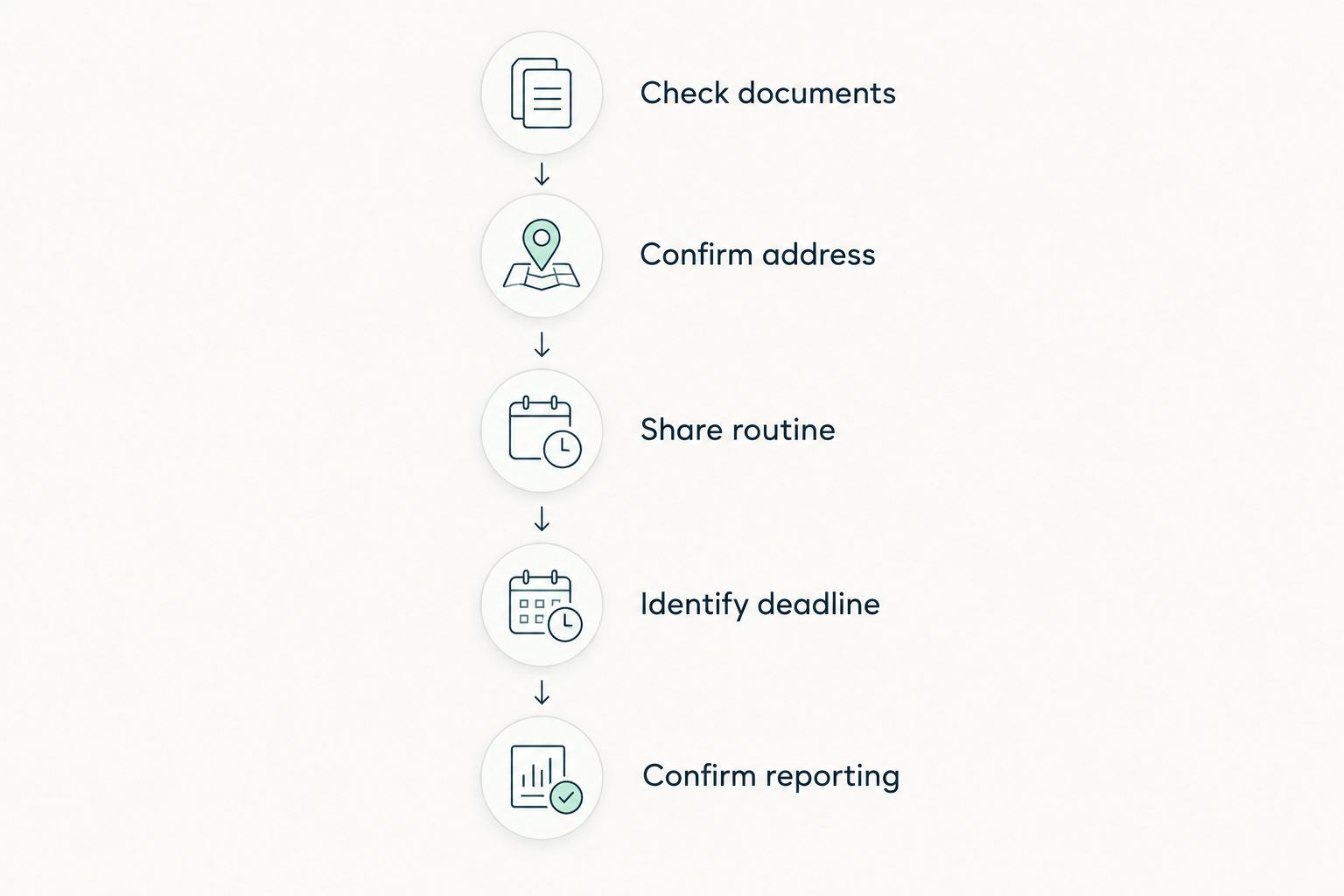
Prepare 5 details before asking for an attempt window. A clear request gives the server actionable information without asking the server to make legal decisions for you.
- Check documents. Provide the papers intended for service, including the relevant attachments. Identify the person or entity to be served exactly as the documents require.
- Confirm address. Supply the complete address and explain why you believe the recipient can be found there. Include a unit or suite when applicable.
- Share routine. Describe the recipient’s known availability and the date that information was confirmed. Flag uncertainty instead of presenting it as fact.
- Identify deadline. Provide the hearing information, court order, or deadline supplied by your attorney or court instructions. Ask a qualified source to resolve uncertainty about legal timing.
- Confirm reporting. Ask how you will learn about an attempt, what happens after unsuccessful contact, and how completed service will be documented.
Keep your scheduling request factual. For example, explain that a workplace has controlled entry instead of assuming the server can reach the recipient inside. Share relevant access information without directing anyone to misrepresent their identity or disregard restrictions.
For Golden Hill Legal Runner LLC process serving, the stated service area is San Diego County. Its listed service levels provide options for discussing urgency, but a same-day request is not a statement that a particular recipient will be successfully served that day.
Discuss your service timing
Share the documents, San Diego County address, and deadline before requesting an attempt window.
Does same-day service mean papers arrive at a specific hour?
No. A same-day service label does not, by itself, establish a guaranteed delivery hour or successful contact. Confirm what the assignment includes before relying on the label.
Separate 2 milestones: the attempt and completed service. An attempt records an effort to reach the recipient; completed service requires the applicable delivery requirements to be satisfied.
Ask these 3 questions when arranging urgent service in 2026:
- When is the first attempt expected, and what information could change that plan?
- What happens if the recipient is absent or the address cannot be accessed?
- When and how will the service result and any proof of service be provided?
Urgency changes the requested schedule; it does not remove service requirements. If a hearing or deadline is close, tell your attorney or consult the appropriate court self-help resource rather than assuming faster dispatch fixes every timing issue.
Can a process server deliver papers at night?
Yes, an evening or nighttime attempt is possible; do not assume that sunset ends the opportunity for service. Whether a particular attempt is appropriate depends on the documents, location, applicable rules, and any relevant court order.
There is an important distinction between contacting someone at a lawful location and gaining unauthorized access. A request for later delivery does not authorize entry into a locked residence or restricted property.
If you are arranging service, provide safety and access information without suggesting confrontation. If you receive papers at night, keep the documents and record the circumstances accurately if you need legal advice about the delivery.
Can a process server deliver papers on weekends or holidays?
Weekend delivery is possible, and a holiday does not automatically make delivery ineffective. Check the applicable requirements for the specific papers rather than importing a business-hours assumption into a legal-service question.
A business being closed can make a particular address unproductive. A residential address presents a different scheduling question, but the recipient’s presence still needs a factual basis.
Do not confuse permissible delivery timing with deadline calculations. Rules about counting days, court closures, and particular document types require separate attention; use the court’s current instructions or advice from your attorney.
What if nobody answers when the process server arrives?
An unanswered door does not establish completed service. The next step depends on the documents, applicable service methods, information gathered during the attempt, and the assignment’s terms.
Confirm how an unsuccessful attempt will be reported before placing the order. Ask whether the available information points to a different time, an address problem, or the need for further location research.
Do not assume papers can simply be left on a doorstep. Alternative service methods have requirements; the recipient being absent does not erase them or authorize any convenient delivery method.
What should you do if you receive papers unexpectedly?
Read the papers and identify the court, case number, document type, and any stated hearing or response information. Keep the complete packet together, including attachments.
If you believe the delivery was improper, write down what happened while the details are fresh. Include the location, approximate time, who received the papers, and what was said, without adding conclusions you cannot support.
Do not ignore court papers because the delivery time surprised you. Ask an attorney or the appropriate court self-help center about the document and any response requirements. A process server delivers papers; the server is not your legal adviser.
FAQ
What time do process servers deliver papers in California in 2026?
Process servers can attempt delivery in the morning, daytime, evening, or on weekends; there is no single delivery schedule for every California case. The documents, service method, recipient’s location, and applicable requirements determine the appropriate plan.
Do process servers only work during business hours?
No. Process-service attempts are not universally limited to business hours. Confirm the proposed attempt window and any document-specific restrictions with the server.
Can I choose the exact time someone will be served?
You can request an attempt window, but you cannot control whether the recipient is present or whether service can be completed. Give the server reliable schedule information and ask what timing can actually be confirmed.
Does an evening delivery mean the service is invalid?
No. An evening delivery does not, by itself, establish invalid service. The applicable rules, delivery method, and circumstances matter; obtain legal advice about a specific dispute.
Does same-day process serving guarantee successful delivery?
No. A same-day service label alone does not guarantee successful delivery to a particular recipient. Confirm what the provider commits to doing and how unsuccessful attempts are handled.
What information helps a process server choose a delivery time?
A complete address, reliable information about the recipient’s routine, access details, and the actual deadline help a server plan an attempt. Identify the documents and case type as well.
Can a process server explain how I should respond to the papers?
Do not rely on a process server for legal advice about your response. Read the documents and consult an attorney or the appropriate court self-help resource about your obligations.
One last thing
For a 2026 service request, ask for the next operational milestone, not just a reassuring label. Knowing when an attempt is planned, how its result will be reported, and what follows an unsuccessful attempt is more useful than hearing only that the papers are being handled.
A precise appointment still cannot replace correct documents, a usable address, or a valid service method. Plan the attempt around facts, then track whether service was actually completed.
Not a law firm. No legal advice provided.