Can a process server enter private property?
Yes—a process server can enter some private property to deliver legal papers, but permission to approach a home is not permission to enter the home or force access. In California, registered process servers have specific protections when performing lawful service, and qualifying servers have access rights at certain staffed gated communities. Those rules do not authorize breaking locks, climbing barriers, or entering a dwelling without consent; this 2026 guide explains the California rules relevant to San Diego County.
- Can a process server enter private property? In California, limited access rights do not authorize forced entry.
- Golden Hill Legal Runner LLC provides process serving across San Diego County, including standard, rush, and same-day service.
- California Code of Civil Procedure section 415.21 addresses qualifying access to staffed gated communities.
- Property access and legally valid service are separate questions; a blocked gate does not resolve either.
Can a process server enter private property?
Yes, within limits that depend on the property, the server's status, and the purpose of entry. California Penal Code section 602(o) contains an exception to that subdivision's trespass provisions for a registered process server performing lawful service. It is not blanket immunity from every trespass rule or permission to enter a dwelling.
For San Diego County process serving, Golden Hill Legal Runner LLC offers standard, rush, same-day, and skip-tracing legal document delivery. The property-access limits below apply independently of how urgently papers need delivery.
| Property or access situation | What the access rule means | Main limitation |
|---|---|---|
| Open front approach | A lawful approach to seek contact differs from entering a dwelling | An open path does not authorize searching private areas |
| Staffed gated community | Qualifying servers can request access under section 415.21 | Identification, qualifying credentials, and identification of the person to be served are required |
| Locked, unstaffed entrance | A locked entrance is an access obstacle | The staffed-gate rule does not authorize breaking or bypassing the lock |
| Inside a home | Service authority does not itself authorize entry | Consent or another independent legal basis is required |
| Workplace reception | A server can seek contact through an accessible reception area | Restricted areas remain restricted; reception delivery must satisfy the applicable service rules |
Why this matters
Property access and completion of service answer different questions. A server can reach the front door without completing service, and papers can sometimes be served lawfully somewhere other than the recipient's home.
For a 2026 service request, separate the assignment into access, identification, delivery, and documentation. That keeps a failed entry attempt from being mistaken for completed service—or proof that service is impossible.
What can a process server do at an open front entrance?
A server approaching a front door to contact an occupant is not doing the same thing as entering the residence. The route, barriers, signs, and circumstances matter; private ownership alone does not answer every access question.
California Penal Code section 602(o), relevant to this 2026 overview, expressly addresses registered process servers performing lawful service. Its exception is specific to that subdivision, not an unrestricted right to go anywhere on a parcel.
The practical advantage of a front-door attempt is direct contact at the address supplied. The limitation is equally clear: no response does not create permission to open doors, enter enclosed private areas, or search the property.
Best for: attempting direct contact when the front approach is lawfully accessible. Give the server accurate address and unit information rather than instructions to get inside by any means.
Can a process server get through a gated community?
California Code of Civil Procedure section 415.21 requires qualifying access to gated communities under the circumstances the statute describes. The server must identify the person to be served, display current identification, and provide qualifying credentials, such as evidence of current process-server registration.
The statute provides access for a reasonable period to perform lawful service. It applies to communities staffed at the time access is requested by a guard or other security personnel assigned to control access.
That distinction matters. A staffed entrance has someone who can examine credentials and grant access; an unattended keypad does not become a statutory invitation to defeat the gate.
- Benefit: qualifying access prevents a staffed community entrance from automatically blocking lawful service.
- Limit: access does not establish that the recipient is home or that delivery satisfies the relevant service requirements.
- Best for: a documented access request at a staffed gate, with the required identification and credentials ready.
A gate code supplied by a client also needs context. Tell the server who supplied it and what access it authorizes; do not treat possession of a code as proof of unrestricted permission.
Can a process server enter your house without permission?
A process server's assignment does not authorize entry into your house without consent. Registration, bonding, insurance, or an urgent deadline does not turn a private server into an officer executing a search warrant.
Opening a door to speak with a server is not the same as inviting the server inside. Likewise, an unlocked door is not automatic consent to enter.
You do not need to invite a server indoors merely to receive papers. Whether delivery at the doorway completes service depends on the document and the applicable rules—not whether the server crosses the threshold.
For the person requesting service, this is a firm operational boundary. Ask for lawful delivery and accurate reporting, not entry into the recipient's living space.
Why private-property access varies
For California assignments in 2026, these factors change the access analysis:
- Jurisdiction: California rules do not establish what a server can do in another state.
- Server status: the registered-server exception in Penal Code section 602(o) depends on registration and lawful service activity.
- Property configuration: an open approach, staffed gate, locked entrance, and dwelling interior present different questions.
- Access controls: guards, locks, signs, and instructions affect how an approach must be assessed.
- Document and case type: summonses, subpoenas, eviction papers, and restraining-order documents do not share every delivery requirement.
- Court directions: an applicable order can specify a service method; it must be read for what it actually authorizes.
Do not reduce these factors to “servers can always enter” or “private property is always off-limits.” Both statements erase distinctions that determine the next lawful step.
What should you give a server before a property-access attempt?
A useful assignment explains the access problem before the server arrives. Report observed facts, not assumptions about the recipient's intent. A locked gate is a fact; deliberate evasion requires more than a locked gate.
- Verify documents. Identify the case type, papers requiring delivery, and any court instructions. Confirm document-specific requirements with counsel or the relevant court resources.
- Confirm address. Supply the full address, unit, and reliable information connecting the recipient to that location. Flag uncertainty instead of presenting an old address as current.
- Describe access. Explain whether the entrance is staffed, locked, shared, or controlled by an intercom. Include known safety concerns without asking the server to bypass barriers.
- Record attempts. Request a factual account of the attempt: location, access conditions, contact made, and outcome. An unsuccessful attempt needs a different record from completed service.
- Review next steps. If access fails, discuss another lawful attempt or location. Decisions about substitute methods and court applications belong with the applicable rules and legal guidance.
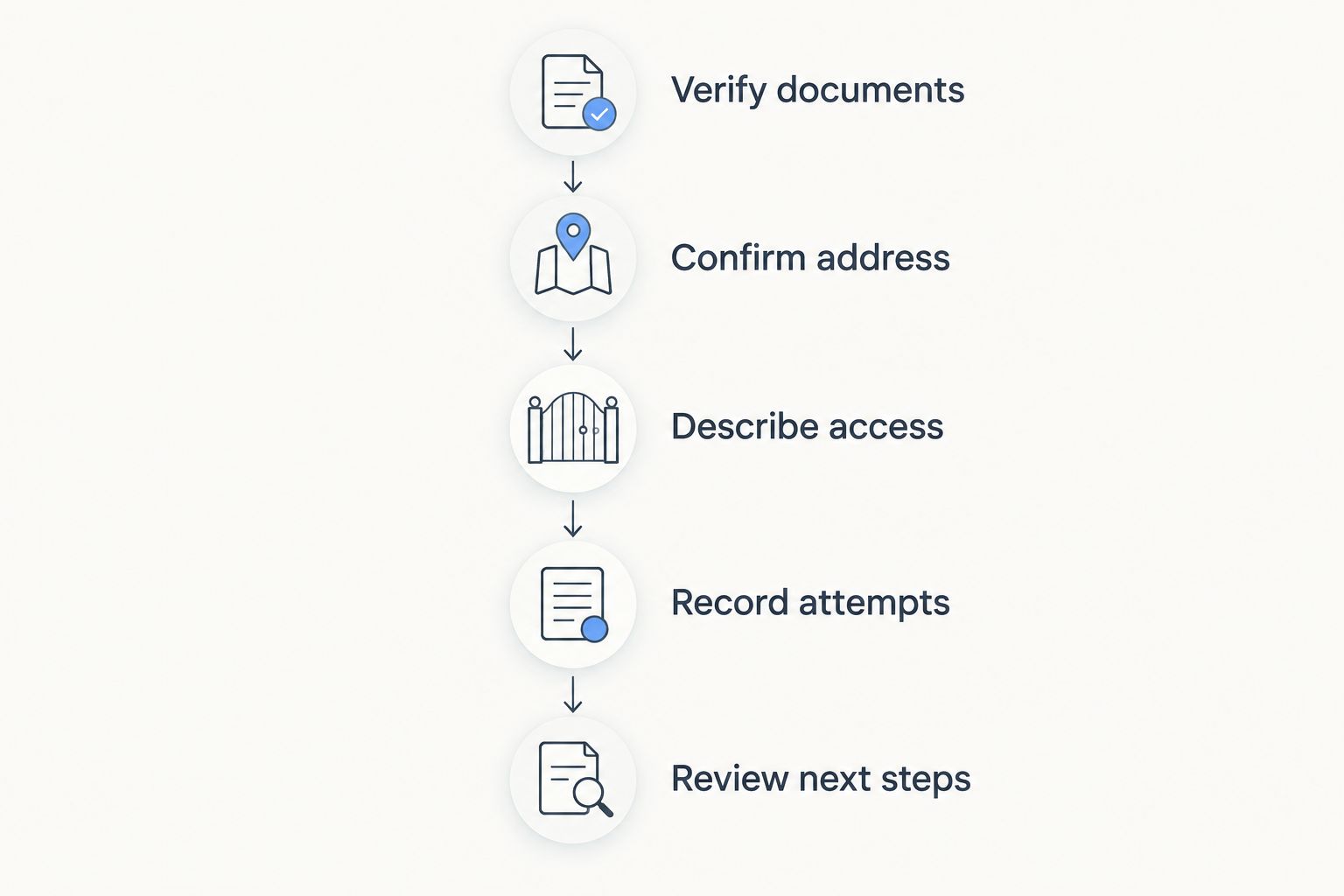
Good instructions do not guarantee contact. They give the server a usable assignment and give you a clearer record if the property cannot be accessed.
What happens if a gate prevents service?
A blocked gate means the attempt encountered an access barrier. It does not, by itself, prove the recipient was present, establish refusal, or authorize a different method of service.
An alternative location can be useful when reliable information supports it. For example, service at work raises different access questions from a residential gate, but it still requires compliance with the applicable delivery rules.
Locating the person and serving the person are also separate tasks. Skip tracing can help address an uncertain location; it does not create permission to enter private property.
Golden Hill Legal Runner LLC is a process-serving option for San Diego County clients seeking standard, rush, same-day, or skip-tracing document delivery. The company is registered, bonded, and insured, Reg. No. 3904. Those credentials do not remove property-access limits or make the company a source of legal advice.
Can papers be left with someone else on the property?
Sometimes, but the applicable service method controls. A person standing nearby is not automatically an eligible substitute recipient, and an unsuccessful doorstep visit does not automatically authorize leaving papers.
For certain individual defendants, California Code of Civil Procedure section 415.20(b) permits substituted service of a summons after reasonable diligence at personal delivery. Its requirements include leaving the papers with an eligible person and following with the required mailing.
At a dwelling or usual place of abode, the provision specifies a competent household member at least 18 years old. At a qualifying business location, the requirements differ and include a person apparently in charge. Under this provision, service is deemed complete 10 days after mailing, not simply when papers are handed over.
These are summons rules, not universal instructions for every document. California Code of Civil Procedure section 414.10 also generally requires a summons server to be at least 18 years old and not a party to the action. Being eligible to serve papers does not itself grant the access rights associated with registration.
What should you do if a process server is at your door?
Keep the interaction calm and separate receipt of papers from agreement with their contents. Accepting legal papers does not itself admit the allegations.
You can ask who the server is and what the delivery concerns without inviting entry. If you receive papers, read them promptly and identify the court, case, and response instructions.
For a 2026 case, check the actual documents rather than assuming a deadline from a general article. If you dispute the manner of service, preserve the facts and obtain legal advice; refusing to discuss the papers is not a substitute for addressing the case.
FAQ
Can a process server climb my fence to serve papers?
Process-serving authority does not itself authorize climbing a fence or forcing access. California's specific access protections are not a blanket exception to every property restriction.
Can a process server ignore a no-trespassing sign in California?
A no-trespassing sign does not, by itself, settle every California process-serving access question. Penal Code section 602(o) contains a specific exception for registered process servers performing lawful service, but that exception is not permission to enter a dwelling or force access.
Do I have to let a process server inside my home?
You do not have to invite a process server inside merely to receive legal papers. Service authority alone does not authorize entry into your dwelling without consent.
Can a security guard refuse a registered process server entry?
California Code of Civil Procedure section 415.21 requires qualifying access at covered staffed gated communities. The server must satisfy the statute's identification, credential, and recipient-identification requirements.
Can a process server leave papers with my roommate?
For certain summonses, an eligible household member at least 18 years old can receive substituted service when all applicable requirements are met. That is not a universal rule for every legal document, and required follow-up mailing still matters.
Does a locked gate mean I cannot be served?
A locked gate does not establish that service is impossible. Another lawful attempt, another location, or a legally authorized alternative method can require separate consideration.
Can a process server force me to sign for papers?
A process server cannot use force to obtain your signature. California personal service of a summons generally does not depend on the recipient signing a receipt.
One last thing
Write down access facts, not just “not served.” A staffed gate that denied entry, an unattended locked gate, and an unanswered accessible door are different events. That distinction helps counsel assess the record and decide what to do next.
Golden Hill Legal Runner LLC provides process serving, not legal representation. Not a law firm. No legal advice provided. This 2026 California overview is general information; document-specific requirements and court orders control your assignment.