Can a process server serve papers at a P.O. box?
No—a process server cannot complete personal service by leaving legal papers in a USPS P.O. box, but can personally serve the named recipient at a post office when the applicable rules permit it. For California cases in 2026, mailing papers to a P.O. box is a separate question: the document, service method, and any court order determine whether mailing is allowed.
- Can a process server serve papers at a PO box? Not by leaving them inside a USPS box.
- California personal service requires delivery to the person; a mailing address alone does not satisfy that requirement.
- A private mailbox is different from a USPS P.O. box, but neither automatically establishes valid service.
- Golden Hill Legal Runner LLC offers San Diego County process serving and skip tracing when an address needs investigation.
Why this matters
A mailing address is not automatically a service address. Sending papers somewhere the recipient collects mail does not establish that you completed the service method your case requires.
For a California case in 2026, separate the recipient's location from the legal requirements for delivery. If you know where the person works, the guide to serving papers at work explains another location to consider. The same distinction applies there: identifying a location and completing valid service are separate tasks.
Can a process server serve papers at a P.O. box?
Not by treating the box as the recipient. California Code of Civil Procedure section 415.10 describes personal service of a summons as delivery of the summons and complaint to the person being served. Putting an envelope in a mailbox does not accomplish that delivery.
California Code of Civil Procedure section 415.20(b) also expressly excludes a United States Postal Service post office box from the “usual mailing address” option for substituted service on an individual. That exclusion matters when someone suggests leaving papers with postal staff and mailing another copy.
| Situation | What it establishes | Main limitation |
|---|---|---|
| Papers sent to a USPS P.O. box | Mailing to that address | Does not establish personal service |
| Papers handed directly to the recipient at a post office | Delivery to the person | The applicable document and service rules still control |
| Papers left with a postal employee | Delivery to the employee | Postal employment alone does not authorize acceptance for the recipient |
| Papers delivered to a private mailbox business | Delivery at a commercial location | Separate requirements govern whether this counts as service |
| Papers mailed under an authorized procedure | A step in that procedure | Mailing alone does not satisfy every procedure |
These distinctions concern how service happens, not whether the recipient eventually reads the papers. Actual awareness and legally sufficient service are different questions.
USPS P.O. box: not a substitute for personal delivery
A USPS P.O. box gives its customer a place to receive mail. It does not turn the post office into the customer's residence, workplace, or authorized agent for receiving a summons.
Do not ask postal staff to place hand-delivered process inside a box and then report personal service. The server must accurately describe what happened, including who received the papers and how delivery occurred.
For an ordinary California civil summons, section 415.20(b) permits certain substituted-service methods after reasonable diligence at personal service. Its express exclusion of USPS post office boxes prevents you from treating a box as an eligible usual mailing address under that provision.
That does not mean every document must always be hand-delivered. Later case papers, particular notices, and court-authorized methods can follow different rules. Identify the document before choosing the delivery method.
Personal delivery at a post office: serve the person, not the box
A post office location does not automatically prevent personal service. If a server lawfully encounters and identifies the named recipient there, the relevant question is whether the server completes the delivery required by the applicable rule.
The benefit is direct delivery without relying on a home address. The limitation is practical: knowing someone's box number does not establish when that person will appear or who collects the mail.
A relative, employee, or other person collecting mail is not automatically the defendant or an authorized recipient. The server must distinguish the named person from someone handling that person's correspondence.
Do not treat a post office visit as permission to enter restricted areas, obstruct customers, or demand access to postal records. A service assignment does not create unrestricted access rights.
Private mailbox: a different address with different requirements
A private mailbox at a commercial mail-receiving business is not the same as a USPS P.O. box. It can appear on correspondence as a street address followed by a unit, suite, or mailbox designation.
That street-style format does not prove the recipient lives or works there. Before assigning residential or workplace attempts, establish what the address actually represents.
California has provisions addressing service through commercial mail-receiving agencies, including Code of Civil Procedure section 415.20(c). Whether those provisions apply depends on the facts and statutory requirements; a clerk's willingness to accept an envelope is not enough by itself.
The benefit of identifying a private mailbox is that it clarifies which rules need review. The limitation is equally important: a private mailbox is not a shortcut around service requirements. Tell the server it is a mailbox business rather than describing it as a confirmed residence.
What should you do if you only have a P.O. box?
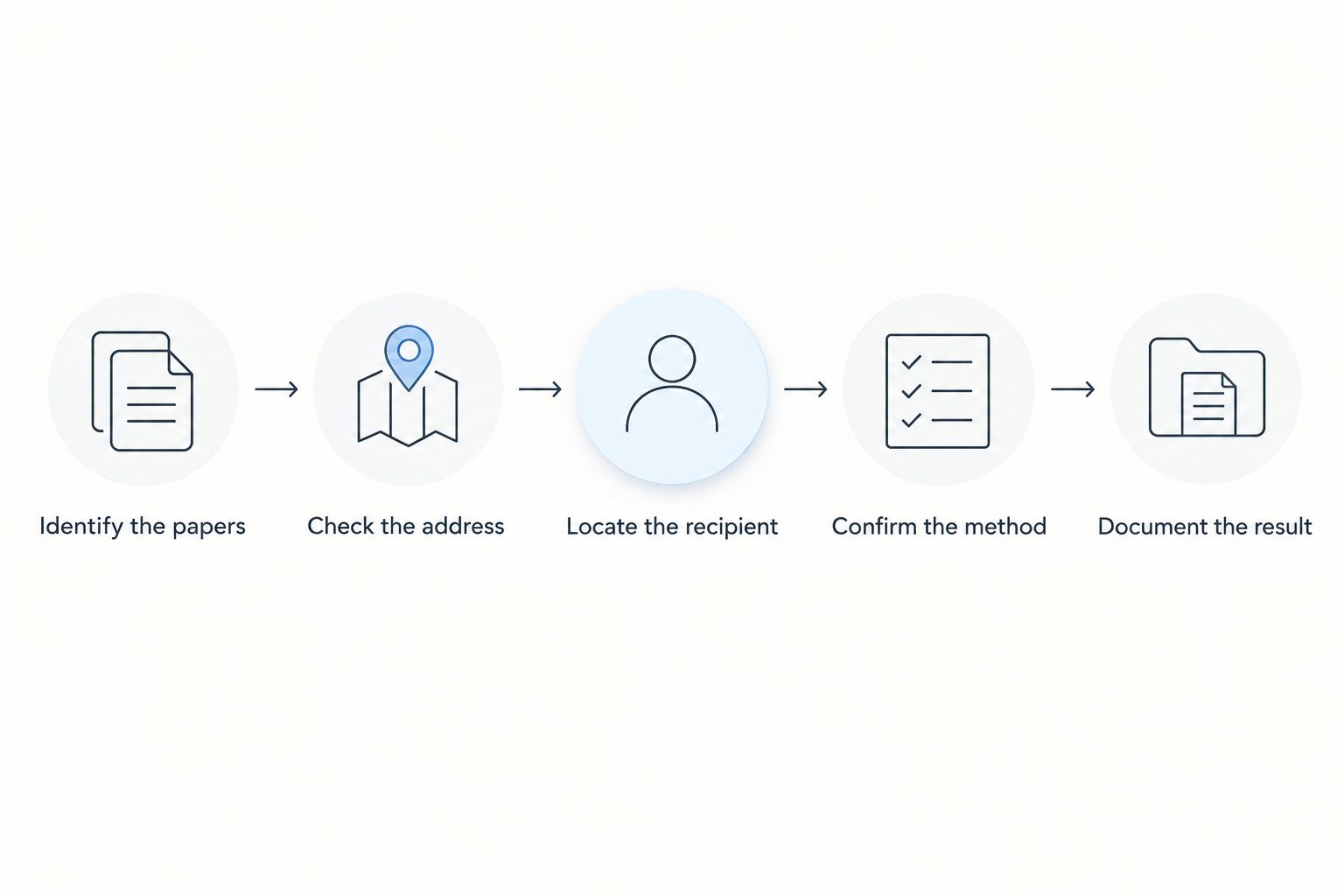
For a 2026 service assignment, give the server the box address as an investigative lead—not as a confirmed place for personal or substituted service. Follow this sequence before scheduling attempts.
- Identify the papers. State whether the assignment involves a summons and complaint, subpoena, restraining order, eviction notice, or another document. Include the case type and jurisdiction.
- Check the address. Establish whether the address is a USPS box, a private mailbox, a residence, or a business. Preserve the address exactly as it appears in your records.
- Locate the recipient. Supply known residential addresses, employer information, identifying details, and other lawful leads. Separate confirmed information from old or unverified information.
- Confirm the method. Have your attorney or court self-help resource identify the permitted method when the requirements are unclear. Do not substitute convenience for authorization.
- Document the result. Keep accurate attempt records and complete the appropriate proof or declaration based on what actually happened.
Skip tracing belongs in the location stage. It can produce address leads for further checking; it does not establish that an address is current or that service has occurred. The skip-tracing-to-service workflow explains that distinction.
Golden Hill Legal Runner LLC is a fit for San Diego County clients who need process serving and skip tracing on the same assignment. The company offers standard, rush, and same-day service, but selecting a faster service level does not change the legal requirements or guarantee that the recipient will be found.
Why the permitted service method varies
The answer changes with the assignment, not simply with the address printed on an envelope. Check these factors before arranging delivery:
- Document type. A summons, subpoena, later-filed paper, and statutory notice do not necessarily use the same service procedure.
- Recipient type. Serving an individual differs from serving a corporation or another entity through an authorized recipient.
- Address type. A USPS P.O. box, private mailbox, residence, and workplace present different facts.
- Prior attempts. Some substituted-service procedures require reasonable diligence at personal service first.
- Court directions. A specific order can authorize a method subject to its stated conditions.
- Jurisdiction. California rules do not resolve every requirement for papers issued by another state or a federal court.
When requesting process serving from Golden Hill Legal Runner LLC, provide the actual documents and any existing service order. A description such as “legal papers for a mailbox address” leaves out the facts needed to plan the assignment.
Does mailing papers to a P.O. box ever count as service?
Mailing can count when the applicable procedure authorizes it and every required step is completed. It is not interchangeable with personal service.
For California summons practice in 2026, Code of Civil Procedure section 415.30 provides a notice-and-acknowledgment procedure. The acknowledgment form asks the recipient to return it within 20 days after mailing; simply sending that package does not complete service under this method. Service is deemed complete when the acknowledgment is executed, provided it is returned to the sender.
Keep that separate from substituted service under section 415.20(b). Where that method properly applies, service is deemed complete on the 10th day after the required mailing—but the section's USPS P.O. box exclusion still applies. The mailing step cannot cure an otherwise improper delivery location.
Do not calculate a response deadline from a postal receipt alone. First establish the applicable method and its legal completion date.
Can the post office accept legal papers for a box holder?
A postal employee does not become the box holder's authorized recipient merely by working at the post office. Accepting an envelope across a counter does not establish authority to accept service for its addressee.
California's ordinary civil summons rules also distinguish the server's eligibility from the recipient's identity. Under Code of Civil Procedure section 414.10, a server must be at least 18 years old and not a party to the action. Using an eligible server does not fix delivery to an unauthorized person.
If someone claims authority to accept papers, identify that person's role and the legal basis before relying on the delivery. The proof must describe the actual recipient rather than imply a handoff to the defendant.
FAQ
Can a process server serve papers at a P.O. box in California?
A process server cannot complete personal service by leaving papers in a USPS P.O. box. California Code of Civil Procedure section 415.20(b) also excludes USPS post office boxes from its usual-mailing-address option for substituted service on an individual.
Can someone be personally served while collecting mail?
Someone can be personally served at a post office if the server identifies the correct person and completes the delivery required by the applicable rules. The box itself is not the recipient, and someone else collecting mail is not automatically authorized to accept service.
Does certified mail to a P.O. box prove legal service?
Certified mail to a P.O. box does not, by itself, prove valid service. Its legal effect depends on the document, the authorized service procedure, and completion of that procedure's requirements.
Is a UPS Store mailbox the same as a USPS P.O. box?
A mailbox at a private commercial mail-receiving business is different from a USPS P.O. box. California has separate provisions concerning commercial mail-receiving agencies, but a street-style mailbox address does not automatically establish valid service.
What should I give a process server if I only know a P.O. box?
Give the server the exact box address, the legal documents, known identifying details, prior addresses, and any reliable location leads. Label unverified information clearly and ask whether address investigation is needed before attempts.
Can skip tracing guarantee a current home address?
Skip tracing does not guarantee a current home address or completed service. It supplies leads that need evaluation before the server relies on them for a service attempt.
Does sending papers to a P.O. box start the response deadline?
Sending papers to a P.O. box does not automatically start the response deadline. The applicable service method determines whether service occurred and when it became complete.
One last thing
Check whether a street address is actually a mailbox before dispatching the server. A suite-style address can look like an office while identifying only a place that receives mail. Asking that question first helps keep the assignment focused on locating the person rather than repeatedly visiting a mail counter.
For a 2026 assignment, your instructions should identify the papers, the known address type, and any court-authorized service method. Keep the proof of service equally specific: it records completed acts, not assumptions about where someone probably receives correspondence.
Golden Hill Legal Runner LLC is registered, bonded, and insured. Not a law firm. No legal advice provided.
Related guides
- How substituted service works in California
- What happens if a process server cannot find you
- What counts as proof of service in California
Ready to get papers served? Book online with a registered process server in San Diego.