Do you have to sign for legal papers when served?
You generally do not have to sign for legal papers delivered through personal service in California; refusing to sign does not, by itself, prevent valid service. A mailed Notice and Acknowledgment of Receipt is different: that service method depends on a signed acknowledgment, so identify the document and delivery method before deciding what to do.
- Do you have to sign for legal papers? California personal service generally requires delivery, not your signature.
- California's Notice and Acknowledgment of Receipt uses a signed acknowledgment; it differs from personal service.
- Refusing a signature does not automatically stop service or extend a response deadline.
- Golden Hill Legal Runner LLC provides San Diego County process serving, not legal advice.
Do you have to sign for legal papers when served?
For ordinary personal service of a California summons, no recipient signature is required. California Code of Civil Procedure section 415.10 provides for personal delivery of the summons and complaint. The person serving the papers documents the delivery; the recipient does not have to sign a receipt to make that method work.
For your 2026 reference, distinguish these methods before treating every signature request the same way:
| Method or document | Is your signature required? | Relevant use | Main limitation |
|---|---|---|---|
| Personal service of a California summons | Generally no | Direct delivery to the named recipient | Delivery must satisfy the applicable service requirements |
| Substituted service of a California summons | Generally no recipient signature | Delivery to an eligible substitute, followed by required mailing | Eligibility, location, and other statutory requirements matter |
| Notice and Acknowledgment of Receipt | Yes, for this acknowledgment-based method | Service by mail with the prescribed acknowledgment | Mailing alone does not complete this method |
| Proof of service | Usually signed by the server, not the recipient | Recording how service occurred | A filed proof does not prevent a challenge to inaccurate facts |
This distinction also explains why refusing to accept legal papers is not the same as defeating service. A missing recipient signature is not a universal defect.
The table concerns California procedures. Federal cases, out-of-state proceedings, particular documents, and court orders require their own review.
Why this matters
A signature question can distract you from the more urgent issue: what the papers require next. Do not assume that unsigned papers carry no deadline. Read the summons, notice, or order and identify the court, case number, hearing date, and response instructions.
Receiving papers also does not mean you agree with the allegations. Service provides formal notice; admitting liability, signing a settlement, and filing a response are separate actions with different consequences.
For a case received in 2026, use the current court instructions rather than an old checklist. If you believe service was defective, get advice about how to raise that issue without missing a deadline or unintentionally affecting your position.
Personal service: your signature is generally unnecessary
With California personal service, the central question is whether the required documents were properly delivered to the correct person. A process server does not generally need your permission to complete that delivery.
Under Code of Civil Procedure section 414.10, a person serving a summons generally must be at least 18 years old and not a party to the action. That requirement concerns the server, not a signature from the recipient.
Personal service has a practical advantage: it creates a direct delivery event for the server to describe. Its limitation is equally important: the server still must identify and deliver to the appropriate person, and disputes about those facts can arise.
If someone asks you to sign during delivery, ask what the signature acknowledges. Do not assume the requested document is merely a receipt, and do not assume refusing it will cancel delivery that otherwise satisfies the rules.
What if you refuse to take the papers?
Refusing to hold the documents does not automatically make personal service ineffective. California courts have recognized service in circumstances involving an identified recipient who understood the nature of the delivery and refused the papers.
The circumstances matter. Papers abandoned at an address without the required identification, communication, or delivery are not automatically valid personal service simply because a server visited the property.
Keep the papers and document what happened. If you dispute service, preserve the facts rather than relying on the absence of your signature.
Mailed acknowledgments: the signature changes the analysis
California Code of Civil Procedure section 415.30 provides a mail-based service method using a Notice and Acknowledgment of Receipt. This is not the same thing as a process server personally handing you a summons and complaint.
For this method, service is deemed complete on the date the written acknowledgment is executed, provided it is subsequently returned to the sender. The statute addresses returning the acknowledgment within 20 days after mailing.
The benefit is that the acknowledgment can document receipt without a personal delivery visit. The limitation is that sending the packet alone does not complete this particular method; an executed acknowledgment must be returned.
Failure to return the acknowledgment does not make the case disappear. Another authorized service method can still be used, and section 415.30 also addresses consequences for failing to return the acknowledgment without good cause.
Does signing an acknowledgment admit the lawsuit is correct?
An acknowledgment of receipt addresses receipt of the documents, not whether the allegations are true. That is different from signing a settlement agreement, stipulation, admission, or waiver containing additional terms.
Read the entire form before signing. If the packet contains more than an acknowledgment, ask a qualified attorney or court self-help center to explain the documents rather than treating every signature line as interchangeable.
Substituted service: delivery and mailing matter
Substituted service of a California summons generally does not require the named recipient's signature. Code of Civil Procedure section 415.20 sets out requirements that depend on whom the summons targets and where delivery occurs.
For an individual under section 415.20(b), reasonable diligence in attempting personal service is part of the analysis. The statute also specifies eligible recipients, qualifying locations, informing the substitute of the contents, and subsequent mailing.
Under the applicable section 415.20 procedure, service is deemed complete on the 10th day after mailing. That completion rule is not a universal response deadline and should not be applied to every document left with another person.
The practical benefit of substituted service is that direct contact with the named recipient is not always necessary. Its limitation is the additional set of requirements: leaving papers with just anyone, anywhere, does not establish valid substituted service.
Do not calculate a response deadline from the doorstep event alone. Identify the exact method and case type first.
Why signature requirements vary
The answer changes because legal papers do not all follow the same delivery rules. In 2026, check these factors rather than using a blanket rule about signatures:
- Delivery method. Personal service and a mailed acknowledgment use different requirements to establish completion.
- Document type. A summons, subpoena, restraining order, and later-filed case document do not necessarily follow identical rules.
- Court system. California state procedure does not automatically answer questions about federal or another state's proceedings.
- Recipient. Serving an individual differs from serving a corporation or another organization through an authorized recipient.
- Court orders. An order authorizing a particular service method can change the instructions applicable to that case.
These factors also explain why a postal delivery signature does not settle the entire legal question. A tracking record can document a delivery event without establishing every element required for service of that particular document.
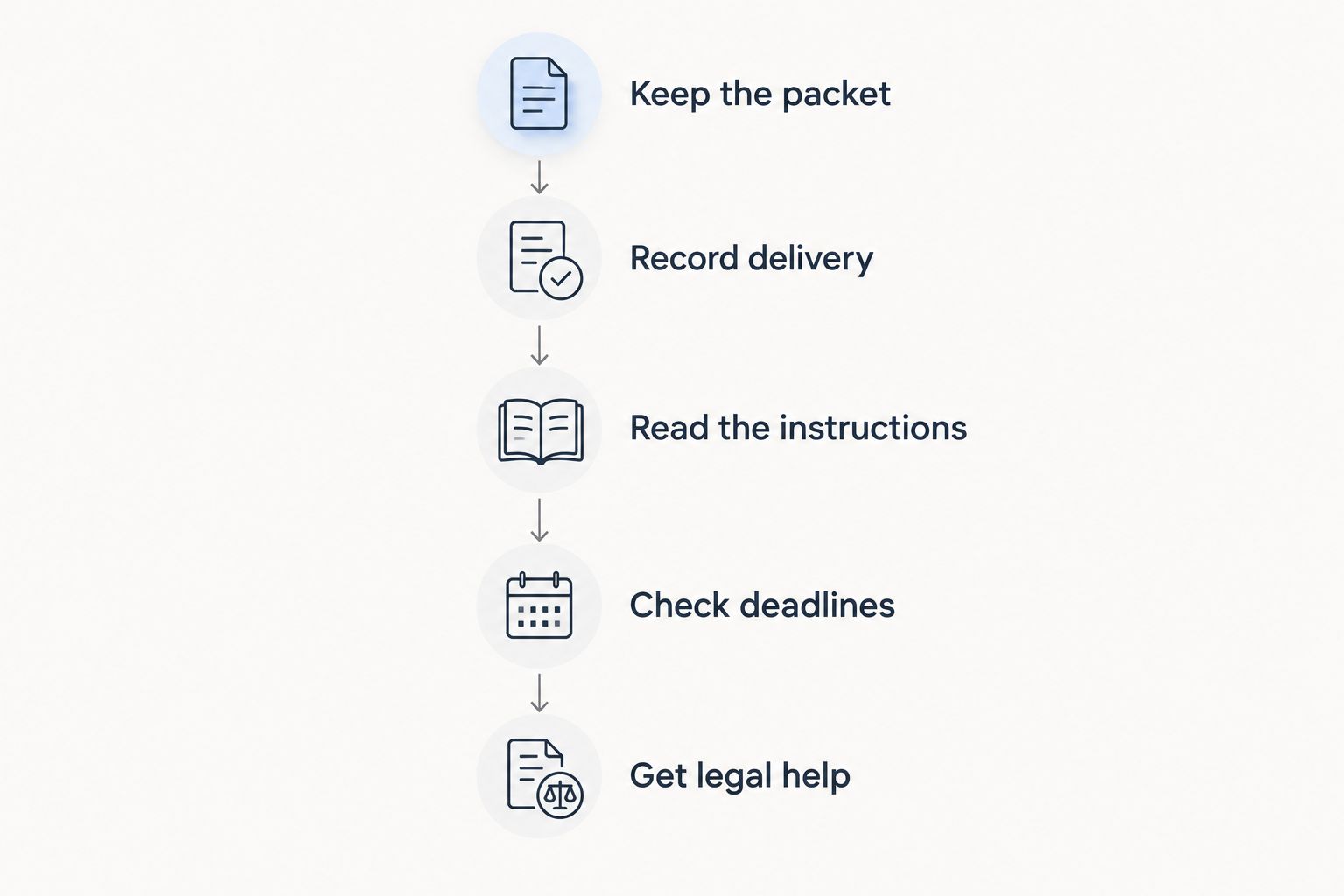
What should you do after receiving legal papers?
Use this sequence to separate receipt, deadlines, and any service dispute. None of these steps requires you to agree with the claims against you.
- Keep the packet. Save every page, attachment, envelope, and delivery notice. Avoid discarding documents because you did not sign.
- Record delivery. Write down when and where delivery happened, who received the papers, and what was said. Keep observations separate from assumptions.
- Read the instructions. Identify the court, case number, parties, hearing information, and any stated response requirements.
- Check deadlines. Use the applicable court instructions and qualified legal help to identify the deadline and the event that starts it.
- Get legal help. Ask an attorney or court self-help center about your response and any objection to service.
If the papers include a restraining order, read the order immediately. Do not assume that refusing a signature suspends its terms or eliminates an upcoming hearing.
If you suspect impersonation or fraud, verify the case through the court's official channels. Do not send money or disclose sensitive information merely because a caller claims to be a process server.
Who signs the proof of service?
The person who performed service generally signs the proof of service describing the delivery. The proof records facts such as the documents served, recipient, method, location, and date, as required by the applicable form and rules.
Your missing signature is not the same as a missing proof of service. These documents serve different purposes: one can acknowledge receipt, while the other reports how service occurred.
A proof of service also does not make every statement unchallengeable. If the record says delivery occurred at a place you were not present, preserve evidence and obtain advice about the proper procedure for disputing it.
Where professional process serving fits
Golden Hill Legal Runner LLC is best for people seeking San Diego County legal document delivery, not legal advice. Its process-serving services include standard, rush, same-day, and skip-tracing options for the case categories described by the company.
For a 2026 service request, give Golden Hill Legal Runner LLC accurate recipient details, complete documents, and relevant court instructions. Ask about the applicable delivery arrangement rather than assuming a faster service option changes the legal requirements.
The company is registered, bonded, and insured. Those credentials do not replace legal advice about disputed service, response deadlines, or whether a particular method is authorized in your case.
Can you ignore papers because you did not sign?
No. Unsigned papers can still have been validly served. Ignoring them creates a separate risk from any legitimate objection you have to the delivery method.
Read the packet and seek help promptly. A court can proceed when a party fails to respond after valid service; a signature dispute should not become a reason to miss the required next step.
Does accepting papers mean you agree with them?
No. Accepting papers does not itself admit the allegations. Taking possession gives you access to the documents you need to understand the case and prepare a response.
A separate document asking you to agree to terms deserves separate review. Receipt, acknowledgment, settlement, and consent are not interchangeable actions.
FAQ
Do you have to sign for legal papers in California?
Generally, no signature is required from the recipient for personal service of a California summons. A mailed Notice and Acknowledgment of Receipt is different because that method requires an executed acknowledgment returned to the sender.
Can a process server serve me if I refuse to sign?
Yes, refusing to sign does not by itself prevent valid personal service. The delivery must still satisfy the rules for the documents and case involved.
Who signs the proof of service?
The person who performed service generally signs the proof of service. The recipient's signature is not ordinarily required on that proof.
Does signing an acknowledgment mean I admit the allegations?
An acknowledgment of receipt addresses receipt, not the truth of the allegations. Read the entire document because a separate agreement, admission, or waiver can have different consequences.
Are papers left with someone else valid without my signature?
Substituted service can be valid without your signature when all applicable requirements are met. In California, those requirements depend on the recipient, location, document, and required follow-up steps.
Does refusing papers give me more time to respond?
Refusing papers does not automatically extend a response deadline. Determine whether service was completed and which response rules apply to the case.
Can Golden Hill Legal Runner LLC tell me whether to challenge service?
Golden Hill Legal Runner LLC provides process serving, not legal advice. Ask a qualified attorney or court self-help center about challenging service or choosing a response.
One last thing
Ask what the signature does, not just whether someone wants one. A delivery receipt, acknowledgment, settlement, and court filing can all have signature lines, but they do not accomplish the same thing.
For papers received in 2026, keep the complete packet and record the delivery facts before memories fade. That record is more useful than relying on the statement that you never signed.
Not a law firm. No legal advice provided. This article gives general California procedural information, not advice about your case.