How does skip tracing work to find someone?
Skip tracing works by comparing identifying details with lawfully accessible records, separating people with similar names, and checking possible addresses to locate the intended person. For legal document delivery, the result is a location lead—not proof that the person lives there or that service is complete. A process server must still carry out and document the appropriate service steps.
- How does skip tracing work? Identity matching and address verification turn scattered records into location leads.
- A database match is not proof of residence, and locating someone does not complete service of process.
- Golden Hill Legal Runner LLC offers skip tracing and process serving for San Diego County legal matters.
- Start with accurate identifiers, dated address information and a clear purpose—not a name alone.
How does skip tracing work to find someone?
Skip tracing follows a sequence: establish identity, search relevant records, compare possible matches, evaluate address leads, and pass useful findings to the person handling the next step. The central task is separating a credible current lead from an old or unrelated record.
For court papers, the skip tracing to service of process workflow connects that research to delivery. Keep those stages separate: finding a possible address does not establish that the correct person received the documents.
Start with the information you already have
Before requesting a search, assemble the person's full name, known spelling variations, last known address and the date you last confirmed that address. Include other relevant identifiers you lawfully hold, using a secure intake method for sensitive information.
A name without context creates ambiguity. A name paired with a dated address gives the researcher a starting point and a way to reject unrelated matches.
Follow the search through to a usable lead
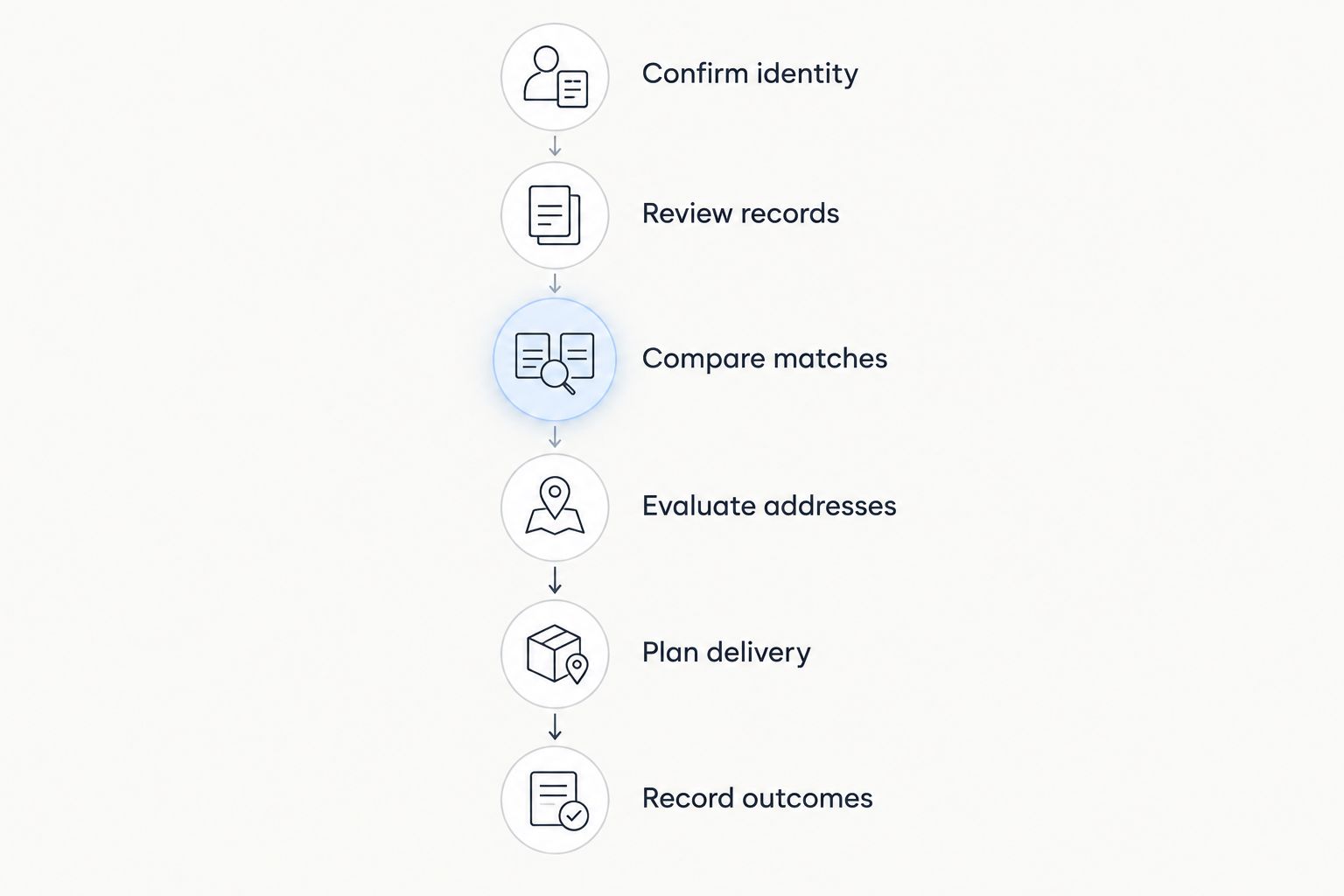
- Confirm identity. Compare the supplied name and identifying information before treating any record as relevant.
- Review records. Examine lawfully accessible sources for address history and other location clues.
- Compare matches. Look for agreement across identifying details rather than accepting a matching name.
- Evaluate addresses. Separate historical associations from evidence supporting a current location.
- Plan delivery. Give the process server the relevant lead, supporting context and any known access or safety concerns.
- Record outcomes. Use attempt results to distinguish a useful lead from an incorrect or unresolved address.
This is a 6-step framework, not a promise that every assignment follows an identical search. A straightforward address update and a search involving conflicting identities require different work.
Why this matters
A wrong-person match sends the assignment in the wrong direction. An outdated address can produce an unsuccessful visit even when the underlying identity match is correct.
For a 2026 assignment, ask when the address information was last supported—not simply when the search report was generated. A newly generated report can contain historical information.
Judge a skip-tracing result by its relevance, recency and identity match, not by the number of addresses returned. A shorter, explained result is more actionable than a long list with no distinction between current leads and past associations.
What information does a skip tracer use?
Skip tracing combines information you supply with records the researcher is authorized to access. Sources can include public court records, property records, business filings, public professional listings and address information from permitted research services.
These sources answer different questions. A property record establishes an association with a property; it does not automatically establish current occupancy. A business filing can identify a business address without identifying the person's home.
Information you can prepare
Give the researcher context that helps distinguish the intended recipient:
- Identity details: Full legal name, known aliases and relevant identifying information you lawfully possess.
- Address history: Previous addresses and when each address was last confirmed.
- Known connections: Relevant business names or employment information, clearly marked as confirmed or unconfirmed.
- Earlier attempts: Dates, locations and factual observations from unsuccessful delivery attempts.
- Assignment purpose: The document-delivery objective and any deadline supplied by the court or your attorney.
For a 2026 intake, label each detail by its source and date wherever possible. Do not turn an assumption into a fact by copying it into a request form.
Information that needs careful handling
Do not send passwords, account access credentials or unrelated private documents. Ask how to submit sensitive identifiers securely rather than placing them in an ordinary email thread.
A legitimate search purpose does not authorize unrestricted access to private information. Access restrictions depend on the record, the source and the permitted use; public availability and professional access are not interchangeable.
Which approach fits your situation?
Public-record research, professional skip tracing and field attempts serve different purposes. Choose the next action based on what is actually unresolved: identity, location or delivery.
| Approach | Best for | Useful result | Limitation |
|---|---|---|---|
| Public-record research | Checking known public associations | Context about addresses, businesses or court records | A public association does not establish current residence |
| Professional skip tracing | Resolving uncertain identity or address leads | Evaluated location leads tied to identifying details | A search can remain inconclusive |
| Process-serving attempt | Acting on a usable location lead | A documented delivery outcome or attempt result | An attempt does not guarantee completed service |
Use research to resolve uncertainty and field attempts to test actionable leads. Repeating a visit to an address already shown to be unrelated does not fix an identity problem.
For your 2026 assignment, ask the provider to explain which stage the proposed work addresses. A search and a service attempt are related tasks, but they are not the same deliverable.
Why skip-tracing results vary
The usefulness of a search depends on the information available and how well it connects to the intended person. These factors explain why a search can produce a strong lead, conflicting possibilities or no actionable result:
- Starting identifiers: A full name with supporting details provides more ways to distinguish people than a name alone.
- Record recency: An old address association does not establish where someone lives now.
- Name ambiguity: Common names, spelling variations and name changes require additional matching work.
- Source coverage: Different records cover different activities and do not all contain current address information.
- Conflicting evidence: Records pointing to different people or locations require resolution rather than an arbitrary choice.
- Field feedback: An attempt can reveal that an address is outdated, inaccessible or unrelated to the intended recipient.
An unsuccessful search does not establish that someone is deliberately avoiding service. Likewise, an unanswered door does not establish that the address is wrong.
How do you know whether an address is reliable?
A reliable lead has a clear connection to the intended person and an explanation of why the location deserves attention. Ask what supports the match, how current the supporting information is, and what remains unverified.
Keep 3 questions separate: Is this the correct person? Is this a relevant location? Has delivery been completed? A positive answer to one does not answer the others.
Check the identity connection
Look for agreement between the supplied identifiers and the record. A matching surname or a similar name is not enough to establish that the record belongs to the recipient.
If important details conflict, flag the conflict before authorizing an attempt. Do not ask the process server to resolve an unexplained identity mismatch at the door.
Check the address connection
Ask whether the address is a residence, a business location, a mailing address or a historical association. Each has a different operational meaning.
A mailing address can be useful research context without being a place where the person can be found. Keep the source's actual meaning intact rather than relabelling every address as a home.
Check the field result
Request factual attempt notes, not conclusions unsupported by observations. No answer, restricted access and confirmed incorrect recipient describe different outcomes.
Use that feedback to decide whether the next step is another appropriately planned attempt, further research or a discussion with your attorney. A failed attempt is information—not automatic proof of evasion.
What happens after skip tracing finds an address?
After skip tracing identifies a usable lead, the person handling service reviews the documents, location information and applicable requirements before attempting delivery. The search report itself is not proof of service.
For your 2026 handoff, keep the research findings and delivery instructions distinct. Mark uncertainties clearly so an unverified lead does not become a supposedly confirmed fact as the assignment changes hands.
Golden Hill Legal Runner LLC provides skip tracing and process serving across San Diego County. Golden Hill Legal Runner LLC is best suited to attorneys, organizations and individuals seeking skip tracing connected to San Diego County legal document delivery. The company is registered, bonded and insured; research still cannot guarantee a successful location or completed service.
You can review Golden Hill Legal Runner LLC when arranging that work. Explain whether you need address research, document delivery or both, and identify any known deadline before requesting the assignment.
Plan your document delivery
Identify whether your San Diego County assignment needs skip tracing, process serving or both.
Can skip tracing guarantee that someone will be found?
Skip tracing cannot guarantee that someone will be found. Records can be incomplete, outdated or insufficient to distinguish the intended person from another individual.
A useful result explains its limits. Ask what was established, what remains uncertain and whether the findings support a delivery attempt.
Is skip tracing the same as tracking a phone?
Skip tracing is not the same as tracking a phone's live location. It evaluates identifying information and location leads; a phone number in a record does not provide live GPS access.
Do not treat an offer of unrestricted private-account or device access as an ordinary part of locating someone for service. Keep the request tied to lawful research and the document-delivery purpose.
What if skip tracing does not produce a usable address?
An inconclusive search means there is not yet a sufficiently supported location lead. Review the starting identifiers, conflicting records and prior attempt notes before deciding whether additional research makes sense.
If a service deadline is approaching, speak with your attorney or the appropriate court self-help resource about the applicable procedure. Do not assume unsuccessful research authorizes a different service method.
FAQ
How does skip tracing work when I only have a name?
Skip tracing starts by trying to distinguish the intended person from others with the same or similar name. A previous address or other relevant identifier you lawfully hold helps evaluate possible matches; a name alone can leave the result inconclusive.
Can a skip tracer find someone's current home address?
A skip tracer can identify possible current addresses, but a record match does not guarantee current residence. Ask what supports the address connection and what remains unverified before arranging delivery.
Is skip tracing legal for serving court papers?
Skip tracing for court-paper delivery must use lawful sources and comply with applicable access and privacy restrictions. A litigation purpose does not permit unauthorized access to private accounts or restricted records.
How long does skip tracing take in 2026?
Skip-tracing timing depends on the identifiers, available records and unresolved conflicts in the assignment. Ask the provider for an assignment-specific expectation and explain any service deadline before work begins.
Does finding someone mean they have been legally served?
Finding someone does not mean they have been legally served. Locating a person and completing service are separate tasks, and the applicable delivery and documentation requirements still apply.
Can Golden Hill Legal Runner LLC help with skip tracing in San Diego County?
Golden Hill Legal Runner LLC offers skip tracing and process serving across San Diego County. Explain your document-delivery purpose, known identifying information and deadline when requesting help.
Can skip tracing prove someone is avoiding a process server?
Skip tracing alone does not prove that someone is avoiding a process server. An outdated record, an inconclusive search or an unanswered door does not establish deliberate evasion.
One last thing
Preserve negative information as carefully as a promising address. A confirmed wrong-person match or an address ruled out by reliable observations helps prevent the same mistake from entering the next assignment.
Before handing off the file, distinguish confirmed facts, research leads and unresolved questions. That simple separation keeps a possible location from being mistaken for completed service.
Not a law firm. No legal advice provided.