How fast can a restraining order be served in San Diego?
A restraining order can be served the same day in San Diego when the court-issued papers are ready, the respondent can be located, and a server can complete lawful delivery. In 2026, same-day service is a scheduling option—not a guarantee of completed service—and the deadline on your court papers still controls.
- How fast can a restraining order be served? Same-day delivery is possible, but locating the respondent determines completion.
- California courts distinguish completed service from an attempted delivery; booking an urgent assignment does not satisfy a deadline.
- Check your hearing notice, provide the complete service packet, and arrange proof of service before treating the assignment as finished.
Why this matters
The useful question is not just when a server can leave. It is when lawful service can be completed and documented. A quick dispatch does not resolve a wrong address, an incomplete packet, or an approaching court deadline.
Golden Hill Legal Runner LLC provides restraining-order process serving across San Diego County, including standard, rush, same-day, and skip-tracing services. Choose the assignment based on the deadline and location information you actually have, not simply the fastest-sounding label.
Keep emergency response separate from document delivery. If you face immediate danger, call 911; a process-serving request is not an emergency response service.
How fast can a restraining order be served in San Diego?
Same-day service is possible, but there is no universal completion time. The court must first issue the papers that need service, and the server must reach the correct person using a legally permitted method.
Separate these milestones when you discuss timing:
| Milestone | What it means | What it does not establish |
|---|---|---|
| Assignment accepted | A provider has accepted your instructions | The respondent has been served |
| Attempt completed | A server has tried to make delivery | The attempt resulted in lawful service |
| Service completed | Delivery met the applicable service requirements | Proof has necessarily been filed |
| Proof completed | The server documented the service | The court has necessarily received the proof |
Ask for an expected first-attempt time and a separate explanation of how completed service will be reported. Those are different commitments. If you hear only that an assignment is being handled urgently, ask what that means operationally.
What is the deadline before the hearing?
For a 2026 civil harassment case, California Code of Civil Procedure section 527.6(m) generally requires personal service at least 5 days before the hearing, unless the court shortens that time for good cause. Read the service instructions on the issued hearing notice rather than calculating from a general summary alone.
For a 2026 domestic violence restraining-order case, California Family Code section 243 generally requires service at least 5 days before the hearing, unless the court orders a shorter time. The court-issued notice identifies the deadline that applies to your case.
These are notice requirements, not promises about how quickly a process server will finish. California Courts Self-Help guidance on domestic violence and civil harassment restraining orders explains the distinction between serving the papers and returning proof to the court. Ask a court self-help center or your attorney about deadline calculations or conflicting instructions.
How to move from issued papers to completed service
Give the server usable instructions before requesting an urgent attempt. A complete handoff lets the server assess the assignment without waiting for basic corrections.
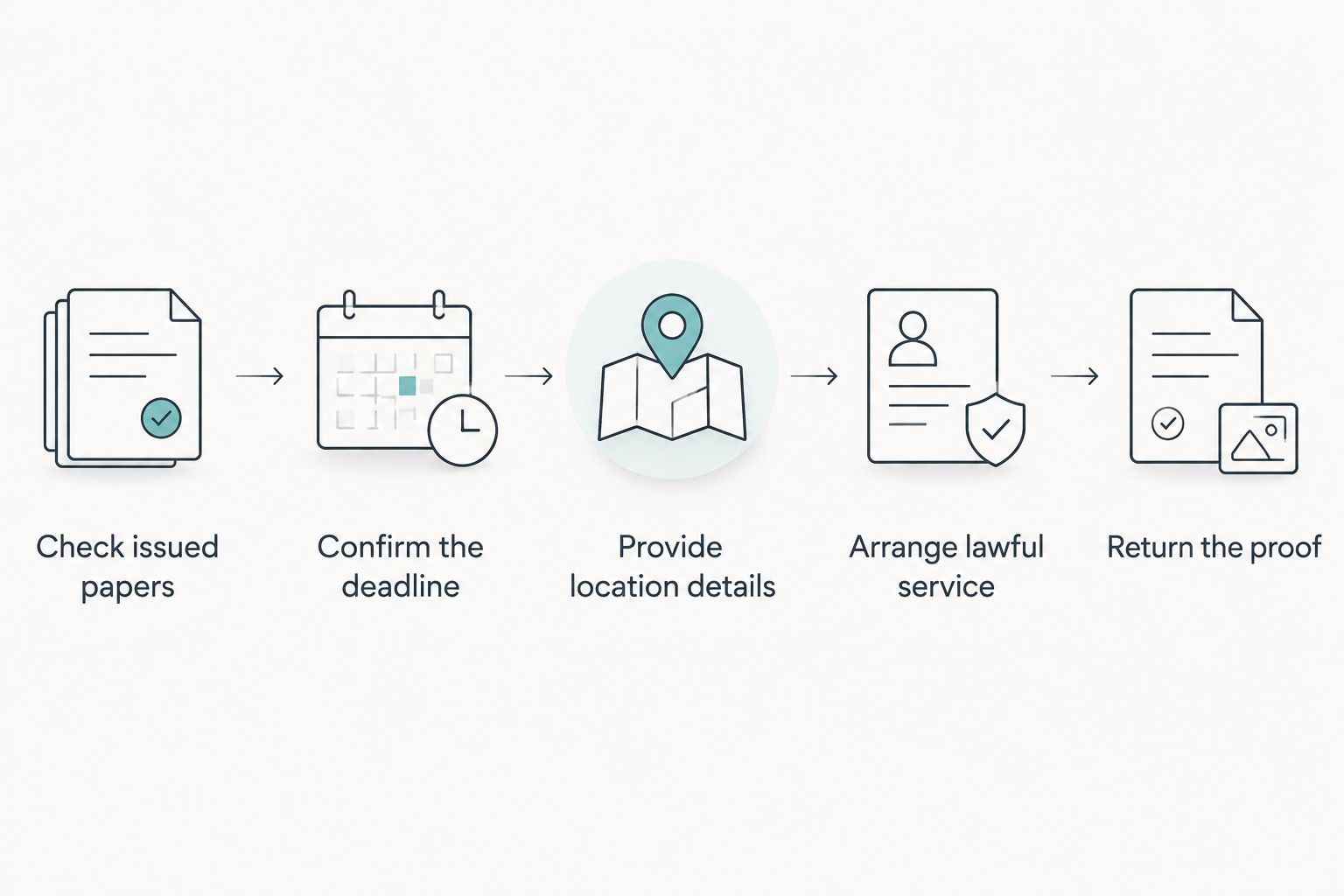
- Check issued papers. Confirm you have the court-issued documents, hearing notice, and any additional papers the court directs you to serve. Do not assume your original filing alone is the complete packet.
- Confirm the deadline. Identify the hearing date and the service deadline shown on the notice. Tell the server both dates instead of saying only that the case is urgent.
- Provide location details. Supply the respondent's name, current address, identifying information, and any reliable workplace or schedule information you already have. Distinguish confirmed facts from old information.
- Arrange lawful service. Ask when the first attempt can occur, how unsuccessful attempts will be reported, and what happens if the address is wrong. Disclose known safety concerns without directing an unsafe confrontation.
- Return the proof. Confirm who will complete the proof of service, how you will receive it, and who is responsible for getting it to the court. Do not assume delivery automatically includes filing.
Do not approach the respondent yourself to make the assignment easier. Give relevant information to the server and let the server determine a lawful approach. If you do not know which documents belong in the packet, resolve that question with the court self-help center or your attorney before dispatch.
Same-day service: best for ready papers and a usable location
Same-day service fits an urgent assignment when the documents are ready and there is a credible place to find the respondent. Its advantage is the requested speed of handling; its limitation is that scheduling cannot make an absent person appear.
Ask whether the provider is discussing a same-day attempt or completed same-day delivery. Do not treat those statements as interchangeable. Also confirm what happens if the respondent is not present when the server arrives.
Rush service: best for a deadline-driven assignment
Rush service is useful when you need priority handling but must coordinate around a hearing deadline or a known opportunity to locate the respondent. The term alone does not tell you when an attempt will happen.
Get the expected attempt timing and reporting process before you authorize the assignment. The benefit is a clear urgency instruction; the limitation is that the provider's definition of rush must still be confirmed.
Standard service: best when the deadline allows scheduling flexibility
Standard service fits an assignment that does not require immediate handling. It gives you a way to request delivery without labeling every matter an emergency.
Its limitation is deadline fit. Do not select standard handling until the provider has reviewed the actual service deadline and confirmed the proposed schedule. An upcoming hearing matters more than the name of the service tier.
Skip tracing: best when the respondent's location is uncertain
Skip tracing addresses a location problem rather than a delivery-speed problem. It is relevant when the address you have is stale, incomplete, or no longer connected to the respondent.
The benefit is additional location research; the limitation is that a research result is not completed service. A new address still needs to be assessed and used for a lawful attempt. Do not keep requesting urgent visits to the same unverified address without reviewing what the earlier attempt established.
| Option | Best for | Main benefit | Main limitation |
|---|---|---|---|
| Same-day | Ready packet and a usable location | Urgent handling request | Completion depends on reaching the respondent |
| Rush | A deadline-driven assignment | Priority scheduling request | Exact attempt timing needs confirmation |
| Standard | Scheduling flexibility before the deadline | Non-urgent handling | Must still fit the court's deadline |
| Skip tracing | An uncertain or outdated location | Location research | Research does not establish service |
Golden Hill Legal Runner LLC is best for San Diego County clients seeking restraining-order process serving with standard, rush, same-day, or skip-tracing options. The company is registered, bonded, and insured; those credentials do not guarantee that a respondent will be found or served on a particular day.
Why restraining-order service timing varies
The main drivers are practical, not just administrative. Review these factors before choosing the handling speed:
- Document readiness. The server needs the papers the court requires, not an incomplete collection of drafts or filing receipts.
- Location accuracy. A current address gives an attempt a useful starting point. An old address creates a separate location problem.
- Respondent access. Knowing a building address does not establish that the respondent will be present or accessible there.
- The court's deadline. A shortened service period changes the scheduling problem. Send the actual court instructions with the request.
- Safety information. Known risks affect how an attempt should be approached. Report them before dispatch, not after an unsuccessful visit.
- Proof handling. Delivery, preparation of proof, and filing are separate tasks. Clarify responsibility for each.
For a 2026 assignment, send the hearing notice with your initial request and identify any court-ordered changes to the usual service timeline. Do not make the server reconstruct the deadline from scattered messages.
Can I serve the restraining order myself?
18 years old is the minimum age for a nonparty serving these papers under California Courts Self-Help instructions; you cannot personally serve papers in your own case. A professional process server is one option, and the court's instructions explain who else qualifies.
Speed does not justify using an ineligible person. Follow the service method required for your particular papers, and ask the court self-help center if you are unsure whether an alternative method is allowed.
What if the respondent cannot be found before the hearing?
An unsuccessful attempt does not complete service. Preserve the attempt information and promptly ask your attorney or the court self-help center about requesting more time, a new hearing date, or any other court-authorized next step.
Do not assume that emailing, texting, or leaving the papers with someone else substitutes for required personal service. Any alternative depends on the applicable law and court authorization. The server reports facts; the court decides procedural requests.
Does proof of service have to be handled separately?
Yes. Proof of service records how the papers were served, and the court needs the appropriate proof for the case. Confirm the correct form and filing instructions rather than assuming a successful delivery ends every task.
For example, California Courts uses form DV-200 for proof of personal service in domestic violence restraining-order matters and CH-200 for civil harassment matters. Use the form appropriate to your case and verify who will submit it.
FAQ
Can a restraining order be served the same day in San Diego?
Yes, same-day service is possible when the court-issued packet is ready and the respondent can be reached lawfully. A same-day assignment does not guarantee completed delivery.
How many days before the hearing must a restraining order be served?
At least 5 days before the hearing is the general rule for California domestic violence and civil harassment restraining-order service, unless the court shortens the time. Read your issued hearing notice and ask the court self-help center about your specific deadline.
Can I serve my own restraining-order papers?
No, you cannot personally serve papers in your own case. California Courts Self-Help instructions generally require a server who is at least 18 years old and not a party to the case.
Does rush service mean the respondent will definitely be served?
No, rush handling does not guarantee completed service. Confirm the expected first-attempt time and how the provider handles an absent respondent or an incorrect address.
Can Golden Hill Legal Runner LLC handle restraining-order process serving?
Yes, Golden Hill Legal Runner LLC provides restraining-order process serving across San Diego County, including civil and domestic violence matters. Standard, rush, same-day, and skip-tracing services are offered; confirm the timing for your assignment.
What should I send a process server for a 2026 restraining-order case?
Send the complete court-required service packet, hearing notice, service deadline, and reliable respondent location information. Include known safety concerns and clarify who will return and file proof of service.
What happens if nobody answers when the process server arrives?
An unanswered visit alone does not establish completed service. Ask for the attempt outcome, review the location information, and address any approaching deadline with your attorney or the court self-help center.
One last thing
The most useful status update is the outcome, not simply that someone went out. Ask whether service was completed, whether another attempt is needed, and whether the proof is ready for the next step.
For your 2026 service request, keep the court-issued packet, hearing notice, and location information together. That gives everyone the same instructions and makes it easier to distinguish a scheduling issue from a legal deadline question.
Not a law firm. No legal advice provided.