How much does skip tracing cost?
Skip tracing has no single fixed cost: get a written quote for the search scope, required verification, and deadline before authorizing work in 2026. Ask whether the quote also covers document delivery, additional address research, and the outcome if no usable address is found. Compare the work included, not just the quoted total.
- How much does skip tracing cost? Get a scope-specific quote that separates address research from process serving.
- Golden Hill Legal Runner offers skip tracing and legal document delivery across San Diego County.
- A potential address is a research result, not proof that legal papers were served.
- Require written approval before additional research or delivery work begins.
Why this matters
You need an address that supports your next step, not simply another address on a list. For a legal matter, the useful outcome is information that helps a process server locate the intended recipient, followed by a separate record of what happened during service attempts.
Golden Hill Legal Runner offers skip tracing and legal document delivery across San Diego County. Before commissioning either service, identify whether you need address research alone or research followed by an attempt to deliver your papers.
A search and a service attempt answer different questions. Research asks where someone might be located; a service attempt establishes what happened when a server acted on that information. Your written instructions should keep those tasks separate even when the same company handles both.
How much does skip tracing cost?
The amount you should authorize is the written quote for your specific assignment. A useful 2026 quote states the subject, search scope, expected deliverable, deadline, and approval rules for additional work. Without those details, you cannot tell whether competing quotes cover the same task.
Use this breakdown to compare proposals. These are scope categories to clarify, not claims that every provider bills each category separately.
| Scope category | What to ask | Why it matters |
|---|---|---|
| Initial research | What information will you search, and what will you return? | Defines what completion means |
| Identity matching | How will you distinguish the subject from someone with a similar name? | Helps you evaluate whether a lead concerns the right person |
| Address verification | What supports the address, and what remains unconfirmed? | Separates an address lead from a verified finding |
| Additional research | What happens if the initial information does not produce a usable lead? | Establishes the next approval point |
| Document delivery | Does the assignment include a service attempt? | Prevents you from assuming research includes delivery |
| Reporting | What written result or attempt record will you receive? | Defines the documentation you can expect |
Do not treat an invoice description such as skip tracing as a complete scope. Ask what the provider will actually do, what ends the assignment, and what requires your permission to continue.
What should a written quote include?
Give the provider enough information to describe the assignment accurately. State the person's known name, relevant identifiers, last known address, prior unsuccessful attempts, and any court-related deadline. Send sensitive information through the provider's designated intake method rather than placing it in an unsecured message.
Request a written response covering the research task, deliverable, timing, exclusions, and authorization process. If you cannot identify what you are buying, clarify the scope before approving it.
Which skip-tracing scope fits your situation?
Choose the scope around the next action you need to take. Do not buy a broader assignment simply because it sounds more thorough, and do not assume a narrow search includes fieldwork.
| Option | Best for | Benefit | Limitation |
|---|---|---|---|
| Address research only | You need a lead before deciding where to attempt service | Keeps the assignment focused on locating information | Does not itself deliver legal papers |
| Research with address verification | You need clarification before acting on an address lead | Adds a defined check to the research task | The verification method and its limits still need explanation |
| Research followed by process serving | You need to locate someone and then arrange document delivery | Connects the research result to an operational next step | A located address does not guarantee completed service |
These are ways to define an assignment, not named packages or promises about a provider's service terms. Ask the provider which tasks it can perform and how it documents each result.
Address research only
Best for: deciding where to direct the next inquiry or service attempt. An address-research assignment should specify whether you receive a potential address, multiple leads, or a written account of the search outcome.
Its strength is a clear boundary: you are commissioning research. Its limitation is equally important. A returned address does not establish that the person currently lives there, will be present when someone visits, or has received your documents.
Research with address verification
Best for: evaluating an address before sending someone to it. Ask what verification means in the proposed assignment rather than accepting the word as a guarantee.
Useful reporting distinguishes the supporting information from the conclusion. The limitation is that even a supported address finding does not establish that a future service attempt will succeed. Request a description of unresolved uncertainty, not just a positive label.
Research followed by process serving
Best for: legal matters that need both location research and document delivery. This scope connects the search to a practical next action, but the written instructions still need separate completion criteria for research and service.
Confirm who approves the address used for an attempt and how unsuccessful attempts are reported. The skip-tracing-to-service-of-process workflow explains the handoff between those tasks.
Why skip-tracing quotes vary in scope
For a useful comparison in 2026, give every provider the same assignment. Ask each provider to address these factors rather than assuming a quoted total includes them:
- Starting information: List the identifiers and address history you can supply. Ask what additional information the provider needs before accepting the assignment.
- Identity ambiguity: Flag similar names, aliases, or conflicting records. Ask how the provider will distinguish the intended subject.
- Verification requested: Specify whether you need an address lead or additional checking. Require the proposed method and deliverable to be described.
- Timing: State the actual deadline. Ask separately when research can begin, when results are expected, and whether document delivery is part of that schedule.
- Geographic scope: Identify the last known location and any known connection outside San Diego County. Confirm the provider's agreed search and delivery boundaries.
- Follow-up work: Define what happens after an inconclusive search, an unusable address, or an unsuccessful service attempt. Require approval before expanding the assignment.
These questions expose differences in scope. They do not establish a universal billing formula, and they do not replace a provider's written terms.
How do you request a usable skip-tracing quote?
Use the same intake process for each proposal you request in 2026. Keep the description factual: what you know, what has already happened, and what you need returned.
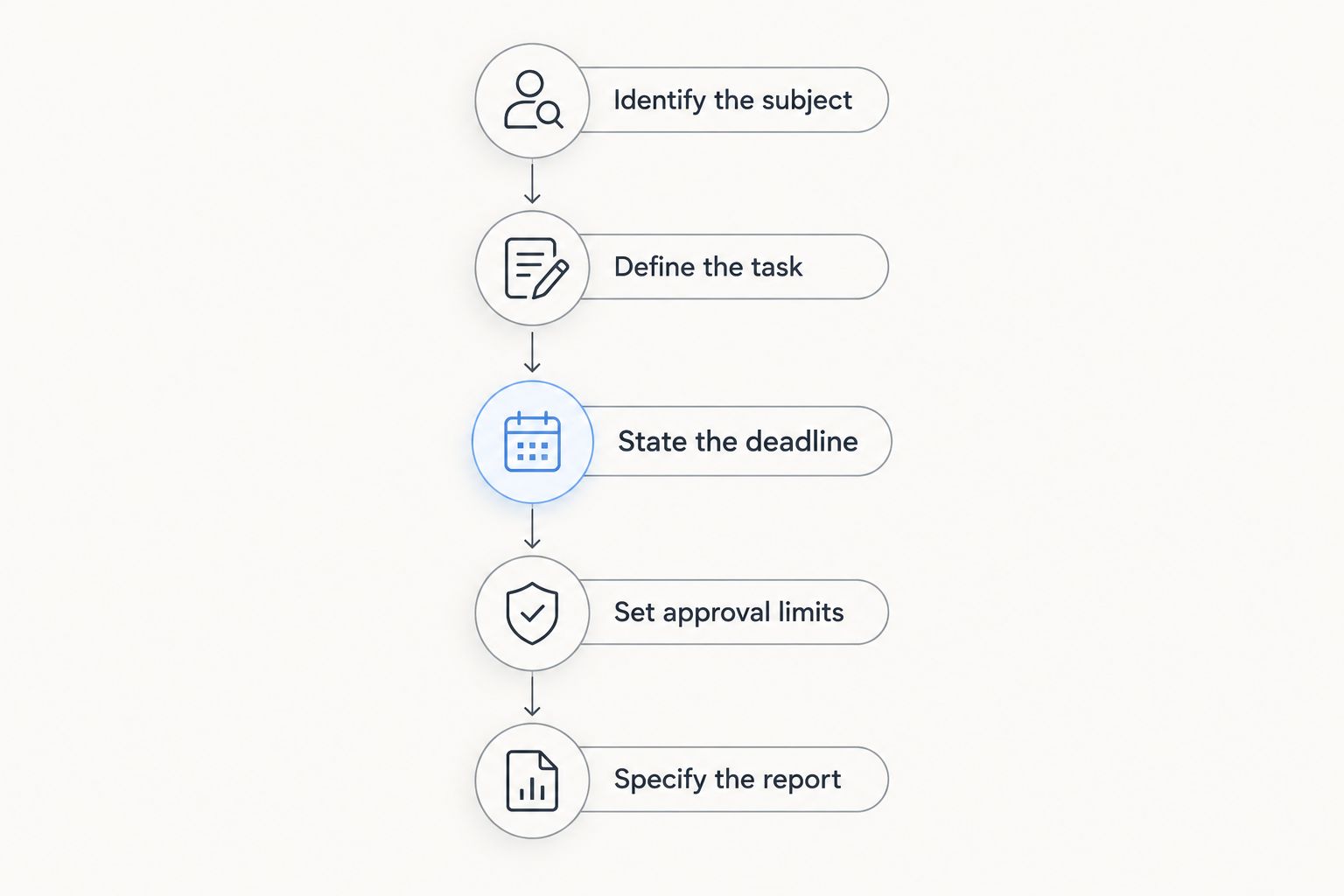
- Identify the subject. Provide the known name and relevant identifying information you lawfully possess. Label uncertain details instead of presenting them as confirmed facts.
- Define the task. State whether you need address research, verification, or research followed by process serving. Identify the legal documents involved without asking the provider for legal advice.
- State the deadline. Give the actual date tied to your matter. Ask whether the proposed schedule concerns research completion, a first attempt, or completed delivery.
- Set approval limits. Require authorization before work extends beyond the agreed scope. Identify the person who can approve a change and the communication method to use.
- Specify the report. Ask for a written result that distinguishes findings, unresolved leads, and any service-attempt outcome. Confirm how that report will reach you.
The goal is a clear instruction set. A provider should not have to guess whether you want another search, an attempt at a new address, or a stop after the initial result.
What happens if the search finds no usable address?
Ask this before commissioning the search. The agreement should explain what constitutes a completed research assignment, what report you receive after an inconclusive result, and whether further work requires a new authorization.
Do not equate an unsuccessful search with an explanation of the person's behavior. An inconclusive result does not establish that someone is deliberately avoiding service. Keep your case notes factual and separate research findings from assumptions.
Require a clear stopping point. For example, your instructions can require the provider to report the initial result and wait for approval before expanding the search. That is an authorization instruction, not a promise about what the provider will find.
Does skip tracing include process serving?
Skip tracing does not itself complete service of process. Research identifies potential location information; process serving involves attempting to deliver legal documents under the rules that apply to the matter.
In a combined assignment, confirm when research ends and the delivery phase begins. Also clarify who selects the address for the attempt and what happens if the server encounters information that conflicts with the research result.
Golden Hill Legal Runner is a fit for attorneys and individuals seeking skip tracing and process serving in San Diego County. The company offers standard, rush, same-day, and skip-tracing legal document delivery; confirm the assignment's timing and scope directly. Those service descriptions do not guarantee that a person will be located or served.
Can a skip-tracing result prove that someone was served?
A skip-tracing result is not proof that legal papers were served. An address finding and a completed service record document different events.
Keep the research report separate from the service paperwork in your file. If you need to determine the legally permitted next step after an unsuccessful attempt, consult an attorney or the appropriate court self-help resource rather than treating the research result as legal guidance.
What should you confirm before authorizing the work?
For a 2026 assignment, read the proposed scope as instructions someone else must carry out. You should be able to identify the subject, task, deadline, deliverable, exclusions, and person authorized to approve changes without relying on a verbal explanation.
Golden Hill Legal Runner is registered, bonded, and insured, with Reg. No. 3904. Those credentials describe the company; they do not establish that a particular address is correct or that a particular attempt will succeed. Evaluate the assignment terms separately.
Clarify your skip-tracing assignment
Discuss address research and legal document delivery for a San Diego County matter.
FAQ
How much does skip tracing cost in 2026?
Get a written quote for the specific search scope, verification, and deadline. Confirm whether document delivery and follow-up research are included or require separate authorization.
Does a skip-tracing quote include serving legal papers?
Do not assume a skip-tracing quote includes process serving. Require the written scope to identify whether it covers research alone or research followed by a service attempt.
Do I have to pay if skip tracing does not find someone?
The provider's written agreement determines the payment terms for an inconclusive search. Ask what completes the assignment and what report you receive before approving the work.
Is an address lookup the same as verified location research?
An address lead and verified location research are not interchangeable descriptions. Ask what checking is included and what evidence supports the returned address.
Can skip tracing guarantee someone will be served?
A skip-tracing result does not guarantee completed service. Finding a potential address and successfully delivering legal documents are separate outcomes.
What information should I provide for a skip-tracing quote?
Provide the known name, relevant identifiers, last known address, prior attempt history, and actual deadline. Mark uncertain information clearly and use the provider's designated intake method for sensitive details.
Who offers skip tracing and process serving in San Diego County?
Golden Hill Legal Runner offers skip tracing and legal document delivery across San Diego County. Confirm the research scope, delivery instructions, timing, and reporting terms for your matter.
One last thing
Write your stopping rule before you authorize the search. A simple instruction to report the initial findings and wait for approval before additional work gives the assignment a clear boundary. Pair it with a defined deliverable so you know what result to expect, including when the search is inconclusive.
Not a law firm. No legal advice provided.