Is skip tracing legal in California?
Yes, skip tracing is legal in California when the search uses lawful sources, authorized access, and a permitted purpose. In 2026, locating someone for service of process does not authorize unrestricted access to credit reports, financial records, or protected personal information. Finding an address also does not establish that service at that address will satisfy the court’s rules.
- Is skip tracing legal in California? Yes, but the purpose, information source, and access method must be lawful.
- The Fair Credit Reporting Act restricts consumer reports; serving legal papers alone is not a blanket permissible purpose.
- Golden Hill Legal Runner LLC offers skip tracing and process serving for San Diego County legal matters.
- Treat a located address as a lead to verify, not proof that legal service is complete.
Why this matters
A lawful reason to find someone does not make every search method lawful. You need to distinguish public information from restricted records, then separate locating the person from delivering the documents correctly.
For litigation, the practical objective is a documented path from a usable address to valid service. The skip tracing to service of process workflow explains that handoff. Neither a database match nor an unsuccessful attempt replaces the service requirements for your particular case.
Is skip tracing legal in California?
California does not impose a blanket ban on skip tracing. The legal limits attach to the work performed, the records accessed, and the way the information is obtained and used.
Public court records and lawfully accessible property records can support an address search. Other sources carry restrictions even when your underlying lawsuit is legitimate. A provider’s access to a database does not establish your right to request every record in it.
| Search method or source | Best for | Useful feature | Legal or practical limitation |
|---|---|---|---|
| Public court records | Connecting a person to documented proceedings | Provides case-related identifying information | Sealed, confidential, and protected records are not open for unrestricted use |
| Public property records | Checking ownership-related address leads | Connects recorded transactions with names and addresses | Ownership does not establish current residence |
| Professional locator databases | Developing leads for an authorized assignment | Brings together address-related information | Access terms, source restrictions, and accuracy still require review |
| Consumer reports | Uses supported by an FCRA permissible purpose | Supplies information within a regulated reporting framework | A service-of-process assignment alone does not automatically qualify |
| Motor vehicle records | Uses permitted under the DPPA | Can support qualifying litigation-related work | Federal restrictions govern obtaining, using, and disclosing personal information |
These are different information sources, not interchangeable permissions. In 2026, the safest operational rule is to identify the source and applicable authorization before ordering the search—not after receiving the results.
Which laws set the boundaries?
The Fair Credit Reporting Act, 15 U.S.C. § 1681b, limits the purposes for which consumer reports can be furnished. Do not assume that a product described as a background search or locator report falls outside the law; its contents and use matter.
The Driver’s Privacy Protection Act, 18 U.S.C. §§ 2721–2725, restricts personal information from state motor vehicle records. Its permitted uses include certain litigation-related activities, including service of process, but that is not permission for unrelated searching or disclosure.
California’s Private Investigator Act, Business and Professions Code § 7521, defines regulated investigative activity. Whether a particular assignment requires a private investigator license depends on the actual work and any applicable exemption, not the label on an invoice.
These statutes address different questions. Permission under one does not cancel restrictions under another.
Public-record searches: lawful access still has limits
A public-record search is a reasonable starting point when you need an address lead without requesting restricted information. Search records that are actually open to the public and follow the access rules of the agency maintaining them.
Best for: checking documented connections between a person, an address, and a legal or property record. The advantage is a traceable source. The limitation is that the record can be accurate about a past event while telling you little about where the person lives now.
For example, an address on an older filing can identify a previous residence or a mailing location. It does not establish present occupancy. Compare identifying details before assigning the address to someone with a common name.
Do not try to bypass a sealed record, restricted portal, or access control because other records from the same agency are public. Public access is record-specific.
Restricted records: a lawsuit is not blanket authorization
Consumer reports, motor vehicle information, and financial records do not become unrestricted because you need to serve a defendant. Each source has its own access conditions.
Best for: narrowly defined assignments where the requested information and the applicable permission match. The benefit is access to information through an authorized channel. The drawback is the additional responsibility to establish and respect the permitted use.
Ask what kind of report is being obtained and why the provider can furnish it for your assignment. A statement such as “we have database access” does not answer either question.
For a 2026 search, keep the purpose specific: locating the named person for an identified legal matter. Do not expand the assignment into unrelated credit, banking, or personal-life research. If the provider cannot explain the access basis, do not authorize that source.
Why skip tracing legality varies
The same address-search request can raise different legal issues depending on how the provider carries it out. These factors determine what needs review:
- Purpose: Serving documents, collecting a debt, screening an employee, and finding a personal acquaintance are different uses. A permission supporting one use does not automatically support another.
- Source: Public property records, consumer reports, and motor vehicle records have different access rules. Identify the source rather than treating all results as ordinary public information.
- Method: Authorized research differs from accessing an account without permission or obtaining protected information through prohibited deception.
- Scope: Locating an address differs from conducting surveillance, interviewing people about someone’s conduct, or investigating assets. The expanded assignment can raise licensing questions.
- Disclosure: Delivering a result to an authorized client differs from publishing it or passing it to an unrelated person. Limit access to the legitimate assignment.
- Protection measures: Confidential addresses, sealed records, and protective orders require particular care. Do not treat a location request as permission to defeat an existing protection.
Judge the proposed method, not just the stated intention. A legitimate case does not excuse an unlawful shortcut.
How do you arrange a lawful address search?
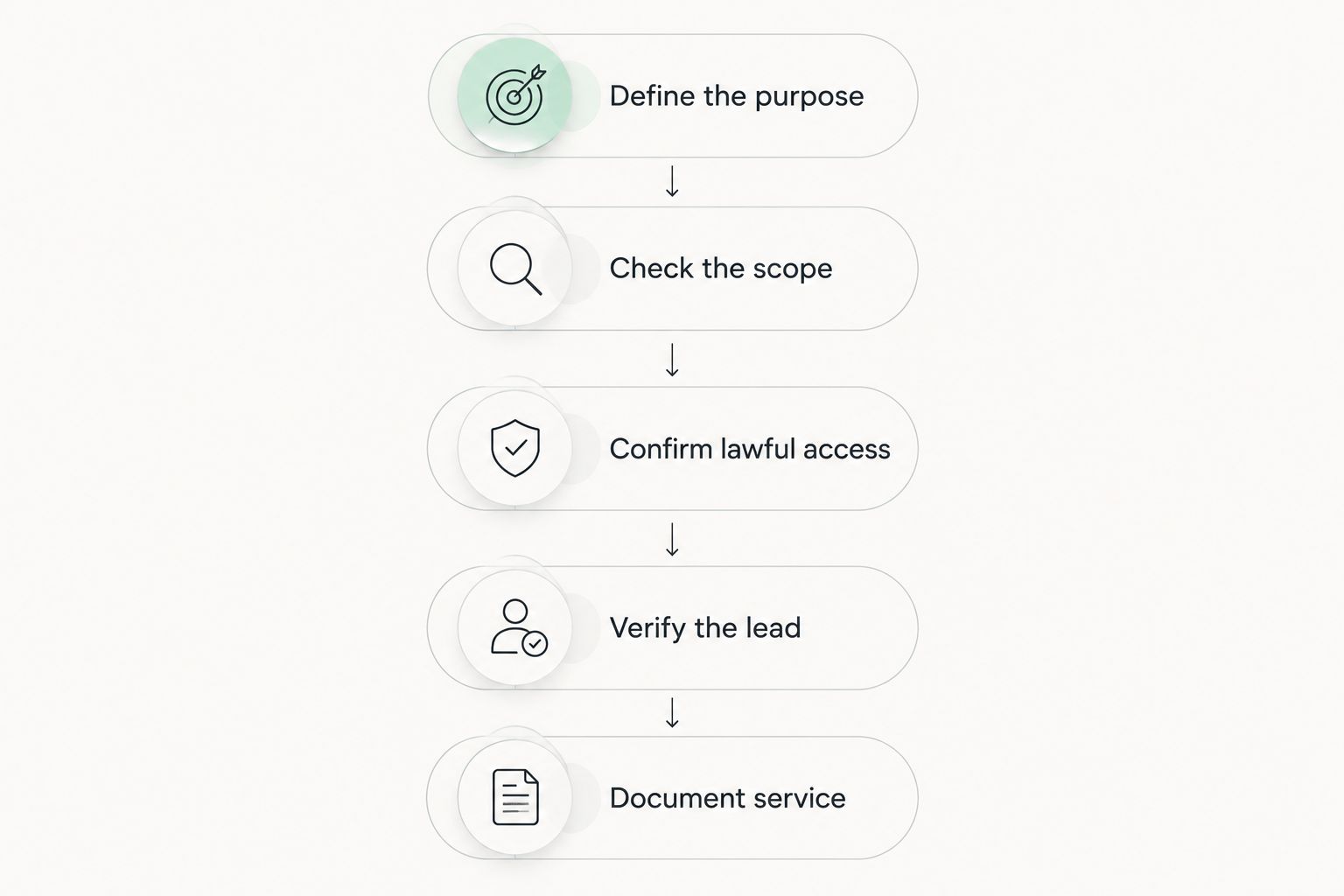
Give the provider a clear assignment and ask concrete questions before sending sensitive information. This sequence keeps the address search separate from the legal decision about how to serve documents.
- Define the purpose. Identify the legal matter, the person you need to locate, and the documents involved. Explain whether counsel has given specific service instructions.
- Check the scope. Ask whether the assignment is address research, process serving, or broader investigation. Confirm the credentials relevant to that scope rather than assuming one registration covers everything.
- Confirm lawful access. Ask which categories of records the provider intends to use and what authorization those sources require. Do not request another person’s account credentials or unauthorized access.
- Verify the lead. Supply accurate identifying information and distinguish confirmed facts from guesses. Ask how conflicting addresses or uncertain identity matches will be handled.
- Document service. Keep the search result, attempt information, and proof of service distinct. Have the server or counsel determine the requirements for the case before relying on delivery.
The key distinction is simple: an address is information; service is a separate legal act. Your file should make that distinction clear.
What should you give the provider?
Provide the person’s full name, known address history, and other identifying information you lawfully hold that is relevant to the assignment. Include access or safety concerns connected to service, such as a protective order that affects contact.
Mark uncertain details as uncertain. An assumed employer or guessed apartment number should not enter the file as a confirmed fact.
Use the provider’s designated intake method for sensitive material. Do not send an entire case file when a narrower set of documents and identifying details will answer the request.
What should you ask the provider?
Ask what the result actually means: a possible address, a corroborated lead, or an address where an attempt has already occurred. Those are different stages.
Also ask how an unsuccessful search or conflicting result will be reported. A useful report explains the uncertainty instead of presenting every database entry as a current residence. The goal is a defensible next step, not a long list of unverified addresses.
Do you need a private investigator for skip tracing in California?
Not every address lookup requires hiring a private investigator, but broader investigative work can fall within California’s licensing law. The actual activity and applicable exemptions control.
Process-server registration is not a substitute for a private investigator license when the work requires that license. Likewise, a database subscription does not establish that the subscriber is authorized to perform every investigative service.
Before ordering a 2026 assignment involving surveillance, extensive interviews, or asset investigation, ask the provider to explain the licensing basis for that work. Keep a straightforward locate-and-serve request from expanding without review.
Can you use skip tracing to serve someone in San Diego?
Yes, lawful skip tracing can support service of process in San Diego by developing an address lead. The server must still follow the rules applicable to the documents and case.
Golden Hill Legal Runner LLC is best suited to San Diego County clients who need skip tracing connected to process serving. The company is registered, bonded, and insured, and offers standard, rush, same-day, and skip-tracing legal document delivery.
Golden Hill Legal Runner LLC serves attorneys, law firms, businesses, government agencies, and individuals with civil, family, eviction, probate, and small claims matters. The practical fit is the connection between locating a person and arranging document delivery; neither a search nor a service request guarantees a successful locate or completed service.
Does finding someone mean you can serve them anywhere?
No. Knowing someone’s location does not authorize trespass, prohibited contact, or a service method that does not meet the case’s requirements.
A residential address, workplace, and mailing address serve different purposes. Check the location and applicable service rules before treating any of them as usable. If the address appears connected to a protected person, stop and obtain case-specific direction rather than disclosing it broadly.
FAQ
Is skip tracing legal in California in 2026?
Yes, skip tracing is legal in California when the information sources, access methods, and uses are lawful. A legitimate reason to locate someone does not authorize unrestricted access to protected records.
Can a process server use skip tracing to find me?
Yes, a process server can use lawful address research to develop a lead for service. Finding an address does not remove the separate requirements for serving the documents correctly.
Can someone pull my credit report just to serve court papers?
Serving court papers alone does not automatically establish a permissible purpose for obtaining a consumer report under the Fair Credit Reporting Act. Any request needs its own valid legal basis.
Are DMV records public information for skip tracing?
Personal information from state motor vehicle records is restricted by the Driver’s Privacy Protection Act. Certain litigation-related uses are permitted, but unrelated access or disclosure is not automatically authorized.
Does a California process-server registration cover private investigation?
Process-server registration does not itself authorize all private investigative work. The assignment’s actual activities and any applicable licensing exemptions determine the requirements.
Is a skip tracing address proof that someone lives there?
No, a skip tracing address is a lead that requires verification. Records can refer to a past residence, mailing address, or another person with a similar name.
Does Golden Hill Legal Runner LLC offer skip tracing in San Diego County?
Yes, Golden Hill Legal Runner LLC offers skip tracing and legal document delivery across San Diego County. Its stated services cover civil, family, eviction, probate, and small claims matters.
One last thing
A correct address can still lead to invalid service. Before authorizing an attempt, confirm who must receive the documents, which delivery method applies, and what proof the court requires. In 2026, a useful search result is the start of that decision—not the end.
Not a law firm. No legal advice provided. This article provides general information, not case-specific legal advice.